
• Hey Guest. Check out your NeoGAF Wrapped 2025 results here!

Are there any scientists who are overrated or get too much credit?

Status
Not open for further replies.
Yeah, Tesla's contributions are important, but his modern reimagination as steampunk wunderkind is kind of annoying.

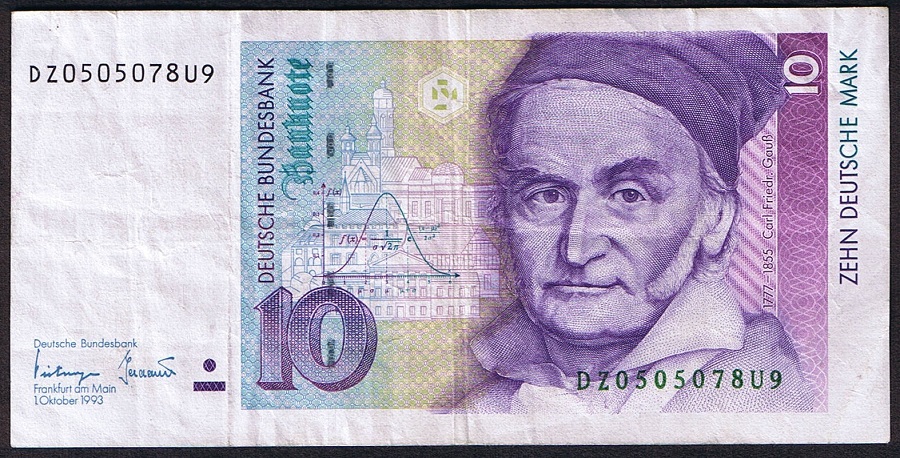
On the flipside Gauss is tremendously underappreciated
gauss_b01x.jpg
Gauss is on money, so that's pretty awesome

 
I've read that Edison wasn't close to being the man many claim him to be.

He has been idolised but his brain and ingenuity was nothing compared to the like of Newton etc.
 
I've read that Edison wasn't close to being the man many claim him to be.

He has been idolised but his brain and ingenuity was nothing compared to the like of Newton etc.

Edison has had a weird arc. In his heydey he absolutely branded himself in such a way. I want to say by the back half of this century we had more of a realistic look at him, his contributions to technology are sizable and his creation of the industrial laboratory is incredibly important, but we also can recognize that he stole a lot of credit and was generally a big asshole. And then the internet got into the whole Edison vs Tesla thing and any sense of perspective went out the window
 
Michio Kaku had a talk at my university. He talked about computers at like a 3rd grade level for 45 minutes and then showed trailers for his TV show. So my answer is Michio Kaku.
 
You can probably say that for every scientist who became part of popular culture for one reason or the other. It would probably not even be very wrong to say that of Einstein, despite his revolutionary contributions, given how much he has become the prototype of the one-in-thousand-years genius.

However, I think the impact of good science popularizers and lobbyists like Carl Sagan or Neil DeGrasse Tyson is also oftentimes under-appreciated. If one could measure the total number of scientists or founding that happened directly or indirectly because of the work of these popularizers and lobbyist, the result would anything but trivial.

Once in a thousand years is a bit of a stretch but I don't think it would be too hyperbolic to call him once in a century. I definitely consider him to be as important as e.g. euler, newton or gauss.
 
Watson and Crick. They only solved the structure of DNA because of Rosalind Franklin's crystallography diffraction patterns and because Linus Pauling wasn't allowed to leave the country at the time.
 
Probably the majority, If your not the first name on a paper, you contribution, typically ain't considered shit.
Also even if you are first author sometimes your contribution ain't shit. My first (review) paper has like 10 citations purely because I beat a massive industry collaboration that actually had way better data to back up their claims to the punch by a few months.

Their report was like 2 years old as well it just hadn't been released publicly ÂŻ\_(ツ)_/ÂŻ
 
Crick and Watson. Rosalind Franklin was as integral to discovering DNA as they were, but got none of the credit.
Watson and Crick did not discover DNA. Watson and Crick described the helical structure of DNA using Franklin's X-ray diffraction research without discussing it with her.

I would certainly put Watson and Crick there though. Their most famous paper involved no actual data obtained by them. They just analyzed something that would have inevitably been found out sometime after Franklin's research was published.
 
Definitely Michio Kaku. Besides the things listed, his Hyperspace book oversimplifies things to the point of being wrong.

To a much lesser extent, Steven Hawking. The general public holds him on a Newton/Einstein/Hawking level, but his accomplishments are impressive, but not on that scale.
 
nearly all of the scientists you've heard of get too much credit in one way or another, particularly any you've heard of in the past 20 or 30 years, because the traditional narrative of the "great man" inventor remains very strong in the media and among laymen. science is a collaborative and iterative process. the faces of new discoveries are intelligent people who made significant contributions to whatever it is they discovered/studied, but behind them are hundreds of others who worked on the project(s) too and behind all of them are thousands who did work on the problem in the past.
 
Some people think Einstein plagiarized stuff in his theory of special relativity. When you start learning about it in school, most of the stuff was named after other guys.

Iirc, he didn't actually come up with E = mc^2, even though everyone attributes that to him.
 
I mean, the answer is Tesla. Dude was a talented engineer who the internet fell in love with because of an underdog story that wasn't even an underdog story.
 
Some people think Einstein plagiarized stuff in his theory of special relativity. When you start learning about it in school, most of the stuff was named after other guys.

Iirc, he didn't actually come up with E = mc^2, even though everyone attributes that to him.

He didn't plagiarize anything. He used the empirical evidence and discoveries developed 10 - 40 years prior to his adulthood to write his ground-breaking papers. He happily gave credit to both his predecessors and contemporaries. If he hadn't made those discoveries, someone else would have, but he was the first to combine all of that knowledge in new and imaginative ways. He's one of the closest people to nearly meet the "great man" criteria in recent times, but even he didn't conjure his theories out of thin air in a eureka moment.
 
KARL DEISSEROTH (jk karl but really why in gods name did you need 5 papers to actually detail how to do clarity).

He is probably gonna win a nobel for optogenetics aka virus based mind control of mice/rats for SCIENCE.

Add to the fact that he didn't really discover optogenetics. Miesenbock first showed to evidence of photostimulation to control behavior, in fruit flies. Also, 2 grad students (Boyden and Zheng) were the first authors on the landmark optegentics paper. Deisseroth got most of the credit from asking to be put as author on every optogenetics paper thereafter, started a company using the tech, and continued innovating techniques. Goes to show that science nowadays is very much a collaborative process, but usually it is 1 person gets most of the credit.
 
Some people think Einstein plagiarized stuff in his theory of special relativity. When you start learning about it in school, most of the stuff was named after other guys.

Iirc, he didn't actually come up with E = mc^2, even though everyone attributes that to him.

This is completely wrong - mass-energy equivalence was not around before Einstein. I take it you are thinking of something like Lorentz transformations? Sure, that was around before Einstein, but mathematicians and physicists had a completely incorrect understanding of the physics surrounding it.

This is the second thread today in which some posters have belittled Einstein. Crazy.
 
Some people think Einstein plagiarized stuff in his theory of special relativity. When you start learning about it in school, most of the stuff was named after other guys.

Iirc, he didn't actually come up with E = mc^2, even though everyone attributes that to him.

Listen to The Infinite Monkey Cage podcast special on Relativity, relativity not special relativity.
Part One
Part Two
 
There are far too many that are under appreciated than over appreciated. But that's just how it goes. For example Higgs. It shouldn't be called the Higgs field. A group of particle physics slowly built up the concept of the scalar field that interacts with the weak force.

We condense achievements and discoveries into easily digestible eureka moments by one or few people. That's not how it works.
 
Michio Kaku had a talk at my university. He talked about computers at like a 3rd grade level for 45 minutes and then showed trailers for his TV show. So my answer is Michio Kaku.

This guy. A bunch of friends dragged me along to one of his talks about "future science", and it felt like he was talking to a bunch of elementary school kids.
 
This is completely wrong - mass-energy equivalence was not around before Einstein. I take it you are thinking of something like Lorentz transformations? Sure, that was around before Einstein, but mathematicians and physicists had a completely incorrect understanding of the physics surrounding it.

This is the second thread today in which some posters have belittled Einstein. Crazy.

To be clear, I don't think he plagiarized stuff. I just remember reading some people think he did and wasn't sure of the veracity of the claims. But yeah, I was thinking of the Lorentz transform. My main point is that in pop culture, Einstein is given almost exclusive credit for the development for special relativity and the concepts related to it when I think others were big contributors as well. Seemed appropriate for the thread. My intent was not to belittle him.

https://en.m.wikipedia.org/wiki/Relativity_priority_dispute
 
I would probably say Dawkins. He's seemingly held up as this brilliant free-thinking scientist, but his contributions to biology aren't as impressive to me as the ones contributed by his supposed contemporaries (especially recently), rather he's held up there because of his actively and antagonistic atheist antics. Perhaps I'm overstating even his reputation, but idk.

I can't really think of too many others, other than the other PopSci folk mentioned in this thread ad nauseam. I do have several scientist I dislike (because they're absolute pricks, see: Watson and Crick) but for the most part are still good scientist at their core and got to their level of recognition, for the most part, validly.
 
There are far too many that are under appreciated than over appreciated. But that's just how it goes. For example Higgs. It shouldn't be called the Higgs field. A group of particle physics slowly built up the concept of the scalar field that interacts with the weak force.

We condense achievements and discoveries into easily digestible eureka moments by one or few people. That's not how it works.

Yeah, most of science is painstakingly incremental.
 
To be clear, I don't think he plagiarized stuff. I just remember reading some people think he did and wasn't sure of the veracity of the claims. But yeah, I was thinking of the Lorentz transform. My main point is that in pop culture, Einstein is given almost exclusive credit for the development for special relativity and the concepts related to it when I think others were big contributors as well. Seemed appropriate for the thread. My intent was not to belittle him.

https://en.m.wikipedia.org/wiki/Relativity_priority_dispute

If your point is that it's a shame more scientists aren't better known by the public, then I agree with you - science and mathematics are very much collaborative fields. But, while the general may be able to say the words "E equals m c-squared" they don't have any clue as to what they mean. And the ones that do are likely to also know the names of people like Lorentz - because, as you pointed out, you are taught about him in physics classes. Hence, there is no credit being taken away at all.

Also, there is a huge difference between being a mathematician and a physicist. Einstein is not praised for being an uber mathematician who invented Riemannian Geometry or the Poincare group. He is praised for creating multiple utterly revolutionary theories that accurately describe physical phenomenon. Saying that - since he utilizes mathematics as a framework for his theory, his work is plagiarized - just seems absurd too me.
 
I heard Michio Kaku is basically an idiot outside of everything BUT his field of expertise.

It happens. Ben Carson can't do, speak, or think anything right except neurosurgery.

I swear I've never once used the Pythogorean Thereom in my day to day so I'm going with that dude.

If you've ever wondered how fast something is going, how straight/even something is, how far away something is, you were using principles of pythagorean theorem.
 
Some people think Einstein plagiarized stuff in his theory of special relativity. When you start learning about it in school, most of the stuff was named after other guys.

Iirc, he didn't actually come up with E = mc^2, even though everyone attributes that to him.


That's completely wrong.

There is a difference between knowing the math to do it and actually discovering a physical law using them. He was the first person to describe the physical law and physical implications. His mathematics was not original, that is true.
 
?

typo, or freudian slip?

(speaking of, my vote is for Freud. Nothing but a coke addled madman thinking that his own issues explained other peoples' behavior)
?
http://dictionary.reference.com/browse/vulgarize

He's one of the closest people to nearly meet the "great man" criteria in recent times, but even he didn't conjure his theories out of thin air in a eureka moment.
Yeah, and neither did anyone else, most like. That kind of moment is popular in fiction but that's just not how it works.
 
Edison, Watson and Crick, the Down's Syndrome guy.

Oooh Dawkins too. Tyson annoys me but I don't think anyone really thinks of him as a genius or anything so I wouldn't say he's overrated. He's like a Bill Nye but more condescending.
 
Neil deGrasse Tyson and Richard Dawkins. Mostly because internet praises them as some sort of guru and if you quote them everyone should believe is the truth (Dawkins has saying some shit for a time now), even if you fake it. It's not their fault, but the dumb people overrate them.

Well, I guess pretty much all these 'mainstream' scientists are overrated in a way.
 
This guy. A bunch of friends dragged me along to one of his talks about "future science", and it felt like he was talking to a bunch of elementary school kids.
I fail to see why this is a bad thing, the ability to explain complex ides in simple terms should be praised not ridicule
 
Status
Not open for further replies.
Top Bottom