Alpha Protocol's gameplay wasn't incredibly broken.
I haven't seen one person explain what's wrong with it, especially considering dialogues and choices ARE part of the gameplay.
Most of the complains I've seen are about bugs, AI or "not being an action game", rather than mechanics. I mean, I've seen people saying "you can't finish the game without using assault rifles!" AND "you can't finish the game without going full stealth!" ... what is it, then?
So, I'm at this stage, right? And I'm completely hating the game by now. Stupid bugs, boring level structure, an uninteresting plot, and then some guy I never met before is all "I AM THE VILLAIN" and my guy's like "IT'S YOU?!" and I'm like "who the hell is this guy? Wait, wasn't he that scientist I met for ten seconds at the start?"
Needless to say, I was pissed.
And then THIS GUY, the senator's son, that poorly-written idiot bastard shows up as a boss.
I die, like, god, I don't know, fifty times trying to beat him and the endless stream of minions. On my umpteenth try, I decide to see if I can climb a tower on the left side of the map from the respawn point. Turns out I can. Up at the top, none of the minions on the ground can kill me. The grenade spam (seriously, the guy would throw like six at once) couldn't reach me either. All I had to do was duck when he shot his sniper rifle. He died in maybe thirty seconds?
Really shit design, and I encountered stuff like this throughout the game.
You're doing it wrong, the last million times I had this discussion they asked if I could consider CoD4 an RPG!
I definitely agree that "RPG", alone, is a pretty worthless categorization. Never the less, people insist on using it, and they have their own personal definitions for what it is (for example, you in this thread). The reason there are so many sub-categories is because it is so diverse, it might not even be right to call it a "genre" more than it is a "category of genres", so to speak. But the term is here, and its here to stay. The problem stems from the fact that the very first RPG videogames had little or no role play at all, because of the limitations of the medium. The computer was not a person, so it couldn't act as a dungeon master or create new storylines. The computer could not adapt to the players doing interesting or new things, it HAD to railroad them by force. What it had in common with Pen & Paper RPGs was certain mechanics for combat resolution and exploration, translated into videogame format.
So in this sense, cRPGs did not have the namesake of Roleplaying games. They were arguably a betrayal of the core tennents of what made RPGs themselves and why they were originally called that. Without roleplay, Dungeons and Dragons is just a board game, essentially. Never the less, these early games were called RPGs, so their successors got grandfathered in to this classification, you might say. This is why it's still valid to call, for example, a 100% linear JRPG with no player dialogue choice, no branching paths, or anything else, an RPG, just because it has turn based combat and leveling. On the other hand, it's not valid to call The Walking Dead an RPG, regardless of the amount of player branching it has (I don't actually know if it has a lot, for reference, since I've only played the first episode so far). You role play in The Walking Dead a heck of a lot more than you do in Pokemon Yellow, yet only one of those games is an RPG.
We are left with the above broad classification from Wikipedia because there is no other way to account for how the games we all consider to be RPGs can all be RPGs. If it leads to borderline cases where some people go "but ME2 isn't an RPG", so be it. Ultimately, Whether or not ME is an RPG ultimately does not matter. It is because it fits the definition, but that does not change the game. The constant back and forth where people make snarky quips like "lol not an rpg" is a sort of drive by shit posting I see all the time (not saying you're doing it here, to clarify), which comes with the implication that if its' not an RPG, then it's worse than if it were an RPG. This of course is fallacious, which is why I have to constantly bicker about it with people on the internet.
Well, the conclusion I've come to (and I've found that others have come to) when going in-depth into the matter is this:
CRPGs weren't good enough at being RPGs, but people understood what they were, and gradually, they got better (see Ultima VII, for instance).
Unfortunately, Horii came along, saw Wizardy and Ultima, and went on to make Dragon Quest, which wasn't an RPG at all, but had elements that were similar. For whatever reason, that got marketed as an RPG, even though it featured no role-play. That's how the JRPG was born, and how the big confusion as to what the hell an RPG was started.
Language barrier, I guess.
Did they borrow all the content design from the mods? You might be saying something else.
I know they did some design work on their own, things are overall better balanced (shooting isn't, though; shooting in Fallout 3 was competent, in New Vegas, I ran into far more "HE'S TWO FEET AWAY WHY DIDN'T I SHOOT HIM?" bits.
I don't get this. Both games are RPGs hybrids. Mass Effect 3 is a good shooter but a bad RPG. Alpha Protocol is a good RPG but a bad stealther/shooter.
Why is the RPG part disassociated from the game part?
Talkin' bout the difference between things like "the way players move" and "how AI works" and "level design" and stuff (it's present in all games), and then the more specialized RPG aspects (how skills affect play, how decisions affect narrative, etc). At a core game level, if neither game had RPG mechanics, Alpha Protocol would be a pile of shit, and Mass Effect 3 would be a middling cover-based shooter. On the flip side, if both games were, oh, isometric Black Isle-style games, where things like level design or player movement don't matter as much (but RPG things are so much more important), Alpha Protocol trounces Mass Effect 3 everywhere but consistency (it has a lot more fucking stupid bits that ruin its tone).
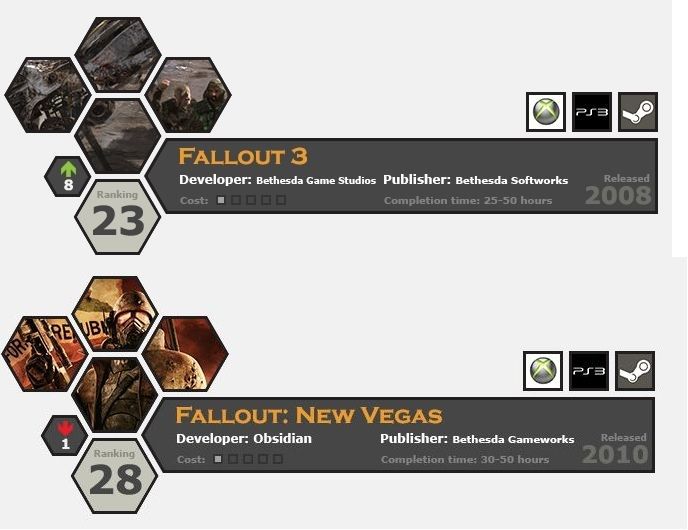
I don't get why people call Fallout 3 an immersive sim. Immersive sims are defined by highly systemic level and gameplay design, which is not one of Fallout 3's strenghts at all. In Fallout 3 (and New Vegas) you find someone, you shoot them in the face. Or you crouch for a while, and shoot them in the face for a critical hit, get caught and then shoot everyone else in the face.
Bethesda's entire approach to game design essentially evolved on a different track than Looking Glass's, but both started with Ultima Underworld. Bethesda had more people who were interested in keeping traditional RPG mechanics, where LGS personnell (rightfully) saw that RPG mechanics were mere abstractions of real life. Having played most immersive sims out there (though, strangely, not Deus Ex yet), my understanding of the genre is that it's about placing players within a real world (not necessarily realistic, but authentic to the fiction). Thus, the levels, the AI, and player abilities all work towards crafting a real experience. In a perfect immersive sim, an RPG skill system would be entirely absent (STALKER/Thief), but the most important element (role-play--that is, defining one's person and place in this authentic fiction) would remain intact.
I've heard the phrase systemic kicked around (Far Cry 2 and Thief primarily), but I've never really had a good understanding of what that meant, exactly. I mostly look at games like STALKER/Far Cry 2/System Shock 2 and shrug when people mention it, because those games seem more like they were trying to establish real places than to establish
designed places.
The level design in Fallout 3 and New Vegas is also pretty much of a corridor shooter or of a Battlefield game from a gameplay standpoint.
Right, but Fallout 3 establishes a world, slightly abstracted (they cram a lot close together more to give the idea of a huge place rather than an actual huge place), and then they use AI/random encounters to make the world feel like it's living and breathing. There are day/night cycles, and the world lives by them. Places that exist, while occasionally cartoonish (but the game's tone really seems to go for that at all times), still manage to maintain a consistent tone. It feels like an authentic place, albeit an unrealistic one. They create the sense that, within its own fictive universe, Fallout 3's world is a real one.
New Vegas... well, on one hand, it's realistic (flat, not as many things close to the player, etc), and on the other hand, it's very, very gamey. Where Fallout 3 just had... stuff, leaving players to draw their own conclusions, New Vegas goes "oh, did we make this thing? WELP, GOTTA HAVE A QUEST FOR IT!" I know a lot of people point out that New Vegas has more quests than Fallout 3, but I think that might be a drawback. Fallout 3's attempting to create a world, and it does this by just plopping things in the world and letting them be a part of it. Obsidian seems to have an inexorable urge to turn EVERYTHING into RPG bits, so if it exists, it's got to be quested. If you're making a classic isometric CRPG, then this is exactly what you want to do, but in a 3D game in the first-person perspective, things work better if it feels more like a world and less like a game.
On top of this, New Vegas has spawn areas that exist more like Zones for Specific Levels. Fallout 3 has some areas populated by people who are tougher than the player (so it's best to avoid them until you've leveled up), but with New Vegas, it's like... if you go to X place, the exact same five ants are going to spawn. If you go somewhere else, same deal. Rarely does the world feel alive. Instead, it feels static and
designed. I'm having a hard time explaining this because I'm very tired. Also, this is actually the last sentence I wrote in this post--the stuff I wrote below came earlier--so good night!
Basically, New Vegas is this awkward juxtaposition of isometric CRPG rules on top of a map that's too realistic to be fun.
Stats are very important because they allow for abstract progression which is one of the core halves of an RPG (the other being non-abstract progression, aka story).
So, in a theoretical game that takes place over the course of a party, would the player have progression? Would they need progression? It's just a moment in time.
My final project for this video game degree I'm getting (it's a pathetic program--the department head loves Second Life and I've had three completely wasted semesters where I learned nothing because of stupid inter-departmental politics--so I'm really just doing this as a self-taught project) takes place during a party at night. It's a role-playing game in one act. There's no real way anyone could get better at anything during the fifteen or twenty minutes they spend at the party, so I've got no stat systems involved, but the "who am I and how do I interact with the world" stuff I'm planning to be extremely heavy. Whether I can do it or not is entirely up to my ability to teach myself enough useful skills to complete the project in four months.
They're the reason Heavy Rain or The Walking Dead or dating sims aren't RPGs, even if you do some sort of roleplay.
I wouldn't call 'decision making' roleplay. Like I said above, I think it's about defining one's person/place.