

"Perfect colors, captured with one ultra-thin lens
No need for color correction—Harvard physicists’ flat optics, using nanotechnology, gets it right the first time"
http://www.seas.harvard.edu/news/2015/02/perfect-colors-captured-with-one-ultra-thin-lens
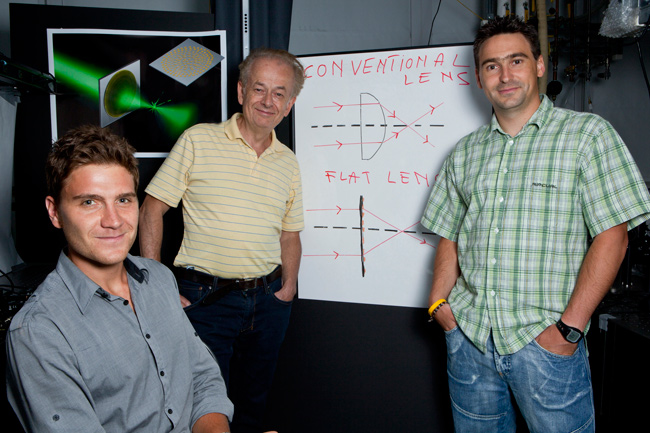
This team at Harvard has built a flat, thin metamaterial which works as an extremely thin flat lens with no chromatic aberration for three wavelengths. A prototype was created in 2012, but that version only worked for one wavelength of light. The new design allows focusing three different wavelengths, which means it would work for the red, green and blue LEDs in a display.
Edit: for applications like photography, they would need something that worked across the spectrum, not just at the three wavelengths. They're not there yet, but they're working on it.
They also have a version which deflects the three wavelengths by the same amount, like a prism but without the diffraction. That could be great for other optics but I can't think of anything that would apply to gaming.
Applying it in a VR headset would mean a much lighter, thinner headset which no longer needed chromatic aberration correction in the rendered image, which I think would result in a more focused image when looking at the periphery (not sure about this part). It'll be interesting to see where these start showing up.
No need for color correction—Harvard physicists’ flat optics, using nanotechnology, gets it right the first time"
http://www.seas.harvard.edu/news/2015/02/perfect-colors-captured-with-one-ultra-thin-lens
This team at Harvard has built a flat, thin metamaterial which works as an extremely thin flat lens with no chromatic aberration for three wavelengths. A prototype was created in 2012, but that version only worked for one wavelength of light. The new design allows focusing three different wavelengths, which means it would work for the red, green and blue LEDs in a display.
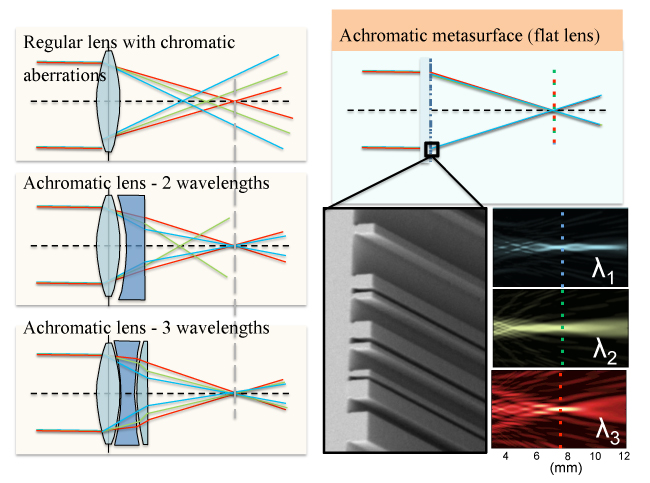
Ordinary refractive lenses (left) suffer from significant chromatic aberrations as different wavelengths are focused in different spots. To compensate for this chromatic dispersion, additional lenses have to be added in an objective to compensate for chromatic aberrations as the number of wavelengths to be corrected increases. An achromatic doublet corrects for 2 wavelengths, an apochromat for 3 and finally a so called super-achromat for four wavelengths. The Harvard team's new metasurface lenses (right) are designed to focus light in the same spot for 3 different wavelengths with no need to increase the lens thickness and footprint. (Image courtesy of Patrice Genevet, Federico Capasso, and Francesco Aieta, Harvard SEAS.)
Edit: for applications like photography, they would need something that worked across the spectrum, not just at the three wavelengths. They're not there yet, but they're working on it.
The team’s computational simulations also suggest that a similar architecture can be used to create a lens that collimates many different wavelengths, not just three.
Harvard's Office of Technology Development has filed for a provisional patent on the new optical technology and is actively pursuing commercial opportunities.
“Our previous work on the metallic flat lens produced a great excitement in regard to the possibility of achieving high numerical aperture and spherical aberration-free focusing with a very compact design. By demonstrating achromatic lenses we have now made a major step forward towards widespread future application of flat optics that will certainly attract the interest of the industry,” said lead author Francesco Aieta, now employed by Hewlett Packard, who conducted the research at Harvard SEAS.
They also have a version which deflects the three wavelengths by the same amount, like a prism but without the diffraction. That could be great for other optics but I can't think of anything that would apply to gaming.
Applying it in a VR headset would mean a much lighter, thinner headset which no longer needed chromatic aberration correction in the rendered image, which I think would result in a more focused image when looking at the periphery (not sure about this part). It'll be interesting to see where these start showing up.