

*Note: if you haven't played Silent Hill 1, 2, 3 and 4, then you probably shouldn't watch this
So earlier today I stumbled upon a video series describing and analysing the Silent Hill series.
Click here to watch The Real Silent Hill Experience* (skip to Part 1 if you do not need the introduction)
It is made by DerFuzhwar, Rosetter and Fungo, who is known for uploading and preserving much Silent Hill media, such as an 1 ½ hours film presentation of Silent Hill 2. The video series is very well-made (considering it is fans behind it) although with the occasional bad joke here and there, plus it is divided into 13 different parts, so it is a mouthful to watch. Their analysis is entertaining and enlightening, while the premises of many of their claims and arguments are highly valid and supported by knowledge restricted to *only* official confirmations of the concepts/theories, meaning that a member of the original Team Silent has to have been quoted as a source for the claim or argument to be considered true. Their best parts are the more ones focused on the concepts of Silent Hill (but all of the parts are worth watching):
Part 11 - Analysis 1
Part 12 - Analysis 2
For example they really do a nice job of highlighting the conceptual deficiencies of the post-Team Silent entries. Such as showing Homecoming's blatant rip-off of Saw and Hostel, thereby reinforcing what fans have been fearing with the direction that the series took with Konami's choice of outsourcing it. I also have no faith in Team Vatra and their Downpour entry in the series based on the quotes made by Devin Shatsky in part 12b. Downpour might just be another poor imitation of Silent Hill 2 with the main character having amnesia.
I think the history of the Silent Hill series is an interesting phenomena that highlights the link between creator, artefact and good business: One simply cannot churn out sequel after sequel of the same IP over and over again without some loss of intellectuality and creativity. What Team Silent (however nebulous that term might be) created in SH1-3 (and to some extent 4) were lightning in a bottle, meaning that the games themselves were so masterfully detailed in their atmosphere, storytelling, homages and inspirations, visuals, and music, that the chances of it happening again by 'milking the cow' was drastically lessened. So when Koanmi dissolved Team Silent and outsourced the IP to future developers, they made a sound business decision, but it resulted in the new developers trying to mimic Team Silent's original games by checking off their Silent Hill Checklist. Obviously this is a recipe for a creative disaster, which shows in the outsourced Silent Hill games. In relation to this aspect, there is the comment made by Masahiro Ito (monster designer of SH1-3) in a reply to an e-mail sent by a Silent Hill fan (Furin from Helldescent):

I think much of the original Team Silent (or at least the key members such as Ito and Owaku) wanted to try something new instead of Silent Hill. It would have been incredibly interesting to see what they would have produced based on SH1-3, but Konami chose to keep on churning out entries in an already established IP. It is another example of good business clashing with artistic creativity, which is why I find the Silent Hill series interesting from a game development standpoint.
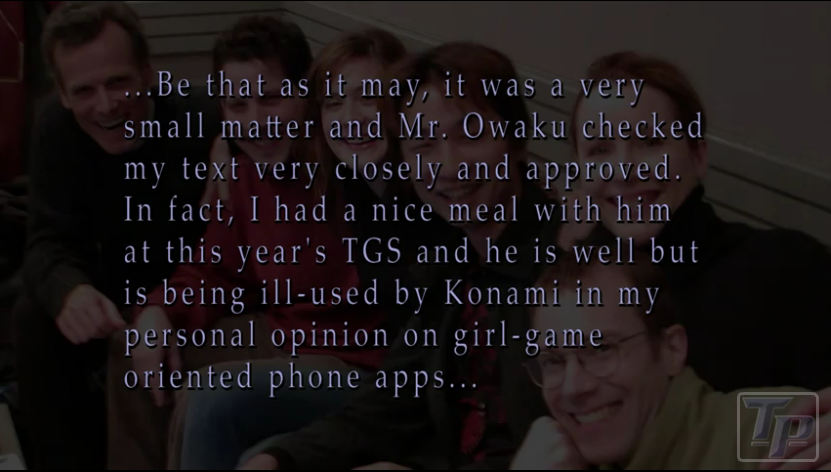
Furthermore, they received an e-mail from Jeremy Blaustein (translator and assistant on SH1-4) writing about what Konami has been doing with Hiroyuki Owaku (co-writer/writer of Silent Hill 1-3). It is terrible to see such talent go to waste:
Sorry for the long OP with some bad wording and grammar (English is my second language), but I just wanted to share it on Neogaf, knowing how many fans of the series and Team Silent exist on this board. I had to try to condense much of the information to simple and interesting points, but there is still much more in the videos that I have left out.
So earlier today I stumbled upon a video series describing and analysing the Silent Hill series.
Click here to watch The Real Silent Hill Experience* (skip to Part 1 if you do not need the introduction)
It is made by DerFuzhwar, Rosetter and Fungo, who is known for uploading and preserving much Silent Hill media, such as an 1 ½ hours film presentation of Silent Hill 2. The video series is very well-made (considering it is fans behind it) although with the occasional bad joke here and there, plus it is divided into 13 different parts, so it is a mouthful to watch. Their analysis is entertaining and enlightening, while the premises of many of their claims and arguments are highly valid and supported by knowledge restricted to *only* official confirmations of the concepts/theories, meaning that a member of the original Team Silent has to have been quoted as a source for the claim or argument to be considered true. Their best parts are the more ones focused on the concepts of Silent Hill (but all of the parts are worth watching):
Part 11 - Analysis 1
Part 12 - Analysis 2
For example they really do a nice job of highlighting the conceptual deficiencies of the post-Team Silent entries. Such as showing Homecoming's blatant rip-off of Saw and Hostel, thereby reinforcing what fans have been fearing with the direction that the series took with Konami's choice of outsourcing it. I also have no faith in Team Vatra and their Downpour entry in the series based on the quotes made by Devin Shatsky in part 12b. Downpour might just be another poor imitation of Silent Hill 2 with the main character having amnesia.
I think the history of the Silent Hill series is an interesting phenomena that highlights the link between creator, artefact and good business: One simply cannot churn out sequel after sequel of the same IP over and over again without some loss of intellectuality and creativity. What Team Silent (however nebulous that term might be) created in SH1-3 (and to some extent 4) were lightning in a bottle, meaning that the games themselves were so masterfully detailed in their atmosphere, storytelling, homages and inspirations, visuals, and music, that the chances of it happening again by 'milking the cow' was drastically lessened. So when Koanmi dissolved Team Silent and outsourced the IP to future developers, they made a sound business decision, but it resulted in the new developers trying to mimic Team Silent's original games by checking off their Silent Hill Checklist. Obviously this is a recipe for a creative disaster, which shows in the outsourced Silent Hill games. In relation to this aspect, there is the comment made by Masahiro Ito (monster designer of SH1-3) in a reply to an e-mail sent by a Silent Hill fan (Furin from Helldescent):
I think much of the original Team Silent (or at least the key members such as Ito and Owaku) wanted to try something new instead of Silent Hill. It would have been incredibly interesting to see what they would have produced based on SH1-3, but Konami chose to keep on churning out entries in an already established IP. It is another example of good business clashing with artistic creativity, which is why I find the Silent Hill series interesting from a game development standpoint.
Furthermore, they received an e-mail from Jeremy Blaustein (translator and assistant on SH1-4) writing about what Konami has been doing with Hiroyuki Owaku (co-writer/writer of Silent Hill 1-3). It is terrible to see such talent go to waste:
Sorry for the long OP with some bad wording and grammar (English is my second language), but I just wanted to share it on Neogaf, knowing how many fans of the series and Team Silent exist on this board. I had to try to condense much of the information to simple and interesting points, but there is still much more in the videos that I have left out.


