cormack12
Gold Member
Source: https://www.bbc.co.uk/news/articles/c5y3j3ngevmo
Artificial Intelligence has been used to design brand new viruses that are fully functional and can replicate in the laboratory, say US researchers.
It is the first time whole genomes have been successfully designed by AI.
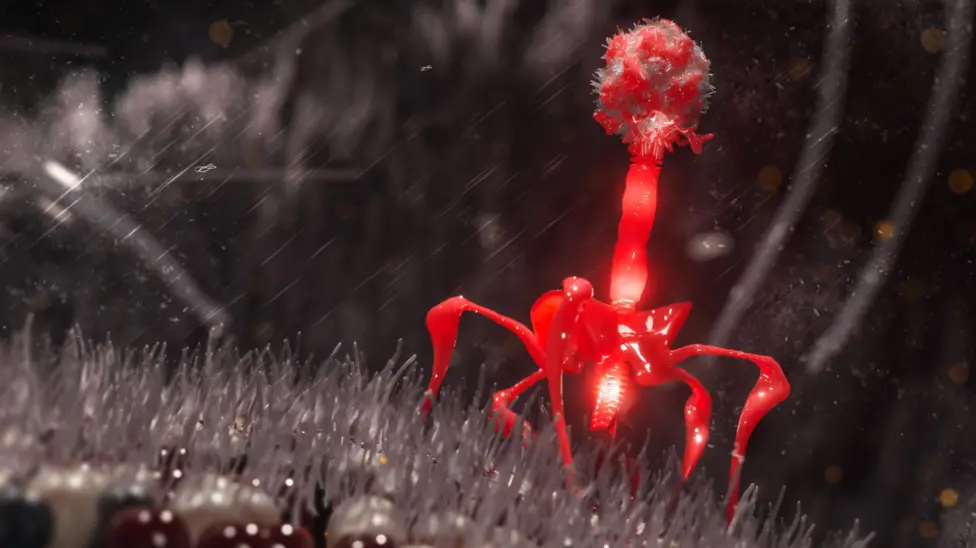
The resulting 16 novel viruses were created to infect bacteria and pose no threat to people.
The breakthrough has been labelled a "very significant turning point" in science that could unlock a new era for treating disease. But experts have also warned AI-designed viruses raise "urgent" safety and security concerns.
The technology works similarly to large language models, like ChatGPT, which predict sequences of text.
In this instance the AI models, known as Evo1 and Evo2, predict the language of life rather than words.
The AI models were trained on genetic codes from viruses, bacteria, plants and people.
They were then refined to produce a type of virus, known as a bacteriophage, which infect only specific species of bacteria.
The Stanford researchers picked the most promising 302 AI designs and synthesised them in the lab. Of these, 16 proved effective at killing E. coli bacteria.
Artificial Intelligence has been used to design brand new viruses that are fully functional and can replicate in the laboratory, say US researchers.
It is the first time whole genomes have been successfully designed by AI.
The resulting 16 novel viruses were created to infect bacteria and pose no threat to people.
The breakthrough has been labelled a "very significant turning point" in science that could unlock a new era for treating disease. But experts have also warned AI-designed viruses raise "urgent" safety and security concerns.
The technology works similarly to large language models, like ChatGPT, which predict sequences of text.
In this instance the AI models, known as Evo1 and Evo2, predict the language of life rather than words.
The AI models were trained on genetic codes from viruses, bacteria, plants and people.
They were then refined to produce a type of virus, known as a bacteriophage, which infect only specific species of bacteria.
The Stanford researchers picked the most promising 302 AI designs and synthesised them in the lab. Of these, 16 proved effective at killing E. coli bacteria.