• Hey Guest. Check out your NeoGAF Wrapped 2025 results here!

Digital Foundry: 007 First Light - A Deep Dive Into The Evolved Glacier Engine

viveks86

Gold Member


AI Summary (need to verify):
This video features Digital Foundry's Alex Battaglia interviewing key tech team members from IO Interactive to discuss the evolution of their Glacier Engine for the upcoming game, 007 First Light. The team explores how they have modernized their existing engine technology to meet the demands of a new, high-fidelity James Bond title while maintaining an ambitious 60fps performance target on current-gen consoles.

Key Technical Highlights:

  • Performance Targets: The team is targeting 30fps quality and 60fps performance mode on PS5 and Xbox Series X. Pro will have only quality mode running at 60 fps, while the Xbox Series S will only run at 30fps (2:19-2:51).
  • Lighting & Rendering: A major upgrade involves the implementation of fully real-time global illumination and a new volumetric system called "Smolder" for enhanced fog, smoke, and particle effects (4:30-5:45, 37:52-40:00). There is no hardware ray tracing. The system uses software ray tracing, similar to Lumen. Clustered Lighting system built (similar to megalights) to handle hundreds or even thousands of light sources.
  • Animation & AI: The animation pipeline has been rewritten to prioritize fluid, full-body motion matching and high-fidelity facial animation. AI behaviors are now more systemic, moving beyond the "drama moments" seen in the Hitman trilogy to more complex, multi-layered decision-making (24:10-27:20, 29:16-32:45).
  • Streaming & World Building: The engine utilizes a powerful "BRICKs" system—an entity-component-based architecture that allows for highly efficient streaming of massive, seamless environments, enabling levels to evolve dynamically (47:03-48:30, 50:18-53:22).
  • Tools & Iteration: The development team emphasizes a node-based editing environment that empowers designers and artists to iterate quickly without needing constant programmer intervention. This is supported by an automated build system that allows for rapid testing (14:40-15:45, 16:24-17:35).
  • Optimization: To hit their frame rate goals, the engine makes aggressive use of async compute, clustered lighting, and a frame graph system to manage GPU resources effectively (55:00-57:25).
The interview concludes with the team reflecting on their pride in the technological synergies achieved and the collaborative effort required to bring this cinematic experience to life.
 
Last edited:
Serious Donald Trump GIF by Bombay Softwares
 
Software RT? Hmmm....
Yeah was surprised to learn that. They have basically replicated software lumen + megalights, built on distance fields.

Seems that the game runs quality mode at 1440P + PSSR2 at 60 fps on Pro versus 1440p 30 fps FSR 3 on base. That's a bit surprising as well, given no hardware RT.
 
I watch a little bit of that video, but with the sound off. It looked interesting so I'll watch it later. It does look interesting with the various environment interactions and physics.
But, wtf is Alex doing in that video? Is he on a fucking treadmill!
 
I watch a little bit of that video, but with the sound off. It looked interesting so I'll watch it later. It does look interesting with the various environment interactions and physics.
But, wtf is Alex doing in that video? Is he on a fucking treadmill!
Yeah. He has chronic back issues and seems to be the only thing that works for him while doing videos. It's either that or extended leave/quitting
 
Not pre-ordering anything but I am still keeping my eye on this. Didn't have time to watch whole video, just kinda skipped through it. I liked the scene with crowd density and that big screen.
 
I don't hate it, I'm interested in it because it's made by hitman studio. Just pointed out that there is a lack of interest for it.
Its a 70min technical interview regarding their custom engine. Most here wont really give a damn about it.

Now if this was a comparison video with some controversy in how console X performs better than console Y than it could easily stretch for several pages.
 
Makes sense for current gen consoles.
Less so for PS5 Pro and PC, but at least on PC there will be Nvidia made PT option.
Also I now kinda understand why all the shots and videos from the game looked kinda meh lighting wise.

There should be a middle hardware RT option with better quality (similar to Lumen).

I like that in many games we get high - nothing... ultra - nothing.... extreme - nothing... max - "modern Crysis tanking fps on 5090" (Crimson Desert is like that + IJ and Doom DA). With zero quality/performance scaling in between.
 
Last edited:
There should be a middle hardware RT option with better quality (similar to Lumen).

I like that in many games we get high - nothing... ultra - nothing.... extreme - nothing... max - "modern Crysis tanking fps on 5090" (Crimson Desert is like that + IJ and Doom DA). With zero quality/performance scaling in between.
I watched the video last night. I don't know why the ai is saying it's software rt. Its per pixel full or half resolution depending on the quality setting.

There is a probe based fallback for lower end gpus they wanted to support.
 
The 007 hate on this site is just so fucking weird. You guys hate video games im convinced. Will watch the video now
I'm at the point where I ignore so many threads that 80% of them are OTs lol

The cool people here keep me around, though.

I'm definitely looking forward to this game. Loved the Hitman games and I wanna experience this game myself.
 
I feel this will be one of the candidates for game of the year for me. Its basically uncharted meets james bond. I like these deep dives, wouldn't mind seeing more of this.
 
There should be a middle hardware RT option with better quality (similar to Lumen).

I like that in many games we get high - nothing... ultra - nothing.... extreme - nothing... max - "modern Crysis tanking fps on 5090" (Crimson Desert is like that + IJ and Doom DA). With zero quality/performance scaling in between.

I watched the video last night. I don't know why the ai is saying it's software rt. Its per pixel full or half resolution depending on the quality setting.

There is a probe based fallback for lower end gpus they wanted to support.

I think you have misunderstood. I deliberately edited software RT into the AI summary after reviewing the video, because it was such an important highlight of that segment that the AI had omitted.

Software RT usually has 2 components - Screenspace tracing or Screen Tracing and Worldspace Tracing or world tracing.

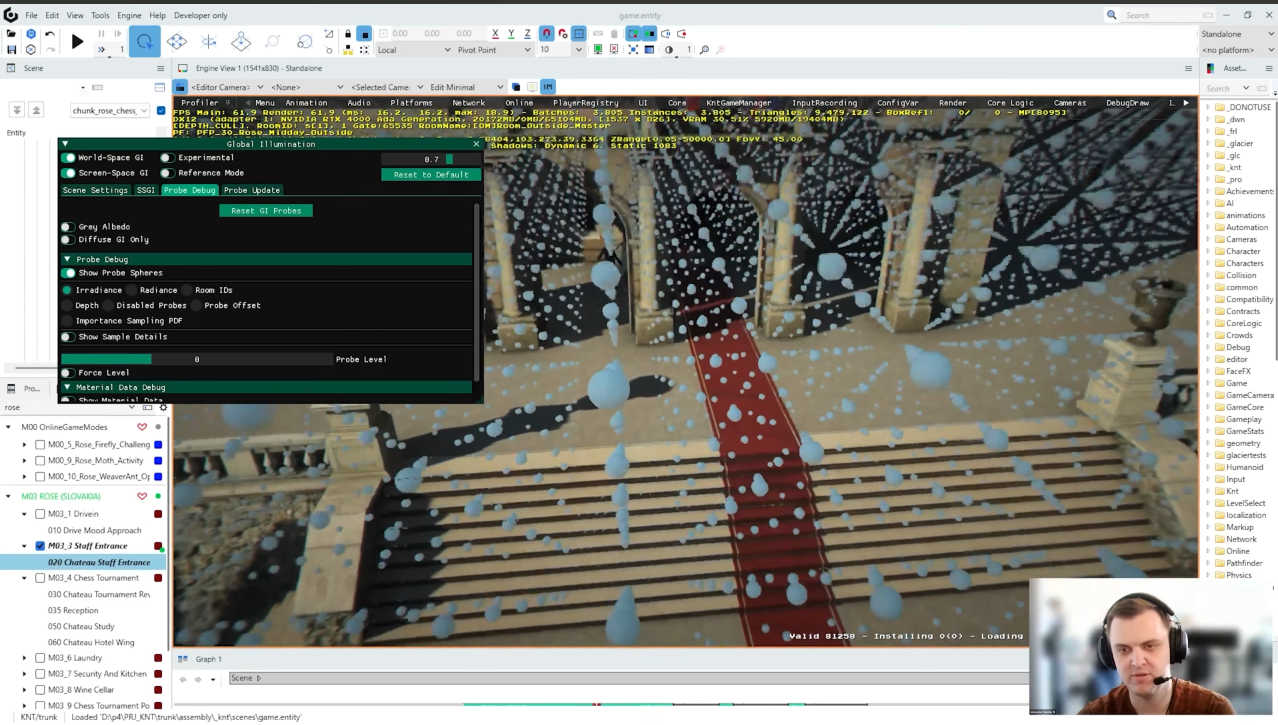
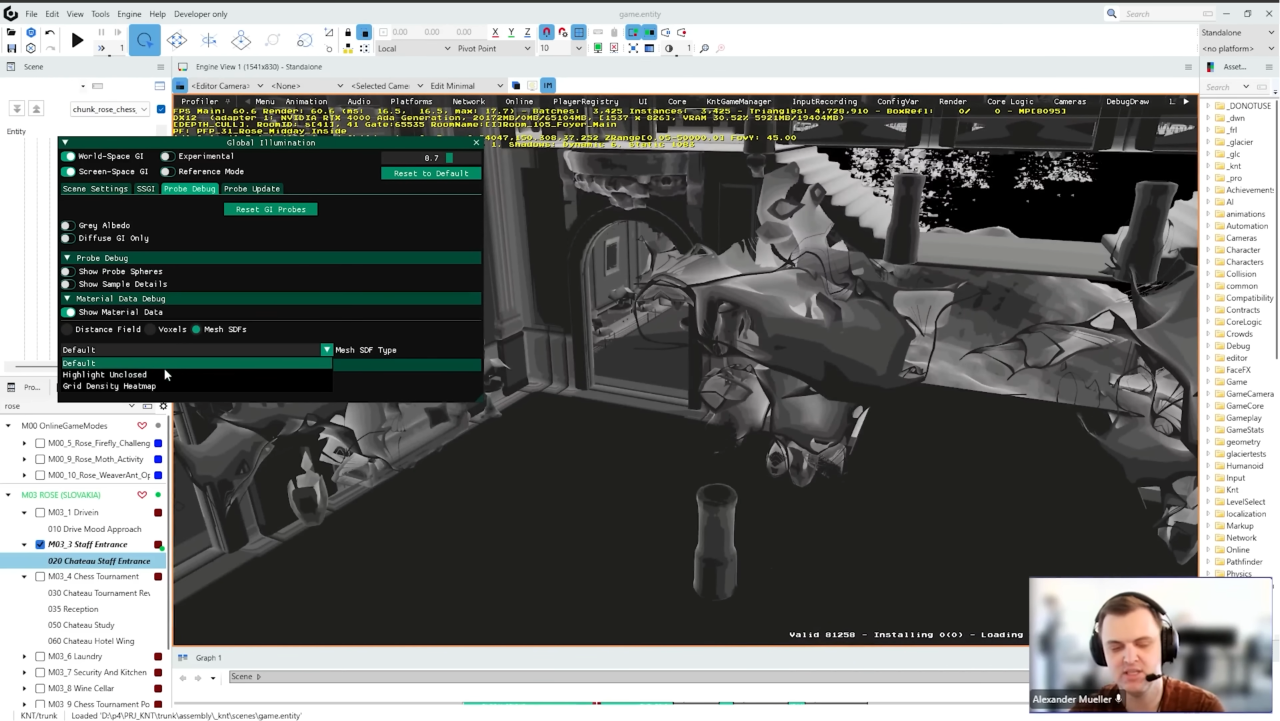
Both Glacier and Lumen are using an identical approach for software RT. Per-pixel screen tracing at half or full resolution i.e bouncing a ray within the 2D space of a rendered scene, and probe-based world tracing with signed distance fields (Mesh SDFs). Irradiance probes are placed throughout the 3D space to cache any rays that intersect with it, thereby allowing for early termination of future rays and preventing additional bounces. Worldtracing in software RT on lower end hardware is simply not viable without such a cache. You will see a visualization of this here:

JWLoleZTpj6tHSLL.png


And the Mesh SDF:

IyGBrk10dafib8Dd.png


This is not just a fallback for low end hardware. It's an integral part of their software ray tracing pipeline for ALL hardware.

This is different from Hardware Ray Tracing, where ALL rays are traced in 3D world space accelerated by a BVH and dedicated RT hardware. This is what Hardware Lumen does as well. There are some variants to this, like ID tech that uses worldspace probes in addition to BVH (even for their non-PT version), to cache the irradiance so they can query the cache instead of generating additional bounces or propagating the ray further. Normally this is done only in PT scenarios using radiance caching like SHARC or NRC, but ID tech, being the geniuses they truly are, have done it just for RTGI to boost performance and hit 60 fps.

Now with this explanation, I recommend watching that segment again. Timestamped below:


They clearly specify that they use no hardware ray tracing at all because they wanted to support low end hardware such as base consoles, switch and even the Nvidia 10 series. Their original design goal was to be able to support everything with one solution and drop any feature that doesn't scale all the way down, hence no hardware ray tracing.

Kind of a dumbass goal imho, as they decided to throw in PT at the last minute anyway. One size never fits all and I never understand when devs try to take this approach. Software RT is clearly not scalable in the opposite direction towards the high end and, for whatever reason, this wasn't in their early design considerations. It's likely why their PT is getting delayed, because it wasn't part of the original design goal and now they are lagging behind due to conflicting priorities of releasing the base game vs working on the bolt-on. Likely Nvidia convinced them to build it during later stages of development. It clearly violates their original stated design goal and they are now making up some lame explanation for it in the video, as if they always wanted to use it as reference. Clearly they didn't want that early on. If they did, they would have built that into their design goal for upwards scalability from the get go. Their response to the question on PT was a total spin that contradicts everything they said in the RTGI segment. It is what it is. Lol.
 
Last edited:
Kind of a dumbass goal imho

Exactly. Who gives a shit about 10 series GPUs?

They have baseline of consoles with hardware RT acceleration, they should make their game use this to the maximum - not completely ignore it.

ID tech is the example of doing things the right way on consoles. On PC they still have that stupid massive gap between in game RT and PT, massive void that could be filled with RT shadows for example.
 
Exactly. Who gives a shit about 10 series GPUs?

They have baseline of consoles with hardware RT acceleration, they should make their game use this to the maximum - not completely ignore it.

ID tech is the example of doing things the right way on consoles. On PC they still have that stupid massive gap between in game RT and PT, massive void that could be filled with RT shadows for example.
Yeah the confidence with which they were stating that was a bit baffling tbh. They made the decision several years ago and are now, understandably, defending it. But in the end, they have pretty robust engine now for the low-mid end hardware, so it's nothing to be ashamed of anyway. The only ones left behind a little are the mid-high end. And most of them will be satisfied once PT is in place anyway.

But like you said, it does leave a wide chasm in between. Pro could easily have had RT Reflections instead of SSR or RT shadows thrown in, if they had implemented any hardware RT. Instead we get 1440P +PSSR2, which is way overkill imo.
 
I think you have misunderstood. I deliberately edited software RT into the AI summary after reviewing the video, because it was such an important highlight of that segment that the AI had omitted.

Software RT usually has 2 components - Screenspace tracing or Screen Tracing and Worldspace Tracing or world tracing.

Both Glacier and Lumen are using an identical approach for software RT. Per-pixel screen tracing at half or full resolution i.e bouncing a ray within the 2D space of a rendered scene, and probe-based world tracing with signed distance fields (Mesh SDFs). Irradiance probes are placed throughout the 3D space to cache any rays that intersect with it, thereby allowing for early termination of future rays and preventing additional bounces. Worldtracing in software RT on lower end hardware is simply not viable without such a cache. You will see a visualization of this here:

JWLoleZTpj6tHSLL.png


And the Mesh SDF:

IyGBrk10dafib8Dd.png


This is not just a fallback for low end hardware. It's an integral part of their software ray tracing pipeline for ALL hardware.

This is different from Hardware Ray Tracing, where ALL rays are traced in 3D world space accelerated by a BVH and dedicated RT hardware. This is what Hardware Lumen does as well. There are some variants to this, like ID tech that uses worldspace probes in addition to BVH (even for their non-PT version), to cache the irradiance so they can query the cache instead of generating additional bounces or propagating the ray further. Normally this is done only in PT scenarios using radiance caching like SHARC or NRC, but ID tech, being the geniuses they truly are, have done it just for RTGI to boost performance and hit 60 fps.

Now with this explanation, I recommend watching that segment again. Timestamped below:


They clearly specify that they use no hardware ray tracing at all because they wanted to support low end hardware such as base consoles, switch and even the Nvidia 10 series. Their original design goal was to be able to support everything with one solution and drop any feature that doesn't scale all the way down, hence no hardware ray tracing.

Kind of a dumbass goal imho, as they decided to throw in PT at the last minute anyway. One size never fits all and I never understand when devs try to take this approach. Software RT is clearly not scalable in the opposite direction towards the high end and, for whatever reason, this wasn't in their early design considerations. It's likely why their PT is getting delayed, because it wasn't part of the original design goal and now they are lagging behind due to conflicting priorities of releasing the base game vs working on the bolt-on. Likely Nvidia convinced them to build it during later stages of development. It clearly violates their original stated design goal and they are now making up some lame explanation for it in the video, as if they always wanted to use it as reference. Clearly they didn't want that early on. If they did, they would have built that into their design goal for upwards scalability from the get go. Their response to the question on PT was a total spin that contradicts everything they said in the RTGI segment. It is what it is. Lol.

Software raytracing
Sexy Hot Girl GIF by Cappa Video Productions
 
Last edited:
Software raytracing
Sexy Hot Girl GIF by Cappa Video Productions
Haha. It's not so bad here though.

Unlike lumen, whatever low frequency correlation artifacts stay static and doesn't boil all over the place. Whatever they have done there is an excellent optimization and Epic should learn how to pull that off
 
Last edited:
Top Bottom