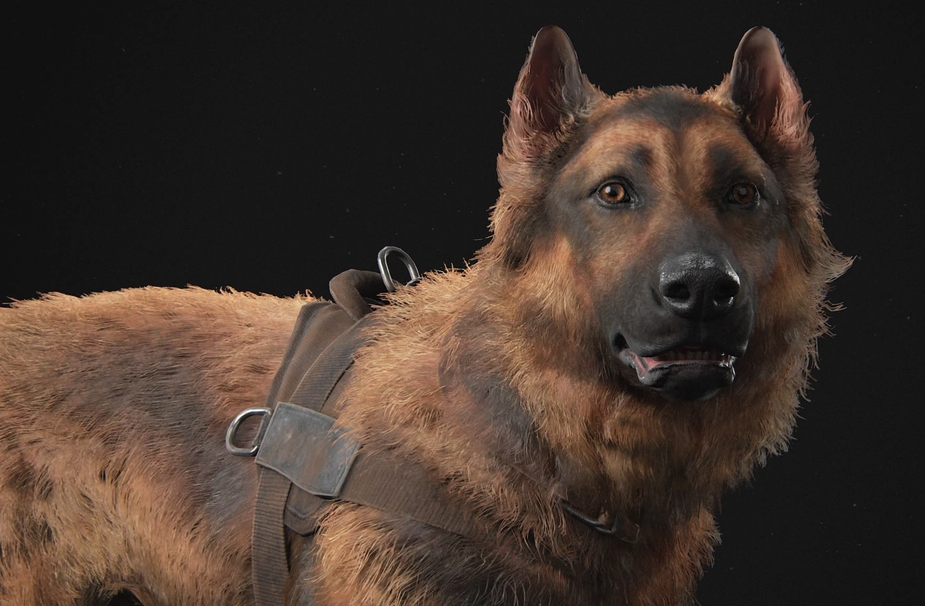
Motion matching is not a trick it is a system...
Motion matching is a system that produces the illusion of organic animated responses to the character's situation, context, and environments. An actual system that produces the real deal would be the
Euphoria physics system Rockstar integrated into RAGE, which can blend procedural, inverse, and key-frame animations in real time. It's also seen to great effect in The Force Unleashed, with its use of DMM and Euphoria. Motion matching requires artists to create literally thousands of animation variations for the system to pick from to create the illusion of a fully procedural and personality based animation system. There are few development companies in the world able or willing to spend the millions of dollars and years of man hours required for that kind of system. It looks great, sure, but, at the end of the day, Naughty Dog brute forced it.
... and even those companies that have a lot of budget don't come close to what Naughty Dog has accomplished...
Well, Microsoft doesn't spend close to what Sony spent on TLOUP2, so you've picked a bad example to make your point. (We'll ignore the obvious counter-point of Concord - the largest failure in entertainment history.) Even Hellblade on the XSX - the most realistic real-time visuals on the market - isn't close to what Sony spent here. At USD$220 million dollars, TLOUP2 was one of the most expensive video games ever made. At that level of budget, you're close to the biggest Assassin's Creeds entries, and edging closer to GTAV, RDR2, and Cyberpunk 2077 with their industry-breaking USD$300 million dollar budgets. At that level, developers deliver massive, expansive games built on complex systems that can be explored for weeks if not years. Naughty Dog delivered a largely one-and-done hyper-linear cinematic third person shooter. In terms of PS4/Xbone gen technical accomplishments, it doesn't rank very highly for me on a tech level, because they simply had more money to deliver a very linear game than basically anyone has ever had.
... That is a particularity of SIE, that they put the money and effort to create those visuals... that also requires talent, because you cannot deliver quality by sheer brute force, the testament of that is all the garbage games, MS has churn out lately...
Check yourself, friend - your fan-boy is showing.
... I wonder what are smoke and mirrors in visual effects? Please elaborate, cause any visual effect requires code and scripting and those are created with knowledge and not tricks...
Sure, there are plenty to pick from. Take reflections for example. Naughty Dog actually just use tried-and-true tricks and techniques for their reflections in TLOUP2. But, they look very impressive - so, clearly, Naughty Dog are just that much better than everyone else, right? Not quite. Developers typically have to chose between one or two systems - cube maps for off-screen elements and SSR for on-screen elements is pretty typical. Cube maps are aligned programmatically, with maybe one or two major areas given artist attention to ensure it aligns correctly. The number of cube maps will also be kept to a minimum, as they do take a little time to bake in offline systems and eat up disc space. Naughty Dog, howeer, had the time and budget to employ this same setup with artist-driven hand-offs between systems for every area in the game to maximise the impact. Some areas rely exclusively on artist aligned cube maps, some use cube maps with specific hand-picked SSR elements incorporated, others use SSR heavily. This all hands off from one combination to another, dozens of times in a given level. The reflections look better because Naughty Dog had the time and money to dedicate a team to implementing these types of tricks to fake better reflections, something most developers could only ever dream of.
In fact, manually handing off one trick or system to another trick or system is employed throughout the entire game. It's their key strategy for the game. Few developers can even attempt to do that because it's so cost and time prohibitive. Swapping between cut-scenes and game play, for example, Naughty Dog change out nearly everything - lighting systems, character models, facial rigs, textures, shaders, and graphical prefixes can all be changed. Few developers can afford to duplicate that much work solely to make their cutscenes look that much better. (God of War, for example, uses mostly the same assets and systems for cut-scenes and gameplay, with only the animation rigs being swapped out.) But Naughty Dog also employ staggered changes between cut-scene and gameplay to hide the hand over, with multiple steps in the transition instead of a hard cut-over. It's smart, and it looks great, but man - it's insanely expensive and takes years to do. Every transition for every cut scene, scripted sequence, or forced camera move is done, effectively, by hand, with artists churning out multiple versions of stuff to hide it. Years and years and years of work was put in to make sure it was as invisible as possible.
In my eyes, that's really the big accomplishment with TLOUP2: that they spent years on a game full of these kinds of tricks. It's a huge undertaking that few developers would ever even try because you'd need, well, hundreds of millions of dollars to pay for it all and a guaranteed development time frame to pull it off. With most developers worried about keeping their lights on, Naughty Dog were in a unique position where they had a blank cheque and as much time as they wanted. The results look amazing - but put it up against last-gen heavy hitters like RDR2 or Cyberpunk 2077, and from a technical perspective, it's just not in the same post-code. It's impressive, not for its tech, but for the sheer time and money its artist spent, effectively, hand-crafting it.