

XHitoshuraX
Banned
The Official Everyday Shooter Thread

Published by: Sony Computer Entertainment
Developed by: Queasy Game
Genre: Shooter
Release Date:
US: October 11th 2007
The Game
Everyday Shooter is an album of games exploring the expressive power of abstract shooters. Dissolute sounds of destruction are replaced with guitar riffs harmonizing over an all-guitar soundtrack, while modulating shapes celebrate the flowing beauty of geometry.

IGN Hands On
Everyday Shooter, an independent game originally created by Jonathan Mak, will be coming to the PlayStation Store in the near future. This game plays a lot like Geometry Wars, but offers a lot more creativity than you might initially think. Although it's slower than other top-down games of its type, Mak has managed to maximize the screen effects and unit count while minimizing the confusion. In the end, although you have to work somewhat vigorously to stay alive (especially in the later levels), the experience feels relaxing instead of taxing.
The game's mellow tone is influenced largely by the "musical score," but it would be more accurate to call it "the guitar." As you play, catchy guitar riffs dominate the game's aural plane. Most of the game's sound effects, explosions and bullet impacts alike, are actually musical notes. In addition to the fluid music, the game's visuals look brilliant. Colors pulse and melt across the screen in what could only be described as a psychedelic parade. This highly surreal presentation suggests that the game will appeal more to a relaxed crowd than adrenaline junkies (though there are frantic moments, to be sure).
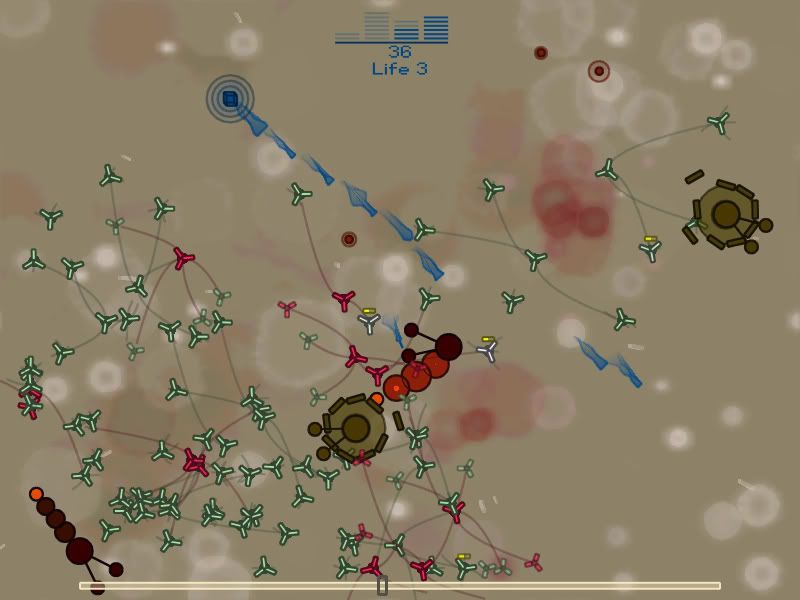
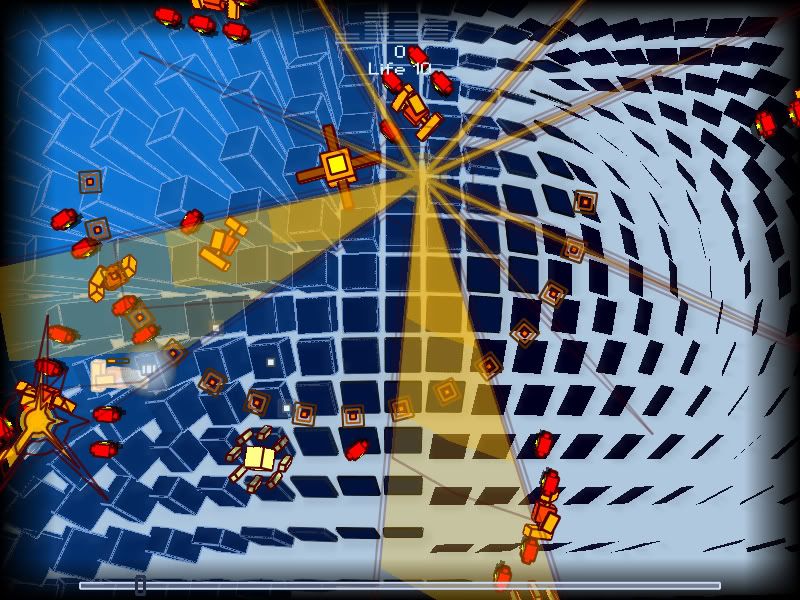
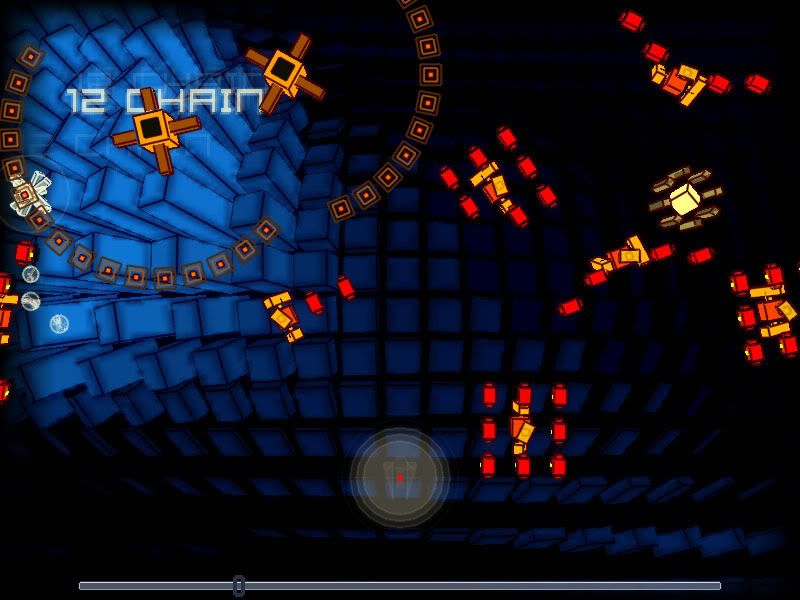
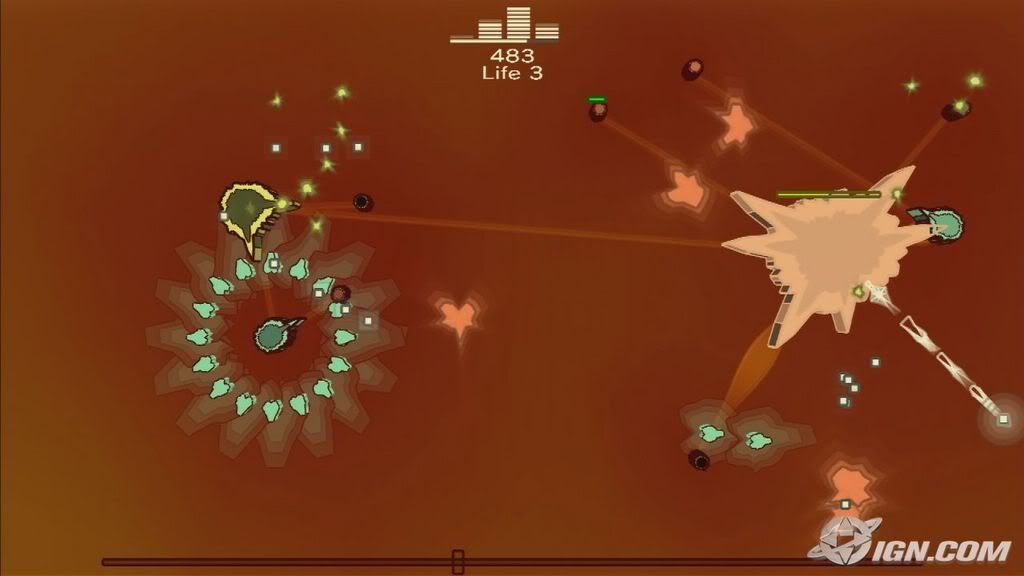
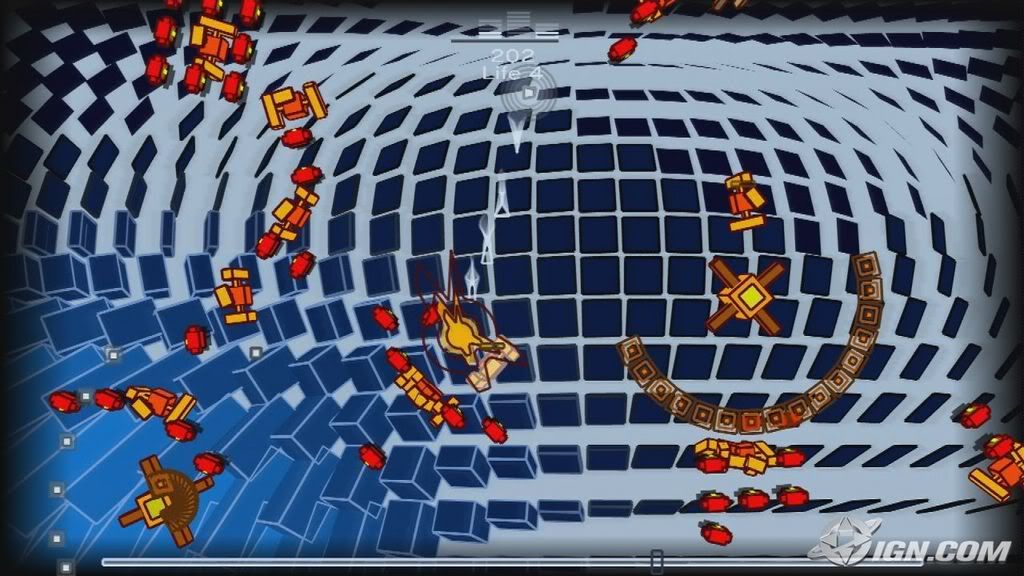
The gameplay itself, however, is familiar. The left analog stick moves your "ship" (a ship identical to a single pixel) while the right analog stick fires your one and only weapon. There are no bombs or field-clearing devices at your disposal; all you have is the ability to move and shoot. When you cease firing, your speed increases by a small margin, which is helpful in tight spots. The game's variety however, which your arsenal lacks, comes from the title's eight or so levels. Each level has a completely different graphical presentation and chain system. For example, in the first level, the enemies are primarily rectangular and robotic, flying in tight square formations. In order to snag a chain bonus, you need to land a hit on small, multi-cylindrical units. If you manage to hit one, it will open up and explode, destroying anything caught within the explosion's radius (including enemy fire). Even better: each subsequent explosion can cause another, which means massive combos for you.
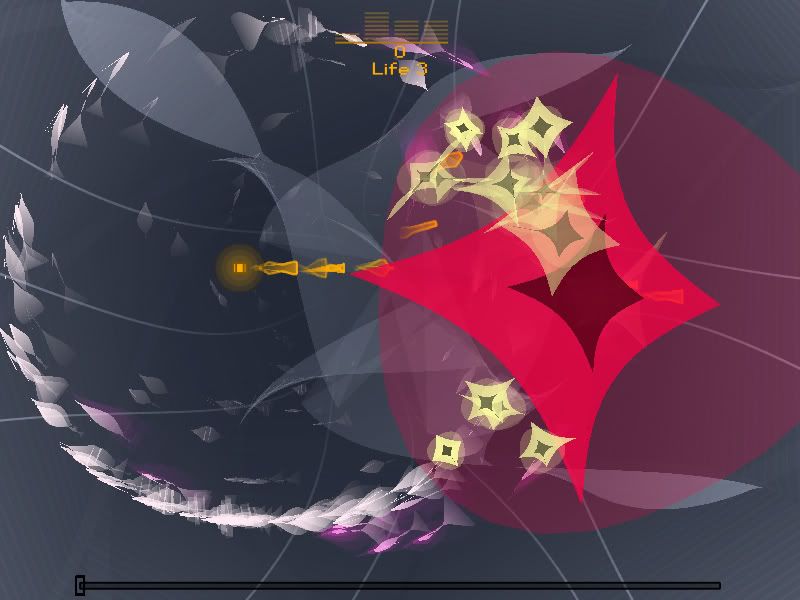
Going up against a massive eye. Funky.In the second level however, the style changes completely. The primary enemies are stationary and they link together to form devastating weapon networks. If you destroy the larger enemy unit, all the linked units will subsequently explode in a menagerie of lights and guitar notes. Each level is structured in this fashion, morphing the visuals and simultaneously changing the way you play the game.
Although this is a simple title, our experience so far has been enthralling. "Surreal" is absolutely the best word to describe it, next to "chill," so if you're a "chill" type of gamer, this is a game to look out for.



John Mak Interview with PS3 Fanboy
One PSN title captivated us more than any other at E3: it's Everyday Shooter, an award-winning music-shooter game. The smooth visuals, combined with the absorbing music, and addictive gameplay, made it one of our favorite (but underrated) games of E3. We had a chance to talk to Jon Mak, after his incredible E3 showing to talk more about Everyday Shooter, and working with Sony as an indie game designer.
We've been having trouble describing Everyday Shooter to gamers. Maybe you'll have a better way with words than us: how would you describe Everyday Shooter?
Everyday Shooter is like a music album, except instead of it being a collection of songs, it's a collection of shoot-em-ups. Each track/song/level is completely different visually, musically, and in terms of gameplay. You can see the screenshots to get a feel for the diversity in levels.
Each level focuses on a different chain reaction system that is not explicitly explained to the player. So with each playthrough, the player gains a sense of wonderment as they discover the nuances of each enemy and how they relate to form the greater chain reaction system. Although this gives a slight puzzle-y aspect to the game, make no mistake, this is a SHOOT-EM-UP, and not a puzzler.
One popular aspect of Everyday Shooter is the way it treats audio. All the sound effects in the game are guitar riffs harmonizing over an all guitar soundtrack. Bigger reactions causes bigger riffs to play. Thus you'll feel as if you're playing along with the music, except that your intstrument is the shoot-em-up!
How did Everyday Shooter begin? The first time I heard of it, it was winning awards at GDC.
Back in Spring 2005, I started working on a new game which I thought would provide maximum replayability through ingenious game design. Of course, the design was crap, and that project went nowhere. At that point, I realized that I had never made a game I was truly proud of, so I set out to make a tight, simple little game that I could be proud of. For me, that meant the shoot-em-up. At the time, I was also obsessed with Every Extend for it's chain reaction gameplay, and Lumines for it's album-y feel, and so those ideas eventually worked their way into the pot. By October 2005, the game officially became Everyday Shooter.
People have been comparing Everyday Shooter to games by Tetsuya Mizuguchi. Do you think that's a fair comparison?
Well, maybe, but probably not to Mizuguchi! Rez is such an awesome piece of work that it's hard for me to see Everyday Shooter existing on the same plane.
A lot of the comparisons come from how both incorporate music into the game. Contemporary music games such as Guitar Hero treat music as a form of enemy: if you cannot play the music then you lose the game. However, in Rez and Everyday Shooter, music is treated as a form of reaction: as you play the game, music will occur. But even with this similarity, both Rez and ES diverge. Rez is dance music oriented, so the musical reactions are fairly calculated, on the beat, and rhythmic. ES on the other hand is the opposite. Since the game is not beat-aware, riffs can sound at any time. It can sound on the beat, off the beat, 137 ms after beat 3, etc. Yet despite the seemingly random mess that might occur, it is not random at all because there are rules to gameplay, and because riffs play in response to gameplay -- there is an order to it.
Essentially, the idea is that you can go anywhere in the world and there will be a sort of music playing. That is, sounds occur and there is a loose order to them. For example, in downtown traffic, you might hear a lot of honking, the cars accelerating and decelerating, perhaps the bell of a streetcar, etc. But the frequency and the timing you hear these things are not random. There are very loose rules that govern when things occur. For example, honking occurs when people get angry, cars accelerate on green light, decelerate on red light, streetcars ding their bell as they cross intersections, etc. So just like how this soundscape is not truly random, so is the soundscape in Everyday Shooter not truly random. There are loose rules such as the frequency of enemies appearing, when they appear, how many shots it takes to destroy the enemy, etc.
So while Rez and Everyday Shooter are both music-reaction games, they both realize the idea in completely opposite ways. Rez is with a strict order, Everyday Shooter is with a loose order.
What went into creating the music for the game? Did you just start strumming on your guitar, or was there a more methodical method to the music design?
The only real method was trusting in what I talked about in the last question. That even when you think there aren't rules, there are rules. After that, then it was just playing whatever I liked. At the time, I was very much into indie rock, so everything has that sort of characteristic to it.
When creating the sounds/riffs, usually high-frequency events play shorter/quieter riffs while big events like a huge chain will play longer/loader sounds. The sounds also have to be chosen to work harmoniously with the background guitar track.
When did Sony contact you about developing for the PLAYSTATION Network?
Shortly after GDC. My agent, Warren Currell, just called me up and said "pack your bags, we're gonna meet Sony."
Sony's been differentiating themselves from the competition by going after "artsy" games for the PSN. What do you think of Sony's approach to downloadable games?
What differentiates them for me isn't the games that they're going after, it's the way they're going after them. Other publishers take a purely business approach to game making which leads to copy-cat, feature-oriented products built on market analysis and the suffocation of talent and creativity. It seems that Sony, or at least the Santa Monica studio, understands that games are not mere products of commodity, but works of expression and personality. From my point of view, this understanding leads to the ideal relationship between game maker and publisher. The game maker is given space to be creative, and the publisher is given an excellent game to market.
One caveat of course is that the game maker might make an unsellable game. But saleability of a work is closely related to accessibility (ease and want to experience the work) of a work. It is not uncommon to view a medium as a method of communication between artist and audience. If the work is inaccessible, then the communication between artist and audience is severed, and at that point, the work of the artist becomes self-indulgent. This isn't necessarily bad, it just means that the work is not meant to be shared with others and thus a relationship with a publisher is inappropriate.
But if the artist genuinely wishes to open a dialog with the audience, then for sure that artist will make all attempts to increase the accessibility of the work, including making it easy and desirable to experience. Because there is a close relationship between accessibility and saleability, then of course the artist will make something that is marketable. And if the artist can do it on his/her own terms, then the final work will be the best he/she can make it. Thus in the end, the publisher ends up with an excellent work to market, the game maker makes the game he/she truly wanted to make, and the audience/consumer is given an awesome game to play. Everybody wins!
I think it is this point that differentiates Sony from the rest of the publishers out there.
How is programming for the PS3? Has it been difficult rebuilding the game from PC to the console?
Technically speaking it's been relatively easy. There were several parts in my code that I had to change because it wasn't being very nice to the PS3. One of the harder parts was porting the gameplay from regular 4:3 format to 16:9 widescreen format. This was not as trivial as adding more enemies because that would completely upset the gameplay balance. In the end I think I've devised a few simple tweaks so that playing in 16:9 and 4:3 is nearly an identical experience.
Is partnering with Sony something you'd consider again in the future?
If they continue to give me the freedom and space to do my thing then absolutely.
How does the superstar status of becoming a published game developer feel? What's the future of Jon Mak?
Superstar status!? Ha! Uhh, it feels tiring? Putting out a game is a lot of work and so the future of Jon Mak is a pillow, a bed, and lots of sleep.
Finally, did Sony ever give you that PS3 they said they would?
They did! And a PSP with Loco Roco too! So I had to violate my no-game diet for a day, but I dunno, it's hard for me to play games right now since it makes me feel guilty for not working on ES. I really just want to finish the game already. Oh, and I got the 60 GB model, which is actually the one I wanted.


Gameplay Videos
Gameplay Montage
Chain Reaction
Design Interview
Official Trailer
E3 2007 Trailer
Published by: Sony Computer Entertainment
Developed by: Queasy Game
Genre: Shooter
Release Date:
US: October 11th 2007
The Game
Everyday Shooter is an album of games exploring the expressive power of abstract shooters. Dissolute sounds of destruction are replaced with guitar riffs harmonizing over an all-guitar soundtrack, while modulating shapes celebrate the flowing beauty of geometry.
IGN Hands On
Everyday Shooter, an independent game originally created by Jonathan Mak, will be coming to the PlayStation Store in the near future. This game plays a lot like Geometry Wars, but offers a lot more creativity than you might initially think. Although it's slower than other top-down games of its type, Mak has managed to maximize the screen effects and unit count while minimizing the confusion. In the end, although you have to work somewhat vigorously to stay alive (especially in the later levels), the experience feels relaxing instead of taxing.
The game's mellow tone is influenced largely by the "musical score," but it would be more accurate to call it "the guitar." As you play, catchy guitar riffs dominate the game's aural plane. Most of the game's sound effects, explosions and bullet impacts alike, are actually musical notes. In addition to the fluid music, the game's visuals look brilliant. Colors pulse and melt across the screen in what could only be described as a psychedelic parade. This highly surreal presentation suggests that the game will appeal more to a relaxed crowd than adrenaline junkies (though there are frantic moments, to be sure).
The gameplay itself, however, is familiar. The left analog stick moves your "ship" (a ship identical to a single pixel) while the right analog stick fires your one and only weapon. There are no bombs or field-clearing devices at your disposal; all you have is the ability to move and shoot. When you cease firing, your speed increases by a small margin, which is helpful in tight spots. The game's variety however, which your arsenal lacks, comes from the title's eight or so levels. Each level has a completely different graphical presentation and chain system. For example, in the first level, the enemies are primarily rectangular and robotic, flying in tight square formations. In order to snag a chain bonus, you need to land a hit on small, multi-cylindrical units. If you manage to hit one, it will open up and explode, destroying anything caught within the explosion's radius (including enemy fire). Even better: each subsequent explosion can cause another, which means massive combos for you.
Going up against a massive eye. Funky.In the second level however, the style changes completely. The primary enemies are stationary and they link together to form devastating weapon networks. If you destroy the larger enemy unit, all the linked units will subsequently explode in a menagerie of lights and guitar notes. Each level is structured in this fashion, morphing the visuals and simultaneously changing the way you play the game.
Although this is a simple title, our experience so far has been enthralling. "Surreal" is absolutely the best word to describe it, next to "chill," so if you're a "chill" type of gamer, this is a game to look out for.
John Mak Interview with PS3 Fanboy
One PSN title captivated us more than any other at E3: it's Everyday Shooter, an award-winning music-shooter game. The smooth visuals, combined with the absorbing music, and addictive gameplay, made it one of our favorite (but underrated) games of E3. We had a chance to talk to Jon Mak, after his incredible E3 showing to talk more about Everyday Shooter, and working with Sony as an indie game designer.
We've been having trouble describing Everyday Shooter to gamers. Maybe you'll have a better way with words than us: how would you describe Everyday Shooter?
Everyday Shooter is like a music album, except instead of it being a collection of songs, it's a collection of shoot-em-ups. Each track/song/level is completely different visually, musically, and in terms of gameplay. You can see the screenshots to get a feel for the diversity in levels.
Each level focuses on a different chain reaction system that is not explicitly explained to the player. So with each playthrough, the player gains a sense of wonderment as they discover the nuances of each enemy and how they relate to form the greater chain reaction system. Although this gives a slight puzzle-y aspect to the game, make no mistake, this is a SHOOT-EM-UP, and not a puzzler.
One popular aspect of Everyday Shooter is the way it treats audio. All the sound effects in the game are guitar riffs harmonizing over an all guitar soundtrack. Bigger reactions causes bigger riffs to play. Thus you'll feel as if you're playing along with the music, except that your intstrument is the shoot-em-up!
How did Everyday Shooter begin? The first time I heard of it, it was winning awards at GDC.
Back in Spring 2005, I started working on a new game which I thought would provide maximum replayability through ingenious game design. Of course, the design was crap, and that project went nowhere. At that point, I realized that I had never made a game I was truly proud of, so I set out to make a tight, simple little game that I could be proud of. For me, that meant the shoot-em-up. At the time, I was also obsessed with Every Extend for it's chain reaction gameplay, and Lumines for it's album-y feel, and so those ideas eventually worked their way into the pot. By October 2005, the game officially became Everyday Shooter.
People have been comparing Everyday Shooter to games by Tetsuya Mizuguchi. Do you think that's a fair comparison?
Well, maybe, but probably not to Mizuguchi! Rez is such an awesome piece of work that it's hard for me to see Everyday Shooter existing on the same plane.
A lot of the comparisons come from how both incorporate music into the game. Contemporary music games such as Guitar Hero treat music as a form of enemy: if you cannot play the music then you lose the game. However, in Rez and Everyday Shooter, music is treated as a form of reaction: as you play the game, music will occur. But even with this similarity, both Rez and ES diverge. Rez is dance music oriented, so the musical reactions are fairly calculated, on the beat, and rhythmic. ES on the other hand is the opposite. Since the game is not beat-aware, riffs can sound at any time. It can sound on the beat, off the beat, 137 ms after beat 3, etc. Yet despite the seemingly random mess that might occur, it is not random at all because there are rules to gameplay, and because riffs play in response to gameplay -- there is an order to it.
Essentially, the idea is that you can go anywhere in the world and there will be a sort of music playing. That is, sounds occur and there is a loose order to them. For example, in downtown traffic, you might hear a lot of honking, the cars accelerating and decelerating, perhaps the bell of a streetcar, etc. But the frequency and the timing you hear these things are not random. There are very loose rules that govern when things occur. For example, honking occurs when people get angry, cars accelerate on green light, decelerate on red light, streetcars ding their bell as they cross intersections, etc. So just like how this soundscape is not truly random, so is the soundscape in Everyday Shooter not truly random. There are loose rules such as the frequency of enemies appearing, when they appear, how many shots it takes to destroy the enemy, etc.
So while Rez and Everyday Shooter are both music-reaction games, they both realize the idea in completely opposite ways. Rez is with a strict order, Everyday Shooter is with a loose order.
What went into creating the music for the game? Did you just start strumming on your guitar, or was there a more methodical method to the music design?
The only real method was trusting in what I talked about in the last question. That even when you think there aren't rules, there are rules. After that, then it was just playing whatever I liked. At the time, I was very much into indie rock, so everything has that sort of characteristic to it.
When creating the sounds/riffs, usually high-frequency events play shorter/quieter riffs while big events like a huge chain will play longer/loader sounds. The sounds also have to be chosen to work harmoniously with the background guitar track.
When did Sony contact you about developing for the PLAYSTATION Network?
Shortly after GDC. My agent, Warren Currell, just called me up and said "pack your bags, we're gonna meet Sony."
Sony's been differentiating themselves from the competition by going after "artsy" games for the PSN. What do you think of Sony's approach to downloadable games?
What differentiates them for me isn't the games that they're going after, it's the way they're going after them. Other publishers take a purely business approach to game making which leads to copy-cat, feature-oriented products built on market analysis and the suffocation of talent and creativity. It seems that Sony, or at least the Santa Monica studio, understands that games are not mere products of commodity, but works of expression and personality. From my point of view, this understanding leads to the ideal relationship between game maker and publisher. The game maker is given space to be creative, and the publisher is given an excellent game to market.
One caveat of course is that the game maker might make an unsellable game. But saleability of a work is closely related to accessibility (ease and want to experience the work) of a work. It is not uncommon to view a medium as a method of communication between artist and audience. If the work is inaccessible, then the communication between artist and audience is severed, and at that point, the work of the artist becomes self-indulgent. This isn't necessarily bad, it just means that the work is not meant to be shared with others and thus a relationship with a publisher is inappropriate.
But if the artist genuinely wishes to open a dialog with the audience, then for sure that artist will make all attempts to increase the accessibility of the work, including making it easy and desirable to experience. Because there is a close relationship between accessibility and saleability, then of course the artist will make something that is marketable. And if the artist can do it on his/her own terms, then the final work will be the best he/she can make it. Thus in the end, the publisher ends up with an excellent work to market, the game maker makes the game he/she truly wanted to make, and the audience/consumer is given an awesome game to play. Everybody wins!
I think it is this point that differentiates Sony from the rest of the publishers out there.
How is programming for the PS3? Has it been difficult rebuilding the game from PC to the console?
Technically speaking it's been relatively easy. There were several parts in my code that I had to change because it wasn't being very nice to the PS3. One of the harder parts was porting the gameplay from regular 4:3 format to 16:9 widescreen format. This was not as trivial as adding more enemies because that would completely upset the gameplay balance. In the end I think I've devised a few simple tweaks so that playing in 16:9 and 4:3 is nearly an identical experience.
Is partnering with Sony something you'd consider again in the future?
If they continue to give me the freedom and space to do my thing then absolutely.
How does the superstar status of becoming a published game developer feel? What's the future of Jon Mak?
Superstar status!? Ha! Uhh, it feels tiring? Putting out a game is a lot of work and so the future of Jon Mak is a pillow, a bed, and lots of sleep.
Finally, did Sony ever give you that PS3 they said they would?
They did! And a PSP with Loco Roco too! So I had to violate my no-game diet for a day, but I dunno, it's hard for me to play games right now since it makes me feel guilty for not working on ES. I really just want to finish the game already. Oh, and I got the 60 GB model, which is actually the one I wanted.
Gameplay Videos
Gameplay Montage
Chain Reaction
Design Interview
Official Trailer
E3 2007 Trailer


