• Hey Guest. Check out your NeoGAF Wrapped 2025 results here!

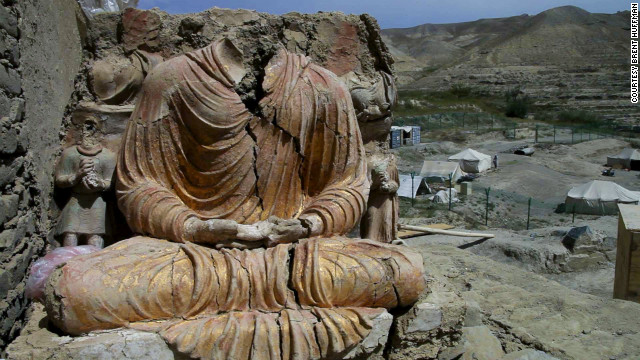
Ancient Buddhist site scheduled for destruction in Afghanistan

Status
Not open for further replies.
120919083929-afghan-mining-01-horizontal-gallery.jpg


http://edition.cnn.com/2012/09/22/opinion/afghanistan-buddha-site-mine/index.html?hpt=hp_c1
This site is called Mes Aynak and is nothing short of awe-inspiring: a massive walled-in Buddhist city featuring massive temples, monasteries, and thousands of Buddhist statues that managed to survive looters and the Taliban. Holding a key position on the Silk Road, Mes Aynak was also an international hub for traders and pilgrims from all over Asia.


Mes Aynak is set for destruction at the end of December 2012. All of the temples, monasteries, statues as well as the Bronze age material will all be destroyed by a Chinese government-owned company called China Metallurgical Group Corporation (MCC). Six villages and the mountain range will also be destroyed to create a massive open-pit style copper mine.


I have seen first hand the destruction reaped by the Chinese government on historical sites along the Silk Road. That they turn their eyes towards places like this outside of China makes my inner historian weep.
 
So it's being destroyed purely to mine and plunder the area, not because it's an affront to the native's beliefs?
 
Jesus, the Buddhists in the Afghanistan region couldn't have picked a worse place to erect their buildings and statues all those years ago.

Such a tremendous loss, all due to stupidity and greed.
 
So it's being destroyed purely to mine and plunder the area, not because it's an affront to the native's beliefs?

Yes. Buddhist historical sites have long survived in Muslim majority Central Asia. The Bamiyan Buddhas were an exception, essentially destroyed by the Taliban, not for offence they caused, but rather an attempt to hold them ransom for aid.

Caliph Umar (radiAllahu anhu) let a bunch of Egyptian temples stand, why would this be any different?
 
I have seen first hand the destruction reaped by the Chinese government on historical sites along the Silk Road. That they turn their eyes towards places like this outside of China makes my inner historian weep.
I didn't read the article, but Afghanistan's government has been cutting lots of mining deals with China. Afghanistan's hand wasn't forced; they simply don't give a shit about this historical landmark.

Sad, but you can't be mad at China.
 
I didn't read the article, but Afghanistan's government has been cutting lots of mining deals with China. Afghanistan's hand wasn't forced; they simply don't give a shit about this historical landmark.

Sad, but you can't be mad at China.

Well yeah, I can.

I was in Kashgar a few months ago, watching them dismantle the Old City brick by brick. I can be plenty mad.

Of course I can be mad with Karzai and his goons too, but methinks he'll take whatever cash he can get. Not to mention Chinese influence, considering how paranoid he is now about the US.
 
More destruction of ancient religious/historical sites.

ugh, it's just painful to read and look at those images and know they're soon going to be just memories.
 
Wait . . . so we went from the Taliban destroying historical landmarks to the free market destroying historical landmarks?


I . . . I don't know what to say.
 
Well yeah, I can.

I was in Kashgar a few months ago, watching them dismantle the Old City brick by brick. I can be plenty mad.

It's like being mad at the demolition expert because he won a contract to raze some shit you liked. Be mad at the person putting the contract on the market, not the person who wins it. If not a Chinese company, it would have been some company from some other country. At issue is the tragic lack of value Afghanistan's leadership finds in their own cultural heritage as far as I can tell...unless you're saying Afghanistan would prefer to keep these but can't say no due to Chinese influence and money demanding access to mine the area. I don't know the situation well enough to comment on that, so if that's the case I understand.

Regardless, I share sadness about the situation in general. Not the first and for damn sure won't be the last, though. Especially in these 3rd world nations that are more easily harmed by political corruption and general poverty.
 
Heh. I wonder what the world would be like today if Buddhism had gained popularity in the Middle East.

Feudal states similar to Tibet? Or expansionist empires similar to Siam?

Buddhism has a history of violence and oppression just like any other religion. Go to any temple in Myanmar and you can see the wall paintings of conquests, or images of prostitutes burning in 'Buddhist hell'.
 
It's like being mad at the demolition expert because he won a contract to raze some shit you liked. Be mad at the person putting the contract on the market, not the person who wins it. If not a Chinese company, it would have been some company from some other country. At issue is the tragic lack of value Afghanistan's leadership finds in their own cultural heritage.
Again, I think the Chinese government has more agency in this situation than the Afghans. They would have had to investigated the site and presented a proposal for it. Blame goes to both.
Unless you're saying Afghanistan would prefer to keep these but can't say no due to Chinese influence and money demanding access to mine the area. I don't know the situation well enough to comment on that, so if that's the case I understand.
That is partly a possibility. They certainly couldn't say no, though I don't know if we can say they would prefer to keep them... I imagine a fair amount of apathy in that respect.

When push comes to shove, people will find their immediate needs trump history. Hence them bombing the crap out of Herat... the oldest permanently settled city in the world.
 
Feudal states similar to Tibet? Or expansionist empires similar to Siam?

Buddhism has a history of violence and oppression just like any other religion. Go to any temple in Myanmar and you can see the wall paintings of conquests, or images of prostitutes burning in 'Buddhist hell'.

Not to mention the numerous, numerous wars waged in SE Asia amongst Buddhist kingdoms.
 
Feudal states similar to Tibet? Or expansionist empires similar to Siam?

Buddhism has a history of violence and oppression just like any other religion. Go to any temple in Myanmar and you can see the wall paintings of conquests, or images of prostitutes burning in 'Buddhist hell'.
I'm not saying there wouldn't be any violence and oppression. Sorry if you got that impression from me.

I'm just wondering out loud (while being a bit buzzed at the moment) what the world be like with a Buddhist Middle East instead of a Muslim Middle East.
 
I'm not saying there wouldn't be any violence and oppression. Sorry if you got that impression from me.

I'm just wondering out loud (while being a bit buzzed at the moment) what the world be like with a Buddhist Middle East instead of a Muslim Middle East.
I'm sorry Atramental, you have activated the self destruct sequence. T minus 30 seconds until thread detonation.
 
Wait . . . so we went from the Taliban destroying historical landmarks to the free market destroying historical landmarks?

And don't forget the pyramids are still a potential target too:

http://frontpagemag.com/2012/raymond-ibrahim/muslim-brotherhood-destroy-the-pyramids/

Just saw this at that link:

http://www.danielpipes.org/blog/2012/07/islam-vs-history

The destruction of Hindu temples in medieval India.
The Mamluks using the Great Sphinx of Egypt as target practice and the Great Pyramid as a quarry.
The Turkish destruction of churches in northern Cyprus since 1974.
The Saudi destruction of antiquities in Mecca since the 1990s,
The Palestinian sacking of the Tomb of Joseph in 2000.
The Taliban destruction of the Bamiyan Buddha in 2001.
Al-Qaeda's bombing of Ghriba synagogue in Tunisia in 2002,
The pillaging of Iraqi museums, libraries, and archives in 2003.
The destruction of an historic Malaysian Hindu temple in 2006.
The destruction of L'Institut d'Égypte in 2011.

Goddamn that's a long tradition of wrecking cool shit.
 
I'm not saying there wouldn't be any violence and oppression. Sorry if you got that impression from me.
You did not. My apologies for the assumption. It is one I am frequently confronted with so forgive my presumptuousness
I'm just wondering out loud (while being a bit buzzed at the moment) what the world be like with a Buddhist Middle East instead of a Muslim Middle East.
I more wonder about a Greek India (since we are talking about that region)!
 
Feudal states similar to Tibet? Or expansionist empires similar to Siam?

Buddhism has a history of violence and oppression just like any other religion. Go to any temple in Myanmar and you can see the wall paintings of conquests, or images of prostitutes burning in 'Buddhist hell'.

It appears someone doesn't understand what Buddhism actually is.

"Buddhism" at its core is not dogmatic. There are plenty of people who project their own cultural beliefs onto it which results in the behaviours you've listed but ultimately it is a path to peace, compassion and ultimate transcendence. How you get there is entirely up to you.
 
Such a shame. For once, it seems like greed, moreso than religious stupidity, is destroying these ancient relics.

Let's not get ahead of ourselves--greed is almost always the reason these relics are lost/plundered/sold/ground up into powder to give men harder dicks.

It appears someone doesn't understand what Buddhism actually is.

The idealistic Western view of Buddhism vs. what Buddhism morphed into over the ages in Asia is quite different.
 
And don't forget the pyramids are still a potential target too:

http://frontpagemag.com/2012/raymond-ibrahim/muslim-brotherhood-destroy-the-pyramids/

Just saw this at that link:

http://www.danielpipes.org/blog/2012/07/islam-vs-history

The destruction of Hindu temples in medieval India.
The Mamluks using the Great Sphinx of Egypt as target practice and the Great Pyramid as a quarry.
The Turkish destruction of churches in northern Cyprus since 1974.
The Saudi destruction of antiquities in Mecca since the 1990s,
The Palestinian sacking of the Tomb of Joseph in 2000.
The Taliban destruction of the Bamiyan Buddha in 2001.
Al-Qaeda's bombing of Ghriba synagogue in Tunisia in 2002,
The pillaging of Iraqi museums, libraries, and archives in 2003.
The destruction of an historic Malaysian Hindu temple in 2006.
The destruction of L'Institut d'Égypte in 2011.

Goddamn that's a long tradition of wrecking cool shit.
Lol. Daniel Pipes.

The Pyramids were used as a quarry by the Ancient Egyptians themselves, and everyone else for that matter. It isn't a religious thing.

The most popular story is that the nose of the Sphinx was destroyed by the troops of Napoleon Bonaparte when they used it as target practice.

Pipes isn't a historian, he is a polemicist. The funniest thing being that he lists the destruction of Muslim religious antiquities by the Saudis.
 
Let's not get ahead of ourselves--greed is almost always the reason these relics are lost/plundered/sold/ground up into powder to give men harder dicks.
Greed is always there as a temptation to do something like this. It's a society's/government's narrow view about cultural and historical value that allows it to happen.
 
Oh do tell. Then I can go and correct all the Buddhists from history with my time travel machine, screaming 'you're doing it wrong because a forum dude told me!'

Okay. Here:

Let's not get ahead of ourselves--greed is almost always the reason these relics are lost/plundered/sold/ground up into powder to give men harder dicks.


The idealistic Western view of Buddhism vs. what Buddhism morphed into over the ages in Asia is quite different.
I view the sutras as a discourse, conversations the historical Buddha had with his followers rather than a guide to follow with strict discipline. Buddhism is like a virus that infects a culture, the Buddhist form that emerges may be completely different from another that appears halfway across the world.

Buddhism as an easily defined religion does not exist.
 
Pipes isn't a historian, he is a polemicist. The funniest thing being that he lists the destruction of Muslim religious antiquities by the Saudis.

Why is that funny given the comments he made regarding their inclusion?

Although these examples include both non-Muslim and Muslim artifacts, motives differ in the two cases: eliminating infidel remnants establishes the superiority of Islam, while eliminating Muslim ones establishes the superiority of Islamism. In both cases, the motive is foul and the results are, historically speaking, tragic.

Anyway, didn't mean to go off-topic considering Islam isn't deliberately destroying these statues, it's just allowing the Chinese to do it.
 
I've studied the full range of Buddhist history. Actually, there are much less skeletons in the closet than you might imagine, and the western image of Buddhism is more accurate than you might expect. Sure, Buddhism constantly reinvents itself, and it has lately downplayed certain doctrines which it certainly did contain (ie reincarnation, hell realms, etc).

The greatest misunderstanding of Buddhism is not now in the west... it deviated most greatly in its Asian Mahayana forms (with gods, bodhisattvas, talisman magic etc).... And these developed mostly in isolation from Buddhist orthodox institutions.

And it really hasn't had warfare based upon theological grounds to the extent of Islam or Christianity (I'm thinking Crusades here). There must have been some minor skirmishes but they are surely footnotes in history.

Obviously Buddhists have done shit things, and continue to do so, but I really would put those down as tribal skirmishes, incidental to the religion. I'm sure the same could be said for many things blamed on Islam, Christianity, etc too...
 
The only people that lose with the destruction of these statues are the Afghanis themselves. They are a part of their cultural legacy and if their indifference to the "removal" of the artefacts is a consequence of their fervent belief in the superiority of Islam then that is very sad indeed.
 
It appears someone doesn't understand what Buddhism actually is.

"Buddhism" at its core is not dogmatic. There are plenty of people who project their own cultural beliefs onto it which results in the behaviours you've listed but ultimately it is a path to peace, compassion and ultimate transcendence. How you get there is entirely up to you.

Um, yes it is. Buddhism is one of the most dogmatic religions out there, from Theravadan to Tantric forms. There's a reason why monasticism continues to be one of its enduring traditions.

/former religious studies student, buddhist.

I've studied the full range of Buddhist history. Actually, there is much less skeletons in the closet than you might imagine, and the western image of Buddhism is more accurate than you might expect. Sure, Buddhism constantly reinvents itself, and it has lately downplayed certain doctrines which it certainly did contain (ie reincarnation, hell realms, etc).

The greatest misunderstanding of Buddhism is not now in the west... it deviated most greatly in its Asian Mahayana forms (with gods, bodhisattvas, talisman magic etc).... And these developed mostly in isolation from Buddhist orthodox institutions.

And it really hasn't had warfare based upon theological grounds to the extent of Islam or Christianity (I'm thinking Crusades here). There must have been some minor skirmishes but they are surely footnotes in history.

Obviously Buddhists have done shit things, and continue to do so, but I really would put those down as tribal skirmishes, incidental to the religion. I'm sure the same could be said for many things blamed on Islam, Christianity, etc too...

False. Mahayana grew from Indic roots, and a lot of its early development was due to Indic philosophy. If you count Tibetan/Tantric traditions as Mahayana, then there are even more Indic links. There's no such thing as "orthodox" Buddhism. That was lost a very long time ago. Even modern Theravadan traditions, especially with the various revival moments out there, are quite dissimilar from what Buddhism was 2000+ years ago.

If anything, Buddhism -- like Christianity -- is a very syncretic religion in that it will adopt local traditions and forms in order to gain local acceptance. You can see that in places like Burma (animism), China (confucianism/taoism), and Tibet (shamanism).
 
Um, yes it is. Buddhism is one of the most dogmatic religions out there, from Theravadan to Tantric forms. There's a reason why monasticism continues to be one of its enduring traditions.

/former religious studies student, buddhist.
There is no requirement in Buddhism that you have to follow anything. Zen Buddhism drops plenty of the dogmatic nonsense found in Tibetan Buddhism (for example) in favour of it's own minimalist solution to the pursuit of "truth" or "enlightenment".

"Therefore, Ananda, be a lamp unto yourself, be a refuge to yourself. Take yourself to no external refuge. Hold fast to the Truth as a lamp; hold fast to the Truth as a refuge. Look not for a refuge in anyone beside yourself. And those, Ananda, who either now or after I am dead shall be a lamp unto themselves, who take themselves to no external refuge, but holding fast to the Truth as their lamp, and holding fast to the Truth as their refuge, shall not look for refuge to anyone beside themselves, it is they who shall reach the highest goal."

Casting aside dogma that serves no purpose (to you personally) is one of the principal teachings of the Buddha.
 
There is no requirement in Buddhism that you have to follow anything. Zen Buddhism drops plenty of the dogmatic nonsense found in Tibetan Buddhism (for example) in favour of it's own minimalist solution to the pursuit of "truth" or "enlightenment".

Do you know the context in which that line was given? (Kind of a rhetorical question, but I'm curious to know how much you do know)
 
Why is that funny given the comments he made regarding their inclusion?
It points to his attempts to define Islam himself as 'things he doesn't like'.

The list is ridiculous. I could just as readily point to any other culture and say the same thing. The plundering of pre-Colombian artefacts for example, or the Allied bombing of Berlin.


Anyway, didn't mean to go off-topic considering Islam isn't deliberately destroying these statues, it's just allowing the Chinese to do it.
Lol. Islam isn't a person.

Obviously Buddhists have done shit things, and continue to do so, but I really would put those down as tribal skirmishes, incidental to the religion. I'm sure the same could be said for many things blamed on Islam, Christianity, etc too...
I would argue that Buddhism is not at all distinct from any other religion in this respect. If the scale is smaller, it is only because numbers/influence is smaller. Conflict is driven by economics, not ideology, and people will fit any ideology to any conflict that they feel works. I would not define the Imperial wars in South East Asia as 'tribal skirmishes' in any way.

The reality of Buddhism is that it is a protestant ideology, protestant in the Hindu tradition. It attempts to reorientate religious authority away from the province of the Brahman class. Hence its failure to really stick in India. To argue that the desecration in Angkor was somehow not religiously justified though would be misleading.. just as to say the same of the evolution of Llamism in Tibet would be the same.
 
Actually, forget it, I'll tell you what that line means.

Basically, shortly before parinibbanna, the Buddha was asked what to do after his death regarding the teachings and what not. Throughout his lifetime, he gave out numerous talks on numerous teachings and, with his death, there would be no one to guide the monks in their teachings.

What the Buddha was getting at was not to abandon all teachings and dogmas; that would go against what he taught during his whole life. What he was getting at was how to evaluate future teachings and monastic rules; to judge any future rules and teachings with a clear and open mind. But nowhere does he advocate the nihilism of abandoning dogma and order.

Do you practice any of the things he taught or any ideas that emerged after he died? Or do you just read about it in dusty text books? If it is the latter then I am sure you're about to tell me how wrong I am.

Well, considering I was about to become a monk before grad school...

edit: I forgot to mention something about Zen vis a vis dogma as well. It's not that they abandon dogma and/or disregard its usefulness, but rather they regard it as fundamentally empty.
 
False. Mahayana grew from Indic roots, and a lot of its early development was due to Indic philosophy. If you count Tibetan/Tantric traditions as Mahayana, then there are even more Indic links. There's no such thing as "orthodox" Buddhism. That was lost a very long time ago. Even modern Theravadan traditions, especially with the various revival moments out there, are quite dissimilar from what Buddhism was 2000+ years ago.

If anything, Buddhism -- like Christianity -- is a very syncretic religion in that it will adopt local traditions and forms in order to gain local acceptance. You can see that in places like Burma (animism), China (confucianism/taoism), and Tibet (shamanism).

It doesn't matter if the Mahayana had roots in India. All the interesting developments happened in east Asia: Tibetan, Pure Land, Zen.

And yes, Buddhism has orthodoxy. There are forms of Buddhism, like the White Lotus sects, which developed in isolation from the monastic-institutional tradition, and they can be considered unorthodox. At least, these are the terms Conze used as a historian. If you'd like to argue for other words, that's fine.
 
The list is ridiculous. I could just as readily point to any other culture and say the same thing.
Definitely, that's your M.O. In fact, you did it in this thread before that post even happened.

Unfortunately, pointing out another similar problem that happened elsewhere does absolutely nothing to refute or address a problem.
 
It points to his attempts to define Islam himself as 'things he doesn't like'.

That's presumptuous.

The list is ridiculous. I could just as readily point to any other culture and say the same thing. The plundering of pre-Colombian artefacts for example, or the Allied bombing of Berlin.

Stealing valuable artefacts and bombing cities in wartime isn't quite the same as attaching a few pounds of TNT to a statue for the sole purpose of making it gone.

Lol. Islam isn't a person.

That's why I used the term 'it' instead of 'he'. Afghanistan is an Islamic nation and we all know how much interest they have in preserving the icons of other religions.
 
Well, considering I was about to become a monk before grad school...

I don't care for the spiritual authority of monks and see as much value in them as anyone else.

I did not state eschewing all dogma was mandatory, I said it is done only if that dogma serves no purpose to you. It is a personal journey and you use what you need, which means not forcing yourself to follow stuff that other people follow if it doesn't work... for you.

To me "Buddhists" that act on masse are a political allegiance, rather than anything to do with anything spiritual.
 
It doesn't matter if the Mahayana had roots in India. All the interesting developments happened in east Asian: Tibetan, Pure Land, Zen.

And yes, Buddhism has orthodoxy. There are forms of Buddhism, like the White Lotus sects, which developed in isolation from the monastic-institutional tradition, and they can be considered unorthodox. At least, these are the terms Conze used as a historian. If you'd like to argue for other words, that's fine.

*mind explodes*

You do know that, by being east Asian centric, that you're ignoring the North-South transmission of sutras and knowledge?

At any rate, Orthodox Buddhism is an extremely dangerous term, and many of the historians/religious scholars I've read have never used such a term. That's partly due to Buddhism being wiped out in India about a thousand years ago. Any tradition that survived is not really "orthodox" in that each has many unique traditions.

As far as monastic institutions go, that cannot be a measure of orthodoxy since much of the Vinaya will be different from lineage to lineage.

I don't care for the spiritual authority of monks and see as much value in them as anyone else.

I did not state eschewing all dogma was mandatory, I said it is done only if that dogma serves no purpose to you. It is a personal journey and you use what you need, which means not forcing yourself to follow stuff that other people follow if it doesn't work... for you.

But that's not what even Buddhism -- or Zen Buddhism -- even is.
 
I don't care for the spiritual authority of monks and see as much value in them as anyone else.

I did not state eschewing all dogma was mandatory, I said it is done only if that dogma serves no purpose to you. It is a personal journey and you use what you need, which means not forcing yourself to follow stuff that other people follow if it doesn't work... for you.

It's all fine and dandy that you have a personal view of Buddhism which you're comfortable with, but I don't see how it relates at all to the discussion of orthodoxy/tradition that began with the posts above.
 
It's all fine and dandy that you have a personal view of Buddhism which you're comfortable with, but I don't see how it relates at all to the discussion of orthodoxy/tradition that began with the posts above.
Because to me the term "Buddhism" is bizarre. Zen is considered a form of Buddhism but seemingly wholly different in how it is practiced, so much so that I can't imagine them aligning themselves with violent actions of other schools of buddhism.
 
*mind explodes*

You do know that, by being east Asian centric, that you're ignoring the North-South transmission of sutras and knowledge?

At any rate, Orthodox Buddhism is an extremely dangerous term, and many of the historians/religious scholars I've read have never used such a term. That's partly due to Buddhism being wiped out in India about a thousand years ago. Any tradition that survived is not really "orthodox" in that each has many unique traditions.

As far as monastic institutions go, that cannot be a measure of orthodoxy since much of the Vinaya will be different from lineage to lineage.
I agree that there are so many forms of Buddhism that the only link between them is reverence for the Buddha story.

But if you're saying there can be no such thing as orthodoxy in Buddhism, then I can say that my religion where I smoke weed and play Smash Brothers is real Buddhism. :P

Anyway, I accept that you seem to know a thing or two about Buddhism, and I think I do too :) gotta leave it at that because I have life to attend to now ;)
 
Status
Not open for further replies.
Top Bottom