

-
Hey Guest. Check out your NeoGAF Wrapped 2025 results here!
You are using an out of date browser. It may not display this or other websites correctly.
You should upgrade or use an alternative browser.
You should upgrade or use an alternative browser.
The Math Help Thread
- Thread starter -COOLIO-
- Start date
- Status
- Not open for further replies.
the-pi-guy
Member
So the answer would be 16+36=52? If I understood you correctly
That is correct.
Hypertrooper
Member
Any Algebra fans here?
I have to show that the polynom f=X^(p-1)+X^(p-2)+...+X+1 is irreducible over Q[X](polynom ring of the rational numbers) with p a prime number. I think that the easiest way to do it is using the Eisenstein's criterion. So inserting X+1 as the variable I am getting:
f(X+1)=p=(X+1)^(p-1)+(X+1)^(p-2)+...+X+2
With the binomial theorem I get:
For a_0, we get:
Let k be a number from 1 to p-2. For a_k we get:
I have to show that the polynom f=X^(p-1)+X^(p-2)+...+X+1 is irreducible over Q[X](polynom ring of the rational numbers) with p a prime number. I think that the easiest way to do it is using the Eisenstein's criterion. So inserting X+1 as the variable I am getting:
f(X+1)=p=(X+1)^(p-1)+(X+1)^(p-2)+...+X+2
With the binomial theorem I get:
Since f is normalized, we know that p does not divide a_(p-1)=1

For a_0, we get:
So p divides a_0, but p^2 does not. So we got two of the criteria already. Lets get to the final one:

Let k be a number from 1 to p-2. For a_k we get:
So yes. Thats a beast. And I am pretty unsure if it fits the bill. Since I can not prove that a_k is a integer. If I can, I would be done, wouldn't I? Every criteria will be done and fulfilled and I get the prize: f is irreducible. So anyone can help me that?

Any Algebra fans here?
So yes. Thats a beast. And I am pretty unsure if it fits the bill. Since I can not prove that a_k is a integer. If I can, I would be done, wouldn't I? Every criteria will be done and fulfilled and I get the prize: f is irreducible. So anyone can help me that?
First, let me confess that I haven't gone through all the details, but at a glance your argument does appear to work. As you said, the only thing you are missing is showing that the last expression (sans p) is an integer. But that actually isn't difficult. You can just use the facts that (p k+1) is an integer, and that p is not a factor of the denominator.
How would I show the cardinality of this set? I've spent like 7+ hours on this one single subproblem that's like 1/50th of my homework set. I started learning the GMP library so I could work with big numbers to find an answer numerically, but my code has like 8 nested functions just to try and calculate values for the rational function on the left-hand side of the inequality but before I finish that, I thought I'd check here and see if there's something fundamental that I'm missing that makes this pretty easy to calculate.
S = { z ∈ Z s.t. | (3z^3 + z^2 - 2z + 4)/( 3z + 4) | ≤ 2^50 - 1 }
find cardinality of the set S.
So I think all I need to do is find the intersection points of the two functions, find what z values they intersect at, and then count the number of discrete z values between the two intersection points....right?
If this is the correct way to do it, how do I throw this into a calculator or something and not have some approximation? I need an exact answer to the number of elements in the set. Then I need to find relative complement, union, and symmetric difference of this set with other sets of similar complexity. I feel like after I can find an easy way to get the cardinality of this set, those other operations shouldn't be that hard.
S = { z ∈ Z s.t. | (3z^3 + z^2 - 2z + 4)/( 3z + 4) | ≤ 2^50 - 1 }
find cardinality of the set S.
So I think all I need to do is find the intersection points of the two functions, find what z values they intersect at, and then count the number of discrete z values between the two intersection points....right?
If this is the correct way to do it, how do I throw this into a calculator or something and not have some approximation? I need an exact answer to the number of elements in the set. Then I need to find relative complement, union, and symmetric difference of this set with other sets of similar complexity. I feel like after I can find an easy way to get the cardinality of this set, those other operations shouldn't be that hard.
How would I show the cardinality of this set? I've spent like 7+ hours on this one single subproblem that's like 1/50th of my homework set. I started learning the GMP library so I could work with big numbers to find an answer numerically, but my code has like 8 nested functions just to try and calculate values for the rational function on the left-hand side of the inequality but before I finish that, I thought I'd check here and see if there's something fundamental that I'm missing that makes this pretty easy to calculate.
S = { z ∈ Z s.t. | (3z^3 + z^2 - 2z + 4)/( 3z + 4) | ≤ 2^50 - 1 }
find cardinality of the set S.
So I think all I need to do is find the intersection points of the two functions, find what z values they intersect at, and then count the number of discrete z values between the two intersection points....right?
If this is the correct way to do it, how do I throw this into a calculator or something and not have some approximation? I need an exact answer to the number of elements in the set. Then I need to find relative complement, union, and symmetric difference of this set with other sets of similar complexity. I feel like after I can find an easy way to get the cardinality of this set, those other operations shouldn't be that hard.
I haven' thought it through, so just some clues maybe helpful.
(3z^3 + z^2 - 2z + 4)/( 3z + 4) = z(z-1) when z is sufficiently large,
then, from z(z-1) < (2^25+1)(2^25-1), z<=2^25. That's the positive half.
(3z^3 + z^2 - 2z + 4)/( 3z + 4) = z(z-1) when z is sufficiently large,
How'd you get this?
Okay I think I got it thanks to Wolfram Alpha (assuming i'm my intersection method makes sense). The program I wrote would have taken about 24 hours to come up with the solution brute force style. Now that I think about it I probably could have written one that would have taken like 5 seconds, but would have had to spend a bunch more time to solve 1/50th of my homework.
Here's hoping sub-problem 1.b doesn't take me half a day.
Here's hoping sub-problem 1.b doesn't take me half a day.
Okay I think I got it thanks to Wolfram Alpha (assuming i'm my intersection method makes sense). The program I wrote would have taken about 24 hours to come up with the solution brute force style. Now that I think about it I probably could have written one that would have taken like 5 seconds, but would have had to spend a bunch more time to solve 1/50th of my homework.
Here's hoping sub-problem 1.b doesn't take me half a day.
What class is this? Sounds like a pain.
By dividing the polynomials we get:How'd you get this?
3z^3 + z^2 - 2z + 4 = z^2 - z + ((2z+4)/(3z+4))
^^ is exact, no approx.
And as the (2z+4)/(3z+4) part is always less than 1 you can ignore it (or call it epsilon)
So z^2 - z + epsilon ~ z^2 - 2z = z(z-2) <= (2^25 + 1)(2^25 - 1)
z <= 2^25
You can try 2^25 in the new equation... 2^50 - 2^25 + e <= 2^50 -1, then try z = 2^25 + 1 (does not satisfy the condition) and z = 2^25 - 1 (satisfies)
ex: (2^25 - 1)^2 - (2^25 - 1) + epsilon = 2^50 - 3*2^25 + 2 + epsilon which is <= 2^50 - 1
So your "exact" answer would be z<= 2^25
Literature student and professional editor who dropped maths at 17
> sees thread about helping people with maths
> thinks "cool, maths is cool, I suck at it, I'm sure there'll be some useful tips in here
> opens thread

> sees thread about helping people with maths
> thinks "cool, maths is cool, I suck at it, I'm sure there'll be some useful tips in here
> opens thread
3z^3 + z^2 - 2z + 4 = z^2 - z + ((2z+4)/(3z+4))
And as the (2z+4)/(3z+4) part is always less than 1 you can ignore it (or call it epsilon)
So z^2 - z + epsilon ~ z^2 - 2z = z(z-2) <= (2^25 + 1)(2^25 - 1)
z <= 2^25
You can try 2^25 in the new equation... 2^50 - 2^25 + e <= 2^50 -1, then try z = 2^25 + 1 (does not satisfy the condition) and z = 2^25 - 1 (satisfies)
ex: (2^25 - 1)^2 - (2^25 - 1) + epsilon = 2^50 - 3*2^25 + 2 + epsilon which is <= 2^50 - 1
So your "exact" answer would be z<= 2^25
Literature student and professional editor who dropped maths at 17
> sees thread about helping people with maths
> thinks "cool, maths is cool, I suck at it, I'm sure there'll be some useful tips in here
> opens thread
Haha, you will be surprised. Without grammar and clear sentences, we couldn't communicate math.
Haha, you will be surprised. Without grammar and clear sentences, we couldn't communicate math.
I did linguistics at university and I've done quite a bit of programming, so I absolutely understand how important syntax is to maths.
It's just a whole other level, haha. So efficient and necessarily so abstract.
Haha... it might seem complicated, but trust me, it's not. The problem usually comes from a lack of concentration... I mean I'm sure you'd need some level of concentration in literature, and after a while most of the stuff become second nature.Literature student and professional editor who dropped maths at 17
> sees thread about helping people with maths
> thinks "cool, maths is cool, I suck at it, I'm sure there'll be some useful tips in here
> opens thread
What class is this? Sounds like a pain.
Discrete Math II.
The material in the book is not that hard. Easier than like Differential Equations for sure. The hw problems (that come from the teacher, not the book) just all require you to use some sort of calculation software, or actually program custom solutions yourself, which takes forever. The reason for this is because the problems the teacher gives us involve insane numbers with like 200 digits. This makes a problem you fully understand conceptually impossible to solve without computer help.
I can program code to solve all the problems, but doing so would take like 50 hours per week because of the number of problems. So what the homework ends up testing is just your access and ability to use to calculation software. Which sucks for me because I've never had to use it for any other class. I'm sure people who can afford Maple or Matlab or whatever and are proficient aren't having any issues. I just do not see the point at all in making simple problems artificially difficult. Got an A in Discrete Math I, which the teacher for that just assigned HW problems from the book that you could do by hand because you weren't having to do calculations on 3^213. Definitely not getting an A in this class...
Sorry for the rant.
Discrete Math II.
The material in the book is not that hard. Easier than like Differential Equations for sure. The hw problems (that come from the teacher, not the book) just all require you to use some sort of calculation software, or actually program custom solutions yourself, which takes forever. The reason for this is because the problems the teacher gives us involve insane numbers with like 200 digits. This makes a problem you fully understand conceptually impossible to solve without computer help.
I can program code to solve all the problems, but doing so would take like 50 hours per week because of the number of problems. So what the homework ends up testing is just your access and ability to use to calculation software. Which sucks for me because I've never had to use it for any other class. I'm sure people who can afford Maple or Matlab or whatever and are proficient aren't having any issues. I just do not see the point at all in making simple problems artificially difficult. Got an A in Discrete Math I, which the teacher for that just assigned HW problems from the book that you could do by hand because you weren't having to do calculations on 3^213. Definitely not getting an A in this class...
Sorry for the rant.
No problem, rant away!

I agree with you that there is no point in arbitrarily making a problem difficult and forcing you to write programs to get the answer. There should be components of logic and proof, and some cherry-picking of problems.
Your class reminds me of a graduate numerical analysis class I had in undergrad. The guy would assign like 20 problems every two weeks (a new professor with too much hope and ambition in his students), and half of the class including me must have ended up dropping it.
cpp_is_king
Member
.
shadowsdarknes
Member
I'd like to brush up on my math skills and work my way back up to doing some calculus. I want to get a master's degree in finance but I know my math is way rusty.
Is there some sort of program or routine out there that will help with practice and take me through a relevant curriculum?
Free is preferable.
Is there some sort of program or routine out there that will help with practice and take me through a relevant curriculum?
Free is preferable.
Permanently A
Junior Member
"Too many" children.
Wouldn't it be between 55 and 65 children? I don't see enough information to pinpoint to a single number.
AzureSkies
Member
EDIT: nvm
Stumpokapow
listen to the mad man
I'd like to brush up on my math skills and work my way back up to doing some calculus. I want to get a master's degree in finance but I know my math is way rusty.
Is there some sort of program or routine out there that will help with practice and take me through a relevant curriculum?
Free is preferable.
Khan Academy is your best bet.
There are between 90 and 100 children at the park before 35 leave.
Let f(x) be the function of how many people are in the park at the end of the day, given that x children are in the park after the bus arrives:
f(x) = x - 35
Subtraction is continuous, and the subtraction a - b is increasing in a, therefor by the intermediate value theorem, the range of the function f(x) is the range f(90) to f(100):
f(90) = 90 - 35 = 55
f(100) = 100 - 35 = 65
The function's domain is only defined in whole integers, and so the range is also only defined in whole integers, between 55 and 65 inclusive.
phatmike128
Member
Hey guys, thought I would pop in here, bit stuck on some integration. I believe my calculation i's correct, but getting stuck in the ln function.
So, I've got an exponential decay function of velocity as a function of time v(t) = 100(1-e^(-0.11t))
I need to get distance as a function of time, so integrate it and I get x(t) = 100t + 909.09e^(-.11t)
All good, right?
Then I need to find t, when that = 100, and this is where I'm getting stuck, as I can't seem to get t by itself.. here's my working, any pointers would be excellent!

So, I've got an exponential decay function of velocity as a function of time v(t) = 100(1-e^(-0.11t))
I need to get distance as a function of time, so integrate it and I get x(t) = 100t + 909.09e^(-.11t)
All good, right?
Then I need to find t, when that = 100, and this is where I'm getting stuck, as I can't seem to get t by itself.. here's my working, any pointers would be excellent!
FortuneFaded
Member
Effectively, you are trying to solve ln(1-y) = -y where y is greater than or equal to zero. When y = 0, the equation holds. As y increases, the left hand side decreases while the right hand side increases so no positive value of y will hold. So y = 0.11t = 0 so t = 0.
Stumpokapow
listen to the mad man
You should really leave your wacky fractions as fractions rather than simplifying early and you also leave out the constant C that should be applied to any indefinite integral. Setting these aside, It seems your integral is correct though. I agree with you that there is no solution to your formula.
You want t when x(t) (distance) is 100. Before trying to solve your distance formula, why not just test something. What distance have you traveled at time t=0? Using your own formula:
100*0 + 909e^(-0.11*0) =
0 + 909*e^0 =
909
It is true that ln(1-y) = -y holds at y=0, but:
100 = 100*t + 909*e^(-0.11t), let t = 0
100 = 0 + 909*e^(-0.11*0)
100 = 909
You want t when x(t) (distance) is 100. Before trying to solve your distance formula, why not just test something. What distance have you traveled at time t=0? Using your own formula:
100*0 + 909e^(-0.11*0) =
0 + 909*e^0 =
909
Effectively, you are trying to solve ln(1-y) = -y where y is greater than or equal to zero. When y = 0, the equation holds. As y increases, the left hand side decreases while the right hand side increases so no positive value of y will hold. So y = 0.11t = 0 so t = 0.
It is true that ln(1-y) = -y holds at y=0, but:
100 = 100*t + 909*e^(-0.11t), let t = 0
100 = 0 + 909*e^(-0.11*0)
100 = 909
phatmike128
Member
Thanks guys, I see what you're saying. I know that at t=0, my distance should also be 0, so the integration constant is thus the -909 correct? Oops, totally forgot about this, a shaky start to the semester!
Thanks a ton!
Thanks a ton!
I just completed my summer class of Linear Algebra. Got an A on it. I've shown some of the material we covered in the class and people have been saying this professor covers stuff they normally didn't in a college Linear Algebra class. Here is the practice test for our final exam. Does the material in this exam seem typical for a first time Linear Algebra class?


I just completed my summer class of Linear Algebra. Got an A on it. I've shown some of the material we covered in the class and people have been saying this professor covers stuff they normally didn't in a college Linear Algebra class. Here is the practice test for our final exam. Does the material in this exam seem typical for a first time Linear Algebra class?
No, I don't think most were good final questions for a first linear algebra course. #6 and #7 are all right (except the spectral norm, as matrix norms aren't usually covered), and I don't understand the notation in #9. #4 is a cute problem, but maybe not in an exam.
Your professor seems to really want you to remember all the definitions and theorems by heart.
He gave out the solution to this practice exam and he filled up like 27 pages to answer these 9 questions too.No, I don't think most were good final questions for a first linear algebra course. #6 and #7 are all right (except the spectral norm, as matrix norms aren't usually covered), and I don't understand the notation in #9. #4 is a cute problem, but maybe not in an exam.
Your professor seems to really want you to remember all the definitions and theorems by heart.
AntraxSuicide
Banned
I just completed my summer class of Linear Algebra. Got an A on it. I've shown some of the material we covered in the class and people have been saying this professor covers stuff they normally didn't in a college Linear Algebra class. Here is the practice test for our final exam. Does the material in this exam seem typical for a first time Linear Algebra class?
It's not what I'd cover at my university, but our first Linear class may not go as far as yours. That's stuff that would be at the end of my Linear 1 and into a second course.
It's not what I'd cover at my university, but our first Linear class may not go as far as yours. That's stuff that would be at the end of my Linear 1 and into a second course.
Where do you normally expect a Linear Algebra class to stop at?
Biggest-Geek-Ever
Member
At a glance, this looks like it's closer to material I covered in my second LA class, which was more theoretical based and used one of my favorite textbooks, Axler's Linear Algebra Done Right.I just completed my summer class of Linear Algebra. Got an A on it. I've shown some of the material we covered in the class and people have been saying this professor covers stuff they normally didn't in a college Linear Algebra class. Here is the practice test for our final exam. Does the material in this exam seem typical for a first time Linear Algebra class?
I just completed my summer class of Linear Algebra. Got an A on it. I've shown some of the material we covered in the class and people have been saying this professor covers stuff they normally didn't in a college Linear Algebra class. Here is the practice test for our final exam. Does the material in this exam seem typical for a first time Linear Algebra class?
Damn, I've got an engineering degree, yet only learnt about half of that and I can only remember a quarter of it.
I just completed my summer class of Linear Algebra. Got an A on it. I've shown some of the material we covered in the class and people have been saying this professor covers stuff they normally didn't in a college Linear Algebra class. Here is the practice test for our final exam. Does the material in this exam seem typical for a first time Linear Algebra class?
This isn't an introductory linear algebra class, is it?... Because I understand almost none of that stuff.
This isn't an introductory linear algebra class, is it?... Because I understand almost none of that stuff.
Yes, it is. It's a class that only has Calculus as a prerequisite for it.
Yes, it is. It's a class that only has Calculus as a prerequisite for it.
Woooah. I think that just means my schools intro LA class was way, way too easy.
We learned about row-reducing to echelon form for about 1 month. And then another month on the invertible matrix theorem. And then the last month was spent on dimensions and Markov chains.
.
..
...
Stumpokapow
listen to the mad man
It's been a very very very long time since I've taken LA1 but it certainly was not that in-depth when I did. My own path took me through Linear Algebra once in a Comp Sci sequence and a second time for econometrics, optimization / linear programming, and graduate stats and I don't recall some of the above mentioned concepts coming up either in the coursework I did or in subsequent reading and work. On the upside, having a tough, rigorous class generally pays long-term dividends when the stress of the exam is long-since gone!
I am not entirely positive on this.
To consider a simple but prototypical version of the physics movement equations, acceleration is often expressed as a constant term (say, 9.8 m/s^2). Integrating this gets us a linear term (for the accrued velocity through repeated application of acceleration) and a constant term (the constant of integration, equal to velocity at time 0)--this is your velocity formula. Integrating this gets us a quadratic term (distance accrued through the weighted average extra velocity on top of the baseline velocity over time), a linear term (distance accrued from the v0 velocity over time), and a constant term (distance at time 0). Typically in these problems either the constant term is set to 0, if distance is relative to the launching point, or it's set to, for example, the height of a building that a bowling ball is dropped off (in this case, velocity and acceleration have negative magnitude and distance refers to height from the ground).
Now, your question supposes a nonconstant acceleration curve, thus a velocity curve that is nonlinear, and thus a distance function that is not the telltale shape described above. But I am quite certain your integration is correct (ran through it on paper and then again through an automatic integration calculator, and then manually reviewed your steps), and if it is correct then your distance at time 0 would be (10000/11) or 909.09 bar, which is well above 100.
The good thing about assuming the integration constant is -909, to force distance at time 0 to be 0, is that solving becomes easier.
100 = 100t + (10000/11)e^(-0.11t) - 909
t = 4.623
Is your question from an engineering course? I ask because--and the last time I did college physics was 2002-2003 was it's been a while)--normally college physics classes give you more trivial calculus, and college calculus classes give you more trivial applied scenarios. I am actually not familiar with examples of objects whose velocity function ramps up in this way. Obviously the exponential form creates a nice asymptotal property that is probably similar to, say, terminal velocity in the real world, but I don't recall seeing it expressed this way because in a freefall situation acceleration is normally modeled as just constant gravity.
Thanks guys, I see what you're saying. I know that at t=0, my distance should also be 0, so the integration constant is thus the -909 correct? Oops, totally forgot about this, a shaky start to the semester!
Thanks a ton!
I am not entirely positive on this.
To consider a simple but prototypical version of the physics movement equations, acceleration is often expressed as a constant term (say, 9.8 m/s^2). Integrating this gets us a linear term (for the accrued velocity through repeated application of acceleration) and a constant term (the constant of integration, equal to velocity at time 0)--this is your velocity formula. Integrating this gets us a quadratic term (distance accrued through the weighted average extra velocity on top of the baseline velocity over time), a linear term (distance accrued from the v0 velocity over time), and a constant term (distance at time 0). Typically in these problems either the constant term is set to 0, if distance is relative to the launching point, or it's set to, for example, the height of a building that a bowling ball is dropped off (in this case, velocity and acceleration have negative magnitude and distance refers to height from the ground).
Now, your question supposes a nonconstant acceleration curve, thus a velocity curve that is nonlinear, and thus a distance function that is not the telltale shape described above. But I am quite certain your integration is correct (ran through it on paper and then again through an automatic integration calculator, and then manually reviewed your steps), and if it is correct then your distance at time 0 would be (10000/11) or 909.09 bar, which is well above 100.
The good thing about assuming the integration constant is -909, to force distance at time 0 to be 0, is that solving becomes easier.
100 = 100t + (10000/11)e^(-0.11t) - 909
t = 4.623
Is your question from an engineering course? I ask because--and the last time I did college physics was 2002-2003 was it's been a while)--normally college physics classes give you more trivial calculus, and college calculus classes give you more trivial applied scenarios. I am actually not familiar with examples of objects whose velocity function ramps up in this way. Obviously the exponential form creates a nice asymptotal property that is probably similar to, say, terminal velocity in the real world, but I don't recall seeing it expressed this way because in a freefall situation acceleration is normally modeled as just constant gravity.
phatmike128
Member
Thanks for the thorough thought. It is from a first year engineering maths subject yes, and the question isn't based on accurate physics in this case. It's assuming a car accelerates from rest to 30m/s in 3 seconds and has a terminal velocity of 100m/s (yes, some sort of superpowered Tesla I would guess by the graph!)
I came out at the same answer for distance, and pretty sure this is correct, will confirm with classmates during the week. It was only really me not thinking about the constant before trying to solve it I believe.
Now I'm just working in Matlab to extract some values. Matlab is new to me so all good fun
I came out at the same answer for distance, and pretty sure this is correct, will confirm with classmates during the week. It was only really me not thinking about the constant before trying to solve it I believe.
Now I'm just working in Matlab to extract some values. Matlab is new to me so all good fun
The One Who Knocks
Member
Just looking for a bit of advice and some feedback on a book if people wouldn't mind.
Firsts, I'm entering my third year of my degree and three of the optional modules (of which I can choose one) at the moment are "Set Theory", "Differential Geometry", and "Numerical Algorithms". I'm not sure which of these to pick. Set Theory is the one I'm most interested in, as I think it's something I'd really enjoy, and the lecturer is fantastic. On the other hand "Numerical Algorithms" contains Matlab programming which would be really interesting, and I think if I was to go into a career in IT or mathematical modelling in finance, that Numerical Algorithms would look great on my transcript and be very useful to have; the only 'issue' here is that while the lecturer is absolutely phenomenal as a teacher, the exams can be quite often brutally difficult and I worry about it hitting my GPA. Those are the two I'm currently focusing on most, as I'm not too sure which would be the most useful and interesting, but I don't really know a huge amount about differential geometry. Calculus is one of my weaker areas (line integrals and Green's and Stoke's Theorems primarily) and this has me wary of differential geometry, but I don't know if maybe it's a highly interesting topic or would serve as a good balance of the other two, or how useful it is.
So any ideas as to which of the three might be the best choice in this case?
Second question, I have a book recommended for my Number Theory course (https://www.amazon.com/dp/0387901639/?tag=neogaf0e-20). I've never had to buy a book before, and while I'm not yet sure if it's essential (probably not) I'm just wondering if anybody can vouch for this book being worth the cost and useful if it does prove to be optional?
Firsts, I'm entering my third year of my degree and three of the optional modules (of which I can choose one) at the moment are "Set Theory", "Differential Geometry", and "Numerical Algorithms". I'm not sure which of these to pick. Set Theory is the one I'm most interested in, as I think it's something I'd really enjoy, and the lecturer is fantastic. On the other hand "Numerical Algorithms" contains Matlab programming which would be really interesting, and I think if I was to go into a career in IT or mathematical modelling in finance, that Numerical Algorithms would look great on my transcript and be very useful to have; the only 'issue' here is that while the lecturer is absolutely phenomenal as a teacher, the exams can be quite often brutally difficult and I worry about it hitting my GPA. Those are the two I'm currently focusing on most, as I'm not too sure which would be the most useful and interesting, but I don't really know a huge amount about differential geometry. Calculus is one of my weaker areas (line integrals and Green's and Stoke's Theorems primarily) and this has me wary of differential geometry, but I don't know if maybe it's a highly interesting topic or would serve as a good balance of the other two, or how useful it is.
So any ideas as to which of the three might be the best choice in this case?
Second question, I have a book recommended for my Number Theory course (https://www.amazon.com/dp/0387901639/?tag=neogaf0e-20). I've never had to buy a book before, and while I'm not yet sure if it's essential (probably not) I'm just wondering if anybody can vouch for this book being worth the cost and useful if it does prove to be optional?
Just looking for a bit of advice and some feedback on a book if people wouldn't mind.
Firsts, I'm entering my third year of my degree and three of the optional modules (of which I can choose one) at the moment are "Set Theory", "Differential Geometry", and "Numerical Algorithms". I'm not sure which of these to pick. Set Theory is the one I'm most interested in, as I think it's something I'd really enjoy, and the lecturer is fantastic. On the other hand "Numerical Algorithms" contains Matlab programming which would be really interesting, and I think if I was to go into a career in IT or mathematical modelling in finance, that Numerical Algorithms would look great on my transcript and be very useful to have; the only 'issue' here is that while the lecturer is absolutely phenomenal as a teacher, the exams can be quite often brutally difficult and I worry about it hitting my GPA. Those are the two I'm currently focusing on most, as I'm not too sure which would be the most useful and interesting, but I don't really know a huge amount about differential geometry. Calculus is one of my weaker areas (line integrals and Green's and Stoke's Theorems primarily) and this has me wary of differential geometry, but I don't know if maybe it's a highly interesting topic or would serve as a good balance of the other two, or how useful it is.
So any ideas as to which of the three might be the best choice in this case?
Second question, I have a book recommended for my Number Theory course (https://www.amazon.com/dp/0387901639/?tag=neogaf0e-20). I've never had to buy a book before, and while I'm not yet sure if it's essential (probably not) I'm just wondering if anybody can vouch for this book being worth the cost and useful if it does prove to be optional?
How strong is your interest in applied math in comparison to the theoretical stuff?
The One Who Knocks
Member
How strong is your interest in applied math in comparison to the theoretical stuff?
I'm not particularly interested in Applied Maths but I've done quite well in most of my applied maths modules (Vector Calculus the only exception), did very well in a Computational Science module (which Numerical Algorithms seems to follow on from but is much more rigorous), and at the same time I recognise they're probably more important career-wise than the pure maths modules are which is making me somewhat hesitant to just select Set Theory and be done with it.
The Summer off from math killed my memory. These are simple questions that I'm forgetting how to set up.
1. f(t) = 3-5t and I'm finding f(a + h) - f(a) / h
1. f(t) = 3-5t and I'm finding f(a + h) - f(a) / h
Where am I substituting in 3-5t?? I wrote something down that has it as 3-5(a+h)*, which doesn't look correct, and the end substitution as 3-5a-5h-(3-5a) / h
**only because I don't understand why I'm keeping "a" and not substituting it for "t". Unless I'm only looking at substituting where F is?
Stumpokapow
listen to the mad man
The Summer off from math killed my memory. These are simple questions that I'm forgetting how to set up.
1. f(t) = 3-5t and I'm finding f(a + h) - f(a) / h
Where am I substituting in 3-5t?? I wrote something down that has it as 3-5(a+h)*, which doesn't look correct, and the end substitution as 3-5a-5h-(3-5a) / h
**only because I don't understand why I'm keeping "a" and not substituting it for "t". Unless I'm only looking at substituting where F is?
Okay, in this question:
f() <-- this is a function. A function is something that takes an input and transforms that input into an output. Each input has exactly one output (each x value has exactly one y value). f is not a variable.
t <-- this is a variable in the function. It stands in for whatever input you have. So if your function is f(t) = 3-5t, and you want to find f(2), you look for every place in the function that has the variable t, and put in "2". f(2) = 3-5(2) = -7. Whatever goes inside the f() function is what you substitute for t in the definition of the function.
Why are you finding f(a+h) - f(a) / h? Well, even if I didn't know Calculus, I could look at the question and tell you what you're getting. Let's say a is 2, right? So f(a) will give me the y-value, the height, the output of the function f at the x-value a--in this case 2. If I add some amount to that, say h, the function will change in some way. Imagine my function was f(x) = 2x. f(2) = 2(2) = 4. f(3) = 2(3) = 6. So if I say a=2 and h=1, then f(a+h) = f(2+1) = f(3) = 6, while f(a) = f(2) = 4.
It's easy to tell from the function f(x) = 2x that every one unit you add to x, f(x) goes up by 2. That's because this function is a linear function. You can go from f(10) to f(11) and the function will add 2 to the output. You can go from f(100000) to f(100001) and the function will add 2 to the output. If you plot this, it's going to be a straight line. The rate of change of a linear function is often called a "slope". You might remember this from middle school. What's the old definition of a slope? "Rise over run". Rise is how much the line rises--how much the y-value, the output of the function changes divided by run--how far forward the x value is. In this case our rise is 2, and our run is 1. So our slope is 2/1 = 2. This is useful because imagine if we didn't have the function, but we just had two points--say I told you f(10) = 20 and f(20) = 40. You'd find the rise (20) and run (10) and find that the slope is 20/10 = 2.
A slope is another way of saying a rate of change. How does the output of the function change? Imagine a function f(x) = 3. Notice that there's no x on the right side of the function? So no matter what you put in for x, the function still outputs 3. This is a constant function. It's a flat line at y=3. The slope or rate of change is 0. Linear functions have constant slopes, like we saw above, where the slope for f(x) = 2x was 2. But some slopes will change depending on where you are in the function... at one place in the function, the slope is flat. While at another place in the function, the "slope" is high. So moving from f(0) to f(1) might not add the same amount to the output as moving from f(10) to f(11).
Eventually you will learn easy rules for figuring out the "slopes" -- really, instantaneous rates of change, or "derivatives" -- for more complicated function. But for now you're learning an easy way to estimate that rate of change. You have a function, f(x). You want to know how much the output will change if you add some to your input.
So you get this formula:
Rate of change = f(a+h) - f(a) / h
This is basically rise over run! h is the amount you're adding to your input, the amount your "x" changes, the run. The rise, we don't know for sure, but what we can do is look at the difference between the output of the function at f(a) and f(a + h) to see how much it rose. If we make h really really really really small, which is something you'll learn about in a little while, then we can basically see what the slope is at this exact point f(a). Just add the teeniest little bit to the function and see how it changes.
Back to actually answering your question:
f(t) = 3-5t
Anything you put inside the function call f(t) replaces t on the right side of the function
f(a + h) = 3 - 5 (a+h) = 3 - 5a - 5h
f(a) = 3 - 5a
f(a+h) - f(a) / h =
(3 - 5a - 5h - 3 + 5a) / h = -5h/h = -5
The slope is -5. No matter where you are in the function, the rise over run will always be -5. You can go from f(100) to f(101) and your function will move down 5. You can go from f(1) to f(2) and your function will move down 5. The a term disappears because it's not relevant where you started. When you add h units to your x input to your function, your rise will always be -5h and your run is by definition h, so the slope is -5h/h = -5. Which you already knew, because the function was y = 3-5x. Remember from junior high? A linear function takes the form y = mx + b where m is the slope and be is the intercept? m in this case is -5. The slope is -5. You just solved it a different way using this f(a+h) - f(a) / h syntax.
Stump, the way you articulated several basic math definitions and how they are related to each other shows a real passion toward math and teaching. I say that because I teach math (up to M.S.) besides my work, and consider myself a math freak... Are you by any chance a teacher?
Stumpokapow
listen to the mad man
Stump, the way you articulated several basic math definitions and how they are related to each other shows a real passion toward math and teaching. I say that because I teach math (up to M.S.) besides my work, and consider myself a math freak... Are you by any chance a teacher?
Thank you, I really appreciate the compliment. I'm sure your students are in good hands too. I am in the middle of a PhD in a somewhat related field (quant-heavy social science) and I have taught graduate probability/stats/econometrics classes to incoming students, many of whom haven't touched math since high school. Everyone learns math differently, so trying to poke at multiple ways of thinking at things is super useful to reach as many students as you can.
Thank you, I really appreciate the compliment. I'm sure your students are in good hands too. I am in the middle of a PhD in a somewhat related field (quant-heavy social science) and I have taught graduate probability/stats/econometrics classes to incoming students, many of whom haven't touched math since high school. Everyone learns math differently, so trying to poke at multiple ways of thinking at things is super useful to reach as many students as you can.
Totally agreed, that's what my experience tells me, and it showed in your thorough replies, it's always nice to see people with that line of thinking.
"Quant-heavy social science"? GAF might be the best sample for that field haha.
i realize this isnt pure math but maybe someone can help me anyways as i dont have a clue what i did wrong with this physics problem
1. Picture a bank building. In front of the building an old lady is trying to cross the road (10m left to right). Just as the lady gets ready to cross the road, a bank robber is fleeing in his car and driving right at the crossing the lady stands at. Unfortunately the lady is blinddeaf and doesnt have a clue whats happening. The car of the bank robber has a motor thats spinning with a constant never changing 3000 rpm. A convienently placed radar trap (1km away from the old lady) is registering a frequency delta of 4Hz right as the car is passing it (this is also the time the lady starts walking).
How fast is the Car ? Will the robber hit the lady if we assume that he doesnt like old ladies (speed of the lady 1m/s) ?
Assume that sound travels at 340m/s that day.
how fast is the car ?
so the motor is the source in this problem while the radar trap is the observer.
the frequency delta is f, frequency of the car if f1, speed of sound is v1 while the speed of the car is v2
if i only take the positive result into consideration i get this
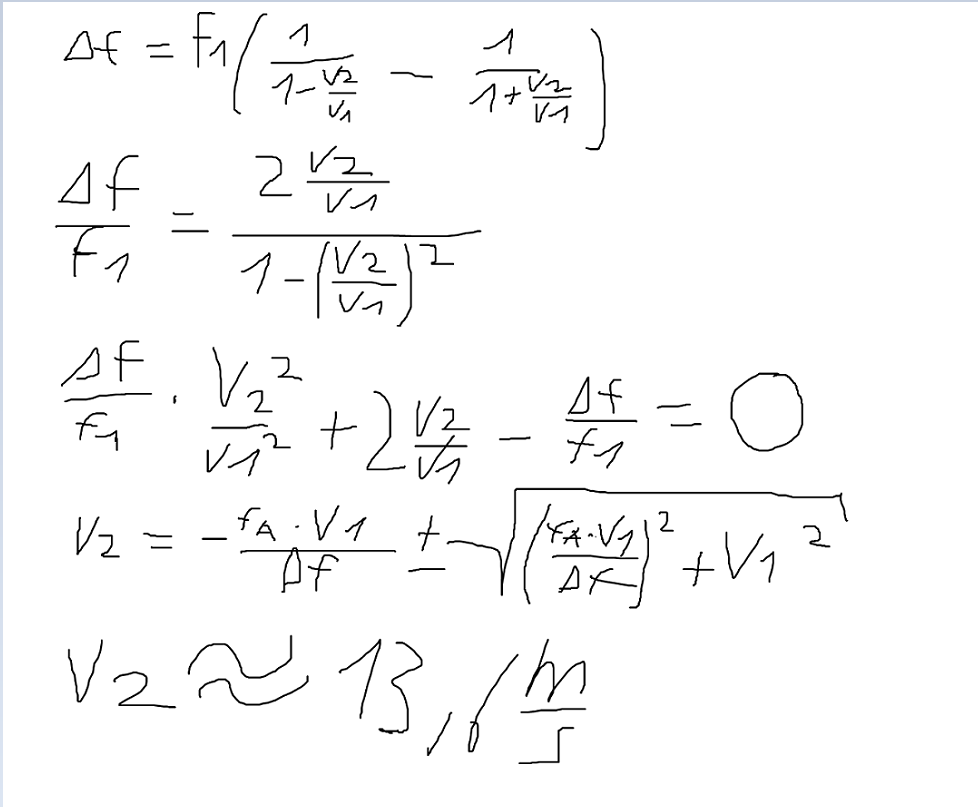
it takes the lady 10secs to cross the road. the car is only advancing 13.6m/s * 10secs = 136m at that time so theres no way hes gonna hit the lady
is there any other way to solve this because my prof did not mark this as correct ....
1. Picture a bank building. In front of the building an old lady is trying to cross the road (10m left to right). Just as the lady gets ready to cross the road, a bank robber is fleeing in his car and driving right at the crossing the lady stands at. Unfortunately the lady is blinddeaf and doesnt have a clue whats happening. The car of the bank robber has a motor thats spinning with a constant never changing 3000 rpm. A convienently placed radar trap (1km away from the old lady) is registering a frequency delta of 4Hz right as the car is passing it (this is also the time the lady starts walking).
How fast is the Car ? Will the robber hit the lady if we assume that he doesnt like old ladies (speed of the lady 1m/s) ?
Assume that sound travels at 340m/s that day.
how fast is the car ?
so the motor is the source in this problem while the radar trap is the observer.
the frequency delta is f, frequency of the car if f1, speed of sound is v1 while the speed of the car is v2
if i only take the positive result into consideration i get this
it takes the lady 10secs to cross the road. the car is only advancing 13.6m/s * 10secs = 136m at that time so theres no way hes gonna hit the lady
is there any other way to solve this because my prof did not mark this as correct ....
i realize this isnt pure math but maybe someone can help me anyways as i dont have a clue what i did wrong with this physics problem
1. Picture a bank building. In front of the building an old lady is trying to cross the road (10m left to right). Just as the lady gets ready to cross the road, a bank robber is fleeing in his car and driving right at the crossing the lady stands at. Unfortunately the lady is blinddeaf and doesnt have a clue whats happening. The car of the bank robber has a motor thats spinning with a constant never changing 3000 rpm. A convienently placed radar trap (1km away from the old lady) is registering a frequency delta of 4Hz right as the car is passing it (this is also the time the lady starts walking).
How fast is the Car ? Will the robber hit the lady if we assume that he doesnt like old ladies (speed of the lady 1m/s) ?
Assume that sound travels at 340m/s that day.
how fast is the car ?
so the motor is the source in this problem while the radar trap is the observer.
the frequency delta is f, frequency of the car if f1, speed of sound is v1 while the speed of the car is v2
if i only take the positive result into consideration i get this
[/IMG]https://i.gyazo.com/244e70a05246a831d2dc650a51e5f8cf.png[/IMG]
it takes the lady 10secs to cross the road. the car is only advancing 13.6m/s * 10secs = 136m at that time so theres no way hes gonna hit the lady
is there any other way to solve this because my prof did not mark this as correct ....
Speed radar uses electromagnetic waves (therefor "radar"), not sound wave. The mostly common one is 10.500-10.550 GHz. So, you go from here.
- Status
- Not open for further replies.