

-
Hey Guest. Check out your NeoGAF Wrapped 2025 results here!
You are using an out of date browser. It may not display this or other websites correctly.
You should upgrade or use an alternative browser.
You should upgrade or use an alternative browser.
Air Force Says Disclosing Bomber's Secret Cost Would Aid Enemies
- Thread starter Piecake
- Start date
- Status
- Not open for further replies.
NYCmetsfan
Banned
The money wouldn't be there if this wasnt for the plane.Personally, I think we could have used 1.5 trillion a lot better than to develop a fighter jet that doesnt seem to be all that much better.
Just think if we spent that on education, infrastructure, free wi-fi, R&D, or whatever
It's not like this money has to be spent. And if we cut it, it goes elsewhere
TangoAlphaLima
Member
I think people just get upset that military contracts really don't get the scrutiniy that say NASA or NIH contracts do.
Meanwhile there is probably a midwest state building tanks that the pentagon doesn't want that we won't use because the local Senator can get jobs and argue its a deterrent for foreign invaders.
Yup. Army doesn't even want them.
http://www.military.com/daily-news/...in-armys-budget-for-more-m1-abrams-tanks.html
Correct me if I am wrong, but didn't we basically buy the contract and lock in the number of aircraft before a design or working plane was actually built? There is a term using that basically describes the process, but I can't help but see how that would create a lot of problems.
There is a “strong correlation between the cost of an air vehicle and its total weight
Given that this cost is the total for the research & procurement program and not the unit cost, we can see it does not:

http://www.defense-aerospace.com/dae/articles/communiques/FighterCostFinalJuly06.pdf
http://www.militaryfactory.com/aircraft/index.asp
That's the F117, Gripen, C130, Eurofighter, C17, Rafale, F/A18, B2, F22, and F35 in the graph. And I doubt it holds up even with unit cost.
Abstrusity
Member
There are already planes that do that, and do it well. Everything the airforce has been talking about for the last 5 years is about global range from domestic bases. Prompt Global Strike or whatever they are calling it this week isn't ready yet, so they want a new manned bomber.
I mean, sure, there will be questions about its range, but it will be a long enough range that anyone in the middle east will be vulnerable from very friendly US allies. That's a given, right? So why the fuck does it matter if somebody can estimate it's range? They already can.
Not really, no. Bombers, due to their weight from armaments, are limited in range. A smaller bomber could make a longer trip than the current stock of bombers, and when you have as much money as ISIS does and as much access to weaponry as ISIS does, you need to be able to stay steps ahead of them. This means the operational range for B-1s and B-52s, which this bomber is to replace, is limited by its fuel(again, mass considerations), and wherever it is. When you consider that your target may also be rather deep, you require stealth, which midair refueling planes aren't readily able to deploy because of their size and shape, but our bombers ARE and would be. They require stealth because complex imaging radar -- the kind that China and Russia develop -- invariably end up being sold to their allies, and are them ending up in the hands of ISIS.
While we're certainly able to fly intercontinental with these things, they would need a constant line of refueling, and it's far safer to ship them inland than fly them inland, and even then, they would need an allied place to take off from.
Stumpokapow
listen to the mad man
People tend to really overestimate the military budget. It's only 3.5% if the GDP, which isn't an obscene proportion by any stretch, and cutting back isn't going to result in some economic miracle.
Why is expressing this as a ratio to total GDP meaningful? Anything is a small percentage of the GDP. Why not compare it to all federal discretionary spending? Or compare it to all federal tax intake?

ThoseDeafMutes
Member
Seems pretty fair to be when we could/can have saved 1.5 trillion over x many years and invested it somewhere else by simply not signing off on it in the beginning.
You wouldn't save 1.5 trillion though, because you still need a backup plan to make up for the F35 not existing. At a bare minimum you would need to restart mass scale F15 / F16 / FA18 production merely to maintain existing capabilities as the airframes suffer wear and tear and start getting more expensive to repair as they get older. The First F15s and F16s rolled off the production lines in the 1970s. If you wanted to modernize to a bit newer, you'll need more expensive aircraft, and you'll need to develop them. Then, you need to maintain and upgrade this aircraft over the same 35+ year period as the F35 program.
How much would it cost? Who knows. More than 0 dollars though.
Abstrusity
Member
B-2 - 1988

2016

Right, it's pretty much just an upgraded B-2 that will replace our aged bombers. Instead of getting new B-2s -- because 30 year old tech -- they're getting new ones made by the same company.
The 1.5 trillion is the estimated cost at the moment. It will get higher. This weapon system acquisition program has been a failure since the contract was signed.
The F-35, along with the far superior F-22, are Cold War relics that will never be used to their full potential. I can go on and on about this...
But back on topic. The B-21 hidden cost is all politics. Give it five years and we'll start getting an idea of the price.
This post is true, hypersonic weapon delivery systems just changed any need for planes.
That's why we're also making the sr72. The F35 is a failure because even when it's ready, it would have been patch worked together and other systems will be superior.
Hypersonic war is going to be best war.
Abstrusity
Member
Didn't know people on GAF were also experts on all aspects of fighter planes and budgetary. Surprised neogaf doesn't have it's own air force at this point.
Well, at a certain point it's just logic and cutting through the smoke and mirrors. 1.5 trillion is a lot of money, so you can write that in a headline and think that they're wasting 1.5 trillion up front. Nobody reads the article. Rabble rabble vote for the opposite party, they wouldn't do this!
But then they keep doing it, and the cycle continues into eternity. We want to change that, and the first rule is "know your enemy."
Prinz Eugn
Member
Seeing the amount of disinformation about the F-35 cost in this thread alone should give you a clue as to the real reason they want to keep the budget on the DL.
Yep.
You wouldn't save 1.5 trillion though, because you still need a backup plan to make up for the F35 not existing. At a bare minimum you would need to restart mass scale F15 / F16 / FA18 production merely to maintain existing capabilities as the airframes suffer wear and tear and start getting more expensive to repair as they get older. The First F15s and F16s rolled off the production lines in the 1970s. If you wanted to modernize to a bit newer, you'll need more expensive aircraft, and you'll need to develop them. Then, you need to maintain and upgrade this aircraft over the same 35+ year period as the F35 program.
How much would it cost? Who knows. More than 0 dollars though.
Yep.
Horribly misleading number.People tend to really overestimate the military budget. It's only 3.5% if the GDP, which isn't an obscene proportion by any stretch, and cutting back isn't going to result in some economic miracle.
https://en.wikipedia.org/wiki/File:U.S._Federal_Spending.png
GDP is irrelevant when talking about a government budget. GDP is a function of private and public action. Percentage of a budget is solely a function of that program's cost, and the total budget.
Looks like it's 16% of the budget.
Abstrusity
Member
Horribly misleading number.
https://en.wikipedia.org/wiki/File:U.S._Federal_Spending.png
GDP is irrelevant when talking about a government budget. GDP is a function of private and public action. Percentage of a budget is solely a function of that program's cost, and the total budget.
Looks like it's 16% of the budget.
Even better is discretionary spending, which cuts out mandatory spending and programs which fund themselves.
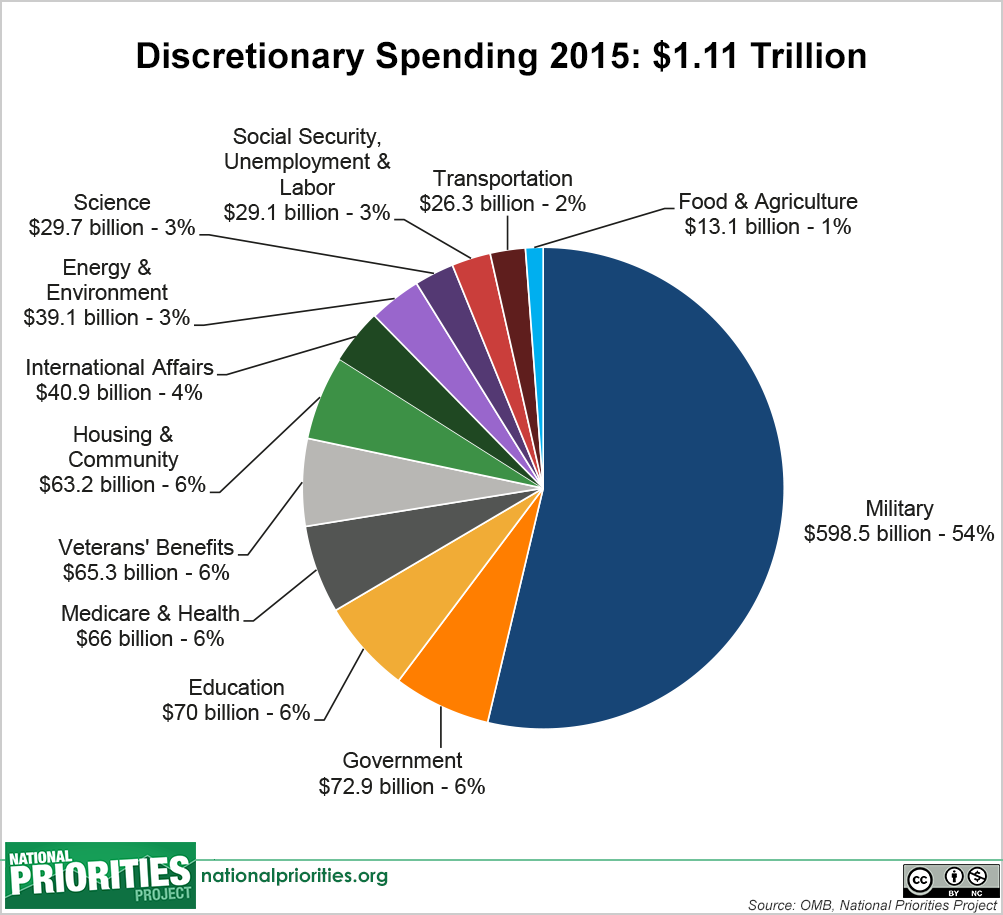
1.1 trillion in 2015, with 598.5 billion earmarked for the DoD.
People tend to really overestimate the military budget. It's only 3.5% if the GDP, which isn't an obscene proportion by any stretch, and cutting back isn't going to result in some economic miracle.
It is a waste when you only use a fraction of the hardware you spend hundreds of billions developing. F22 Raptor program cost billions of dollars, the fighter jets barely saw any flight time and were grounded for years with problems and the successor F35 program already started and nearing completion.
There was a point in the 80's when the Soviet Union was militarily the strongest but by the end of the decade they were broken without a single shot fired. The US cannot maintain a 3.5-4% military GDP when it is pushing record deficits per year.
ThreePiMatt
Member
I apologize for aiding the enemy here, but I can make some pretty good determinations of its range and payload:
Range: Anywhere
Payload: Enough
Range: Anywhere
Payload: Enough
Right, it's pretty much just an upgraded B-2 that will replace our aged bombers. Instead of getting new B-2s -- because 30 year old tech -- they're getting new ones made by the same company.
Yes, that's true. The USAF needs the B-21.
It would be great if the U.S. Navy could have a modern equivalent of this:

The canceled McDonnell Douglas/General Dynamics A-12 Avenger II, that was meant to replace the Grumman A-6 Intruder.
Abstrusity
Member
Yes, that's true. The USAF needs the B-21.
It would be great if the U.S. Navy could have a modern equivalent of this:
The canceled McDonnell Douglas/General Dynamics A-12 Avenger II, that was meant to replace the Grumman A-6 Intruder.
Well, given their size, shape, they're not likely to launch from a catapult system, they need more room for takeoff.
The Growler/Super Hornet are what they'll be stuck with til the F-35, ignoring other vtol and smaller stuff I'd hesitate to call a fighter.
Well, given their size, shape, they're not likely to launch from a catapult system, they need more room for takeoff.
I didn't mean a B-21 for the U.S. Navy, I meant something smaller, something similar in size and shape to the A-12, which was being designed as a carrier-based attack aircraft.
Wasn't there a report some months back about how there were millions wasted on completely failed anti-nuke technology? Incredibly huge amounts wasted on projects people knew weren't gonna work or were unfeasible but they tried anyway? That's the kind of shit that makes people or me mad. Hell I remember my father (who was in the Air Force) used to tell me that DARPA is just a giant money pit where we just chuck money in and hope some new project we can use eventually finds its way out.People tend to really overestimate the military budget. It's only 3.5% if the GDP, which isn't an obscene proportion by any stretch, and cutting back isn't going to result in some economic miracle.
I don't have my Pilot's License yet, that's all.Didn't know people on GAF were also experts on all aspects of fighter planes and budgetary. Surprised neogaf doesn't have it's own air force at this point.
Prinz Eugn
Member
Wasn't there a report some months back about how there were millions wasted on completely failed anti-nuke technology? Incredibly huge amounts wasted on projects people knew weren't gonna work or were unfeasible but they tried anyway? That's the kind of shit that makes people or me mad. Hell I remember my father (who was in the Air Force) used to tell me that DARPA is just a giant money pit where we just chuck money in and hope some new project we can use eventually finds its way out.
ARPANET was a mistake, it's nothing but trash.
ARPANET is literally ONE example out of how many? And how long are we gonna coast on that? We've had quite a few billion dollar projects now, quite a few of them not only aren't ARPANET in terms of utility but have been completely scrapped.ARPANET was a mistake, it's nothing but trash.
ARPANET was a mistake, it's nothing but trash.
I think we all know, and being on GAF proves, that's true.
Prinz Eugn
Member
ARPANET is literally ONE example out of how many? And how long are we gonna coast on that? We've had quite a few billion dollar projects now, quite a few of them not only aren't ARPANET in terms of utility but have been completely scrapped.
Like, a lot. Wikipedia has a short list.
The point is to fund stuff that may or may not work ("things you can hold in your hand that get a signal from satellites in space to tell you where you are"), but will never work if not given a chance. You might as well complain about any basic research.
People tend to really overestimate the military budget. It's only 3.5% if the GDP, which isn't an obscene proportion by any stretch, and cutting back isn't going to result in some economic miracle.
This is a pretty awful statistic to use.
Lifted from https://www.nationalpriorities.org/budget-basics/federal-budget-101/spending/
This is what the government spends every year, around 3.5 trillion:
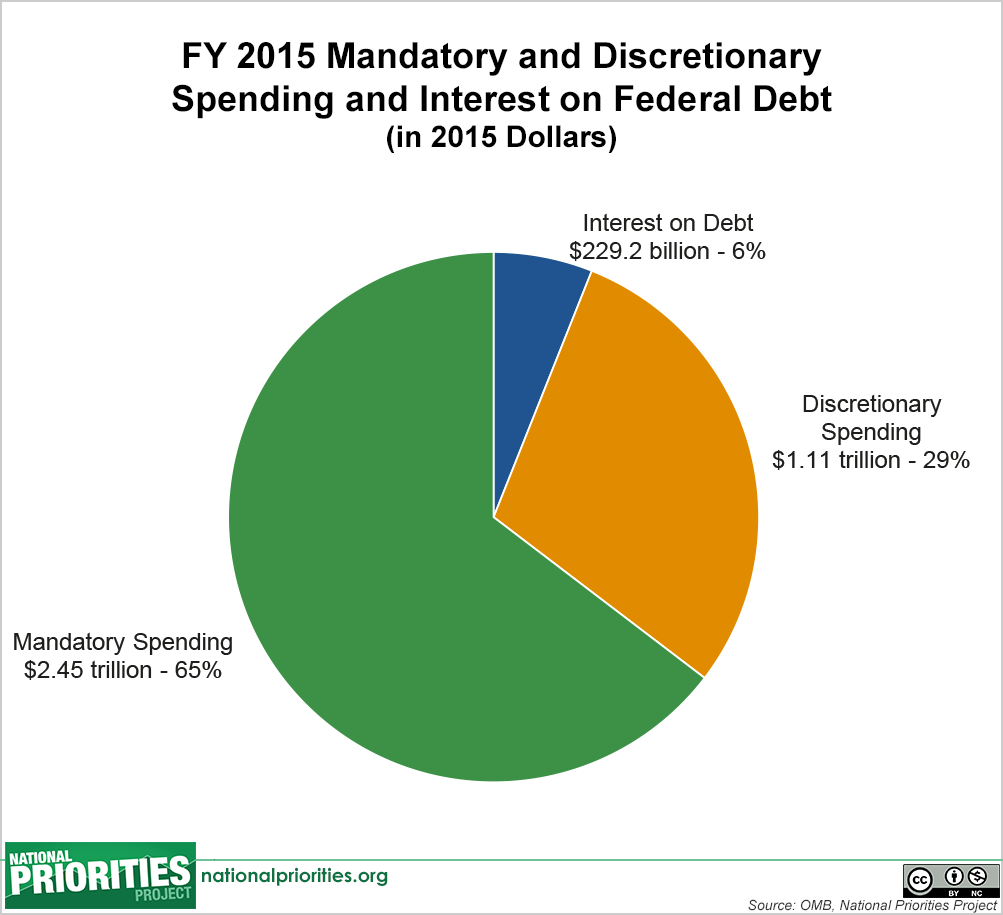
Every year, Congress decides through the appropriations process the discretionary spending budget - the 1.11 trillion from the previous figure. And over half of that goes to military expenditures.
Bonus image: US military spending compared to other nations', lifted from https://en.wikipedia.org/wiki/List_of_countries_by_military_expenditures

It does. I'm in chargeDidn't know people on GAF were also experts on all aspects of fighter planes and budgetary. Surprised neogaf doesn't have it's own air force at this point.
You wouldn't save 1.5 trillion though, because you still need a backup plan to make up for the F35 not existing. At a bare minimum you would need to restart mass scale F15 / F16 / FA18 production merely to maintain existing capabilities as the airframes suffer wear and tear and start getting more expensive to repair as they get older. The First F15s and F16s rolled off the production lines in the 1970s. If you wanted to modernize to a bit newer, you'll need more expensive aircraft, and you'll need to develop them. Then, you need to maintain and upgrade this aircraft over the same 35+ year period as the F35 program.
How much would it cost? Who knows. More than 0 dollars though.
Isnt that investing it someplace else?
The F-35 is the epitome of a boondoggle military contract with enormous cost-overruns, failures, and a time-frame that was extended so long that it might not even be state of the art tech or viable one we finally get it.
When people bring up the 1.5 trillion, or at least myself, they aren't talking about exact figures, but terrible military contracts and enormous waste and cost over-runs that results from military contractors. That is the money that can be spent elsewhere.
And I personally think that spending a lot of money to built the new super high-tech fighter jet is worth it when we have such a commanding lead in military tech. Just go in small steps to save money, time, and reduce fuck-ups. But nope, we need fancy new toys apparently.
Abstrusity
Member
ARPANET is literally ONE example out of how many? And how long are we gonna coast on that? We've had quite a few billion dollar projects now, quite a few of them not only aren't ARPANET in terms of utility but have been completely scrapped.
Well, to be fair, a lot of things DARPA develops make their way down to industry. Thought-controlled prosthetics? Much of that funding, and plenty of the successes, come from DARPA. Remember that laser missile defense system? DARPA. Exoskeletal suits designed for use in the field for carrying progressively heavier loads? DARPA, and that could make construction a safer affair, more effective physical therapy a reality, grant movement to those bound by powered or unpowered chairs.
The hitch with DARPA is that just about everything they do can change the reality of warfare or life in general. It was designed that way so that whatever we could think of could be doable at some point.
You throw a few billion at the problem with people that only have to manage that particular thing, give them a task long thought impossible, and tell them that they need to make it reality, or do the best they can do. That becomes the stable test bed for industry to fine tune and market it. Next thing you know, we have the internet, or a means of creating less fragile, better heat resistant couplings cheaply, or a way for an amputee to hug his or her kids with both arms when they've only had the one for the longest time.
That's what it means to make the impossible possible, and that's why DARPA exists.
Basic research still has FEASIBILITY. When you have $2 Billion Dollar Projects that even experts are saying these projects are attempting to "defy the limits of physics and economic logic."Like, a lot. Wikipedia has a short list.
The point is to fund stuff that may or may not work ("things you can hold in your hand that get a signal from satellites in space to tell you where you are"), but will never work if not given a chance. You might as well complain about any basic research.
I'm not sure what Wikipedia list you have but I can list off some easy projects that went no where right now with budgets.
- SBX-1 - $2 billion
- The Airborne Laser - $5.3 Billion
- Kinetic Energy Interceptor - $1.7 Billion
- MKV - around $700 million
That's quite a few billion to be tossing around in some kind of technological lottery, which is exactly what it is when you're told upfront these projects are pretty much a fantasy.
I can compare it basically to this. We roughly know FTL travel is possible, hell we might even have the math mostly down, but we sure as hell don't have the means or the budget (or the Congressional support) to make that shit happen, so for now we don't even bother.
ThoseDeafMutes
Member
When people bring up the 1.5 trillion, or at least myself, they aren't talking about exact figures, but terrible military contracts and enormous waste and cost over-runs that results from military contractors. That is the money that can be spent elsewhere.
People bring it up because it's an imposing number. It's almost never brought up with the correct context, many do not even know what the number truly represents. How can we spend ONE POINT FIVE TRILLION? But... how much would other programs cost? If you're not providing alternative figures or even historical comparisons in an apples-to-apples way, what's the point of quoiting it except as a rhetorical trick? It's reminiscent of people quoting the size of the national debt to score points in a debate.
And I personally think that spending a lot of money to built the new super high-tech fighter jet is worth it when we have such a commanding lead in military tech. Just go in small steps to save money, time, and reduce fuck-ups. But nope, we need fancy new toys apparently.
You're entitled to your opinion of course, although there is widespread political support for staying ahead of the curve on military matters. Russia+India have their partner program and China has its own indigenous program for stealth fighters so the technology is proliferating to some extent. The idea of making your entire fighter-bomber force stealth capable instead of just a small portion of it is quite a powerful one and certainly has major military implications.
CyclopsRock
Member
Seems pretty fair to be when we could/can have saved 1.5 trillion over x many years and invested it somewhere else by simply not signing off on it in the beginning.
The F35 is replacing three other aircraft. If they had "simply not signed off on it" then the US would either have a big hole in its capability (if not right now then in the future - the planes they are replacing are decades old and the F35 is going to be around for decades into the future) or they'd need three new contacts for three new planes.
People bring it up because it's an imposing number. It's almost never brought up with the correct context, many do not even know what the number truly represents. How can we spend ONE POINT FIVE TRILLION? But... how much would other programs cost? If you're not providing alternative figures or even historical comparisons in an apples-to-apples way, what's the point of quoiting it except as a rhetorical trick? It's reminiscent of people quoting the size of the national debt to score points in a debate.
It is a rhetorical trick, but it is a rhetorical trick that means something - bloated military contracts with huge over-runs that the taxpayer has to pay for. That is mighty different than the national debt which is just a big number
You're entitled to your opinion of course, although there is widespread political support for staying ahead of the curve on military matters. Russia+India have their partner program and China has its own indigenous program for stealth fighters so the technology is proliferating to some extent. The idea of making your entire fighter-bomber force stealth capable instead of just a small portion of it is quite a powerful one and certainly has major military implications.
I never said that we shouldn't. We don't need to spend far more than any other on the military to do that though. And I certainly think we deserve to know how much this is costing us, and really truly want to drastically reform how military contracts are given out.
The F35 is replacing three other aircraft. If they had "simply not signed off on it" then the US would either have a big hole in its capability (if not right now then in the future - the planes they are replacing are decades old and the F35 is going to be around for decades into the future) or they'd need three new contacts for three new planes.
http://www.theatlantic.com/magazine/archive/2015/01/the-tragedy-of-the-american-military/383516/
3 new contracts for 3 different planes seems like it would have made far more economic and militaristic sense based on that article.
CyclopsRock
Member
http://www.theatlantic.com/magazine/archive/2015/01/the-tragedy-of-the-american-military/383516/
3 new contracts for 3 different planes seems like it would have made far more economic and militaristic sense based on that article.
Well, I'd take issue with a number of things in that article; Firstly, a lot of the criticism seems to hinge on the A-10, which it's no longer replacing - if it were, it would have been four new aircraft they'd need, not three. Secondly, there are three variants that share 80% of the parts for the 3 US Military branches that are using it (Air Force, Navy and Marines), which not only enables them to specialise somewhat (ie it isn't the same plane that needs to be ultra-manoeuvrable for the USAF and hardy for the Navy, though they are similar in many ways - and at any rate, the F22 is the air-superiority fighter for the USAF, not the F35). Thirdly, whilst the delays might be causing a political issue with the US's "partner" nations, they're still buying them - the UK, which was the second largest funder behind the US - are fitting out all of our new Supercarriers with them. Finally, there are huge advantages in terms of infrastructure - which is the primary area in which the US dominates military power - to having a single airframe with mostly the same parts. It makes it easier and cheaper to maintain compared to three different planes of the same total number.
Additionally, there's the fact that this project is not unique - is the reason modern military projects cost so much and go over-budget due to the sneaky contract work by the big aerospace companies? Pork barrel politics in the House? That we're coming to the limits of material science and physics? Some combination of the above? Well, none of those things would cease to be a problem in three separate planes rather than one multi-role one.
However none of this was actually my point. Even if we take that The Atlantic article as totally true (and I don't think it's nonsense or anything, I think it's just being a bit disparaging) my point was that the $1.5tr figure doesn't exist in a vacuum. The alternative to spending it is either having a hole in US military capability as those old planes that it's replacing (Harrier, F16 and the old F18s) or spending at least some of that money elsewhere. So ThoseDeafMutes point stands, really - $1.5tr is a figure that, without context, is largely meaningless. How much would the alternatives have cost, and would they have succeeded where the F35 has failed? ("Failed", really, since it's still a great airframe).
Prinz Eugn
Member
Basic research still has FEASIBILITY. When you have $2 Billion Dollar Projects that even experts are saying these projects are attempting to "defy the limits of physics and economic logic."
I'm not sure what Wikipedia list you have but I can list off some easy projects that went no where right now with budgets.
- SBX-1 - $2 billion
- The Airborne Laser - $5.3 Billion
- Kinetic Energy Interceptor - $1.7 Billion
- MKV - around $700 million
That's quite a few billion to be tossing around in some kind of technological lottery, which is exactly what it is when you're told upfront these projects are pretty much a fantasy.
I can compare it basically to this. We roughly know FTL travel is possible, hell we might even have the math mostly down, but we sure as hell don't have the means or the budget (or the Congressional support) to make that shit happen, so for now we don't even bother.
Pro tip: DARPA and the Missile Defense Agency are in fact not the same thing. The MDA is further downstream in trying to apply things (to a particularly hard problem), is in a weird place in the DoD, and has a lot of political baggage.
The broader point is that often research is undertaken to figure out whether or not something is feasible in the first place; it wouldn't be research if you had a guaranteed outcome. If you only invest in well-proven technology, you will eventually get left behind by those who took risks and found the next revolution.
B-2 - 1988
2016
A diamond is the best stealth shape so i guess that limits what you can do with the design.
curls
Wake up Sheeple, your boring insistence that Obama is not a lizardman from Atlantis is wearing on my patience ð¤
B-2 - 1988
2016
So its lighter, thinner and more expensive than the older one. Does it come in rose gold?
People tend to really overestimate the military budget. It's only 3.5% if the GDP, which isn't an obscene proportion by any stretch, and cutting back isn't going to result in some economic miracle.

https://en.m.wikipedia.org/wiki/List_of_countries_by_military_expenditures
The Ultimate point of what I was saying is not DARPA but if we wanna talk DARPA failures we can discuss Telepathic Spies or the Bomb Detector that was known to be a failure but still had millions thrown at it.Pro tip: DARPA and the Missile Defense Agency are in fact not the same thing. The MDA is further downstream in trying to apply things (to a particularly hard problem), is in a weird place in the DoD, and has a lot of political baggage.
The broader point is that often research is undertaken to figure out whether or not something is feasible in the first place; it wouldn't be research if you had a guaranteed outcome. If you only invest in well-proven technology, you will eventually get left behind by those who took risks and found the next revolution.
DARPA is only one part of the point I'm saying that is we're throwing money at research that could be better spent elsewhere and that is not something to be lauded or seen as "necessary because that's the nature of research". The fact of the matter is we can fantasize all day long about impossible fun projects to throw money but when up until recent non-Military minded research is barely able to get anything then these things are only going to hold us back in the long-term.
Prinz Eugn
Member
The Ultimate point of what I was saying is not DARPA but if we wanna talk DARPA failures we can discuss Telepathic Spies or the Bomb Detector that was known to be a failure but still had millions thrown at it.
DARPA is only one part of the point I'm saying that is we're throwing money at research that could be better spent elsewhere and that is not something to be lauded or seen as "necessary because that's the nature of research". The fact of the matter is we can fantasize all day long about impossible fun projects to throw money but when up until recent non-Military minded research is barely able to get anything then these things are only going to hold us back in the long-term.
Nitpicking failures actually misses the point. Obviously DARPA and any research organization needs to be reasonable in dispersing funding (and responsive in cancelling projects that are very likely going nowhere), but there are always going to be things that were dumb in retrospect, especially when you are trying to do stuff that by definition no one has tried before. But that's the thing about retrospect: it only works after something is done.
Knowing which concepts are "impossible" and what can "Better spent elsewhere" are a nice ideas, but really really hard to implement in reality. Personally, I think it would be great to put more money into NSF (which now gets twice as much money as DARPA, fun fact), but military research has also had countless downstream benefits to civilian technology.

Goro Majima
Kitty Genovese Member
A dollar spent in China goes way farther than a dollar spent in the US due to labor costs if nothing else.
The US also has a nasty habit of military contracts being politicized. The F-22 famously had parts made in all 50 states. Many major military projects are used as a "win" for jobs in congressional districts vs manufacturing parts where it would make the most sense and for the lowest logistical cost.
Bleeding edge R&D is also always going to be super expensive. We'll simply never and have never had a military as large as Russia or China so maintaining the technological edge is pretty important. Unfortunately, this is yet another area where China is catching up but, again, an engineer or a software developer in China won't cost as much as one in the US...which just forces defense contractors to spend even more money and increase the bids on their contracts.
However there have been cases where generals have literally said that they don't want certain portions of the budget allocated to them (basically you're giving us too much money in this area) so there's probably room for cuts in the defense budget. It's a quagmire for sure.
- Status
- Not open for further replies.