• Hey Guest. Check out your NeoGAF Wrapped 2025 results here!

Anandtech releases preliminary iPhone 6 Perf/Battery tests

Status
Not open for further replies.
What is he trying to rebut? Are you implying Anandtech had ulterior motives for leaving the Sony phones off the benchmarks? I would think that including dozens of phones, some of which aren't marketed or sold in high numbers, wouldn't be feasible for them to do. Obviously it would be preferable and make for better benchmarks, but... I'm not seeing your reasoning for attacking anyone as being iPhone fantards.

I'm not implying anything, I said it's weird that they did not include a released handset in the benchmarks. It's possible they haven't reviewed it yet, but typically there'd be some information out there by now.

People are talking specs, he's talking about sales making benchmarks irrelevant for what?

It's not as if the battery life is going to convince someone leaning iPhone to switch over to an obscure Z3 or Z3c.
 
I'm not implying anything, I said it's weird that they did not include a released handset in the benchmarks. It's possible they haven't reviewed it yet, but typically there'd be some information out there by now.

People are talking specs, he's talking about sales making benchmarks irrelevant for what?

It's not as if the battery life is going to convince someone leaning iPhone to switch over to an obscure Z3 or Z3c.

It's not weird at all; it's precisely for the reason you cited: it hasn't been reviewed by them yet, which itself is not weird considering the Z3 hasn't released in most markets yet, nor has it been reviewed by most major outlets (and Anandtech are usually late to the game, as evidenced by the fact the iPhone 6/6+ still hasn't been reviewed).
 
it's a strange omission only because so many in the tech sector are talking about the amazing battery life in the Z3 and Z3C and neither being on the AnandTech chart just stand out. i doubt there was any malice in the omission.
 
It drives home the point that Apple being in control of both hardware and software is what allows it to stay in the game. I get the feeling that Android is the weak link for all those other phones. No point having all that power under the hood if the OS itself is wasteful.

The geekbench tests also show a similar pattern to the intel vs amd divide. More cores in the competition but slower singled threaded performance and everything suffers because of this design.

64-bit ARM chips from other vendors are beginning to appear, which should narrow that gap.

In terms of battery life, Ars Technica found a 36% increase in battery life on a Nexus 5 from Android L, although I'm guessing any effect won't be anywhere near that pronounced in day-to-day use.
 
I don't understand these tests. How does a GS4 with all the extra Samsung garbage get better battery life than the Google Play edition without it?
 
Pretty common for Apple to have hardware edge when they release. Good to see they keep pushing Android hardware to catch up while conversely Android has been towing them with software features
 
No battery benchmarks for Windows Phone handsets.

How come none of these sites ever do drop tests?

Annoying factor for smartphones.

My Lumia 1520, last me almost 2 days and blows any Android phones in terms of battery and its not even on the list. Joke comparision

Anandtech's battery suite require that the screen is on without anyone using the phone (it loads a bunch of webpages, but with a waiting time inbetween where you'd "read" the page that also gives slower phones time to load the page and not punish a phone for being too fast) and Windows Phone didn't allow the screen timeout to be disabled. I'm not sure if they've changed that, but it used to be the main issue on top of the other issues. They spend a lot of time on each phone and there is really only one person (Joshua) reviewing high end phones. That's nothing new for them. Apart from Anand helping in some Brian used to do almost every phone review.

Drop tests are about as scientific as "it feels fast" :P
Dat Z3C battery. This baby will be mine :)

I think the 720p screen is the main reason. 1080p is twice the pixels to render so the S800 is just idling and barely sipping power. That probably helps the iPhone 6 a lot with its 750p screen while the 6+ has to render at a res higher than 1080p internally and downsample (for compatibility).
 
Phone Arena:

FsdRC35.jpg


http://www.phonearena.com/news/All-...3-Compact-score-a-record-battery-life_id60922

This seems more realistic but still wouldn't replicate real world use properly. The Anandtech results in the OP do not look accurate based on my experience with the iPhone 5 and 5S, but then again I've never recorded battery life doing only one single task. Real world use is what counts.
 
Specs don't lie. It's not even close:http://www.phonearena.com/phones/benchmarks

It's good, no doubt. But not even close to the best.

huh? in general or for battery? performance-wise it looks to have the crown until you move on to non-traditional devices. battery yeah, the Plus sits right in the middle of the pack.. nothing outstanding but an ok place to be considering the performance you get for "average" battery life for a 5" device.
 
the problem with sony phone is the front camera, it doesnt let in enough light + i really like the touch id thing + the reachability mode. i have z1c right now and will probably get iphone 6
 
huh? in general or for battery? performance-wise it looks to have the crown until you move on to non-traditional devices. battery yeah, the Plus sits right in the middle of the pack.. nothing outstanding but an ok place to be considering the performance you get for "average" battery life for a 5" device.

Battery. I think something is off with anandtech's tests.
 
huh? in general or for battery? performance-wise it looks to have the crown until you move on to non-traditional devices. battery yeah, the Plus sits right in the middle of the pack.. nothing outstanding but an ok place to be considering the performance you get for "average" battery life for a 5" device.

i use a lot of intensive apps and my 6 Plus does 9 hours. iOS uses its OS more efficiently than others. specs dont matter if the software is built around hardware vs hardware built around software. Software built around hardware yields better results in less specs
 
i use a lot of intensive apps and my 6 Plus does 9 hours. iOS uses its OS more efficiently than others. specs dont matter if the software is built around hardware vs hardware built around software. Software built around hardware yields better results in less specs

In real usage should be higher though. That graph was run on a custom web script straight up till the battery died.
 
Is there an iOS app that gives you battery statistics such as the total amount your screen is on between charges? Saying you use your iPhone for 9 hours doesn't mean much without detailed statistics. That could really mean 1-2 hours of streaming music with the screen off + 3 hours of internet browsing + 1 hour texting + 2 hours of video watching for example, etc. In this case that could equate to 6 hours screen time in a single day with medium - heavy usage in day which would be considered very impressive if the majority was down while on LTE. Then there's of course the idle time of the Phone when it isn't working and it's resting.

This just goes to show how varied people's usage can be and you have to measure things relatively. You have two web sites now that have tested and place the Xperia Z3 and Xperia Z3 Compact significantly on top of all other flagship phones. Therefore, I'd say relative to the competition it's very likely that a person would get better battery performance.
 
In real usage should be higher though. That graph was run on a custom web script straight up till the battery died.

So real usage should be higher than "a custom web-script, designed to replicate the power consumption of typical real-life usage"? I think something is off with phonearena's tests.
 
Anandtech's battery life results are better than PhoneArena because they do the same test across all devices and they have outlined their methodology before.

What is PhoneArena's testing method? I know some websites take their phones, move the brightness slider to the middle and test the phones like that but that's not accurate because the maximum brightness on different phones is different. Anandtech does their tests with 200 nits brightness across all phones.

Also to those people bitching about the Z3 and Z3C, it's not in the graphs because they haven't reviewed it yet. I also noticed some guy saying that the "information is widely available" but that makes no difference because Anandtech has to test the battery before it can be included in their benchmarks.
 
So real usage should be higher than "a custom web-script, designed to replicate the power consumption of typical real-life usage"? I think something is off with phonearena's tests.

It also says "without putting the phone down"

It's basically screen on time.

That being said, I think it is meant to be comparative rather than absolute.
 
It also says "without putting the phone down"

It's basically screen on time.

That being said, I think it is meant to be comparative rather than absolute.

Where does it say that? Anandtech's methodology specifically calls for the screen to be on at 200 nits throughout the test.
 
So real usage should be higher than "a custom web-script, designed to replicate the power consumption of typical real-life usage"? I think something is off with phonearena's tests.

Ha ha. I suppose you are right
To be fair, It's an attempt to mimic real life web usage. E.g. going from page to page, scrolling I am guessing. To be honest I don't know. But the time given is how long the battery lasted in one go. In real life we would of course put the phone down and have long idle periods.
 
Battery. I think something is off with anandtech's tests.

battery tests are like judging gymnastics... all you can really determine is how the phone lines up during that test with the other phones during that test. It's near pointless to try to glean any real world numbers from battery tests due to the near infinite variables involved with phones (and iOS settings over the years) setup.

That being said, I think it is meant to be comparative rather than absolute.

Basically yes... You can see roughly how one phone will perform in battery life compared to another.. but trying to grab real world numbers from this is like tilting at windmills.
 
Where does it say that? Anandtech's methodology specifically calls for the screen to be on at 200 nits throughout the test.

How do we test? We run a custom script that replicates real-life non-stop usage of a smartphone, so the result is indicative of how long the phone would last under average use when you use the phone without putting it down. In reality, of course, our phones stay idle for long periods of time...

http://www.phonearena.com/news/Sony...us-to-the-era-of-two-day-battery-life_id60955
 
My battery life isn't as poor as Phone Arena's but it's definitely not as good as Anand's findings either. I really wonder what is up with the wide range of experiences. Wish there would be some settings posted so I can get a baseline. I've disabled a lot of stuff and I still can't get anywhere close to the claimed 11 hours browsing time that Apple advertises

Well a lot of these are Wi-Fi based tests at 50% or 200 nit level of brightness...

Also during these tests they don't have multiple apps running at the same time. If you're using an LTE radio most of the day or have a poor data connection, this can drastically effect your phone life..

I find GSMArena's to be most helpful. I actually found that my HTC One M7 battery life ended up coming pretty close on average to the score it got on average with their test (while having good LTE reception for most of the day and being on Wi-Fi at home).
 
Anandtech's battery life results are better than PhoneArena because they do the same test across all devices and they have outlined their methodology before.

What is PhoneArena's testing method? I know some websites take their phones, move the brightness slider to the middle and test the phones like that but that's not accurate because the maximum brightness on different phones is different. Anandtech does their tests with 200 nits brightness across all phones.

Also to those people bitching about the Z3 and Z3C, it's not in the graphs because they haven't reviewed it yet. I also noticed some guy saying that the "information is widely available" but that makes no difference because Anandtech has to test the battery before it can be included in their benchmarks.

Arstechnica set the screens to 200 nits and got half the time Anandtech did on the 6. I think there is something funny with the Anandtech test since it's so different from everyone else. Ars also talks about throttling in their review.

http://arstechnica.com/apple/2014/09/iphone-6-and-6-plus-in-deep-with-apples-thinnest-phones/4/
 
My battery life isn't as poor as Phone Arena's but it's definitely not as good as Anand's findings either. I really wonder what is up with the wide range of experiences. Wish there would be some settings posted so I can get a baseline. I've disabled a lot of stuff and I still can't get anywhere close to the claimed 11 hours browsing time that Apple advertises

We could devise a gaf test. Charge your battery to 100%. Browse GAF consistently for set amount of time at set brightness. Ten minutes to an hour. Reveal data ( how much charge left after ten minutes and up to an hour)

You can only compare to other users of the same phone though. As I don't know whether apple's 50% brightness is the same as Samsung's. Or iPhone 6's is the same as iPhone 6 plus.
And even then you can not control things such as utilising the same wireless router or distance to router. But you will get a general idea given enough data.
 
the whole throttling thing is unrealistic :P

"Huh? They throttle?"

Well to be fair Schiller shouldn't have said they "don't" throttle. But to also be fair, I'm assuming Schiller wasn't implying that they wouldn't throttle while running Geekbench for 20 minutes straight :P

A big difference that we've already seen is that Snapdragon absolutely will throttle and/or shutdown cores in common usage scenarios. I think had Schiller just added "under most use cases" or something similar, his statement would have been entirely accurate. As it stands, his statement was reasonably accurate, just not absolute.
 
They even specify using 50% brightness which isn't very fair when AMOLEDs tend to be a lot less bright.
Also very vague, but this part:
How do we test? We run a custom script that replicates real-life non-stop usage of a smartphone, so the result is indicative of how long the phone would last under average use when you use the phone without putting it down. In reality, of course, our phones stay idle for long periods of time and this is why the Z3 Compact will be able to run for two days off the charger under average use.
Makes it sound like the phone is never sleeping. Joshua replied this when someone posted phonearena's results:
As far as I can tell the results of our testing are accurate. The web browsing test has been carefully designed to ensure that all SoCs have some level of sleep in order to avoid penalizing SoCs for being faster.
Of course, when a phone is faster you'd do more just like you'd accelerate harder in a faster car (and get worse fuel economy), but these tests should be apples to apples and compare the same workload.
Arstechnica set the screens to 200 nits and got half the time Anandtech did on the 6. I think there is something funny with the Anandtech test since it's so different from everyone else. Ars also talks about throttling in their review.

http://arstechnica.com/apple/2014/09/iphone-6-and-6-plus-in-deep-with-apples-thinnest-phones/4/
Ars doesn't specify it, but this part makes it sound like their battery test doesn't include waiting time where the SoC can sleep:
Chalk it up to something our Wi-Fi test can't really measure—Apple is pretty good at tamping down idle power usage, at least when your signal is good.

It is good that all the details aren't available for the battery tests because OEMs would love to try to optimize for them, but if the SoC is constantly working that will really punish faster chips that have to do more work.
 
They have charts at the link.. It shows the drop off which is real.. however it should be noted that the 6 and 6 Plus ran Geekbench (which is unarguably more intensive than probably any normal app or game out there) for 5 minutes before throttling. It isn't unrealistic at all to expect the chip to not throttle during normal usage (including gaming)
 
Alternatively gaffers could just keep an eye on their usage for a week, and note data at the end of the day.. That should literally give them real life usage per day over a week. :p
 
All iphones batteries start out strong, then quickly degrade in the following months. My 5s had amazing battery life too, now I can barely keep it on. Maybe I'm just charging them wrong, but the same thing happened to my 5, 4s, 4 etc.

Here's hoping the 6 Plus's battery is easily replaceable.

You're charging it wrong
 
I usually charge my phone to full and then take it off and let it sip juice. I tend to recharge if it's below 60% at the end of the day otherwise I just won't charge it as it will easily last the 2nd day. When I had my HTC One M7, battery was not as good as when I first got it, but it was still solid with no drastic decrease.
 
I usually charge my phone to full and then take it off and let it sip juice. I tend to recharge if it's below 60% at the end of the day otherwise I just won't charge it as it will easily last the 2nd day. When I had my HTC One M7, battery was not as good as when I first got it, but it was still solid with no drastic decrease.

You shouldn't discharge it regularly. Keep it topped up.
 
They have charts at the link.. It shows the drop off which is real.. however it should be noted that the 6 and 6 Plus ran Geekbench (which is unarguably more intensive than probably any normal app or game out there) for 5 minutes before throttling. It isn't unrealistic at all to expect the chip to not throttle during normal usage (including gaming)

Thanks! I missed the pages at the bottom :P

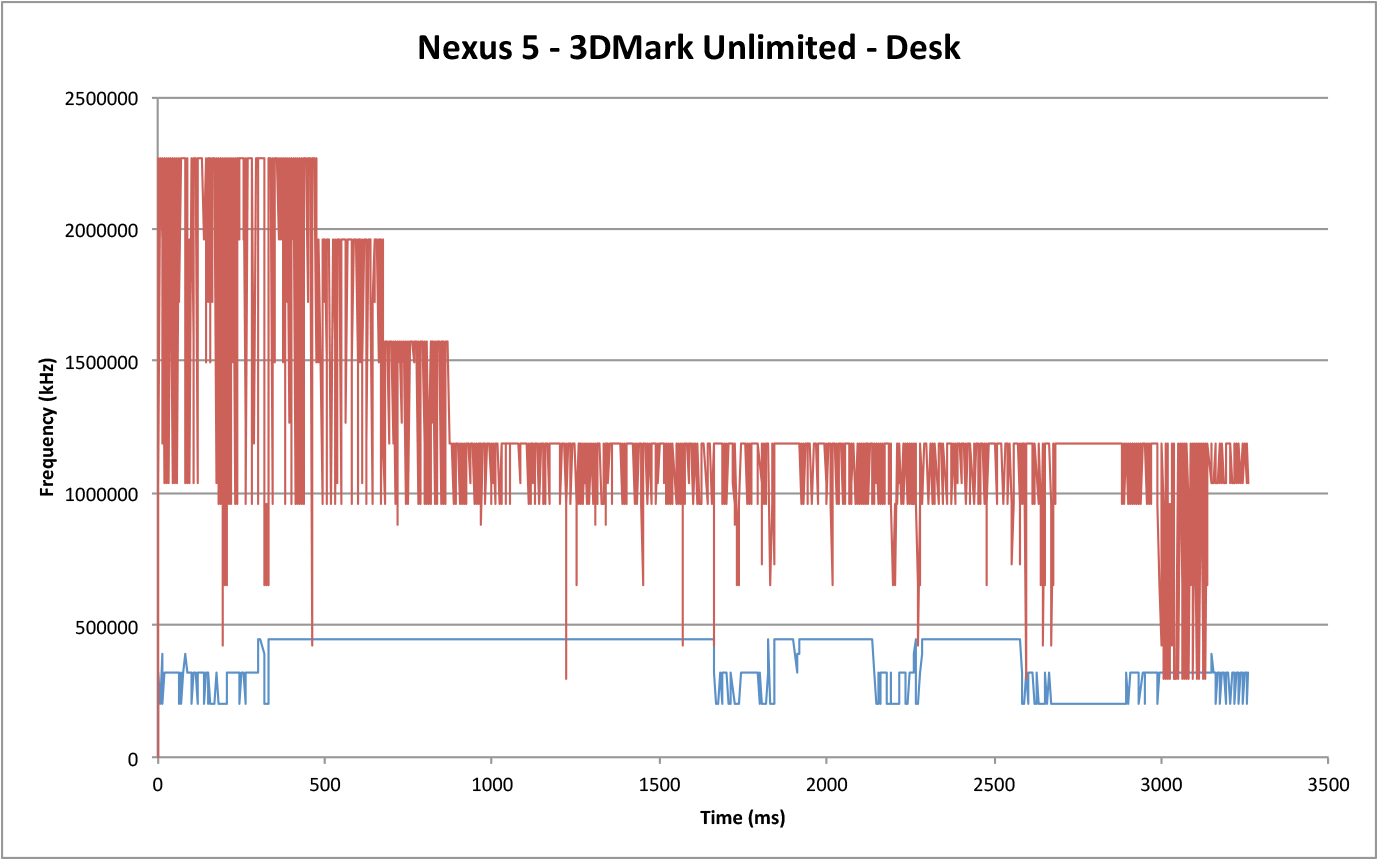
The iPhone still does much better than Snapdragon devices as you pointed out:

Especially when you notice the Nexus 5 timescale is in ms and drops to 1.2Ghz in less than one second. It's slightly missleading because CPU0 (shown here) tends to be first to throttle, but it really proves that the S800 is far from 2.3 or 2.5ghz in real world usage. Brian's words are still true:
The reality is that vendors in the mobile device industry tend to advertise what ends up being a boost or turbo clock rather than the nominal or steady state clock, something that needs to and hopefully will change once we’re out of the current mobile MHz race.

It's totally different from the PC space where Intel chips are rarely seen below their boost clock under load. Base speed needs a task more intensive than Prime95 and I've never actually seen it used :P
 
Status
Not open for further replies.
Top Bottom