• Hey Guest. Check out your NeoGAF Wrapped 2025 results here!

Apple faces multibillion tax bill in EU ruling

Status
Not open for further replies.
I honestly don't know how you can have a single market without some type of tax harmonisation - at the very least corporation tax. You're encouraging a race-to-the-bottom where countries attempt to attract HQ's when your overall economy isn't great, as evidenced by Ireland.

Well yeah, that's a massive debate. It's plainly obvious that for the single currency to survive long term there will need to be full fiscal union with harmonisation of tax rates. But this would mean pretty much perpetual bailing out of poorer countries by richer countries and I don't think there is much appetite for that.

The Eurozone is made up of countries with such different economies, cultures, languages, skills, climates I'm not convinced that union is the best way. Ireland, or the Irish government anyway, thinks that a low tax economy is best for the particular set of circumstances it has. Seems to be on a right track with the largest growth in the Eurozone at the moment whilst many others are still flat lining. That's Ireland's choice, it is what suits them at the moment, but that is not compatible with other Eurozone nations.

I'm not defending Apple or their practices by the way, I think they are a pretty much scumbag company and I don't support them. But I do support a sovereign nation setting its own affairs in accordance to the economy of that nation. Something has to give here, and this fight has long been coming.
 
When you think about it this is a pretty huge "bait and switch" for the EU tax authorities. Ireland offered lots of multinationals the best possible tax deals to attract them into locating their European headquarters there, and lots of expensive corporate lawyers thought the deals were legal. Now the EU says "lol nope" you owe 13 billion euros. If it wasn't for the deal though Apple and other multinationals may not have located in Ireland.

Well, shame on those expensive corporate lawyers for not knowing EU-Law.
 
Either way our government will fight it. They'll keep fighting it aswell. It'll damage our economy in the long run if they didn't
It's damaging the whole EU economy now because corporations use these deals to pay less tax, which leaves larger bills for the wider population to pick up.

When you think about it this is a pretty huge "bait and switch" for the EU tax authorities. Ireland offered lots of multinationals the best possible tax deals to attract them into locating their European headquarters there, and lots of expensive corporate lawyers thought the deals were legal. Now the EU says "lol nope" you owe 13 billion euros. If it wasn't for the deal though Apple and other multinationals may not have located in Ireland.
It's not. Ireland made the deal with Apple. The EU had nothing to do with it until now.
 
Lots of people confusing this with the double dutch crap or whatever that was used. This isn't that.

This isn't companies running things through Ireland due to their lower tax rates.

This is Apple getting a special deal and not paying the standard rate even for that
 
The Eurozone is made up of countries with such different economies, cultures, languages, skills, climates I'm not convinced that union is the best way. Ireland, or the Irish government anyway, thinks that a low tax economy is best for the particular set of circumstances it has. Seems to be on a right track with the largest growth in the Eurozone at the moment whilst many others are still flat lining. That's Ireland's choice, it is what suits them at the moment, but that is not compatible with other Eurozone nations.

I'm not defending Apple or their practices by the way, I think they are a pretty much scumbag company and I don't support them. But I do support a sovereign nation setting its own affairs in accordance to the economy of that nation. Something has to give here, and this fight has long been coming.
This ignores the fact that Ireland is an attractive place for these companies to be based because it is a member of the EU. Ireland is sovereign and if they want to set their taxation in conflict with the EU they can leave.
 
I am interested to read some tax experts breakdown of the details of the EU ruling. Preferably two, one from both perspectives. Paying an "effective tax rate of 1%" is different than Ireland giving Apple a special 1% tax rate that only applies to them.
 
This ignores the fact that Ireland is an attractive place for these companies to be based because it is a member of the EU. Ireland is sovereign and if they want to set their taxation in conflict with the EU they can leave.

The thing that people are confusing is that this isn't even Ireland setting their tax rates, this is special one off deals beyond the stated tax law
 
I am interested to read some tax experts breakdown of the details of the EU ruling. Preferably two, one from both perspectives. Paying an "effective tax rate of 1%" is different than Ireland giving Apple a special 1% tax rate that only applies to them.

From what I've understood from my cousin who is a tax lawyer is that most of the lawyers/accountants in the business think this was just a matter of time (Basically no way that this is coming as a suprise to apple. This has been years in the making). The system just didn't make any sense. The larger you were the less you paid in taxes by basically blackmailing the best deal for yourself. Even though everyone was supposed to pay the same 12.5% flat rate. Especially once Ireland voted in to follow the EU regulations that basically banned giving these special deals to companies. Even then Apple didn't even pay the whole 1% of the special deal but instead actually paid around 0.005%.

Now that whole EU is working together on this it is much much harder to work out these special deals as you cannot really make one with an individual country.
 
Tax deals in general are bad for the general population. US states pull the same shit not realizing its a total race to the bottom.
 
Tax deals in general are bad for the general population. US states pull the same shit not realizing its a total race to the bottom.

The big problem is that it's a race to the bottom for the large corporations that can negotiate and make the rules work while the small companies are stuck footing a much larger bill.
 
The narrative of the EU jeopardising FDI in Ireland would of course embolden those who would seek Ireland to leave the EU. There's a small cohort in Ireland that would push for that.

Of course, that ignores the fact that a substantial element in Ireland's attractiveness for FDI is its EU membership.

Right now it wouldn't be in Ireland's best interests to leave the EU or in the EU's interests for Ireland to do so (Ireland is small, but its departure would further embolden those political forces seeking a breakup of the EU).

I don't think there'd be any serious discussion about any of that unless and until the EU tries to interfere with the base corporation tax rate. This ruling is not that, and for now the setting of tax rates is entirely the prerogative of individual states.
 
The narrative of the EU jeopardising FDI in Ireland would of course embolden those who would seek Ireland to leave the EU. There's a small cohort in Ireland that would push for that.

Of course, that ignores the fact that a substantial element in Ireland's attractiveness for FDI is its EU membership.

Right now it wouldn't be in Ireland's best interests to leave the EU or in the EU's interests for Ireland to do so (Ireland is small, but its departure would further embolden those political forces seeking a breakup of the EU).

I don't think there'd be any serious discussion about any of that unless and until the EU tries to interfere with the base corporation tax rate. This ruling is not that, and for now the setting of tax rates is entirely the prerogative of individual states.

And that's something Ireland definitely won't give up. We didn't give it up under pressure when we were in the shits, definitely not gonna do it now ha
 
And that's something Ireland definitely won't give up. We didn't give it up under pressure when we were in the shits, definitely not gonna do it now ha

It's not directly in question here anyway. The nub of this report isn't about the base rate, but about a company getting a special deal not available others.

That issue of rates and tax harmonisation would be a different argument for a different day in a different context, if and when it ever comes up again.
 
The big problem is that it's a race to the bottom for the large corporations that can negotiate and make the rules work while the small companies are stuck footing a much larger bill.

yeah its crazy that we make these kind of deal and then small companies lose out because they have no rate. There should not be any negotiation on tax rates at all. this is where yet again leaving things up to states have had an adverse effect on the Country as a whole.
 
Apple's statement completely dodges the issue and is a bit deceitful:
http://www.apple.com/ie/customer-letter/

Thirty-six years ago, long before introducing iPhone, iPod or even the Mac, Steve Jobs established Apple’s first operations in Europe. At the time, the company knew that in order to serve customers in Europe, it would need a base there. So, in October 1980, Apple opened a factory in Cork, Ireland with 60 employees.

At the time, Cork was suffering from high unemployment and extremely low economic investment. But Apple’s leaders saw a community rich with talent, and one they believed could accommodate growth if the company was fortunate enough to succeed.

We have operated continuously in Cork ever since, even through periods of uncertainty about our own business, and today we employ nearly 6,000 people across Ireland. The vast majority are still in Cork — including some of the very first employees — now performing a wide variety of functions as part of Apple’s global footprint. Countless multinational companies followed Apple by investing in Cork, and today the local economy is stronger than ever.

The success which has propelled Apple’s growth in Cork comes from innovative products that delight our customers. It has helped create and sustain more than 1.5 million jobs across Europe — jobs at Apple, jobs for hundreds of thousands of creative app developers who thrive on the App Store, and jobs with manufacturers and other suppliers. Countless small and medium-size companies depend on Apple, and we are proud to support them.

As responsible corporate citizens, we are also proud of our contributions to local economies across Europe, and to communities everywhere. As our business has grown over the years, we have become the largest taxpayer in Ireland, the largest taxpayer in the United States, and the largest taxpayer in the world.

Over the years, we received guidance from Irish tax authorities on how to comply correctly with Irish tax law — the same kind of guidance available to any company doing business there. In Ireland and in every country where we operate, Apple follows the law and we pay all the taxes we owe.

The European Commission has launched an effort to rewrite Apple’s history in Europe, ignore Ireland’s tax laws and upend the international tax system in the process. The opinion issued on August 30th alleges that Ireland gave Apple a special deal on our taxes. This claim has no basis in fact or in law. We never asked for, nor did we receive, any special deals. We now find ourselves in the unusual position of being ordered to retroactively pay additional taxes to a government that says we don't owe them any more than we've already paid.

The Commission’s move is unprecedented and it has serious, wide-reaching implications. It is effectively proposing to replace Irish tax laws with a view of what the Commission thinks the law should have been. This would strike a devastating blow to the sovereignty of EU member states over their own tax matters, and to the principle of certainty of law in Europe. Ireland has said they plan to appeal the Commission’s ruling and Apple will do the same. We are confident that the Commission’s order will be reversed.

At its root, the Commission’s case is not about how much Apple pays in taxes. It is about which government collects the money.

Taxes for multinational companies are complex, yet a fundamental principle is recognized around the world: A company’s profits should be taxed in the country where the value is created. Apple, Ireland and the United States all agree on this principle.

In Apple’s case, nearly all of our research and development takes place in California, so the vast majority of our profits are taxed in the United States. European companies doing business in the U.S. are taxed according to the same principle. But the Commission is now calling to retroactively change those rules.

Beyond the obvious targeting of Apple, the most profound and harmful effect of this ruling will be on investment and job creation in Europe. Using the Commission’s theory, every company in Ireland and across Europe is suddenly at risk of being subjected to taxes under laws that never existed.

Apple has long supported international tax reform with the objectives of simplicity and clarity. We believe these changes should come about through the proper legislative process, in which proposals are discussed among the leaders and citizens of the affected countries. And as with any new laws, they should be applied going forward — not retroactively.

We are committed to Ireland and we plan to continue investing there, growing and serving our customers with the same level of passion and commitment. We firmly believe that the facts and the established legal principles upon which the EU was founded will ultimately prevail.

Tim Cook

 
Lots of people confusing this with the double dutch crap or whatever that was used. This isn't that.

This isn't companies running things through Ireland due to their lower tax rates.

This is Apple getting a special deal and not paying the standard rate even for that

As much as they spin it to be a case of a special negotiated deal, my understanding is that it was a tax ruling saying that an arrangement complies with Irish tax law. Companies also get tax rulings from the IRS (the Yahoo Alibaba spin-off was scuttled because of uncertainty whether they could get a ruling from the IRS that the spin-off would be tax-free).

That is why there is criticism from the US that this is a supranational determination of another nation's tax laws.

Whenever the IRS gives tax rulings for tax-free spin-offs or tax inversions, what it is technically doing is saying that the actions comply with US tax law. But they can be spun to say that it is the IRS giving a specially negotiated deal.
 
As much as they spin it to be a case of a special negotiated deal, my understanding is that it was a tax ruling saying that an arrangement complies with Irish tax law. Companies also get tax rulings from the IRS (the Yahoo Alibaba spin-off was scuttled because of uncertainty whether they could get a ruling from the IRS that the spin-off would be tax-free).

That is why there is criticism from the US that this is a supranational determination of another nation's tax laws.

Whenever the IRS gives tax rulings for tax-free spin-offs or tax inversions, what it is technically doing is saying that the actions comply with US tax law. But they can be spun to say that it is the IRS giving a specially negotiated deal.

This special deal violates EU law. Ireland, as a member of the EU, has to comply with EU law. There's very little to argue about here.
 
This special deal violates EU law. Ireland, as a member of the EU, has to comply with EU law. There's very little to argue about here.

Tax has always been a sovereign choice under eu law. And that's where they'll most likely win it under appeal.

The "loophole"(for lack of a better term) was closed in 2014 but it was an internal tax ruling that allowed it.

Same way the EU can't really mess with Ireland's Corp tax is where this will eventually fall flat

They'll most likely argue that it was theoretically available to everyone had they the resources and such wasn't selective to Apple. So it'll skip the state aid rules they're going after it under
 
This special deal violates EU law. Ireland, as a member of the EU, has to comply with EU law. There's very little to argue about here.

I am addressing the point he brought up. He claimed that it was not the Double Dutch, but I understand that the Double Dutch is implemented with the use of advanced tax rulings from the Dutch authorities, so I think it is comparable.
 
Wow, only 0.005%, what a disgrace Apple are. they make shitloads of money on there high markup products and barely pay there dues in taxes.

The EU need to go all in on this disgraceful behaviour by multinationals.
 
Meanwhile normal businesses pay 40+%, Apple, Google and all of the others should be shamed for this.

Cook's letter is such bullshit. They funnel most of their profits through their Cork location, no? So why does he not address that?
 
Can somebody explain to me why the f@#k Ireland would turn down the €14 Billion in back taxes as a result of this EU ruling?

How many hospitals can you build with that type of money?

I don't think the average tax paying Irish citizen would be impressed with the Government's response to a company who paid tax at 0.005% being told to pay billions into the country's coffers.

- EU interference in the Irish tax system;
- Tax uncertainty created by this decision;
- Fear of job loss if tax bill goes up for large corporations;

Not saying I agree, but that's their logic.
 
Can somebody explain to me why the f@#k Ireland would turn down the €14 Billion in back taxes as a result of this EU ruling?

How many hospitals can you build with that type of money?

I don't think the average tax paying Irish citizen would be impressed with the Government's response to a company who paid tax at 0.005% being told to pay billions into the country's coffers.

The government putting money to actual use. That's a good one.
 
Can somebody explain to me why the f@#k Ireland would turn down the €14 Billion in back taxes as a result of this EU ruling?

How many hospitals can you build with that type of money?

I don't think the average tax paying Irish citizen would be impressed with the Government's response to a company who paid tax at 0.005% being told to pay billions into the country's coffers.

Most likely any monies received would pay off national debts.

Also if Apple get hit by this bill they might consider pulling out of Ireland. It'll cost them millions in tax revenue from employees each year (like they employ 6000 people, assuming just 2000k tax paid by them that's 12m alone in income tax gone. Significant worse when you consider VAT and other indirect taxes lost.

It'd be a short term gain that'll cause a long term problem
 
As much as they spin it to be a case of a special negotiated deal, my understanding is that it was a tax ruling saying that an arrangement complies with Irish tax law. Companies also get tax rulings from the IRS (the Yahoo Alibaba spin-off was scuttled because of uncertainty whether they could get a ruling from the IRS that the spin-off would be tax-free).

That is why there is criticism from the US that this is a supranational determination of another nation's tax laws.

Whenever the IRS gives tax rulings for tax-free spin-offs or tax inversions, what it is technically doing is saying that the actions comply with US tax law. But they can be spun to say that it is the IRS giving a specially negotiated deal.
An EU state can not give aid to a specific company. That is anti-competitive, so you can't do it. EU is pretty clear on that.

Can somebody explain to me why the f@#k Ireland would turn down the €14 Billion in back taxes as a result of this EU ruling?

How many hospitals can you build with that type of money?

I don't think the average tax paying Irish citizen would be impressed with the Government's response to a company who paid tax at 0.005% being told to pay billions into the country's coffers.
Afraid the international companies there then no longer see the benefit of those companies getting all their money to Ireland and having their headquarters there, leading to jobs being lost.
 
Friendly reminder that people are horrified by the thought of anyone stealing 1 dollars from every bank account, but when companies pay 0.005% in taxes vs the 40% of most working people and small companies, it's "technically legal". Well no shit, they abuse loopholes for which laws weren't designed for in the first place, and then lobby with all their moneys to avoid said loopholes from being closed (and this isn't even the case here, as Apple actually lobbied for a new loophople to be created that allowed them to pay essentially 0 taxes).

You know how we treat people that "abuse" the social care system to get more money than they deserve and survive? Scum, parasites etc... But companies that make trillions? They work in the law dude, it's in the game blablblablablablablba.
Brainwashed.
 
So how much revenue do these 6,000 people generate on paper?

Assuming they're all on minimum wage of 18k a year it's just shy of €4m in income taxes alone.

They'd also have indirect taxes like VAT, then rent/mortgage payments which lead to landlord/Corp tax payments.

It'd roughly be €108m to the economy each year assuming absolute minimum wage on all employees
 
Most likely any monies received would pay off national debts.

Also if Apple get hit by this bill they might consider pulling out of Ireland. It'll cost them millions in tax revenue from employees each year (like they employ 6000 people, assuming just 2000k tax paid by them that's 12m alone in income tax gone. Significant worse when you consider VAT and other indirect taxes lost.

It'd be a short term gain that'll cause a long term problem

Ireland is the EU country with the lowest corporate tax rate within EU. Apple has to have an office in some EU country to do business in EU. The EU law bans any EU member country government from giving these deals. So to me it doesn't seem like there is any other place they could really move to and save more money.
 
Most likely any monies received would pay off national debts.

Also if Apple get hit by this bill they might consider pulling out of Ireland. It'll cost them millions in tax revenue from employees each year (like they employ 6000 people, assuming just 2000k tax paid by them that's 12m alone in income tax gone. Significant worse when you consider VAT and other indirect taxes lost.

It'd be a short term gain that'll cause a long term problem

pulling out of ireland to go where exactly?
 
From the official press release:

Tax rulings as such are perfectly legal. They are comfort letters issued by tax authorities to give a company clarity on how its corporate tax will be calculated or on the use of special tax provisions.
The role of EU state aid control is to ensure Member States do not give selected companies a better tax treatment than others, via tax rulings or otherwise. More specifically, profits must be allocated between companies in a corporate group, and between different parts of the same company, in a way that reflects economic reality. This means that the allocation should be in line with arrangements that take place under commercial conditions between independent businesses (so-called "arm's length principle").
In particular, the Commission's state aid investigation concerned two consecutive tax rulings issued by Ireland, which endorsed a method to internally allocate profits within Apple Sales International and Apple Operations Europe,two Irish incorporated companies. It assessed whether this endorsed method to calculate the taxable profits of each company in Ireland gave Apple an undue advantage that is illegal under EU state aid rules.
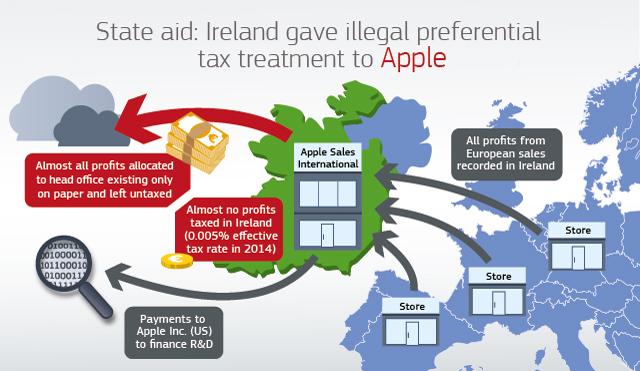
The Commission's investigation has shown that the tax rulings issued by Ireland endorsed an artificial internal allocation of profits within Apple Sales International and Apple Operations Europe, which has no factual or economic justification. As a result of the tax rulings, most sales profits of Apple Sales International were allocated to its "head office" when this "head office" had no operating capacity to handle and manage the distribution business, or any other substantive business for that matter. Only the Irish branch of Apple Sales International had the capacity to generate any income from trading, i.e. from the distribution of Apple products. Therefore, the sales profits of Apple Sales International should have been recorded with the Irish branch and taxed there.
The "head office" did not have any employees or own premises. The only activities that can be associated with the "head offices" are limited decisions taken by its directors (many of which were at the same time working full-time as executives for Apple Inc.) on the distribution of dividends, administrative arrangements and cash management. These activities generated profits in terms of interest that, based on the Commission's assessment, are the only profits which can be attributed to the "head offices".
Similarly, only the Irish branch of Apple Operations Europe had the capacity to generate any income from trading, i.e. from the production of certain lines of computers for the Apple group. Therefore, sales profits of Apple Operation Europe should have been recorded with the Irish branch and taxed there.
On this basis, the Commission concluded that the tax rulings issued by Ireland endorsed an artificial allocation of Apple Sales International and Apple Operations Europe's sales profits to their "head offices", where they were not taxed. As a result, the tax rulings enabled Apple to pay substantially less tax than other companies, which is illegal under EU state aid rules.
This decision does not call into question Ireland's general tax system or its corporate tax rate.
Furthermore, Apple's tax structure in Europe as such, and whether profits could have been recorded in the countries where the sales effectively took place, are not issues covered by EU state aid rules. If profits were recorded in other countries this could, however, affect the amount of recovery by Ireland (see more details below).

P032257000402-444876.jpg


Interesting stuff. I'd like to see the tax ruling from the Revenue crowd.

and some more:

The amount of unpaid taxes to be recovered by the Irish authorities would be reduced if other countries were to require Apple to pay more taxes on the profits recorded by Apple Sales International and Apple Operations Europe for this period. This could be the case if they consider, in view of the information revealed through the Commission’s investigation, that Apple's commercial risks, sales and other activities should have been recorded in their jurisdictions. This is because the taxable profits of Apple Sales International in Ireland would be reduced if profits were recorded and taxed in other countries instead of being recorded in Ireland.

The amount of unpaid taxes to be recovered by the Irish authorities would also be reduced if the US authorities were to require Apple to pay larger amounts of money to their US parent company for this period to finance research and development efforts. These are conducted by Apple in the US on behalf of Apple Sales International and Apple Operations Europe, for which the two companies already make annual payments.

Everybody can get a cut if they like.
 
pulling out of ireland to go where exactly?

Ireland is the EU country with the lowest corporate tax rate within EU. Apple has to have an office in some EU country to do business in EU. The EU law bans any EU member country government from giving these deals. So to me it doesn't seem like there is any other place they could really move to and save more money.

Maybe not a complete withdrawal but they could relocate a considerable portion of their operations to a more tax beneficial location. They only need a head office in Europe to work there, don't need full ops here and it wouldn't be beneficial to stay here if they could move the ops abroad and pay little to no tax in a more suitable country
 
Assuming they're all on minimum wage of 18k a year it's just shy of €4m in income taxes alone.

They'd also have indirect taxes like VAT, then rent/mortgage payments which lead to landlord/Corp tax payments.

It'd roughly be €108m to the economy each year assuming absolute minimum wage on all employees
Nah, I wanted to know how much revenue they officially generate for Apple on paper, since they're recording huge portions of their worldwide profits there.
6,000 is not a lot.
 
Nah, I wanted to know how much revenue they officially generate for Apple on paper, since they're recording huge portions of their worldwide profits there.
6,000 is not a lot.

Oh sorry thought you meant Irish revenue(tax guys) point of view
 
Status
Not open for further replies.
Top Bottom