• Hey Guest. Check out your NeoGAF Wrapped 2025 results here!

Bill Nye: Creationism Is Not Appropriate For Children

Status
Not open for further replies.
I completely sympathize with Nye's statements. You can see some of his frustration poking through in the video, I think, and often times I share that same frustration. It's a shame to think of the potential of the human race being held back for...essentially no reason what so ever.

But like he said, I agree that in the not so distant future (he said a couple centuries, I think it will be A LOT sooner than that) we won't be living in a world that believes creationism over evolution. That is a pleasing thought, though I may not live to see it.
 
I understand if you're a biology major but if you're just some guy it doesn't really affect your life.

It matters very much when we live in a democratic society. The more informed society on the whole is, the more we can advance. Having almost half the population believe in medieval bullshit is good for no one.

Imagine for example if no one in this country actually believed you could "pray the gay away", where would we be on that issue?
 
Okay thanks for replying. At least you're not completely crazy, there is hope! What do you think about the Catholic Church's stance on evolution?

Oh, and could have! not could of :@ sorry for the grammar nazi OT but that one is among the worst haha

Lol. I have two styles. This is my relaxed style of typing in which i type things that I say while relaxed (after all, isn't GAF just a place to relax, laugh, read, etc?). And another is a serious style in which im careful with grammar. But no worries!
The church's stance on evolution is fine with me. If things connect well and an description of how it works together, then i see no biggie in it with how some things in religion and evolution can go together.
In the end, I like to think that there is something that happens when we die. Like we go someplace. Rather then not believe in something. Not believing in something is rather grim (in my experience) then to hope and believe that there is something. No one really knows what happens when we die. Maybe the atheists were right or maybe a religion was right, but for me, I like to believe in something and see sense in it rather than not believing in something. This is why I've taken up religion again.
 
Bill Nye is a sensationalist? Oh dear.

Are all scientists sensationalist to you?

Not at all, but I just don't see how "the potential of the human race" is being held back. An understanding of genetics/functionality is more fundamental than ideas of how the eye evolved, for example.
 
Understanding basic scientific information is important for everyone, because in a democratic society people vote and can be swayed and swindled by political entities that capitalize on their ignorance.

For example, people's ignorance about evolution has been used recently to manipulate them into distrusting science and rationalism as a whole, turning evolution into a buzzword with negative connotations.

Evolution is something so basic to the understanding of life itself, yes, people need to understand the gist of it. A rough analogy might be: I am not a nuclear physicist and do not need to be familiar with advanced knowledge in the field. However, I understand that nuclear physics are real, based in peer reviewed science, and am unlikely to believe random scare claims about say nuclear power plants that bank on ignorance. I know enough to be able to go and educate myself further to see if there's anything to such claims.

The creationism vs evolution battle is also significant in that creationism is really just part of a multi-pronged assault on the secular world, an attempt to undermine the average person's rational understanding of the world in a very broad sense, and condition them to distrust actual scientists and scientific expertise. That's rather sweeping and sinister. We live in a technological society, and the future is going to be determined in large part by how we make use of science.


Not at all, but I just don't see how "the potential of the human race" is being held back. An understanding of genetics/functionality is more fundamental than ideas of how the eye evolved, for example.

It's my understanding that evolution is intrinsic to much of biology and genetics at this point. It seems a bit like saying astronomy doesn't need to worry about why the universe is in motion in order to look through telescopes at stars.
 
Not at all, but I just don't see how "the potential of the human race" is being held back. An understanding of genetics/functionality is more fundamental than ideas of how the eye evolved, for example.
If you don't understand evolution you don't understand genetics, and you don't understand why the human body functions or doesn't function the way it does.

Furthermore, many challenges we face today are ecological in nature and evolution is what makes that tick.
 
Not at all, but I just don't see how "the potential of the human race" is being held back. An understanding of genetics/functionality is more fundamental than ideas of how the eye evolved, for example.

It's not the idea how the eye evolved that's the troubling context of this discussion, but rather the acceptance of the idea that the eye evolved.

If the population believes creationism over evolution, the potential of the human race is held back because one can be studied scientifically and theorized and one is written in an old book.
 
Understanding basic scientific information is important for everyone, because in a democratic society people vote and can be swayed and swindled by political entities that capitalize on their ignorance.

For example, people's ignorance about evolution has been used recently to manipulate them into distrusting science and rationalism as a whole, turning evolution into a buzzword with negative connotations.

Evolution is something so basic to the understanding of life itself, yes, people need to understand the gist of it. A rough analogy might be: I am not a nuclear physicist and do not need to be familiar with advanced knowledge in the field. However, I understand that nuclear physics are real, based in peer reviewed science, and am unlikely to believe random scare claims about say nuclear power plants that bank on ignorance. I know enough to be able to go and educate myself further to see if there's anything to such claims.

The creationism vs evolution battle is also significant in that creationism is really just part of a multi-pronged assault on the secular world, an attempt to undermine the average person's rational understanding of the world in a very broad sense, and condition them to distrust actual scientists and scientific expertise. That's rather sweeping and sinister. We live in a technological society, and the future is going to be determined in large part by how we make use of science.

The bolded does make me wonder why the Germans and Japanese got all up in arms over nuclear power recently. I understand it was the aftermath of the earthquake in Japan, but I always thought Germans and Japanese were very educated on the benefits of nuclear energy.
 
If you don't understand evolution you don't understand genetics, and you don't understand why the human body functions or doesn't function the way it does.

Furthermore, many challenges we face today are ecological in nature and evolution is what makes that tick.

I agree understanding genetic changes within a genome, and how they potentially affect populations is a critical aspect of life. Moreover, ecological imbalances within an ecosystem (via pollutants or mutations) is also critical for life.

With that said, the creationism vs evolution debates center around the origins of these genomes we currently study, and that part has not proven to be very vital for life.


If the population believes creationism over evolution, the potential of the human race is held back because one can be studied scientifically and theorized and one is written in an old book.

You could argue that one side wonders how it evolved, and the other questions why is it made the way it is. They both can be approached scientifically.
 
You know, not believing in certain science can be life changing.

For example, say you have a family on top of the empire state building that don't believe in gravity. Now you have a child who asks if jumping from the tower is safe. There's a 50/50 chance the child could die depending on the answer the parent gives.

I'm not sure what the equivalent to evolution would be. Maybe you don't believe viruses can mutate so you stop taking medicine? Lol.
 
The bolded does make me wonder why the Germans and Japanese got all up in arms over nuclear power recently. I understand it was the aftermath of the earthquake in Japan, but I always thought Germans and Japanese were very educated on the benefits of nuclear energy.
Nuclear energy also carries significant risk, and, in general, it's hard to trust industry backers who say "it's totally safe now, trust us" especially when something bad happens or if you're in America and look at natural gas fracking and tar sands oil pipelines.
 
Nuclear energy also carries significant risk, and, in general, it's hard to trust industry backers who say "it's totally safe now, trust us" especially when something bad happens or if you're in America and look at natural gas fracking and tar sands oil pipelines.

Nuclear energy is backed by the scientific community, though.

I mean, sure they're going to make a business out of it, but they do that with everything, including coal-derived power and oil.

Lectures by Kirk Sorensen have really swayed me in favor of Liquide Fluoride Thorium Reactors, which are safer than the current gen of nuclear power plants and are much more efficient in terms of cost and energy propensity.
 
You could argue that one side wonders how it evolved, and the other questions why is it made the way it is. They both can be approached scientifically.

A valid and intriguing statement. However, how and why are likely closely related. But to ask "why", in a religious sense is to assign life a "higher" purpose, I think, which I don't personally agree with the concept of.
 
Nuclear energy is backed by the scientific community, though.
Eh, once you get to the industry end you end up with people liable to cut corners even if the design is solid, and waste management remains an issue.

Lectures by Kirk Sorensen have really swayed me in favor of Liquide Fluoride Thorium Reactors, which are safer than the current gen of nuclear power plants and are much more efficient in terms of cost and energy propensity.
I find those interesting as well, but that's not what we're being given at the moment.
 
Nuclear energy is backed by the scientific community, though.

I mean, sure they're going to make a business out of it, but they do that with everything, including coal-derived power and oil.

Lectures by Kirk Sorensen have really swayed me in favor of Liquide Fluoride Thorium Reactors, which are safer than the current gen of nuclear power plants and are much more efficient in terms of cost and energy propensity.

As you imply, it's probably less to do with a distrust of science and more to do with a distrust of business.
 
Not at all, but I just don't see how "the potential of the human race" is being held back. An understanding of genetics/functionality is more fundamental than ideas of how the eye evolved, for example.

Should we dump cosmology too, because everything is too far away to be immediately useful, and some people prefer to think that the universe is 6000 years old?

I think it's important to create ever more accurate models of reality.
 
It's not the idea how the eye evolved that's the troubling context of this discussion, but rather the acceptance of the idea that the eye evolved.

If the population believes creationism over evolution, the potential of the human race is held back because one can be studied scientifically and theorized and one is written in an old book.

A valid and intriguing statement. However, how and why are likely closely related. But to ask "why", in a religious sense is to assign life a "higher" purpose, I think, which I don't personally agree with the concept of.

3182.gif


Eh, once you get to the industry end you end up with people liable to cut corners even if the design is solid, and waste management remains an issue.

I agree. I don't believe nuclear power should be privatized. I believe in strict government regulation concerning that, as well as further government funding of the science behind it.
 
http://alfa.gifs-planet.com/new/3182.gif[IMG][/QUOTE]

I agree with him. I hope to see humans accomplish awesome things, and I think collective stupidity is holding us back from advancing as fast as we should, but I don't think there's any purpose to it.
 
I'm with Bill Nye. I never so much as hear the word "evolution" even mentioned in most of my schooling. I think the only time I was exposed to it in school was in grade 7 & 8. Before and after that, the concept just disappeared from my educational environment.

But of course, I learned about it WAY before as a sticky and curious little brat by watching his Science Guy show on PBS.
 
Knowing that dinosaurs turned into birds doesn't matter, so I cringe when people make sensationalist claims like in the OP's video.

Genetics on the other hand...

Dinosaurs didn't "turn into" birds. Birds ARE dinosaurs. You wouldn't say that mammals turned into humans, would you?

And yes, it does matter. Picking out a specific point is silly. The real point is, without a good understanding of how evolution works, modern medicine wouldn't exist.
 
The lack of transitional fossils is curious to me but I'm not sure how that is supposed to contradict evolution.

The fossil record is highly incomplete. Most species don't ever end up getting fossilized because the required conditions have to be perfect, and the ones that do are often broken up eventually. In addition, an even smaller % of fossils end up actually getting discovered. Paleontology is quite the crapshoot and we only have a snapshot of animal history with a lot of holes in the picture.

Woah, neogaf is letting me post now! I won't just be lurking anymore.
 
God is a very simple concept. Imaginary friend with unlimited power. How much more simple can you get than that? Its not overly reductionist, its a pretty good description really. Doesn't have quite the same ring as "Magic man in the sky" though.
 
Hmm should I be concerned that there are youtube comments that baffle me. That "why we still got monkeys" notion being used outside in a non-serious post baffles me.
 
I havent studied biology in 20 years but I have heard some of the arguments in that chart. Evolution made sense to me when I studied it but I couldn't individually respond to every argument. The lack of transitional fossils is curious to me but I'm not sure how that is supposed to contradict evolution.

I was pretty much sold at carbon dating. Not to mention how beneficial genetics, which to my understanding is a direct result of the theory of evolution.
The important thing isn't even the number of fossils, of which we still have plenty, or even the number of "holes", but the fact that the fossil evidence coheres with the theory of evolution. Assume, for example, that we know nothing of the evolutionary lineage of whales and dolphins and that whale fossils simply appeared in the fossil record some 40 million years ago. That would still be evidence for evolution, because the fossils appeared exactly where we would expect them to be. If whales appeared 300 million years ago, before the first mammals, then it would contradict our understanding of evolution. For some reason, creationists don't seem to understand this and are focused almost exclusively on the "transitional fossils" themselves.

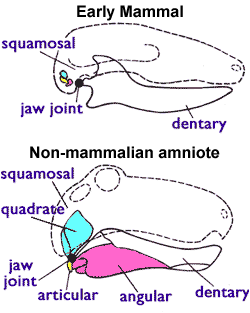
Fortunately for us, we do have a decent fossil record. One of my favorite examples is the evolutionary history of the mammalian ear. As Wikipedia explains:

The evolution of mammalian auditory ossicles is one of the most well-documented and important evolutionary events, demonstrating both numerous transitional forms as well as an excellent example of exaptation, the re-purposing of existing structures during evolution.

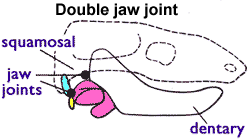
In reptiles, the eardrum is connected to the inner ear via a single bone, the stapes or stirrup, while the upper and lower jaws contain several bones not found in mammals. Over the course of the evolution of mammals, one lower and one upper jaw bone (the articular and quadrate) lost their purpose in the jaw joint and were put to new use in the middle ear, connecting to the stapes and forming a chain of three bones (collectively called the ossicles) which amplify sounds and allow more acute hearing. In mammals, these three bones are known as the malleus, incus, and stapes (hammer, anvil, and stirrup respectively).

The evidence that the malleus and incus are homologous to the reptilian articular and quadrate was originally embryological, and since this discovery an abundance of transitional fossils has both supported the conclusion and given a detailed history of the transition. The evolution of the stapes was an earlier and distinct event.


Here are the skulls of a mammal and non-mammal:

Jaw_joint_-_mammal_n_non-mammal.png


And a more intermediate form from around 200 million years ago:

Jaw_joint_-_double.png
 
Though what's interesting is that it was someone like Gregor Mendel, a catholic priest, who could be described as the father of genetics.
Mendel might have been the father, but if all one understands are his laws of inheritance, then one's understanding of genetics is woefully incomplete. I think the main issue is that anyone who claims to understand genetics on a molecular level, yet still denies evolution, doesn't actually understand it at all. Creationists have to posit the existence of magical genetic barriers that prevent the changing of one species into another. Even Michael Behe, who has a slightly more sophisticated argument, claims that genes can't undergo more than a few successive mutations before their functions break down. This flies in the face of modern genetic theories.
 
I think the main issue is that anyone who claims to understand genetics on a molecular level, yet still denies evolution, doesn't actually understand it at all. .

Nah. There are people who understand evolution but are willfully ignorant.

There's only 2 possible ways to be a creationist

1. You are ignorant of evolution, either due to lack of education on the subject or some physical inhibition from understanding (mentally challenged)

2. You are willfully ignorant. You understand evolution but refuse to believe it for arbitrary reasons.
 
Dinosaurs didn't "turn into" birds. Birds ARE dinosaurs. You wouldn't say that mammals turned into humans, would you?

It's an entirely different genus, and saying that birds "evolved" from Dinosaurs does nothing to advance our understanding of birds. That's my point. I respect those who dedicate their lives to hypothesizing about the past, but humanity is not being held back if you consider birds as birds.

And yes, it does matter. Picking out a specific point is silly. The real point is, without a good understanding of how DNA works, modern medicine wouldn't exist.

Fixed to make my point. Study of common ancestry is not as useful as studying gene expression and potential changes in genomes. That's my only gripe about the video.
 
It's an entirely different genus, and saying that birds "evolved" from Dinosaurs does nothing to advance our understanding of birds. That's my point. I respect those who dedicate their lives to hypothesizing about the past, but humanity is not being held back if you consider birds as birds.

It advances our knowledge of their lineage. How is that not advancing our understanding of them?
 
It's an entirely different genus, and saying that birds "evolved" from Dinosaurs does nothing to advance our understanding of birds.

Wrong. There's over a thousand genera of birds. Ducks and owls do not belong to the same genus. You don't know how taxonomy works, do you?


Fixed to make my point. Study of common ancestry is not as useful as studying gene expression and potential changes in genomes. That's my only gripe about the video.

Right. So how about the myriad applications to drug development? Vaccines? Agronomy?
Or is that not useful enough?
 
Status
Not open for further replies.
Top Bottom