• Hey Guest. Check out your NeoGAF Wrapped 2025 results here!

Can't solve this riddle

Status
Not open for further replies.

Two Words

Member
I have two riddles. One I have figured out, the other I can't figure out. I'll give them both. If you can figure it out, answer in a spoiler. No cheating!

Solved Riddle:
You walk down a road until you hit a fork. One direction will lead you to your destination, the other will leave you lost. There are two men at the fork in the road. One always lies, the other always tells the truth. You can only ask one question and only one is allowed to answer. What do you ask and who do you ask it to in order to determine the correct way to go. Both know the correct way.


Unsolved Riddle:
It's the same riddle, but add a third person who sometimes lies and sometimes tells the truth. You can ask three questions. There is some dispute on how many questions you may ask here.
 
Those Resident Evil riddles are getting trickier with each game!

What would the other guy say? Either way you go the opposite direction, right?

2nd one, I need to think about.
 
I have two riddles. One I have figured out, the other I can't figure out. I'll give them both. If you can figure it out, answer in a spoiler. No cheating!

Solved Riddle:
You walk down a road until you hit a fork. One direction will lead you to your destination, the other will leave you lost. There are two men at the fork in the road. One always lies, the other always tells the truth. You can only ask one question and only one is allowed to answer. What do you ask and who do you ask it to in order to determine the correct way to go. Both know the correct way.


Unsolved Riddle:
It's the same riddle, but add a third person who sometimes lies and sometimes tells the truth.

Anyone who listens to XFM or the ricky gervais podcasts knows the answer to the first one. Ricky covered it and explained the answer.

I wont post it as if no one has heard it yet ill let them come up with it.
 
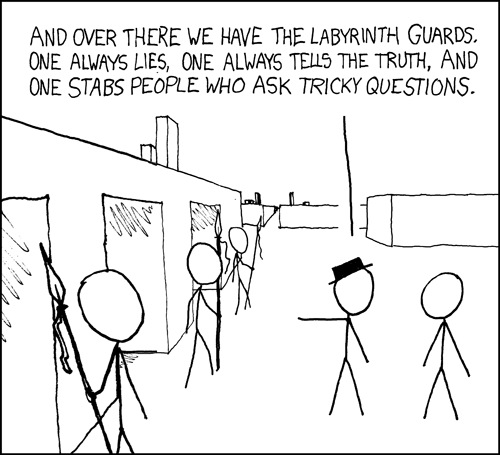
XOwqsMJ.jpg
 
I ask the person who always tells the truth, which path will lead me to my destination? no? I really feel stupid, because it can't be that easy.
 
The second one doesn't work too well if there are only 2 paths and 3 guys.

Are they guarding a path?
Do they each want you to go down their respective path?

That said.. looking up the puzzle (cause I can sheesh)
The 3 person riddle requires at least 2 questions depending on how it is told.
So.... yeah.
 
I don't get how this is answerable.

The original is solved by
parsing the question through both people so you get the direction you want ("ask one man what direction the other would tell me to go, then go the opposite way".)

If you add a third person,
let alone one who unreliably lies, then the system breaks. You can't do the same trick because you aren't certain how one of them is going to answer like you are the original two.

Maybe something like "each tell me which way the other two would tell me to go?". I don't know if that's even a valid question anymore if the third guy is unreliable to start with. EDIT: I guess that might count as more than one question, oops.

Very interested to hear an answer, if there is one.
 
I'm getting tired of thinking. If there's three of them just say "fuck it" and flip a coin for two the of the paths of your choosing, Tails never fails, baby.

Riddle solved.
 
Answer to the second one, I think:

Would you say 'yes' if I asked you if the left path leads to my destination? (If the answer is yes, go down the left path; if no, go down the right)
 
Answer to the second one, I think:

Would you say 'yes' if I asked you if the left path leads to my destination?

Problem with this is that you don't know which is which, so the liar is going to say "yes" if the path to your left is wrong, the truth teller will say no, and the unreliable guy will unreliably answer yes or no. Your chances are still sitting at about 50/50.
 
Being this is a .44 Magnum, the most powerful handgun in the world and would blow your head clean off, you've gotta ask yourself one question: "Do I feel lucky?" Well, do ya, punk?
 
Problem with this is that you don't know which is which, so the liar is going to say "yes" if the path to your left is wrong, the truth teller will say no, and the unreliable guy will unreliably answer yes or no. Your chances are still sitting at about 50/50.

Let's break it down.

Let's say that the correct path is the left path.

Suppose that you ask the truth-teller. The truth-teller would answer yes to "Does the left path lead to my destination?". So then the truth-teller says yes to "Would you say yes if I asked if the left path lead to my destination?"

What if we ask the liar instead? The liar would obviously say no to "Does the left path lead to my destination?". But if you ask the question, "Would you say yes if I asked if the left path lead to my destination?", they'd be forced to lie about their lie. So they'd say yes.

Same reasoning applies if the correct path is the right path.

Edit: As you can see, it doesn't matter if the person you ask lies or tells the truth. If they tell the truth, you're good. If they lie, they have to lie about their lie, giving you the truth anyways.
 
Answer to the second one, I think:

Would you say 'yes' if I asked you if the left path leads to my destination? (If the answer is yes, go down the left path; if no, go down the right)

Oh shit this one actually works :O

Problem with this is that you don't know which is which, so the liar is going to say "yes" if the path to your left is wrong, the truth teller will say no, and the unreliable guy will unreliably answer yes or no. Your chances are still sitting at about 50/50.

actually it would work like this:

if the left would be correct:
The truther would say yes since he would say yes to the sub part of the question, the lier would say yes since the question causes a double negative, and due to that, the rando, would always say yes. you go left!

if the right is correct:
the truther would say no. The lier would think "i would say yes since it is not the way, but i have to lie about saying yes" so he says no, and thus the randomer also must say no. you go right.

edit: just realized this answer works for both questions. SHIIIIIIIIIIIIIIIIIIIIII
 
Almost certain it does. Might not, but after 5 minutes of straight thinking I sure as hell can't figure it out.

It does. You'd have to narrow down the options. Maybe ask, "Would either of you give me a straight answer?" You'd get Yes, No, and Yes/No. If you got Yes, No, No then you know which one is truthful, Yes, Yes, No means that you know which one is the liar.

Then you'd ask the question for directions, I guess.
 
That just doesn't make sense to me though.. I mean, you don't know who answers the question right? Or am I reading it wrong.
If you end up asking the truth teller, he will say the liar will tell you to go whichever is the wrong way. If you end up asking the liar, he will lie and say the other person will tell you to go whichever is the wrong way. So the question always has the same answer for whoever you ask. You just take the opposite path.
 
Oh shit this one actually works :O


actually it would work like this:

if the left would be correct:
The truther would say yes since he would say yes to the sub part of the question, the lier would say yes since the question causes a double negative, and due to that, the rando, would always say yes. you go left!

if the right is correct:
the truther would say no. The lier would think "i would say yes since it is not the way, but i have to lie about saying yes" so he says no, and thus the randomer also must say no. you go right.

edit: just realized this answer works for both questions. SHIIIIIIIIIIIIIIIIIIIIII
I don't get how it fixes the problem with the random person.
 
I don't get how it fixes the problem with the random person.

unless there is some caveat where the randomer can switch between lying and not lying mid answer, he must choose either the liers route or the truth route, that being the case, both would be the same as the other two. choose where he says. if yes go left, if no go right.
 
Oh shit this one actually works :O


actually it would work like this:

if the left would be correct:
The truther would say yes since he would say yes to the sub part of the question, the lier would say yes since the question causes a double negative, and due to that, the rando, would always say yes. you go left!

if the right is correct:
the truther would say no. The lier would think "i would say yes since it is not the way, but i have to lie about saying yes" so he says no, and thus the randomer also must say no. you go right.

edit: just realized this answer works for both questions. SHIIIIIIIIIIIIIIIIIIIIII

Let's break it down.

Let's say that the correct path is the left path.

Suppose that you ask the truth-teller. The truth-teller would answer yes to "Does the left path lead to my destination?". So then the truth-teller says yes to "Would you say yes if I asked if the left path lead to my destination?"

What if we ask the liar instead? The liar would obviously say no to "Does the left path lead to my destination?". But if you ask the question, "Would you say yes if I asked if the left path lead to my destination?", they'd be forced to lie about their lie. So they'd say yes.

Same reasoning applies if the correct path is the right path.

Edit: As you can see, it doesn't matter if the person you ask lies or tells the truth. If they tell the truth, you're good. If they lie, they have to lie about their lie, giving you the truth anyways.

Interesting!

So you turn it into a question about how they answer instead of about the path, and exploit the fact that the liar (or the unreliable man choosing to lie) always answers you with a lie, and is not necessarily trying to mislead you. I think that's where I was getting mixed up.

That's pretty cool!
 
unless there is some caveat where the randomer can switch between lying and not lying mid answer, he must choose either the liers route or the truth route, that being the case, both would be the same as the other two. choose where he says. if yes go left, if no go right.
I see, so the random person is a bit of a red herring here.
 
Uhhh... why wouldn't the random person answer randomly to the question? You guys are making a leap of logic wider than the grand canyon that you can trap someone answering randomly using a double negative.
 
Idk if it's been answered but

you ask "what would the other man tell me to pick?" and then pick the opposite of his answer. If hes the liar, he'll have you pick his road, so choosing the opposite would get you the right road. If hes the truther, he'll answer with the liar's road, so picking the opposite will give you the right road

Oh nvm you solved this one already
 
Uhhh... why wouldn't the random person answer randomly to the question? You guys are making a leap of logic wider than the grand canyon that you can trap someone answering randomly using a double negative.

He doesn't answer completely randomly, he randomly decides whether or not his answer will be the truth. If the double negative traps the liar into giving you the right direction, and at the same time doesn't affect the truth-teller's answer, then the random answerer ends up giving you the correct response regardless of which way he "decides" to answer you.
 
Uhhh... why wouldn't the random person answer randomly to the question? You guys are making a leap of logic wider than the grand canyon that you can trap someone answering randomly using a double negative.

It's the same riddle, but add a third person who sometimes lies and sometimes tells the truth.

The third person doesn't answer truly randomly, though. The problem states that he/she sometimes tells the truth, and sometimes lies, as opposed to someone who says "yes" half of the time and "no" half of the time regardless of the question. The difference is that you can use logic to figure out what the former would say, while the latter is entirely unpredictable (and not present in the question).

Also yeah, someone explain why the random guy is a red herring, im being stupid.
Or it's 2am.

There are a couple of different solutions for the first puzzle, but the addition of the third guy invalidates most of them in the second. The third guy basically makes you have an answer where it doesn't matter if you're lied to or not, since you, well, don't know if you're being lied to or not.

I hate that I got here late. This was my first thought when I saw the thread, and now I cant link it :P

:P
 
Uhhh... why wouldn't the random person answer randomly to the question? You guys are making a leap of logic wider than the grand canyon that you can trap someone answering randomly using a double negative.
I think the point is that whether he lies or tells the truth, his answer is the same.
 
How do we know this?

How do we know this?
Its in how the riddle is setup. One ALWAYS lies, one ALWAYS tells the truth, and importantly, they know this about each other.

So asking what the other would say is the right path gives only four options (assume left is correct here):

Truth-teller - He knows and says the liar would say left. Since the liar is a liar he would say the wrong way, you can go right.
Truth-teller - He knows and says the liar would say right. Since the liar is a liar he would say the wrong way, you can go left.
Liar - He knows the truth-teller would say left, BUT he is a liar so he says he would say right. You can go left assuming he is telling the truth or lying.
Liar - He knows the truth-teller would say right, BUT he is a liar so he says he would say left. You can go right assuming he is telling the truth or lying.
 
I think the point is that whether he lies or tells the truth, his answer is the same.

The random guy never lies or tells the truth--he doesn't know anything and just picks a random response. His response has no meaning and provides no insight whatsoever. The goal of the puzzle is to identify that he is random, and thus to be ignored completely. It can't be solved in one question.
 
Status
Not open for further replies.
Top Bottom