

-
Hey Guest. Check out your NeoGAF Wrapped 2025 results here!
You are using an out of date browser. It may not display this or other websites correctly.
You should upgrade or use an alternative browser.
You should upgrade or use an alternative browser.
Ebert (once again) reiterates his position on games.
- Thread starter Campster
- Start date
What makes games art is making them an unforgettable experience. What makes games high art is making them an unforgettable experience while making them all those things he mentions in my above post. Bioshock could also be considered "High Art", conceptually everything I've seen about that game makes it a shoe in. He's ignorant and even he got these games he doesn't have the literacy or skills to actually play the game to see how wrong he is, so he'll just keep spouting his crap. Good thing he's old and will die soon, Siskel is waiting for you ignoramus. :lol
AstroLad said:well that is different, not all games are even art. i forget who but there is a games writer who breaks down two different kinds of games--one kind being kiddie mario/non-game stuff where it's basically not considered art (and definitely not high art) by anyone. it's like how you wouldn't consider a workout tape art.
BUT the other kind of game--the modern game ushered in by the PS and refined by the 360 to it's essence--is not only art but can often reach the plateau of "high art" once reserved for old media and now being dethroned like prospero for the shakespeare fans out there. so what you have is a Succession of The Crown of sorts. an Evolution if you will.
to those clinging to the past: is "the great gatsby" still "high" art? maybe, maybe not. the question is much stickier now than it was before this new kind of gaming that exists now. but the funny thing is that the best stories of all never die--that is, there is always hope that CliffyB will read gatsby and say. now based on my experience i can almost guarantee THAT would be "high art" to anyone not hopelessly clinging to the "last gen" of media.hey, it would be pretty cool to make the player control Gatbsy in an FPS with Wilson as the Final Boss--give the player the immersion and FULL CONTROL over what happens
... Man, I'm among the biggest games-are-art proponents you'll ever meet, and even I think this is... hyperbolic at best?
Story is king? Where's gameplay?
Books and movies are dead? Sales figures and continued artistic innovation say otherwise.
Great Gatsby as an FPS?!
Stumpokapow
listen to the mad man
No6 said:I agree. And who's nostalgic for 80s films (seriously, that decade was terrible, and I place most of the blame on the use of terrible synth in movies)?
Terrible decade? Yes. Still, there are at least a few films worth remembering:


Thought I could edit my post to make my statement a bit more clear before anyone replied. =PNo6 said:All art has limitations on self-expression. The canvas, page, brush, camera, guitar; all are limiters of expression.
No6 said:That was me, and so am I correct in assuming that you CAN name a movie at which point cinema became high art? If so, what? It would give us a nice timeframe to work with. Hell, games get a few thousand years of credit if we're considering Shakespeare as the required level of playwright.
No, you're misunderstanding. The first great work of art didn't come along in cinema and raise everything else up with it, it just stood as a high point. "This" is a height the medium is capable of, but there are still plenty of lowbrow, less artistic movies, too.
Video games hasn't had a medium-defining high water mark yet. There are video games many would consider better than their peers, but they do not stand outside of the medium as great works of art.
VALIS said:No, you're misunderstanding. The first great work of art didn't come along in cinema and raise everything else up with it, it just stood as a high point. "This" is a height the medium is capable of, but there are still plenty of lowbrow, less artistic movies, too.
Video games hasn't had a medium-defining high water mark yet. There are video games many would consider better than their peers, but they do not stand outside of the medium as great works of art.
I don't know. Pac-man could be it.
I respect Ebert's position and though I believe his view of games is prejudiced and somewhat uninformed, I do think that the games he described and grossly generalized cannot be high art.
It is an artform to create beaitufil virtual worlds, or to use the more industry specific term 'sanboxes' for users to play in and destroy. High art has as I understand it, usually involves a lot more than primal experiences or beautiful things, it's a state of being.
It is an artform to create beaitufil virtual worlds, or to use the more industry specific term 'sanboxes' for users to play in and destroy. High art has as I understand it, usually involves a lot more than primal experiences or beautiful things, it's a state of being.
Confidence Man
Member
VALIS said:No, you're misunderstanding. The first great work of art didn't come along in cinema and raise everything else up with it, it just stood as a high point. "This" is a height the medium is capable of, but there are still plenty of lowbrow, less artistic movies, too.
Video games hasn't had a medium-defining high water mark yet. There are video games many would consider better than their peers, but they do not stand outside of the medium as great works of art.
Video games aren't a medium, so I doubt they'll ever get there.
Campster said:... Man, I'm among the biggest games-are-art proponents you'll ever meet, and even I think this is... hyperbolic at best?
Story is king? Where's gameplay?
Books and movies are dead? Sales figures and continued artistic innovation say otherwise.
Great Gatsby as an FPS?!
He's joking...

davepoobond
you can't put a price on sparks
i think games contain art, but are not art themselves.
Stumpokapow
listen to the mad man
Flynn said:It was a slow development. The earliest movies, around the time of Lumiere, were just trains pulling into stations or a guy getting squirted in the face with a hose. Then you get these rudimentary plots like guys going to the moon or clansmen trying to keep America pure. (Early 1900's-1920)
Then you get Citizen Kane in '41. I think games are somewhere between those.
I really think you over-credit Citizen Kane there. You call Birth of a Nation rudimentary, but I think it's very well realized and "full". Films had adopted full plots, modern run times, and character developed by at the latest the mid 20s, and definite before Citizen Kane.
The following movies are all probably at least as fully developed as Citizen Kane:


Chapter 2-3 of Super Paper Mario deserves some consideration. The route through the scenario is emergent from the time constraints placed on the player by reality. At every point the linear progress is blocked by quantifiably unreasonable requirements. This indirectly communicates to the player that an avenue for progress exists because he knows he is playing a video game.
By finding these alternatives, the player changes his relationship with the unreasonable quantity, and gains a feeling of empowerment over his rate of progress. But he cannot avoid making
The chapter with the
is also notable because they are iteration personified and the interruption of their iterative narrative is literally the
By finding these alternatives, the player changes his relationship with the unreasonable quantity, and gains a feeling of empowerment over his rate of progress. But he cannot avoid making
Mario do his time in the treadmill.
The chapter with the
Sammerguys
end of their world
Flynn said:I don't know. Pac-man could be it.
That's interesting. Maybe. I have always had the notion that video games were more universally appealing and akin to higher art when they were more abstract and simple, ala Pac-Man.
davepoobond said:i think games contain art, but are not art themselves.
Go play Rez.
TwinIonEngines said:Chapter 2-3 of Super Paper Mario deserves some consideration. The route through the scenario is emergent from the time constraints placed on the player by reality. At every point the linear progress is blocked by quantifiably unreasonable requirements. This indirectly communicates to the player that an avenue for progress exists because he knows he is playing a video game.
By finding these alternatives, the player changes his relationship with the unreasonable quantity, and gains a feeling of empowerment over his rate of progress. But he cannot avoid makingMario do his time in the treadmill.
The chapter with theis also notable because they are iteration personified and the interruption of their iterative narrative is literally theSammerguysend of their world
Jesper?
SapientWolf
Trucker Sexologist
I would argue against that point too. Designing an enjoyable and engrossing game is an art in and of itself.AstroLad said:well that is different, not all games are even art.
AstroLad said:Jesper?
Gonzalo?

Joe Molotov
Member
Gekkonidae said:The form is 30-40 years old and film by this point in it's lifetime had a produced a myriad of great works. This is not to say that video games will never be great art, I just wouldn't bet on it within the near future.
The first movies came out in the 1890's, so 30 years would put us in the 1920's. I would challenge you to find me 10 people who could even name any 10 movies that came out in the 1920's, much less great ones. It would be around 20 years, in the late 30's and 40's before any of the established "greats" would be released (Casablanca, Citizen Kane, Gone with the Wind, Wizard of Oz, etc.)
And anyway, most of the movies that are considered great were only declared to be great in retrospect. In 20-30 years, you might discover that there are a myriad of great works from this era of videogames.
He's kind of right really. I mean lots of games HAVE art, and USE art, or are creative or allow the player to be creative, but the game itself isn't art. Until the gameplay itself evolves so that it goes beyond just instances of interactivity that fills in a story (even thought the story itself may be art), it will remain just what it is.
Some of you guys really have no knowledge of the history of film...its kinda painful to read actually. In any case, as I said before, art is purely subjective...if the maker/makers are striving to reach a certain level of aesthetic then it is by extension, art. Ebert is old and kinda decrepit and he once panned "Blue Velvet" so who gives a shit what he thinks.
SapientWolf
Trucker Sexologist
I'm not going to quote any dictionary definitions, but I want to ask your opinion. Why do you think that the game itself isn't art? What quality or component is it missing?mrkgoo said:He's kind of right really. I mean lots of games HAVE art, and USE art, or are creative or allow the player to be creative, but the game itself isn't art. Until the gameplay itself evolves so that it goes beyond just instances of interactivity that fills in a story (even thought the story itself may be art), it will remain just what it is.
No6 said:I agree. And who's nostalgic for 80s films (seriously, that decade was terrible, and I place most of the blame on the use of terrible synth in movies)?
The 80s had some pretty great movies. Maybe not "art," but they're fun to watch and many are still considered classic.

PkunkFury
Member
Joe Molotov said:The first movies came out in the 1890's, so 30 years would put us in the 1920's. I would challenge you to find me 10 people who could even name any 10 movies that came out in the 1920's, much less great ones. It would be around 20 years, in the late 30's and 40's before any of the established "greats" would be released (Casablanca, Citizen Kane, Gone with the Wind, Wizard of Oz, etc.)
Metropolis! ... and that's all I've got

but you guys dwelling on cinema are missing the entire point. Games are not movies. Games should never strive to become movies. They are capable of very different things. If you are looking for games that compare to the artistical development of movies in order to qualify games as art, you are going to have a lot more trouble than if you consider games as their own medium. Some of you are discounting every game that does not involve cinematics and epic screenplays simply by insisting games are not art in comparison to movies. Games are about the experience, not the narrative, and as a fan of gaming you should never forget that.
Stumpokapow
listen to the mad man
Joe Molotov said:The first movies came out in the 1890's, so 30 years would put us in the 1920's. I would challenge you to find me 10 people who could even name any 10 movies that came out in the 1920's, much less great ones. It would be around 20 years, in the late 30's and 40's before any of the established "greats" would be released (Casablanca, Citizen Kane, Gone with the Wind, Wizard of Oz, etc.)
I'm not sure why people think that there weren't films of substance before Gone with the Wind.
Pre-1930 Films that most people today would still recognize by title even if they had not seen them:
Voyage dans la Lune
The Great Train Robbery
Ben Hur
The Story of the Kelly Gang
The Birth of a Nation
Intolerance
Metropolis
Faust
The Hunchback of Notre Dame
The Mysterious Doctor Fu Manchu
The Phantom of the Opera
Safety Last!
The Ten Commandments
Frankenstein
Glorifying the American Girl
I think most people would recognize at least half of those, even if they haven't seen them. Also most of Chaplin's films including Shoulder Arms, the Pilgrim, A Woman of Paris, etc... Buster Keaton as well had his career before 1930 and he's still known.
The main problem with pre-1930s films is that it's virtually impossible to find full copies of early films. Metropolis is easily the largest pre-1930s film and there has literally never been a full copy of the movie found.
Caution: This is a very long winded response to Mr. Ebert. If you are not interested, please, avoid this wall of text :lol
The word "prejudiced" often translates as "disagrees with me." I might suggest that gamers have a prejudiced view of their medium, and particularly what it can be. Games may not be Shakespeare quite yet, but I have the prejudice that they never will be, and some gamers are prejudiced that they will.
On the contrary, Mr. Ebert, I find that rarely will prejudiced translate to disagrees with me. What he was suggesting, however, was that you have come to a conclusion in which you have deemed video games as less than art, which was formed without knowledge, thought, or reason. By definition, sir, you are prejudiced toward the concept of video games as art forms. Your suggestions that you have a prejudice that games will never be Shakespeare simply suggests that you have come to that conclusion without any knowledge or reason pertaining to the realm of video games.
Perhaps if the experience moves your bowels, it is worthy of some serious medical study. Many experiences that move me in some way or another are not art. A year ago I lost the ability (temporarily, I hope) to speak. I was deeply moved by the experience. It was not art.
You have a point sir, but you also prove one. While your loss is tragic, should you write about it, would that not be considered art? Or would that book merely be a collection of words to describe an event in your life? You can define art however you want, but in its most simple form, art is nothing more than the expression of self. Given that there are many people who come together to express themselves and certain ideas in videogames, I think its safe to say some degree of art is involved. Do you not think it unfair, at least in the slightest, to come to a conclusion based only on your inexperience?
A reviewer is a reader, a viewer or a player with an opinion about what he or she has viewed, read or played. Whether that opinion is valid is up to his audience, books, games and all forms of created experience are about themselves; the real question is, do we as their consumers become more or less complex, thoughtful, insightful, witty, empathetic, intelligent, philosophical (and so on) by experiencing them? Something may be excellent as itself, and yet be ultimately worthless. A bowel movement, for example.
If I understand you correctly, and I think I do, you are saying that we should judge games and compare them to a bowel movement, and by that you mean they are ultimately worthless? I apologize for what I am about to say, but you are being extremely absurd. Can you tell me what form of art makes us more insightful, intelligent, or even philosophical? Did the wonderful smile of Mona Lisa make you any more thoughtful, insightful, complex, or witty? Does watching a play on Broadway, or attending your local Opera showing make you any more philosophical or intelligent? If it does, then why, sir, is it not possible for a video game to stir the same emotions and though behind these simple forms of art? Unfortunately, that is an answer you cannot deliver, as its not there.
He is right again about me. I believe art is created by an artist. If you change it, you become the artist. Would "Romeo and Juliet" have been better with a different ending? Rewritten versions of the play were actually produced with happy endings. "King Lear" was also subjected to rewrites; it's such a downer. At this point, taste comes into play. Which version of "Romeo and Juliet," Shakespeare's or Barker's, is superior, deeper, more moving, more "artistic"?
Again, by your definition, we are all artists. Many games give us the ability to change what we participate in. From simple plot line deviations to deep insightful side quests, games offer us the opportunity to alter the experience presented to us. To construct these stories as we see fit and effect the outcome (however minor the result of our actions) gives us the ability to control this art and our journey. Does a musician not control the instrument he plays?
If you can go through "every emotional journey available," doesn't that devalue each and every one of them? Art seeks to lead you to an inevitable conclusion, not a smorgasbord of choices. If next time, I have Romeo and Juliet go through the story naked and standing on their hands, would that be way cool, or what?
Does being sad and angry that youve lost a loved one, but being happy at the same time that you still have your family devalue any of the prior emotions? Even in a poem such as The Raven by Edgar Allen Poe, there are multiple hints of mixed emotions and confusion. Would you doubt his work as well? Is he any less of an artist?
Spoken with the maturity of an honest and articulate 4-year old. I do not have a need "all the time" to take myself away from the oppressive facts of my life, however oppressive they may be, in order to go somewhere where I have control. I need to stay here and take control. Right now, for example, I cannot speak, but I am writing this. You lose some, you win some.
Ah, wonderful choice of words sir. To go back to Edgar Allen Poe, whom you seem to believe represents art, specifically in horror stories, I want to talk about his essay, The Philosophy of Composition written after The Raven. He talks about how he wrote the poem, and how none of it was constructed by mistake or chance. He claims that no aspect of the poem was an accident, rather, it was based on total control by the author. Would you now stoop so low as to call Edgar Allen Poe an honest and articulate 4-year old?
In Conlucsion, I ask only that you refrain from the grouping of all video games as one non-artistic medium, and come to accept that in the end, art is what we make of it. There are good movies, and bad, great books, and poor. The same applies to video games, where some stories are great, carefully crafted and artistic, while others are chaotic, unorganized, and sporadic. Experience is necessary to be one of those reviewers you spoke so highly about, only it seems you write not for an audience, but for yourself. Learn and let live, education is also a part of art.
The word "prejudiced" often translates as "disagrees with me." I might suggest that gamers have a prejudiced view of their medium, and particularly what it can be. Games may not be Shakespeare quite yet, but I have the prejudice that they never will be, and some gamers are prejudiced that they will.
On the contrary, Mr. Ebert, I find that rarely will prejudiced translate to disagrees with me. What he was suggesting, however, was that you have come to a conclusion in which you have deemed video games as less than art, which was formed without knowledge, thought, or reason. By definition, sir, you are prejudiced toward the concept of video games as art forms. Your suggestions that you have a prejudice that games will never be Shakespeare simply suggests that you have come to that conclusion without any knowledge or reason pertaining to the realm of video games.
Perhaps if the experience moves your bowels, it is worthy of some serious medical study. Many experiences that move me in some way or another are not art. A year ago I lost the ability (temporarily, I hope) to speak. I was deeply moved by the experience. It was not art.
You have a point sir, but you also prove one. While your loss is tragic, should you write about it, would that not be considered art? Or would that book merely be a collection of words to describe an event in your life? You can define art however you want, but in its most simple form, art is nothing more than the expression of self. Given that there are many people who come together to express themselves and certain ideas in videogames, I think its safe to say some degree of art is involved. Do you not think it unfair, at least in the slightest, to come to a conclusion based only on your inexperience?
A reviewer is a reader, a viewer or a player with an opinion about what he or she has viewed, read or played. Whether that opinion is valid is up to his audience, books, games and all forms of created experience are about themselves; the real question is, do we as their consumers become more or less complex, thoughtful, insightful, witty, empathetic, intelligent, philosophical (and so on) by experiencing them? Something may be excellent as itself, and yet be ultimately worthless. A bowel movement, for example.
If I understand you correctly, and I think I do, you are saying that we should judge games and compare them to a bowel movement, and by that you mean they are ultimately worthless? I apologize for what I am about to say, but you are being extremely absurd. Can you tell me what form of art makes us more insightful, intelligent, or even philosophical? Did the wonderful smile of Mona Lisa make you any more thoughtful, insightful, complex, or witty? Does watching a play on Broadway, or attending your local Opera showing make you any more philosophical or intelligent? If it does, then why, sir, is it not possible for a video game to stir the same emotions and though behind these simple forms of art? Unfortunately, that is an answer you cannot deliver, as its not there.
He is right again about me. I believe art is created by an artist. If you change it, you become the artist. Would "Romeo and Juliet" have been better with a different ending? Rewritten versions of the play were actually produced with happy endings. "King Lear" was also subjected to rewrites; it's such a downer. At this point, taste comes into play. Which version of "Romeo and Juliet," Shakespeare's or Barker's, is superior, deeper, more moving, more "artistic"?
Again, by your definition, we are all artists. Many games give us the ability to change what we participate in. From simple plot line deviations to deep insightful side quests, games offer us the opportunity to alter the experience presented to us. To construct these stories as we see fit and effect the outcome (however minor the result of our actions) gives us the ability to control this art and our journey. Does a musician not control the instrument he plays?
If you can go through "every emotional journey available," doesn't that devalue each and every one of them? Art seeks to lead you to an inevitable conclusion, not a smorgasbord of choices. If next time, I have Romeo and Juliet go through the story naked and standing on their hands, would that be way cool, or what?
Does being sad and angry that youve lost a loved one, but being happy at the same time that you still have your family devalue any of the prior emotions? Even in a poem such as The Raven by Edgar Allen Poe, there are multiple hints of mixed emotions and confusion. Would you doubt his work as well? Is he any less of an artist?
Spoken with the maturity of an honest and articulate 4-year old. I do not have a need "all the time" to take myself away from the oppressive facts of my life, however oppressive they may be, in order to go somewhere where I have control. I need to stay here and take control. Right now, for example, I cannot speak, but I am writing this. You lose some, you win some.
Ah, wonderful choice of words sir. To go back to Edgar Allen Poe, whom you seem to believe represents art, specifically in horror stories, I want to talk about his essay, The Philosophy of Composition written after The Raven. He talks about how he wrote the poem, and how none of it was constructed by mistake or chance. He claims that no aspect of the poem was an accident, rather, it was based on total control by the author. Would you now stoop so low as to call Edgar Allen Poe an honest and articulate 4-year old?
In Conlucsion, I ask only that you refrain from the grouping of all video games as one non-artistic medium, and come to accept that in the end, art is what we make of it. There are good movies, and bad, great books, and poor. The same applies to video games, where some stories are great, carefully crafted and artistic, while others are chaotic, unorganized, and sporadic. Experience is necessary to be one of those reviewers you spoke so highly about, only it seems you write not for an audience, but for yourself. Learn and let live, education is also a part of art.
Confidence Man
Member
SapientWolf said:I'm not going to quote any dictionary definitions, but I want to ask your opinion. Why do you think that the game itself isn't art? What quality or component is it missing?
You didn't ask me, but I'd say (and probably Ebert would also say) that the nature of a 'game' in essence is such that it requires the player to make choices which influence an outcome.
Confidence Man said:You didn't ask me, but I'd say (and probably Ebert would also say) that the nature of a 'game' in essence is such that it requires the player to make choices which influence an outcome.
But that's the medium's primary strength. You're making the narratological fallacy - that linear, authorial narrative is the only means to create art.
Micromegas
Member
Why the **** would anybody care what Roger Ebert has to say about video games?
Joe Molotov
Member
Stumpokapow said:I'm not sure why people think that there weren't films of substance before Gone with the Wind.
Pre-1930 Films that most people today would still recognize by title even if they had not seen them:
Voyage dans la Lune
The Great Train Robbery
Ben Hur
The Story of the Kelly Gang
The Birth of a Nation
Intolerance
Metropolis
Faust
The Hunchback of Notre Dame
The Mysterious Doctor Fu Manchu
The Phantom of the Opera
Safety Last!
The Ten Commandments
Frankenstein
Glorifying the American Girl
I think most people would recognize at least half of those, even if they haven't seen them. Also most of Chaplin's films including Shoulder Arms, the Pilgrim, A Woman of Paris, etc... Buster Keaton as well had his career before 1930 and he's still known.
The main problem with pre-1930s films is that it's virtually impossible to find full copies of early films. Metropolis is easily the largest pre-1930s film and there has literally never been a full copy of the movie found.
I'm sure a lot of people have heard of The Ten Commandments, Ben Hur, The Hunchback of Notre Dame, and Frankenstein, The Phantom of the Opera, but it only because of the remakes/readaptations. I really don't think any of the rest would be instantly recognizable to most people, except maybe Birth of the Nation. I don't hate 20's movies, but unless you're a major film buff or a student of film, there's not really much there that's required viewing.
Stumpokapow
listen to the mad man
Campster said:But that's the medium's primary strength. You're making the narratological fallacy - that linear, authorial narrative is the only means to create art.
Google finds zero results for "narratological fallacy" and I'm inclined to agree. Why is it fallacious to argue that art is definitionally contingent on narrative? You could certainly say "well, here's an example of what I believe to be art accomplished through a means other than narrative", but ultimately you're just mincing words.
Because this is an argument about a definition, there is no fallacy or truth, there's just more or less agreeable definitions and examples for each.
Napoleonthechimp
Member
Some of the replies in this thread suggest that 'high art' is something just invented by Ebert, the idea has been around for a fair while now.
I think as technology on both the hardware and development tools side of things advance, especially the tools, it will get easier and easier to create meaningful experiences.
As it is stands now, you need a whole lot of people and a huge chunk of change to make popular games like MGS4 or GOW. But if you really look at these games carefully, the rendering, animation, believability, writing, story, interaction, etc are all in the B-movie territory.
I think really interesting work comes from really interesting people. This may offend people but I don't think the brightest people in the arts are all that interested in gaming as it is today.
Development time and cost is rising at an exponential rate right now, but some day it'll start dropping and become something of a commodity. The tools will simultaneously get better and cheaper. For example, imagine the kind of increase in ease of development from tweaking verts to 'painting' models in zbrush3 applied to every other aspect of gaming development: texturing, lighting, physics, props, a.i., etc.
Today, the lone filmmaker can invest in some decent, but affordable equipment and with enough talent compete with the slow-moving bigwigs.
The same goes for a CG artists/filmmakers. There is an abundance of cheap software for linear storytelling. Besides CG is basically film (a fairly old medium) with some fiddly technical bits.
Writers just need pencil and paper. A painter some paints and brushes. These guys also have the benefit of a long back-catalog of greatest hits to learn from.
Games are fundamentally different, and very very new. The reason a lot of games pursue the cinematic route is because it's the path of least resistance. There isn't anything out there in terms of A.I. or simulation that game developers can really latch on or draw inspiration from.
If every filmmaker had to engineer his own camera to get something done, film would probably be in the same place as gaming today . Ditto with the CG artist and his software.
So yea, it goes without saying that the majority of games are rather crude and sophmoric. These are the infant years of interactive entertainment, and it'll stay this way for a long time. When a game needs a gaggle of developers and millions of dollars you don't see the quick and nimble growth you see in other arts. When developer tools eventually start to hit diminishing rate of returns then we will see amazing things for sure.
Of course by then ebert will probably be dead.
As it is stands now, you need a whole lot of people and a huge chunk of change to make popular games like MGS4 or GOW. But if you really look at these games carefully, the rendering, animation, believability, writing, story, interaction, etc are all in the B-movie territory.
I think really interesting work comes from really interesting people. This may offend people but I don't think the brightest people in the arts are all that interested in gaming as it is today.
Development time and cost is rising at an exponential rate right now, but some day it'll start dropping and become something of a commodity. The tools will simultaneously get better and cheaper. For example, imagine the kind of increase in ease of development from tweaking verts to 'painting' models in zbrush3 applied to every other aspect of gaming development: texturing, lighting, physics, props, a.i., etc.
Today, the lone filmmaker can invest in some decent, but affordable equipment and with enough talent compete with the slow-moving bigwigs.
The same goes for a CG artists/filmmakers. There is an abundance of cheap software for linear storytelling. Besides CG is basically film (a fairly old medium) with some fiddly technical bits.
Writers just need pencil and paper. A painter some paints and brushes. These guys also have the benefit of a long back-catalog of greatest hits to learn from.
Games are fundamentally different, and very very new. The reason a lot of games pursue the cinematic route is because it's the path of least resistance. There isn't anything out there in terms of A.I. or simulation that game developers can really latch on or draw inspiration from.
If every filmmaker had to engineer his own camera to get something done, film would probably be in the same place as gaming today
. Ditto with the CG artist and his software.So yea, it goes without saying that the majority of games are rather crude and sophmoric. These are the infant years of interactive entertainment, and it'll stay this way for a long time. When a game needs a gaggle of developers and millions of dollars you don't see the quick and nimble growth you see in other arts. When developer tools eventually start to hit diminishing rate of returns then we will see amazing things for sure.
Of course by then ebert will probably be dead.
Stumpokapow said:Google finds zero results for "narratological fallacy" and I'm inclined to agree. Why is it fallacious to argue that art is definitionally contingent on narrative? You could certainly say "well, here's an example of what I believe to be art accomplished through a means other than narrative", but ultimately you're just mincing words.
Because this is an argument about a definition, there is no fallacy or truth, there's just more or less agreeable definitions and examples for each.
It's a fallacy because paintings, sculptures, classical music, ballet, and performance art all contain little narrative in a traditional sense, but they're still art.
Stories are art. But having a story isn't a prerequisite for art. It's not mincing words.
I could say that I find color beautiful, and therefore in my opinion color is a prerequisite for art. Sure, it's my own opinion, but that doesn't mean it's a helpful or valid statement to make.
Confidence Man
Member
Campster said:But that's the medium's primary strength. You're making the narratological fallacy - that linear, authorial narrative is the only means to create art.
I'd say it's what precludes it from being a medium at all. I'm not talking about game stories here, just pure interactivity.
speculawyer
Member
beelzebozo said:he's wrong. games often involve no control of the outcome whatsoever--they just require the player to perform a set of actions that will trigger the preset outcome, which ultimately deflates his argument. he's still dealing in that fictional world where people think you can "do anything" in games, and that's a buncha shit.
Yeah, that is what immediately jumped out at me. The "(3) player control of the outcome" is illusory. In most games, you control your character through the adventure, the over-arching outcome is a completely linear narrative. You defeat Gannon in Zelda, you defeat the rebels in GRAW, you stop the terrorist plot in Rainbow Six Vegas, you defeat the aliens in Half-Life, you defeat the Locusts in Gears of War, etc.
Most games do a pretty weak job of telling a story. But games like Metal gear solid, Gun, Grand Theft Auto, and others show that you can have interesting narrative stories. The games are often filled with social commentary. GTA is filled with satiric social commentary. Parasite Eve ended with an interesting observation.
Ebert simply does not know what he is talking about.
Confidence Man said:I'd say it's what precludes it from being a medium at all. I'm not talking about game stories here, just pure interactivity.
In what sense?
If I'm a designer, and I design a system such that the interaction says something, how is that any different than a film maker using editing and different lenses?
JzeroT1437
Member
Stumpokapow said:Terrible decade? Yes. Still, there are at least a few films worth remembering:
80's movies
I KNOW YOU DIDN'T JUST FORGET INDIANA JONES! OR E.T!
Stumpokapow said:Google finds zero results for "narratological fallacy" and I'm inclined to agree. Why is it fallacious to argue that art is definitionally contingent on narrative? You could certainly say "well, here's an example of what I believe to be art accomplished through a means other than narrative", but ultimately you're just mincing words.
Because this is an argument about a definition, there is no fallacy or truth, there's just more or less agreeable definitions and examples for each.
Improv acting, free form dancing, sculpting, improv jazz, and other forms of spontaneous art are all independant of direction and narrative. Yet they are art.
Please tell me how that is so?
Videogames are art as in profession/craftsmanship, but not art as work of art.
Artwork/drawings/illustrations are not automatically art. Art is pretentious. Art is created for the sake of being art from the beginning. It's about the creator's intention. There are a lot of interactive, game inspired art pieces in museum, and they're art because they're created as art. Even the most dumbest dogshit (literally and figuratively) art pieces are art when they're created as art. Again, it's all pretty pretentious.
Checkout some gamey "high art."
http://www.we-make-money-not-art.com/archives/cat_games.php
Art is like porn; you know it's art when you see one. Videogames don't pass this test.
Artwork/drawings/illustrations are not automatically art. Art is pretentious. Art is created for the sake of being art from the beginning. It's about the creator's intention. There are a lot of interactive, game inspired art pieces in museum, and they're art because they're created as art. Even the most dumbest dogshit (literally and figuratively) art pieces are art when they're created as art. Again, it's all pretty pretentious.
Checkout some gamey "high art."
http://www.we-make-money-not-art.com/archives/cat_games.php
Art is like porn; you know it's art when you see one. Videogames don't pass this test.
Stumpokapow
listen to the mad man
Joe Molotov said:I'm sure a lot of people have heard of The Ten Commandments, Ben Hur, The Hunchback of Notre Dame, and Frankenstein, The Phantom of the Opera, but it only because of the remakes/readaptations. I really don't think any of the rest would be instantly recognizable to most people, except maybe Birth of the Nation. I don't hate 20's movies, but unless you're a major film buff or a student of film, there's not really much there that's required viewing.
Well I'd say that you're right that people might only be aware of those films because of their remakes, but this does not discredit them as films--evidently there was something culturally relevant or powerful about those films that caused them to be remade and remain in the collective conciousness.
Voyage dans la Lune is very well known; almost anyone recognizes this even if they are unaware of what it is from:
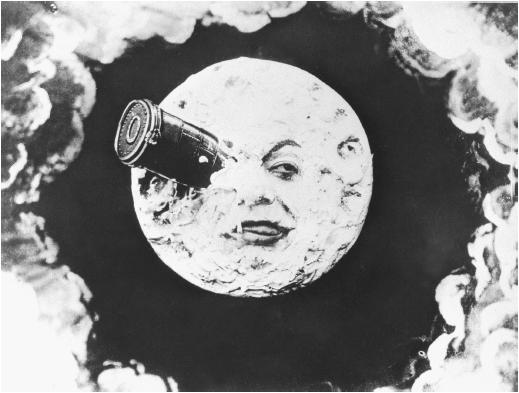
I think most people are aware of Metropolis as a film.
I'll grant that someone might need to know a little about film to have heard of The Story of the Kelly Gang (basically, the first feature length film) and Glorifying the American Girl (film had nudity, was one of the drivers towards the Hayes Code, which most people have heard of)
Put it this way; most kids born in the 80s and 90s have probably not seen Taxi Driver, the Godfather, the Good, the Bad, and the Ugly, or Dirty Harry, but they are still part of our culture and most people can probably recognize aspects or moments or quotes from the films.
Music is very similar. Very few people would claim they are aware of music before Chuck Berry / Elvis Prestley, but people are still aware of individual composers (Bach, Beethoven, Schubert, Wagner, etc) even if they are not aware of their music--and people are also aware of certain melodies even if they can't place what the song is or who wrote it.
People might think that they are unaware of movies before Gone with the Wind / Wizard of Oz / Citizen Kane, but I think most people would be surprised how much they know before that era... and regardless of what people know, I think everyone can agree that the assertion that film only began to fully realized itself with GWTW/Oz/Kane is just base wrong.
(I'm not a film student and I wouldn't consider myself a buff. I probably have more movies than many and I normally watch a few hundred a year, but I'm certainly not knowledgeable relative to real buffs)
KennyL said:Videogames are art as in profession/craftsmanship, but not art as work of art.
Artwork/drawings/illustrations are not automatically art. Art is pretentious. Art is created for the sake of being art from the beginning. It's about the creator's intention. There are a lot of interactive, game inspired art pieces in museum, and they're art because they're created as art. Even the most dumbest dogshit (literally and figuratively) art pieces are art when they're created as art. Again, it's all pretty pretentious.
Checkout some gamey "high art."
http://www.we-make-money-not-art.com/archives/cat_games.php
Art is like porn; you know it's art when you see one. Videogames don't pass this test.
That is a really stupid test. "Subjectivity ahoy!"
Confidence Man
Member
Campster said:In what sense?
If I'm a designer, and I design a system such that the interaction says something, how is that any different than a film maker using editing and different lenses?
As a designer, what you're doing is setting up conditions under which outcomes can potentially occur. If someone can explain to me how that in itself can say something, I'm all ears.
Like Warren Spector used to talk about how emergent gameplay allows the player to create their own narrative. So you look at somethign like Deus Ex or more recently Crackdown and what you get is that the designers are setting up the conditions under which art can happen.
Most of his comments are petty quibling, but his closing argument is sound.
I agree with him that Spiderman 2, as was his example, is a good superhero movie, but lousy art.
In the same way, I think most video games are good at being video games, but when taken as "art," they fall flat on their face without anything to really say.
The trick is that you must accept that not all film is art, not all music is art, etc. Most people do not do this. They want a convenient categorization, and lump entire mediums in or out of the box.
That's really the problem here, because honestly - 99% of video games have more in common with Spiderman 2 than with Citiizen Cane. Most video games, I agree, are not really art by almost any aspect you try to quantify it as.
I agree with him that Spiderman 2, as was his example, is a good superhero movie, but lousy art.
In the same way, I think most video games are good at being video games, but when taken as "art," they fall flat on their face without anything to really say.
The trick is that you must accept that not all film is art, not all music is art, etc. Most people do not do this. They want a convenient categorization, and lump entire mediums in or out of the box.
That's really the problem here, because honestly - 99% of video games have more in common with Spiderman 2 than with Citiizen Cane. Most video games, I agree, are not really art by almost any aspect you try to quantify it as.
Stumpokapow said:I really think you over-credit Citizen Kane there. You call Birth of a Nation rudimentary, but I think it's very well realized and "full". Films had adopted full plots, modern run times, and character developed by at the latest the mid 20s, and definite before Citizen Kane.
The following movies are all probably at least as fully developed as Citizen Kane:
I'm with you, but Kane is a great example of a fully modern film, one that amalgamates multiple fields/mediums artfully and in a unique manner that only the medium of film can accomplish. It rises above genre, a label I'd target at most of the films you've cited, and manages (much more than Oz's veiled allegory) a multi-layered universal tale that simultaneously speaks to the human condition while fully realizing the potential of the medium it was made in.
I think that's the distinction that Ebert is making between art and high art. Citizen Kane isn't just a great film, it's a film that fully reveals the capabilities of the medium it was made in and couldn't be told with the same success in any other medium.
Stumpokapow
listen to the mad man
tha_con said:Improv acting, free form dancing, sculpting, improv jazz, and other forms of spontaneous art are all independant of direction and narrative. Yet they are art. Please tell me how that is so?
You falsely conflate "yet they are art" and "yet we agree that they are art".
Someone arguing that narrative is required for art might have a disagreeable definition of art because of improv, free form dance, sculpting, etc. I agree. I do not think that art requires narrative. But there's nothing inherently wrong with any given set of rules for art. There's nothing wrong with believing that art must be visual or must be aural or must have narrative or must involve interaction or must be emotional. I think any of those limited definitions would likely expand under scrutiny.
But "fallacy" is a logical term and it is not applicable to this argument, which is fundamentally one of taste. Fallacy is used when discussing something that can be rigorously true or false, not something that is fuzzy.
Flynn said:I'm with you, but Kane is a great example of a fully modern film, one that amalgamates multiple fields/mediums artfully and in a unique manner that only the medium of film can accomplish. It rises above genre, a label I'd target at most of the films you've cited, and manages (much more than Oz's veiled allegory) a multi-layered universal tale that simultaneously speaks to the human condition while fully realizing the potential of the medium it was made in.
I think that's the distinction that Ebert is making between art and high art. Citizen Kane isn't just a great film, it's a film that fully reveals the capabilities of the medium it was made in and couldn't be told with the same success in any other medium.
This is definitely interesting commentary, but I'd still argue that of the films I mentioned at least Metropolis is as demonstrative of the potential of the medium as Kane is. I will grant you that your definition does tend to reject Safety Last!, the Wizard of Oz, and Duck Soup.
Ebert's position is not hard to understand. Film like the other forms of 'high art' which preceded it is an observational medium. Sound, and moving pictures made the experience more intense and allowed the telling of a narrative, but it's essentially looking at images.
Anyone who has taken introductory film courses will run into the field of film studies which involve dissecting the 'director's intent' with things such as lighting, framing, and timing of a shot dissected to full effect. I frankly think a lot of it may be overanalysing things that may have come naturally or even subconsciously to a director. But that's how the 'high' art of film is studied.
In games, where users not only control the character but also the camera, it's much harder to mount a similar analysis.
I disagreed with Ebert's characterization of games 'like' Myst as 'scavenger hunts.' At their best, games can establish mood effectively. But then again it's irrelevant to Ebert's point. You're still controlling the character, the framing of screen and the progression of the narrative.
Ebert compared it to sports, which is a type of game. I would simply compare video games to chess. There's a method to how the game is played, there is a set rule a 'board' to play on and total user freedom within those key limitations.
Anyone who has taken introductory film courses will run into the field of film studies which involve dissecting the 'director's intent' with things such as lighting, framing, and timing of a shot dissected to full effect. I frankly think a lot of it may be overanalysing things that may have come naturally or even subconsciously to a director. But that's how the 'high' art of film is studied.
In games, where users not only control the character but also the camera, it's much harder to mount a similar analysis.
I disagreed with Ebert's characterization of games 'like' Myst as 'scavenger hunts.' At their best, games can establish mood effectively. But then again it's irrelevant to Ebert's point. You're still controlling the character, the framing of screen and the progression of the narrative.
Ebert compared it to sports, which is a type of game. I would simply compare video games to chess. There's a method to how the game is played, there is a set rule a 'board' to play on and total user freedom within those key limitations.