• Hey Guest. Check out your NeoGAF Wrapped 2025 results here!

Forspoken Will Be The First Game To Use Microsoft's Direct Storage API


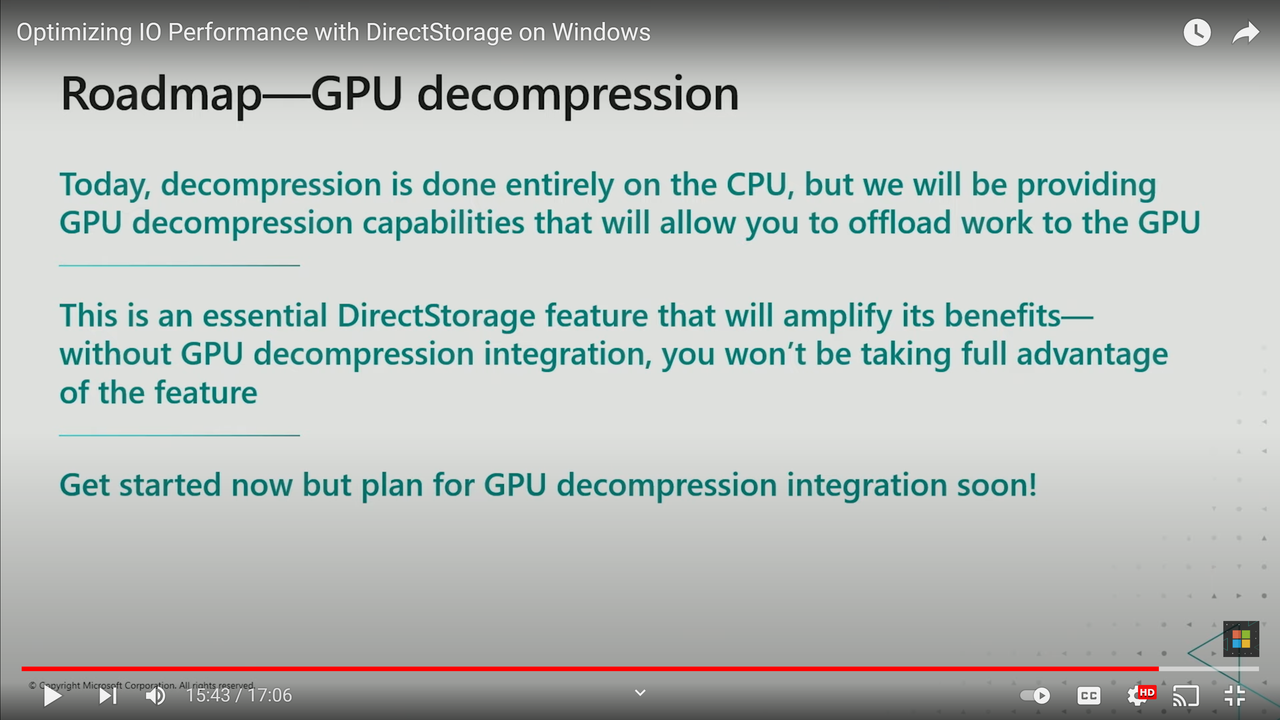
Huge improvement even without the GPU decompression final goal of Direct Storage being available.

Screenshot-2022-03-23-214406.png
 
Yeah, finally we can see the benefits of Direct Storage.
Having a nVme SSD will not longer be the same as having a Sata SSD for games.
 
Last edited:
Yeah, finally we can see the benefits of Direct Storage.

Sorry but I don't - 0.2s faster loading, like c'mon,... And SATA drives are still basically on par with the fastest NVMe drives, because honestly, 2s is literally nothing, especially when we consider the drives are 10x slower than NVMe ones.
 
Sorry but I don't - 0.2s faster loading, like c'mon,... And SATA drives are still basically on par with the fastest NVMe drives, because honestly, 2s is literally nothing, especially when we consider the drives are 10x slower than NVMe ones.

It's 3.7 seconds vs 1.9 seconds. That's almost twice as fast.
But the best part is that a game with an open world, with high detail assets, is loading this fast.
This shows that the pervious MS file system was a bottleneck even for Sata SSDs.


qHwHdDI.jpg
 
Last edited:
It's 3.7 seconds vs 1.9 seconds. That's almost twice as fast.

But still, it's not even mere 2s we're talking about... Especially in times where many games require 40, 60, 80, 100h to complete this kind of savings are worthless really. Going from HDD to SSD a decade ago and decreasing loaging times from 4-5min. all the way down to 5-15s, now that was something, a new quality (specially Windows booting), but now going from those 5s to 2, it's nothing, it's pretty much imperceptible, let alone cutting tenths of a second.
 
But still, it's not even mere 2s we're talking about... Especially in times where many games require 40, 60, 80, 100h to complete this kind of savings are worthless really. Going from HDD to SSD a decade ago and decreasing loaging times from 4-5min. all the way down to 5-15s, now that was something, a new quality (specially Windows booting), but now going from those 5s to 2, it's nothing, it's pretty much imperceptible, let alone cutting tenths of a second.

The move from HDDs to SSDs (sata) removed the biggest bottleneck in storage: access times.
Remember that the first sata SSDs didn't have a read/write speed that was that much higher that HDDs.
But sata SSDs no longer needed to have plate and a read head moving around to find and read files.

For the last few years, we had nvme drives, but devs couldn't take advantage of them.
Forespoken is still a game that is between techs. With time, I bet we'll see the difference between sata and nvme grow further.
Now devs can build games with even more detail, without worrying about being bottlenecked by the file system in windows.

There is also an advantage we might see, besides faster load times. That is less hitching when a game loads assets.

Here's a bit more detail and explanation on this demo. And some of the reasons we are not seeing a bigger difference.

Forspoken Game Dev Says DirectStorage + 20,000 files at 4.5 GB loads in 1.7 seconds


Teppei Ono, Luminous' Technical Director, used a video that was partially put online today to demonstrate the speed advantages that may be expected from using the new DirectStorage subsystem. Complex scenes including over 20,000 files (weighing in roughly 4.5 GB) required only 1.7 seconds to transition from the loading screen to Forspoken's amazing open world.

Two separate scenarios were loaded across multiple storage subsystems in the video presentation: an M.2 SSD, SATA SSD, and HDD. Both the new DirectStorage API and the traditional (and eventually outdated) Win32 storage subsystem were used to test the setups.

Not all storage is created equal. Even the slowest of SSD options would outperform the HDD used to load the game, whether DirectStorage was activated or not. An M.2 SSD took 1.9 seconds to load the scene in scene one with DirectStorage enabled. This was followed by the SATA SSD at 3.7 seconds - more than quadruple the interval - while the HDD took 21.5 seconds to find its own spinning platters.

For this initial scene, Luminous gave further statistics on throughput for the various storage systems, and the findings are eye-opening. The M.2 SSD achieved an outstanding 4,839 MB/s performance while using the DirectStorage API. Under the Win32 API, the identical disk provided nearly half that, at 2,826 MB/s.

It appears that a bottleneck is still in place: one would anticipate load times to be impacted in the same proportion as throughput, but this isn't the case. A 71 percent boost in SSD performance in DirectStorage over Win32 only results in a 0.2 second (about 10%) reduction in load times, dropping it from 2.1 seconds to 1.9 seconds.

One explanation for this might be that Forspoken is still hitting a CPU wall, despite DirectStorage's advances. Perhaps the still-missing GPU acceleration component, which Microsoft is still working on including into DirectStorage, might help matters even more. The developers hope that they will eventually be able to reduce load times to less than one second, albeit this should be considered the exception rather than the rule.

Scene two has the quickest load times. The performance ratio between the three storage systems remains almost the same: the M.2 SSD took 1.7 seconds, while the SATA drive took 3.2 seconds. The HDD finished in last position, as expected, with a time of 19.9 seconds. Forspoken was supposed to be released on May 25th, however, a recent delay pushed that date back by five months to October 11th. If only the Forspoken release could take advantage of DirectStorage as well.

 
Last edited:
Hopefully this picks up quick because we need devs to start designing their game worlds around the streaming capabilities of these new consoles.
 
At this point it's starting to sound like DirectStorage is a more likeable and charismatic character than the game's protagonist :goog_relieved:
 
Top Bottom