• Hey Guest. Check out your NeoGAF Wrapped 2025 results here!

Games that have really nice parallax scrolling

That's not 2d at all, that's exactly like Don't starve, flat 2d textures in a 3d world, just made differently.
The guy says:

"It looks like in Don’t Starve, but remember: Diablo 2 is a 2D game! There’s no official information about this mode."

So he says that without any source... but he has a source, he linked it too... too bad it says the complete opposite:

http://paul.siramy.free.fr/_divers/dt1_doc/

"Ok, so what are the DT1 files ? They are all the Diablo 2 Tiles that are used for the floors and walls of the maps (a Tile beeing the gfx element of a map). Or maybe the T stand in fact for Textures ? Well, that's not important"

"Another usefull things to know : Diablo 2 is a 3D-isometric game"

Ehh, I think you're getting hung up on semantics in articles written by third party sources.

Also, the perspective effect in D2 isn't as simple as mapping textures to already perspective-correct 3D geometry like you seem to think. Standalone objects like pillars, characters, rock piles, etc. are easy to apply as a texture to a 3D polygon and distort in perspective (although D2 is also distorting these in other ways to try and keep them better grounded than a simple polygon would), but the vertical walls which need to seamlessly snap together aren't being drawn on polygons that already exist in the planar 3D space they appear to occupy. Instead they're using some really tricky non-standard distortions to take things already in isometric view and transform them in screen space to fake a shift in perspective. This isn't at all how 3D geometry typically works, and D2's approach functions more like a hybrid, none of which is as simple and straightforward as just mapping "flat 2d textures in a 3d world" because there is no cohesive "3d world" on which to map 2D textures and keep things correctly grounded and stitched together.

Generally I think the posts here that are just showing games rendered in full 3D but restricting player movement to a 2D plane are kind of missing the boat compared to a lot of the clever hacks and tricks developers used to fake 3D depth in fully 2D engines, but I was just supplying a detailed article that explained a lot of what D2 was doing because someone asked.
 
Serious answer, there's some games that make really great use of this effect but I think a lot of them have already been mentioned. When I have time I'll look through the thread and see if I can think of any good ones that are missing.
 
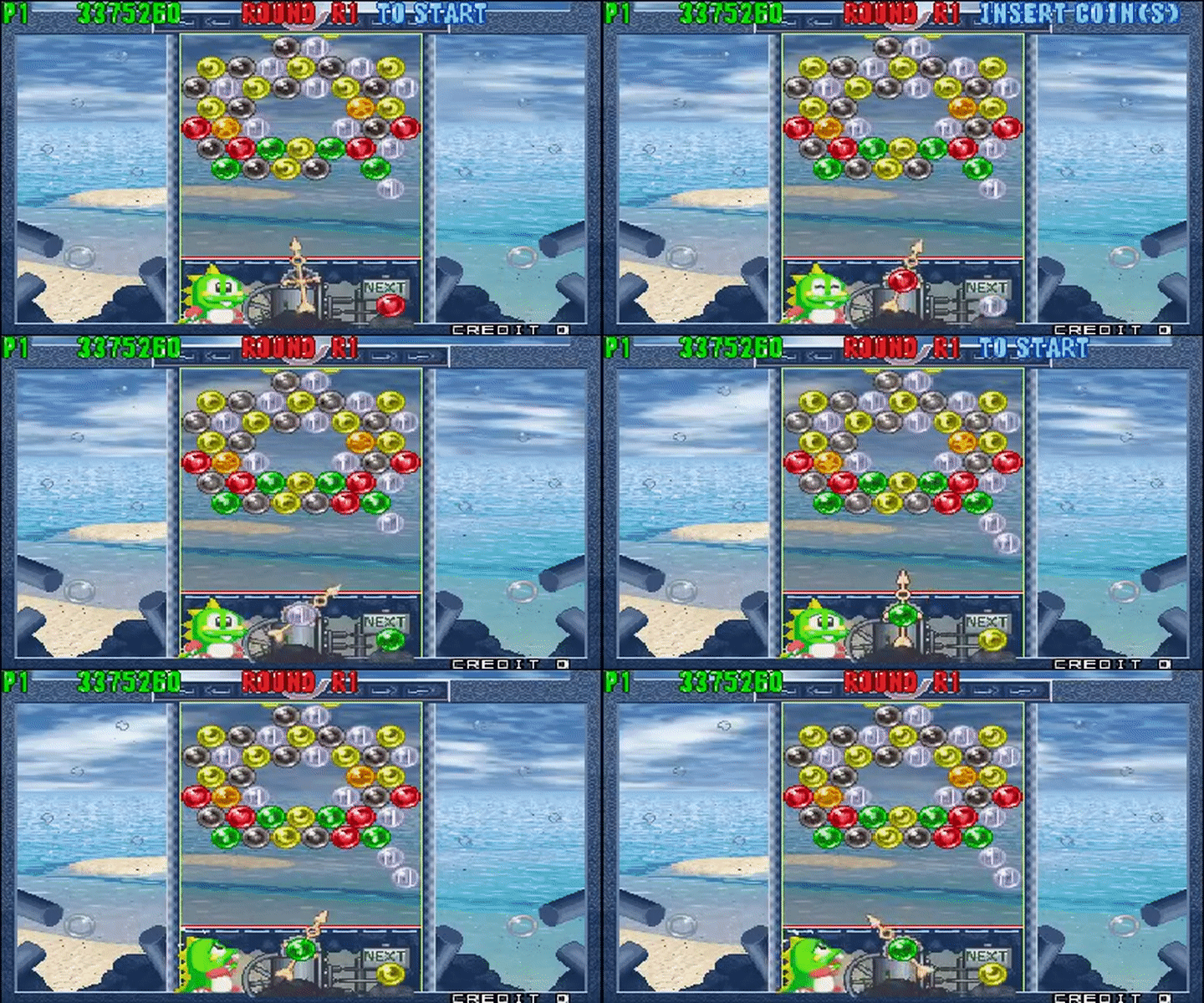
Taito F3 arcade board had some pretty cool effects. Not many puzzle games had parallax scrolling

HU8t4F.gif


This was perhaps the most memorable FG stage back then from SNK. Was really impressed first time I saw it

iTcPQ6.gif
 
Jim Power for the SNES makes my eyes feel funny.
Jim Power: The Lost Dimension in 3-D is the parallaxingest game you'll ever see. Not sure about "really nice parallax scrolling", but it sure is "really parallax scrolling".
Watching footage of that game almost made me throw up.
I have no idea why they chose to have parallax layers scrolling in opposite directions (basically all except the main layer). This makes it look as if the character is navigating a circular area, very weird.
The scrolling in the Amiga version Jim Power in Mutant Planet is much better, and the game is equally impressive technically:

https://youtu.be/5JHIpbWdKow?t=287


More recently, I thought that Valiant Hearts: The Great War made excellent use of multi-layer parallax scrolling (be warned of possible spoilers, the linked part happens towards the end of the game):

https://youtu.be/9XKdrxs40aw?t=670
 
I have no idea why they chose to have parallax layers scrolling in opposite directions (basically all except the main layer). This makes it look as if the character is navigating a circular area, very weird.

I think it might have something to do with the game's 3D gimmick. I'm not sure how it worked, but the game shipped with a pair of glasses.
 
I have no idea why they chose to have parallax layers scrolling in opposite directions (basically all except the main layer). This makes it look as if the character is navigating a circular area, very weird.

I remember one of the levels in Pulseman does the same thing:

https://www.youtube.com/watch?v=BtoBY2S2zzo&t=14m13s

Though looking at the background, maybe he is supposed to be in some sort of circular dome on this stage.
 
Ehh, I think you're getting hung up on semantics in articles written by third party sources.

Also, the perspective effect in D2 isn't as simple as mapping textures to already perspective-correct 3D geometry like you seem to think. Standalone objects like pillars, characters, rock piles, etc. are easy to apply as a texture to a 3D polygon and distort in perspective (although D2 is also distorting these in other ways to try and keep them better grounded than a simple polygon would), but the vertical walls which need to seamlessly snap together aren't being drawn on polygons that already exist in the planar 3D space they appear to occupy. Instead they're using some really tricky non-standard distortions to take things already in isometric view and transform them in screen space to fake a shift in perspective. This isn't at all how 3D geometry typically works, and D2's approach functions more like a hybrid, none of which is as simple and straightforward as just mapping "flat 2d textures in a 3d world" because there is no cohesive "3d world" on which to map 2D textures and keep things correctly grounded and stitched together.

Generally I think the posts here that are just showing games rendered in full 3D but restricting player movement to a 2D plane are kind of missing the boat compared to a lot of the clever hacks and tricks developers used to fake 3D depth in fully 2D engines, but I was just supplying a detailed article that explained a lot of what D2 was doing because someone asked.

Those "third party sources" are the sources of the article, and it's not semantics when they clearly say D2 is a 3d game.

You are probably thinking of the usual 3d texturing in mind, with the usual tecnique of doing textured square tiles and then rotating them so they look isometric, instead they used unrotated textured diamond shaped tiles, probably to be as close to usual 2d development as possible, and everything else is built around that.

Also some people that didn't put the right compatibility mode got a Direct3D error, D3D was just for 3d, DirectX had DirectDraw or whatever for 2d.
 
The Sonic games popped in my head when I saw the thread because of that other thread, and I was originally thinking Aladdin on Genesis did, but after looking through a youtube vid... maybe not. I guess I was remembering something that wasn't there.
 
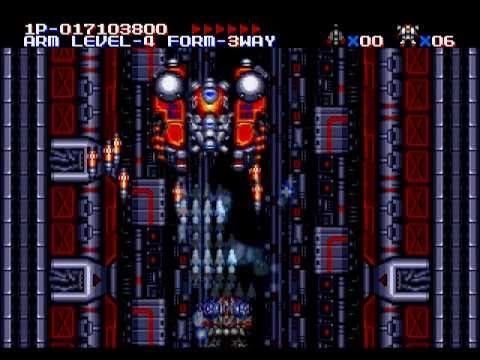
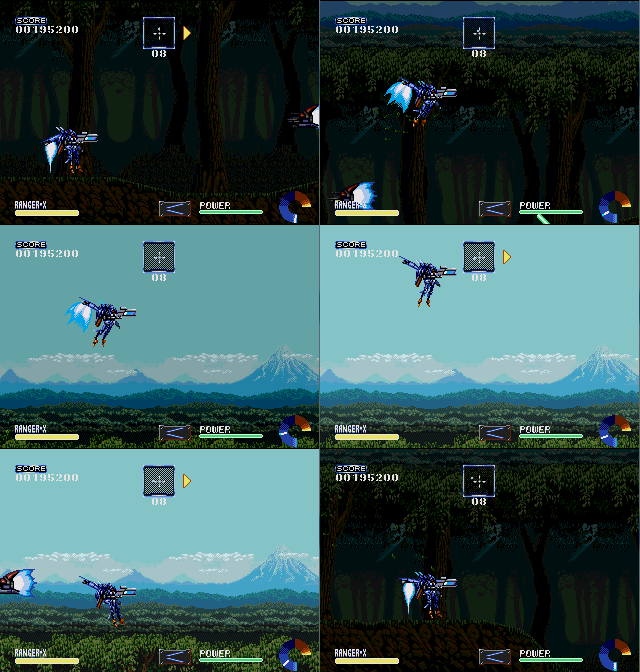
The shmup stages of Rendering Ranger (SFC) come to mind. the maybe most impressive non-chipped 16bit game ever programmed.
stage 7 looks mind blowing: https://www.youtube.com/watch?v=pe1vQnfzLVs

also Super Aleste is a parallax heaven
https://www.youtube.com/watch?v=F6fcQYt_rsk

phalanx (snes) had smooth multi layer parallax throughout the entire game:
https://www.youtube.com/watch?v=ACMWalwYeBU

E.D.F. (snes): https://www.youtube.com/watch?v=qJrA1bFiBlw

second stage of Biometal (snes) looks good too:
https://www.youtube.com/watch?v=JpqMn1mPY-k
 
Top Bottom