

• Hey Guest. Check out your NeoGAF Wrapped 2025 results here!

Google Chrome - Google's Web Browser Revealed

Status
Not open for further replies.
http://blogoscoped.com/archive/2008-09-01-n47.html
google-chrome.png


Today there was a comic book in my mail, sent by Google and drawn by no less than Scott McCloud, creator of the classic Understanding Comics. Within the 38 pages, which I’ve scanned and put up [edit: link to comic coming back soon, the server is a bit stressed right now], in very readable format Google gives the technical details into a project of theirs: an open source browser called Google Chrome. The book points to www.google.com/chrome, but I can’t see anything live there yet. In a nut-shell, here’s what the comic announces Google Chrome to be:

- Google Chrome is Google’s open source browser project. As rumored before under the name of “Google Browser”, this will be based on the existing rendering engine Webkit. Furthermore, it will include Google’s Gears project.

- The browser will include a JavaScript Virtual Machine called V8, built from scratch by a team in Denmark, and open-sourced as well so other browsers could include it. One aim of V8 was to speed up JavaScript performance in the browser, as it’s such an important component on the web today. Google also say they’re using a “multi-process design” which they say means “a bit more memory up front” but over time also “less memory bloat.” When web pages or plug-ins do use a lot of memory, you can spot them in Chrome’s task manager, “placing blame where blame belongs.”

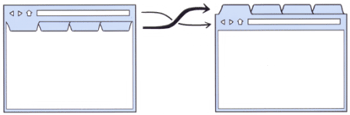
- Google Chrome will use special tabs. Instead of traditional tabs like those seen in Firefox, Chrome puts the tab buttons on the upper side of the window, not below the address bar.
google-chrome-tabs.png


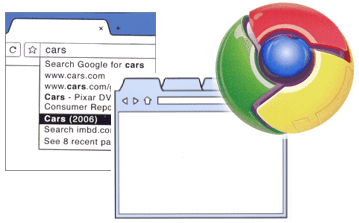
- The browser has an address bar with auto-completion features. Called ’omnibox’, Google says it offers search suggestions, top pages you’ve visited, pages you didn’t visit but which are popular amd more. The omnibox (“omni” is a prefix meaning “all”, as in “omniscient” – “all-knowing”) also lets you enter e.g. “digital camera” if the title of the page you visited was “Canon Digital Camera”. Additionally, the omnibox lets you search a website of which it captured the search box; you need to type the site’s name into the address bar, like “amazon”, and then hit the tab key and enter your search keywords.

- As a default homepage Chrome presents you with a kind of “speed dial” feature, similar to the one of Opera. On that page you will see your most visited webpages as 9 screenshot thumbnails. To the side, you will also see a couple of your recent searches and your recently bookmarked pages, as well as recently closed tabs.

google-chrome-home.png


- Chrome has a privacy mode; Google says you can create an “incognito” window “and nothing that occurs in that window is ever logged on your computer.” The latest version of Internet Explorer calls this InPrivate. Google’s use-case for when you might want to use the “incognito” feature is e.g. to keep a surprise gift a secret. As far as Microsoft’s InPrivate mode is concerned, people also speculated it was a “porn mode.”

- Web apps can be launched in their own browser window without address bar and toolbar. Mozilla has a project called Prism that aims to do similar (though doing so may train users into accepting non-URL windows as safe or into ignoring the URL, which could increase the effectiveness of phishing attacks).

- To fight malware and phishing attempts, Chrome is constantly downloading lists of harmful sites. Google also promises that whatever runs in a tab is sandboxed so that it won’t affect your machine and can be safely closed. Plugins the user installed may escape this security model, Google admits.

This looks like a very interesting project, and I think it can’t hurt to have more competition in the browser area. Google is playing this as nicely as possible by open-sourcing things, with perhaps part of the reason to try to defend against monopoly accusations – after all, Google already owns a lot of what’s happening inside the browser, and some may feel owning a browser too could be a little too much power for a single company (Google could, for instance, release browser features that benefit their sites more than most other sites... as can Microsoft with Internet Explorer). For now, until Chrome is released in a testable version, how much of the speed, stability and user interface promises will be fullfilled – and how much of the interface you’ll be able to configure in case you don’t like it – remains to be seen.
 
Interesting stuff, but I think I'll stick with Firefox. I'll definitely test it out once it's released however.
 
jenov4 said:
Interesting stuff, but I think I'll stick with Firefox. I'll definitely test it out once it's released however.

same, i'm really happy with firefox 3 right now.
 
Here's the thing: now that we're at a point where so many web rendering engines are shared and the overall browsing experience is pretty similar between browsers, new browsers have to absolutely blow my socks off for me to care anymore. Right now, it's basically the "what one feature do I like better?" game. I like Flock's image bar for working with stuff like Flickr and Photobucker, but the fact that they neutered their bookmark tagging system while Firefox build their own great one means I'll never use Flock.

If Google is serious about this, they need to do far more than just slap a couple of "nice" features together and call it a browser.
 
never understood why people want thumbnails of browser pages. it's kinda useless to me if i can't really see what's on the page.

it would be useful if you hover over the thumbnail and it zooms into a realtime shot of the page, move away to zoom back out to the thumbnails.
 
As long as they won't attempt to push their own set of web standards, I'll give it a try. FF3.0 just feels too clunky for me.

- Chrome has a privacy mode; Google says you can create an “incognito” window “and nothing that occurs in that window is ever logged on your computer.” The latest version of Internet Explorer calls this InPrivate. Google’s use-case for when you might want to use the “incognito” feature is e.g. to keep a surprise gift a secret. As far as Microsoft’s InPrivate mode is concerned, people also speculated it was a “porn mode.”

Once they start blocking data from being logged anywhere else as well, the beast will be unleashed.
 
So basically Firefox has beaten them to most of these features, and Opera already has the others. nice work Google!
 
mattiewheels said:
never understood why people want thumbnails of browser pages. it's kinda useless to me if i can't really see what's on the page.

I'll tell you exactly where I'd like thumbnails of pages: in my history and bookmarks. It's far easier to remember a site by, well, sight than by name. I'll often remember that I was on that one page that was like really green with a big graphic at the top, but have no memory of what it was called or the URL.

Being able to scroll through snapshots of pages I've visited or bookmarked would be heaven.
 
Eh, interesting. Wonder if it'll kill off the Google-Mozilla quasi-partnership. I'll check it out, but nothing makes me say "holy shit".
 
Additionally, the omnibox lets you search a website of which it captured the search box; you need to type the site’s name into the address bar, like “amazon”, and then hit the tab key and enter your search keywords.

Uh...in Firefox, I can click the website I want in the top right searchbar and search that website, ex: ebay, wikipedia, amazon, without having to type the name. Just 2 clicks.

So, not impressed.
 
jonnybryce said:
Uh...in Firefox, I can click the website I want in the top right searchbar and search that website, ex: ebay, wikipedia, amazon, without having to type the name. Just 2 clicks.

So, not impressed.
You can even type shit into FF's address bar and it'll try using google's im feeling lucky.

Disclaimer: I have nothing to do with Mozilla.
 
jonnybryce said:
Uh...in Firefox, I can click the website I want in the top right searchbar and search that website, ex: ebay, wikipedia, amazon, without having to type the name. Just 2 clicks.

So, not impressed.

I've been using that method since it was added to FF (or was it before?), but I've switched to Ubiquity's method now. And that's way faster than this version, too. <Ctrl+Spacebar>, "g porn".
 
Phoenix said:
Can't imagine why they would add to the browser confusion out there by building a new one.
Of the types of "browser confusion" you could be referring to, only confusion over inconsistent support of standards would be the one I'd be concerned about. But since this supports webkit, hopefully that's not a concern here and we can just evaluate on the basis of the supporting functions and performance.
 
Illuminati said:
Fixed

People like choices?


Do you like going to websites and seeing the layout all jacked up because developers couldn't deal with the 15 different browser interpretations of the W3C spec?
 
Phoenix said:
Do you like going to websites and seeing the layout all jacked up because developers couldn't deal with the 15 different browser interpretations of the W3C spec?
There are only two paths when coding webpages, IE and then the other browsers that actually follow web standards.
 
Koshiro said:
So basically Firefox has beaten them to most of these features, and Opera already has the others. nice work Google!

If they can integrate google services well into this browser (as I use a shitload of them) then I'm sold.
 
If the javascript engine is really all that and a bag of chips than Firefox can surely incorporate it right?
 
Azih said:
If the javascript engine is really all that and a bag of chips than Firefox can surely incorporate it right?
I think one of the goals of Firefox 3.1 is to improve javascript performance.
 
Guybrush Threepwood said:
I like a lot of what I just read. The separate processes do sound memory intensive, but I guess I can't go forever without upgrading my computer. The benefits seem to outweigh the negatives - which would only be really prominent with someone with an old machine like me anyway.

I fucking hate the intrusive way auto-complete works and the suggestions it will give deep into a site rather than the homepage. Their version of autocomplete sounds so much better.

The understanding that many people don't have a homepage or keep a really simple one for speed reasons is nice as well. The speed dial clone they suggest would be a nice alternative if it learns as well as they make it seem and loads as quickly as vanilla google or no homepage at all.

Also the built-in sand boxing sounds great as well. I stopped using Sandboxie because it felt like a resource hog. I like its functionality though.

All around I'm very excited to use this browser.
 
Some neat ideas in there. But it'll have to exceed Opera functionality out of the box, while providing extensions ala Firefox to get me to change.
 
Illuminati said:
There are only two paths when coding webpages, IE and then the other browsers that actually follow web standards.

That's simply not true. People seem to think that only IE has weird browser behaviors.

Safari, Firefox, and Opera will render things differently as well. This is one of the reasons why people will specifically 'say incompatible' Safari or Opera.
 
I love the idea of a Google browser, given how much I use their services, but until they can compare with Firefox's speed and memory usage, even with my 30+ extensions, they're better off just keeping it on the down low. They should keep developing this for a couple more years, get the memory usage down & makes sure it's feature rich.


Also, tabs above the address bar is silly and not as practical.
 
Illuminati said:
Fixed

People like choices?

yeah the web browser arena is the place where I kind of wish there was less choice.

I wish all the browser companies would get together and come to some sort of consensus on standards, the way electrical companies do. Thats how things really take off, when multiple companies can produce their own version, but they all comply.

Trying to develop for the two major browsers is enough of a ballache as it is, adding another major browser (which it might be being Google) would just make things unmanageable.

Firefox 3 people. Love it.
 
Phoenix said:
That's simply not true. People seem to think that only IE has weird browser behaviors.

Safari, Firefox, and Opera will render things differently as well. This is one of the reasons why people will specifically 'say incompatible' Safari or Opera.

QFT, however it says this runs on Webkit, which would probably ensure it's nearly entirely compatible with Safari... unless the Javascript engine is whacked.

Note that:

http://www.google.com/chrome

yields a totally different 404 page than, say

http://www.google.com/chrome2

Reality is confirmed.
 
kaizoku said:
yeah the web browser arena is the place where I kind of wish there was less choice.

I wish all the browser companies would get together and come to some sort of consensus on standards, the way electrical companies do. Thats how things really take off, when multiple companies can produce their own version, but they all comply.

Trying to develop for the two major browsers is enough of a ballache as it is, adding another major browser (which it might be being Google) would just make things unmanageable.

Firefox 3 people. Love it.

There are standards. The issue is that a) Some don't follow them, and b) they change often.
 
SpeedingUptoStop said:
Also, tabs above the address bar is silly and not as practical.
Why is that?

kaizoku said:
yeah the web browser arena is the place where I kind of wish there was less choice.

I wish all the browser companies would get together and come to some sort of consensus on standards, the way electrical companies do. Thats how things really take off, when multiple companies can produce their own version, but they all comply.

Trying to develop for the two major browsers is enough of a ballache as it is, adding another major browser (which it might be being Google) would just make things unmanageable.

Firefox 3 people. Love it.

Standardization seems to be one of the goals of Google's browser efforts though. So why not embrace it, hope MS and Mozilla take some of their open-source solutions to rendering, and implement them into their own browsers? Once that happens it basically then just comes down to MS being a fucking douche with its proprietary stuff like ActiveX.
 
SnakeXs said:
There are standards. The issue is that a) Some don't follow them, and b) they change often.

The problem is actually that the standards haven't changed enough. W3C didn't do anything for nearly a decade after 4.0.1 transitional (aside from XHTML and SOAP stuff). They didn't do anything to standardize XMLHttpRequest, and as such the AJAX revolution was only by great fortuity "standard" enough to work in two modes: IE and everything else.
 
i love firefox so itll take a very impressive web browser to pull me away. ill check this out when it comes out though
 
Dali said:
Why is that?

From my own perspective, I change tabs a hell of a lot more than actually typing out an address.


Your question actually sparked this interest in my head: you know what I'd absolutely LOVE to see? For a browser to do away with the permanent address bar completely. Instead, integrate the address bar into the right click menu.

I'll gladly check this out when it's released; it's not uncommon for Google to pleasantly surprise.
 
Davidion said:
From my own perspective, I change tabs a hell of a lot more than actually typing out an address.


Your question actually sparked this interest in my head: you know what I'd absolutely LOVE to see? For a browser to do away with the permanent address bar completely. Instead, integrate the address bar into the right click menu.

I'll gladly check this out when it's released; it's not uncommon for Google to pleasantly surprise.

I keep the Location bar hidden in Safari (Command-Shift-|) and use Command-L to bring it up, then it hides itself when I don't need it.
 
Looks interesting, I will probably check this out.
 
Pretty cool. I'd love a web browser that would integrate all of Google's services. Have it already set up for Notebook clips, saves your bookmarks to Google bookmarks so they appear in the menu if you use the browser on a different location, etc.

The one thing I don't like about Opera (not really Opera's fault) is that a lot of Google's services don't work well with as opposed to IE or Firefox. Chrome + Opera would be great for me.
 
I hereby surrender my soul to Google. I advise you all to do the same. Their mastery of cyberspace is inevitable, and eventually they will bleed out into the real world. The wicked shall be crushed under their superior software and the faithful shall reap their rewards from the future, Google's future.

Odegra.
 
Phoenix said:
Do you like going to websites and seeing the layout all jacked up because developers couldn't deal with the 15 different browser interpretations of the W3C spec?

Google Chrome is Google’s open source browser project. As rumored before under the name of “Google Browser”, this will be based on the existing rendering engine Webkit.
It's not going to be any different than Safari.
 
This was probably a pretty minor investment from Google, come to think of it. I wouldn't be surprised if the architecture is based on the webkit-based build they've done for Android. They probably just needed to add multi-core optimization and a cross-platform UI on it.
 
Davidion said:
From my own perspective, I change tabs a hell of a lot more than actually typing out an address.


Your question actually sparked this interest in my head: you know what I'd absolutely LOVE to see? For a browser to do away with the permanent address bar completely. Instead, integrate the address bar into the right click menu.

I'll gladly check this out when it's released; it's not uncommon for Google to pleasantly surprise.

you know I almost never type addresses anymore. Its kind of sinister but I use a combination of apps and google to navigate around the web. Pretty much the only time I type URLs to an extent is when I'm developing websites at work - and even then its only if I haven't visited it before.

Firefox's URL word-match, Firefox Ubiquity commands, Firefox google search box - if I want to find something on imdb, I don't go to imdb then search, I search google for "word imdb", or more recently I Ubiquity it.

Some blog lately was suggesting that eventually the address bar will be completely removed and in its place will be a bar which says Google. Frightening how close we are to that.

Some companies have even given up putting horrible looking URLs into adverts and instead put in the term users should search for to find their page.
 
Status
Not open for further replies.
Top Bottom