• Hey Guest. Check out your NeoGAF Wrapped 2025 results here!

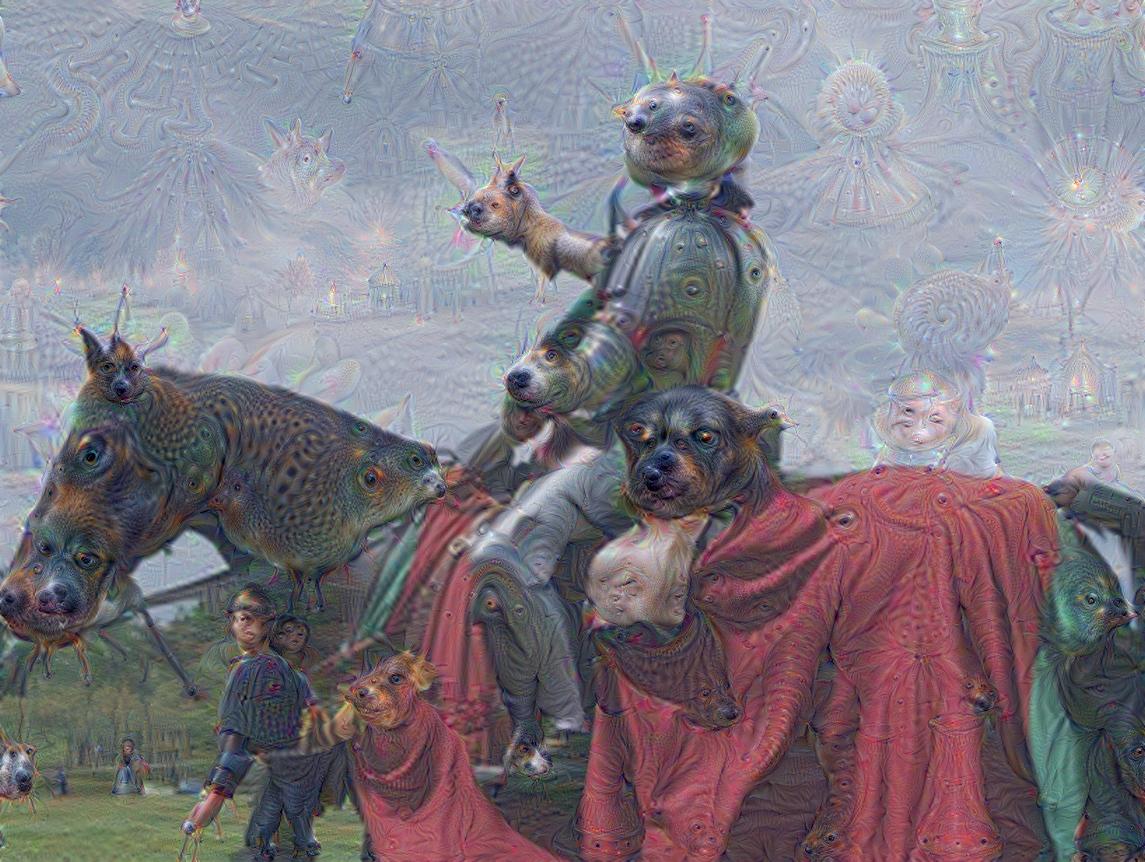
Google sets up feedback loop on it's image recognition neural network - holy shit

Status
Not open for further replies.
iscgLVm.png

there's been a programme to write new music in the style of beethoven etc. for a while now.
 
So, I mean I'm not that much into how a neural networks, but in laymens terms what they're doing is giving this program a picture, and then putting in parameters such as 'Find the animals' or 'find dogs', and then it pulls images and tries to 'draw' those images into where it would fit?
 
Basically to see how the machine does what it does. The article talks about dumbbells for example. It could only picture dumbbells with these muscular biceps gripping them.

It's kind of weird when you think about it. They made this software, but don't know how a lot of it works. It taught itself to recognize patterns for image recognition, and research like this helps identify what those pattern recognition systems boil down to.

It's even more robust than that, these neutral networks are layered - where the low levels look for edges and other low level concepts, and the higher levels look for the less conceptual, like a building or an animal. When they focus on certain levels, you see different results - this let's them understand the relationship better.

Well they would ask find X, and show only the highest probability. So basically, improve Google image search. In this case, they just kind of tweaked it so that it would show us where it thinks it saw what was asked.
Woah, thanks a lot
 
LSD trips for machines. It's fascinating to see, while incredibly infantile technology - deep learning - that machines can actually 'see'. And this technology will only improve over time, so these images will become more accurate.
 
So, I mean I'm not that much into how a neural networks, but in laymens terms what they're doing is giving this program a picture, and then putting in parameters such as 'Find the animals' or 'find dogs', and then it pulls images and tries to 'draw' those images into where it would fit?

That's basically it for some of these pictures, for others it's more permissive.

So to explain what I mean (and to be fair, I'm basically a layman here too), I'll try to explain how object recognition NN's work, from my understanding.

Think about a sort of... multi-sectioned pipe. Lets say 3 sections. In one end, you put in a image, in the other end, you have all interesting objects in that image outlined.

When the image goes in, in that first section of the pipe, the section goes to work finding edges. Apparently, this is based heavily on how our own mind works, and was one of the big breakthroughs in object recognition, getting this process to work well. So this section of the pipe finds all the notable edges, and even lets say basic shapes and highlights them, and shoots them over to the next pipe section. This section finds, lets call them 'object parts'. These parts are the accumulation of edges and shapes and whatnot, into really basic things like... a wheel. Or an eye, or a nose or a roof... you get the idea. Now these are highlighted and put into the next sectioned piece of the pipe. This last piece looks at these things and is like 'so what has two eyes, a nose and a mouth?' - and it figures out this is a face. We can go deeper, and figure out -how- a face was defined to have these things - it's really interesting to be honest, and if you look up something like 'google recognizing cats' you'll read more about it - but I think there are more than a few ways to map these recognized object parts into a final top level object.

So that's roughly (very roughly, there are more layers and they are more interesting than what I described) how object recognition works. And what Google has done in some of these images is said "Hey Layer one, can you -really- go over those edges and shapes over and over again?" or "hey, layer 3, can you check these clouds over and over again and see if you find anything interesting?" and they feed these things back through the system over and over again, with the outlining and highlighting from the previous result, and the original result of like "Maybe there is a 2% chance this thing (a cloud) could be a race car, here let me highlight that spot for you and outline it" gets reinforced to "this thing is totally a racecar".
 
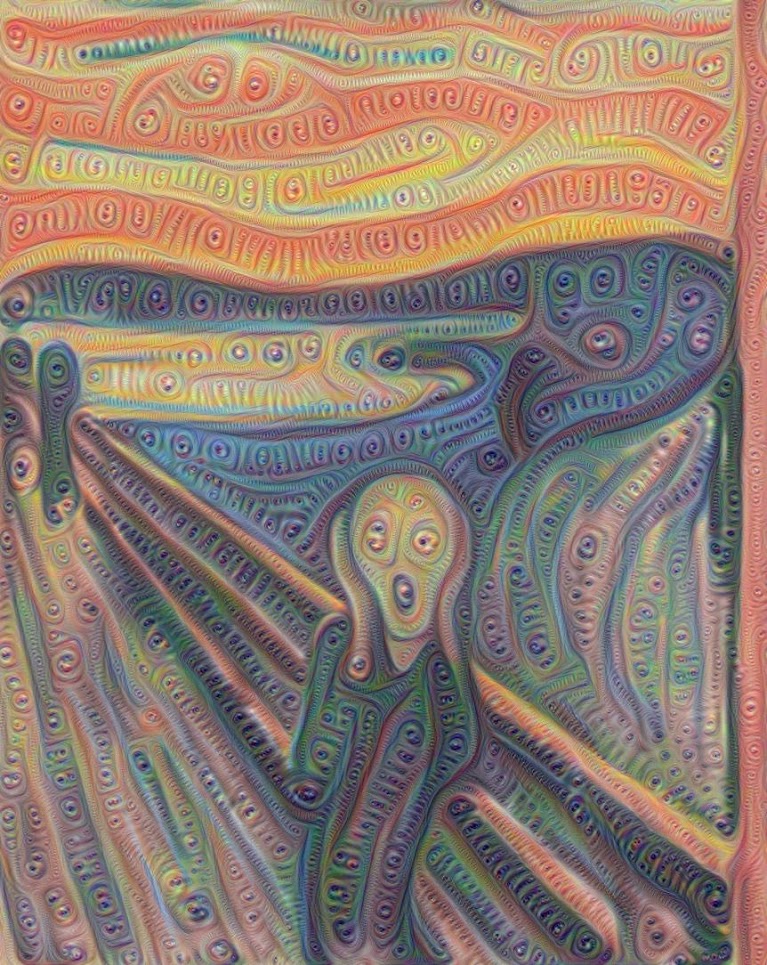
These are pretty beautiful, honestly! And surreal. I mean, it makes sense that a program like this would look for eyes, but I didn't realize it'd see eyes in everything.

Something something eyes of God.

Edit: not sure what to think of the comparisons of the brain with this. It's a very interesting experiment, but I don't really think I'd say it demystifies the brain.
 
Something something eyes of God.

Edit: not sure what to think of the comparisons of the brain with this. It's a very interesting experiment, but I don't really think I'd say it demystifies the brain.

Well, considering things like edge detection, a fundamental part of modern day object recognition, are based on how our own brain interprets and recognizes objects, it makes a ton of sense, Mind you this is my own (and other peoples) idle observations and considerations, and not something that Google is saying themselves - just take a look at how often people here are saying that these images map extremely close to their own experiences on mind altering hallucinogens.

I think I remember one person even saying that some hallucinations are basically what google is telling this machine to do - finding subtle patterns that are reinforced on loop, into weird otherworldy objects.
 
I want some of those poster sized to put on my wall.

Would make some great conversation.

"Awesome art. Who's the artist?"
"Google AI."
"No seriously man, who did that shit? It's inspired!"
"Seriously. It was created by a neural network Google designed."
"Damn. Skynet be trippin!"
 
Well, considering things like edge detection, a fundamental part of modern day object recognition, are based on how our own brain interprets and recognizes objects, it makes a ton of sense, Mind you this is my own (and other peoples) idle observations and considerations, and not something that Google is saying themselves - just take a look at how often people here are saying that these images map extremely close to their own experiences on mind altering hallucinogens.

I think I remember one person even saying that some hallucinations are basically what google is telling this machine to do - finding subtle patterns that are reinforced on loop, into weird otherworldy objects.

I can see where the perspective is coming from. I have to read the articles a bit more, but I think my general objection would be maybe the visual outcome of these images and someone hallucinating is the same, but I'm not sure that the road for getting there is the same thing. I'm not a brain scientist so I could just not know what I'm talking about.

Nevertheless I do think it's an interesting theory and would like to see this kind of stuff explored in other areas.

I'll try to finish the last two articles you posted to see if I can better formulate my position.
 
It's neat seeing the contrast between what happens when the AI tries to create western architecture out of random noise and when it tries to create east asian architecture:

 
These pics are to LSD like a family photo is to actually being there. The Munch ones are insane though.

Edit: Imagine those pics being living entity's and you would come a little closer to a trip.
 
I wonder how much processing power is required to generate these images.

Imagine if you could build these in real-time and apply it as a filter to a video feed. Next you put on some AR glasses, switch the filter on, and trip balls.
 
Status
Not open for further replies.
Top Bottom