


keraj37
Contacted PSN to add his card back to his account
What is your GOTY of 1962?
Back in the days I loved Marienbad not only cause it was made by Pole like I am, but also it had some innovations video game industry hasn't seen yet.
Anyway here is the entire list of all games from this year (all quotes from wikipedia):
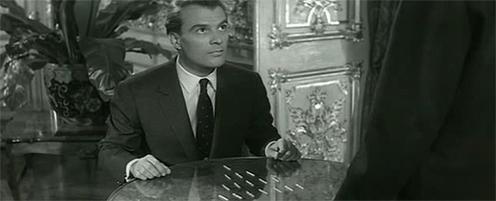
1. Marienbad

2. Spacewar!

Back in the days I loved Marienbad not only cause it was made by Pole like I am, but also it had some innovations video game industry hasn't seen yet.
Anyway here is the entire list of all games from this year (all quotes from wikipedia):
1. Marienbad
Marienbad was a 1962 Polish puzzle mainframe game created by Elwro engineer Witold Podgórski in Wrocław, Poland for its Odra 1003. It was an adaption of the logic game nim. Inspired by the discussion in the magazine Przekrój of a variant of nim in the 1961 film Last Year at Marienbad (L'Année dernière à Marienbad), named "Marienbad" by the magazine, Podgórski programmed the game for the in-development 1003 mainframe, released in 1963. The game had players opposing the computer in alternating rounds of removing matches from a set, with the last player to take a match the loser. As the computer always played the optimal moves, it was essentially unbeatable.
In nim, players take turns removing at least one object from a set of objects, traditionally matchsticks, with the goal of either being or not being the player who removes the last object. The gameplay options can be modeled mathematically.[1] In Marienbad's default game mode, four rows of matches were generated, with either one, three, five or seven matches within each row. The side that was left with the last match lost. The computer printout showed the player the current layout of matches. A single player could play the game at a time, whose turn alternated with the computer's.[2] Regardless of which side started the game, the computer was almost certain to be the winner, as it always made the perfect moves.[3]
On its maximum settings, the game consisted of 8,000 rows containing up to 1 trillion matches, requiring an hour for the computer to choose its next move. The game did not support a video output, as the Odra 1003 did not have a screen. Instead, the game was played via a teletypewriter and card perforator, on which the machine printed the results.[3]
2. Spacewar!
Spacewar! is a space combat video game developed in 1962 by Steve Russell, in collaboration with Martin Graetz and Wayne Wiitanen, and programmed by Russell with assistance from others including Bob Saunders and Steve Piner. It was written for the newly installed DEC PDP-1 at the Massachusetts Institute of Technology. After its initial creation, Spacewar was expanded further by other students and employees of universities in the area, including Dan Edwards and Peter Samson. It was also spread to many of the few dozen, primarily academic, installations of the PDP-1 computer, making Spacewar the first known video game to be played at multiple computer installations.
The gameplay of Spacewar involves two monochrome spaceships called "the needle" and "the wedge", each controlled by a player, attempting to shoot one another while maneuvering on a two-dimensional plane in the gravity well of a star, set against the backdrop of a starfield.[2][4] The ships fire torpedoes which are not affected by the gravitational pull of the star. The ships have a limited number of torpedoes and a limited supply of fuel, which is used when the player fires his thrusters.[6] Torpedoes are fired one at a time by flipping a toggle switch on the computer or pressing a button on the control pad, and there is a cooldown period between launches. The ships follow Newtonian physics, remaining in motion even when the player is not accelerating, though the ships can rotate at a constant rate without inertia.[2]
Each player controls one of the ships and must attempt to shoot down the other ship while avoiding a collision with the star or each other. Flying near the star can provide a gravity assist to the player at the risk of misjudging the trajectory and falling into the star. If a ship moves past one edge of the screen, it reappears on the other side in a wraparound effect. A hyperspace feature, or "panic button", can be used as a last-ditch means to evade enemy torpedoes by moving the player's ship to another location on the screen after disappearing for a few seconds, but the reentry from hyperspace occurs at a random location, and in some versions there is an increasing probability of the ship exploding with each use.[6]
Last edited:


