• Hey Guest. Check out your NeoGAF Wrapped 2025 results here!

HIV vaccine shows modest results for first time

Status
Not open for further replies.
methane47 said:
I also dont understand how these tests are done..

Scientist: *HIV VACCINE TESTING!!!*
/people show up.
/Scientist injects them with vaccine
Scientist: Ok you're good.. go have unprotected sex.

???

good question

 
Graf Nudu said:
One half (eight thousand people) got the vaccine, the other got a placebo. 74 people out of eight thousand of that placebo group got AIDS. in the vaccine group only 51 people out of eight thousand got AIDS.

74 -51 = 23

23/74 = 0.310810811

0.310810811 * 100 = 31%


-> 31% less infected people.

Really? Seems like a difference of 23 people in 8,000 could be easily explanded as just normal randomness. =/
 
Amibguous Cad said:
Because heterosexual women never have AIDS, and it is impossible to transfer AIDS through vaginal sex or heterosexual anal sex.

The more you know!
Wow. Really? Load off my mind. I think you're directing your sarcasm at the wrong poster.
 
ZealousD said:
Really? Seems like a difference of 23 people in 8,000 could be easily explanded as just normal randomness. =/

That's why we have statistics. There is less than 5% chance that this difference is a random happening.
 
Amibguous Cad said:
Because heterosexual women never have AIDS, and it is impossible to transfer AIDS through vaginal sex or heterosexual anal sex.

The more you know!

My sarcasm meter may be reading you wrong, but...

Janice Shaw Crouse said:
In regards to women’s vulnerability to HIV, to be blunt again, the HIV virus can burrow through natural barriers, enter the blood stream, gain access to deeper tissues and reproduce much more easily in the rectum than in the vagina. Thus, women are better protected against the virus. Dirty needles bypass the skin barrier of addicts; likewise, a nursing infant of an infected mother is directly vulnerable to the virus. The healthy vagina, however, has a strong lining that is infection resistant, and under normal circumstances, its tremendous elasticity minimizes the risk of tears and abrasions so that the HIV virus, barring a weakening of the system, has great difficulty breeching its natural barriers. Thus, according to Dr. Grossman, some researchers contend that vaginal transmission is very rare. This view is supported by the fact that studies of prostituted women reveal that AIDS is found overwhelmingly only among those who are also intravenous drug abusers.

http://americansfortruth.com/news/hivaids-anybody-can-get-it.html

Heterosexual women are just more protected by it, not completely invulnerable.
 
Nizar said:
Is this true?

HIV is a retrovirus. This means when a person gets infected with it, the virus (which is an RNA virus) gets into the cell and uses a reverse transcriptase to create a DNA analog of it (most viruses are DNA or RNA only). Once the DNA is created, it gets integrated into the DNA of the cell itself.

What does this mean?

1. It is not an efficient RNA/DNA duplication. This means a lot of mutations occur, meaning the virus changes a lot as it continues to spread.

2. Once it is in the cell's DNA, it is hard to detect (the host can't use its immune system to detect it)
 
methane47 said:
I also dont understand how these tests are done..

Scientist: *HIV VACCINE TESTING!!!*
/people show up.
/Scientist injects them with vaccine
Scientist: Ok you're good.. go have unprotected sex.

???

I presume they then take blood from these people then use sciency skills to see how it defends itself against HIV, maybe.
 
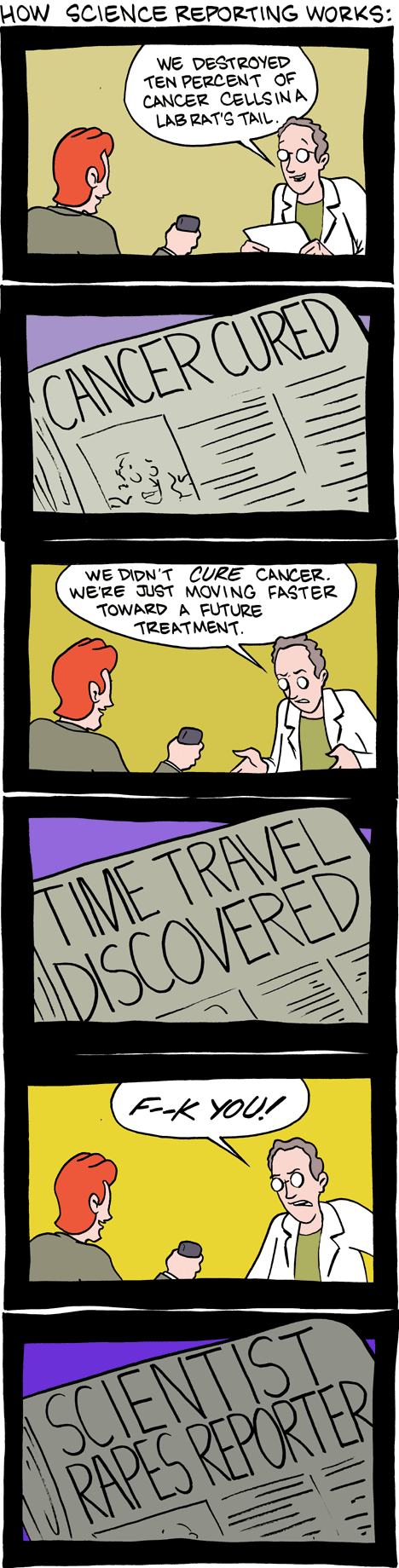
this could not be more relevant:

20090830.gif
 
-COOLIO- said:
good question

I was thinking the same thing.

Doesnt testing the vaccine depend on the general health and the actual body of the person to produce more anti bodies, etc.

With just a blood sample I dont know...
 
I also wonder how the test was done.

It seems, like another poster pointed out, that such a small percentage, compared to the pool that is, would be a margin of error.

The amount of times people had sex, or if they were totally abstinent, would seem to skew the results.
 
What is the predominant cause of HIV/AIDS and why is there such a massive focus of it in the US in that map? I've heard of pretty much all the suggestions and theories but none of them made sense to me
 
Meus Renaissance said:
What is the predominant cause of HIV/AIDS and why is there such a massive focus of it in the US in that map? I've heard of pretty much all the suggestions and theories but none of them made sense to me

That picture is somewhat misleading. It goes by sheer numbers of cases in each region. Given that the United States is one of the most populated nations in the world, obviously it will have one of the highest numbers.

Look at the tiny African nations that have as many cases as the US. They are, proportionally, far worse.

gamergirly said:
I hope they do come up with a cure to AIDS. I'm still in the belief it's going to end humanity in another 100 years if we don't burn ourselves up or God hasn't orchestrated The Rapture

Humanity isn't going to die from a disease that isn't contagious via the air or something similar. Diseases like HIV can be quarantined, the only reason they haven't done it yet is because it isn't a serious enough problem yet.
 
They gave half of the test group a placebo - that scares the shit out of me.

Scientist: half of you are going to catch AIDS and it won't be cured, btw.
 
I think people would be aware that not all of them are getting a cure. You'd have to sign an agreement anyways, wouldn't you? Also, people who are taking the survey probably know a little about statistics that they can accurately say that their findings are in a large part due to the vaccine rather than random chance.
 
On paper, the results sound somewhat promising, although I would remain cautiously optimistic until I get the chance to see the actual results of the study, including the type of risk behavior (if any) that infected pacientes on each group might have incured into.

There are a number of reasons that have prevented the development of an effective HIV vaccine so far (using the usual approach involving the creation of effective antibodies and a strong cytotoxic T lymphocyte response), including the fact that because of its very nature as a retrovirus, the mutation rate of HIV is extremely high, which leads to poor immune recognition, and of course the fact that the window of opportunity for the immune system to get rid of the infection is very narrow, since it only takes days to weeks for the virus to enter hidden reservoirs and establish latent infection. Once HIV gets there, it's safe from immune response and from the action of ARV medications.

This seems to be a step in the right direction, although the challenges the virus poses to the scientific community in order to develop a successful vaccine are still overwhelming, given the nature of the virus, and the characteristics of our immune response to it.
 
whitehawk said:
What a horrible legend. I can't tell the difference between 6.0 and 2.5.

That's not even the worst thing about the image. It's incredibly misleading with regard to how much of the citizenry of each nation is infected, which is almost always the relevant data in this kind of thing.

Though Canada is of course still the best! :lol
 
esbern said:
this could not be more relevant:

20090830.gif

:lol

I've had first hand experience at this. Had my research, for whatever reason, picked up by the national newspaper as if I were working on the cure to the disease that I wasn't even directly studying. Still, it was probably worth my 15 minutes of fame.
 
The study was funded by the National Institutes of Allergy and Infectious Diseases and the U.S. Army Medical Research and Materiel Command.

Study takes place in thailand.

This sounds all kinds of fucked up.
 
ZealousD said:
Really? Seems like a difference of 23 people in 8,000 could be easily explanded as just normal randomness. =/
Take a college-level statsand probability course. You'll learn all about how to analyze studies like this on a statistical level. A study with just a few thousand people (so long as they are chosen randomly and without bias) should be able to accurately reflect a population of any size.

Given the sample size of the placebo group and the vaccine group, and the number of individuals in each group who contracted HIV, you can calculate the likelihood that the discrepency in results can be attributed to random chance. In other words, you assume that the vaccine had no effect, and calculate the likelihood you'd get a discrepancy like this in the results by chance.

If the likelihood is below, say, 5%, 3%, 1%, or some other low threshold, you conclude that you can consider the possibility that the vaccine likely DID have an effect.

A typical threshold for statistical significance is 5%. Just doing two independent trials of the experiment both achieving the minimal level of statistical significance individually (5% likelihood by chance) has a 1/400 likelihood of actually being a coincidence.


SCIENCE! MATH! STATISTICS! WOW!
 
Tntnnbltn said:
Part of me wonders whether some people were (subconciously) more willing to take risks because they thought they were protected from HIV.

Sucks to be them.
that's why you use a large sample size, and you don't tell the subjects whether they're getting a vaccine or a placebo, or even let them know that there's a placebo (a lot of people don't even know how studies liek this work).

You can assume, given large enough sample sizes, that both groups will behave approximately the same. Yes, they may have subconsciously taken more risks, but that applies equally to the placebo group as well. Both groups are the same in that regard.
 
Status
Not open for further replies.
Top Bottom