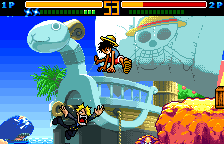
Hmm... well, that's hard to say. In terms of hardware power, the two have different strengths.
First though, the NGP released in Nov. '98 in Japan. The NGPC and first WS both launched in March '99. The WSC came much later, in Dec. '00. So there's a big gap between the releases of the two -- for the most part, the NGPC was competing with the original WonderSwan, not the color one.
As for the tech specs, just see these...
http://en.wikipedia.org/wiki/Wonderswan#Technical_specifications
Note that there are a couple of issues with these specs. First, it doesn't actually list the amount of RAM the B&W system has, and I can't find it; that stuff in the "ram" box for the first WS is the save-data stuff, not system ram. Also, I'm not sure if that 512"kB" is actually kilobytes or not -- IGN said 512KB in their summary of hardware information, but Giantbomb says that it's actually 64KB:
http://www.giantbomb.com/wonderswan-color/60-54/ (so is that actually 512 kilobits? I don't know).
http://en.wikipedia.org/wiki/Neo_Geo_Pocket_Color#Technical_specifications
Comparing these specs, the NGPC has less ram than the WSC (can't compare to the first WS for the above reasons), but has a CPU that's twice as fast. For the original NGP, it's pretty similar to the color one, with the same CPU speed and such, just without color, and with less RAM as you'd expect. Of course though, the WSC doesn't increase the CPU speed either, it also just adds more RAM.
However, despite the NGPC's faster CPU, the WSC definitely can do some things the NGPC couldn't, or at least never tried. All NGPC games are either topdown or side-view -- none attempt a fake-scaling racing game like those Final Lap games on the WS/WSC, and none attempt Mode 7 like in FF4 for WSC, either. In flat-on 2d games the NGPC probably has the advantage, but the WS/WSC seems to have support for some graphical stuff the NGPC either couldn't do, or no one tried to attempt. So which one is better depends on which kind of game you're trying to make, probably.
Oh, and the WS/WSC run at a higher resolution, too -- the NGP/NGPC are 160x152, while the WS/WSC are 226x144. Both systems have 4096 colors, but the WSC can display 241 at once, while the NGPC can display 146. For the B&W systems, both have 8 shades of grey (twice as many as the original GB).
Ironically, even though its graphics are worse, the Game Boy Color actually has a faster CPU than any of the above systems -- in GBC mode it's 8Mhz (though it also has a 4Mhz mode that matches the original GB's speed). Basically, the NGP/C and WS/C, in terms of raw system power (ignoring the major advances in screens, system size, and battery life, that is), aren't better than the handhelds of eight to ten years before, like the GB, GG, and Lynx. The Lynx's 16Mhz graphics chip isn't matched by any of them, in particular... while the GB and WS/C have a handful of 3d-ish games each, none come even close to what the Lynx could do. I think it shows how by the late '90s, handheld designers had finally started actually designing systems based on what was reasonable within the limitations of battery life and screen technology, instead of ignoring that and making powerful systems that are extremely impractical as actual portables, like the Lynx and GG. The result was that graphics didn't really improve, but the systems got smaller, battery lives longer (the original GB had good battery life, but nothing else from that era did; in comparison, all late '90s handhelds have decent to good battery life), etc. But I'd say graphics didn't really see a big step forward until the GBA. That is, unless you count the Virtual Boy as a handheld.