
Pamplemousse
Member
I'm an American and know very little about it. I assume anyone interested in history knows about it, and those who aren't don't.

The US Civil War is legitimately a big deal in US history. It is the culmination of issues that started with the founding of the nation, and the results of the Civil War have shaped American politics since. You can't really understand large chunks of US history and politics without understanding the causes of the war and the effects of the subsequent Reformation. The US Civil War also had far more American casualties than any other conflict the US has participated in. We simply don't have the luxury of ignoring it, much as Europe can't ignore World War 1. The Civil War resulted in entire cities being leveled and such, so many of the re-enactments involve people keeping significant parts of their local history remembered.Not much, I think they just mention it once or twice here in Chile. I mean, the USA may be important but the Civil War is just that: a civil war, something internal.
Most information we got is from the TV. I've always found weird how much you seem to bring it up, even reenacting battles... I mean, its a civil war, shouldn't it be a moment of shame for the nation? at least here that's how we treat our own civil war.
Many, if not most, US history textbooks for elementary and high school students are most definitely sanitized and designed to persuade people to embrace the idea of US exceptionalism. The extent to which students learn about the dark side of US history runs the gamut, but is fairly often confined to a minimum discussion of crucial issues like genocide and racism. Teachers often must compensate for a lack of attention/detail in the textbook when it comes to such materials.I always got the impression that it was all really cleaned up and kind of propaganda-ified in US schools?
Hence why I said it runs the gamutI don't know what school you attended but in Florida we never got any sanitized history. I'm pretty sure it all depends on where you go to school, what teacher you have, and what level of class you are taking. I took AP classes and had amazing history teachers who went through ever aspect of American and European history, the good and the bad.
As an American, it matters less to me that Europeans know about the American civil war than, for instance, Americans know about the French revolution.
Many, if not most, US history textbooks for elementary and high school students are most definitely sanitized and designed to persuade people to embrace the idea of US exceptionalism. The extent to which students learn about the dark side of US history runs the gamut, but is fairly often confined to a minimum discussion of crucial issues like genocide and racism. Teachers often must compensate for a lack of attention/detail in the textbook when it comes to such materials.
Yes, its facing Cuautemoc, an Aztec Hero. The Avenue both statues are in its called "Paseo de los Heroes" because of them, and its one of the main streets in Tijuana.

I've always been curious about how/if this is taught in other countries.
Not that I'm attacking you but why? I put both conflicts at around equal weight.
Many, if not most, US history textbooks for elementary and high school students are most definitely sanitized and designed to persuade people to embrace the idea of US exceptionalism. The extent to which students learn about the dark side of US history runs the gamut, but is fairly often confined to a minimum discussion of crucial issues like genocide and racism. Teachers often must compensate for a lack of attention/detail in the textbook when it comes to such materials.
Spider Man is going to be on it.
Not that I'm attacking you but why? I put both conflicts at around equal weight.

Teddy gives him a run for his money.
Sorry I'm on my phone and quite drunk so I can't answer this with the gravity it deserves. But...
The American civil war is an event isolated to American history... There aren't many existential political or social movements that were berthed from the civil war. From an American perspective, its immensely important... The most important internal event in our nation's history, but from a social, economic, and political point of view, the french revolution stands as the turning point between the the classical and contemporary history.
I love the American civil war, as lincoln is the greatest president in American history, but there are more lasting truths about humanity to be gleened from the french revolution than the American civil war.
But again I'm drunk on beers and can't explain anything
I read Gone with the wind. I realized I didn't know much about the civil war except for Lincoln, North vs South and slavery. Then I watched Ken Burns : The Civil War on Netflix.
I just wish there were more movies/tv shows about the civil war. The last one I watched is Glory and even though I love me some Denzel I found the movie pretty meh ... The Lincoln biopic by Spielberg was also pretty good but I felt like it idealized Lincoln waaaaay too much.
Many, if not most, US history textbooks for elementary and high school students are most definitely sanitized and designed to persuade people to embrace the idea of US exceptionalism. The extent to which students learn about the dark side of US history runs the gamut, but is fairly often confined to a minimum discussion of crucial issues like genocide and racism. Teachers often must compensate for a lack of attention/detail in the textbook when it comes to such materials.
EDIT: Hence why I said it runs the gamut
Oh Teddy was hardcore. But the Roosevelts are just naturally high on the power level. FDR was president 3 times, ya know!
Would we include the Napoleonic Wars as part of the French Revolution, because I would say that is what really effected and changed the rest of Europe?Sorry I'm on my phone and quite drunk so I can't answer this with the gravity it deserves. But...
The American civil war is an event isolated to American history... There aren't many existential political or social movements that were berthed from the civil war. From an American perspective, its immensely important... The most important internal event in our nation's history, but from a social, economic, and political point of view, the french revolution stands as the turning point between the the classical and contemporary history.
I love the American civil war, as lincoln is the greatest president in American history, but there are more lasting truths about humanity to be gleened from the french revolution than the American civil war.
But again I'm drunk on beers and can't explain anything
I get that but when I really thought about it the French Revolution and the corresponding Napoleonic Wars really only affected Europe, which would be on par to the U.S. in terms of size. Thus, objectively it had about equal impact as the Civil War had on the entire U.S., shaping decades upon decades of politics of a certain part of a continent.
I don't know what school you attended but in Florida we never got any sanitized history. I'm pretty sure it all depends on where you go to school, what teacher you have, and what level of class you are taking. I took AP classes and had amazing history teachers who went through ever aspect of American and European history, the good and the bad.
I watched all of ken burns civil war documentary, so quite a bit
Would we include the Napoleonic Wars as part of the French Revolution, because I would say that is what really effected and changed the rest of Europe?
I'm an American and know very little about it. I assume anyone interested in history knows about it, and those who aren't don't.
Considering many Americans don't even understand the meaning behind a flag, I would say whatever their knowledge baseline is, is more than the average American.
Considering many Americans don't even understand the meaning behind a flag, I would say whatever their knowledge baseline is, is more than the average American.
Would we include the Napoleonic Wars as part of the French Revolution, because I would say that is what really effected and changed the rest of Europe?
I mean this aspect of him was touched on a bit in Bill and Ted's Excellent Adventure...Sadly most people outside of France only know the conqueror side of Napoleon and not the great things he achieved on a social/political standpoint.
The US Civil War is legitimately a big deal in US history. It is the culmination of issues that started with the founding of the nation, and the results of the Civil War have shaped American politics since. You can't really understand large chunks of US history and politics without understanding the causes of the war and the effects of the subsequent Reformation. The US Civil War also had far more American casualties than any other conflict the US has participated in. We simply don't have the luxury of ignoring it, much as Europe can't ignore World War 1. The Civil War resulted in entire cities being leveled and such, so many of the re-enactments involve people keeping significant parts of their local history remembered.
Americans often begin conversations about equality with Thomas Jeffersons invocation of it as one of the four first principles in the Declaration of Independence. Americans like being first with ideas. But as Abraham Lincoln reminded us, more than four-score years later, the nation founded in a revolution against monarchy had to fight a second revolution against itself in order to determine whether the proposition of equality had a future in any republic. And that second revolutionthe Civil Warwas so bloody, so devastating, a result so fundamental and astounding, as Lincoln put it, that ever since, Americans of all backgrounds have yearned to declare, or at least feel, its deepest issues over and resolved. Americans may love the epic story of their Civil War, but would, by and large, prefer its nightmarish causes and consequences to fall quiet, to rest in peace.
Much of Americas devastating failures with race relations and the origins of the Jim Crow segregation that took firm hold across the South by 1900 can be traced to the nations failure to face the unending legacies of emancipation. The bitterly contested Reconstruction policies of the federal government of the late 1860s, at the heart of which stood the unprecedented participation by blacks in southern political life, and the violent counter-revolution by the former Confederate states in the 1870s, laid the groundwork for such a debacle. In his modern synthesis of the period, Eric Foner called this revolution, and the counter-revolution it provoked, a massive experiment in interracial democracy without precedent in the history of this or any other country that abolished slavery in the nineteenth century. Since so much of Reconstruction, in political terms and in labor relations, remained essentially the unfinished Civil War, firm endings for the meaning and consequences of this event have remained elusive.
The Union, and all that it meant to northerners as a kind of shield for liberal democracy against oligarchy and aristocracy, survived. It was transformed through blood and reimagined for later generations. The first American republic, created out of revolution in the late 18th century, was in effect destroyed. A new, second republic took its place, given a violent birth in the emancipation of four million slaves and the re-crafting of the U. S. Constitution in the 13th, 14th, and 15th Amendments. Those Amendmentsending legal slavery forever, sanctifying birthright citizenship and establishing equal protection of the law, and creating black male suffragein effect re-made the United States Constitution. This comprised a second American revolution.
But as the occupation gave way to a political process of reunion, especially around elections in the South, widespread vigilante and organized violence broke out all over the region. Indeed, violence left Reconstructions most vexing, twisted legacy. In 1866, bloody massacres of blacks and the destruction of freedmens communities wracked the cities of Memphis and New Orleans. In the political violence of Reconstruction, especially in the periods 1868-71 and again in 1875-77, a counter-revolution unfolded. Terrorist organizations such as the Ku Klux Klan and its many imitators served as paramilitary arms of the reviving southern Democratic Party. Their violence reveals the implications of an unending struggle over race, power, land, and hugely different visions of the ideas of liberty and federalism.
sameAs a Canadian, not very much at all.
The US Civil War is legitimately a big deal in US history. It is the culmination of issues that started with the founding of the nation, and the results of the Civil War have shaped American politics since. You can't really understand large chunks of US history and politics without understanding the causes of the war and the effects of the subsequent Reformation. The US Civil War also had far more American casualties than any other conflict the US has participated in. We simply don't have the luxury of ignoring it, much as Europe can't ignore World War 1. The Civil War resulted in entire cities being leveled and such, so many of the re-enactments involve people keeping significant parts of their local history remembered.
I mean this aspect of him was touched on a bit in Bill and Ted's Excellent Adventure...
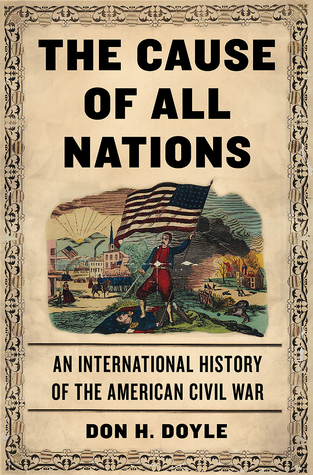
When Abraham Lincoln delivered the Gettysburg Address in 1863, he had broader aims than simply rallying a war-weary nation. Lincoln realized that the Civil War had taken on a wider significancethat all of Europe and Latin America was watching to see whether the United States, a beleaguered model of democracy, would indeed perish from the earth.
In The Cause of All Nations, distinguished historian Don H. Doyle explains that the Civil War was viewed abroad as part of a much larger struggle for democracy that spanned the Atlantic Ocean, and had begun with the American and French Revolutions. While battles raged at Bull Run, Antietam, and Gettysburg, a parallel contest took place abroad, both in the marbled courts of power and in the public square. Foreign observers held widely divergent views on the warfrom radicals such as Karl Marx and Giuseppe Garibaldi who called on the North to fight for liberty and equality, to aristocratic monarchists, who hoped that the collapse of the Union would strike a death blow against democratic movements on both sides of the Atlantic. Nowhere were these monarchist dreams more ominous than in Mexico, where Napoleon III sought to implement his Grand Design for a Latin Catholic empire that would thwart the spread of Anglo-Saxon democracy and use the Confederacy as a buffer state.
Hoping to capitalize on public sympathies abroad, both the Union and the Confederacy sent diplomats and special agents overseas: the South to seek recognition and support, and the North to keep European powers from interfering. Confederate agents appealed to those conservative elements who wanted the South to serve as a bulwark against radical egalitarianism. Lincoln and his Union agents overseas learned to appeal to many foreigners by embracing emancipation and casting the Union as the embattled defender of universal republican ideals, the last best hope of earth.
A bold account of the international dimensions of Americas defining conflict, The Cause of All Nations frames the Civil War as a pivotal moment in a global struggle that would decide the survival of democracy.
The American Civil War is a huge part of the American general education curriculum but I would imagine it occupies the same amount of coverage as any other foreign nation's internal struggles do in other countries. Probably a section in the text book as part of a chapter but not like whole units on it.
The Civil War probably gets more play than WWII in the education system.
Oh cool didn't know that! Lincoln is my favorite US president but for other reasons besides slavery. Here in Guadalajara nobody knows about the Civil War, I only know because I studied in the US...
The film Gettysburg is pretty awesome.I just wish there were more movies/tv shows about the civil war. The last one I watched is Glory and even though I love me some Denzel I found the movie pretty meh ... The Lincoln biopic by Spielberg was also pretty good but I felt like it idealized Lincoln waaaaay too much.
Here in brazil very little is said about the USA before they took control of the world (end of WW1/begining of WW2)
Civil war is only mentioned like "So Brazil SUCKED HARD and was the last to made slavery illegal. Pretty much everyone else from the Americas had it and was pressuring Brazil to make it illegal, including Uk and USA"
Teddy gives him a run for his money.
Finding out about that just boggles my mind about how people can interpret it as being anything other than slavery, but oh well. I don't really care for war/military related stuff in general so I tend to tune it all out and blur it together though.
20000 former confederates migrated to Brazil.
https://en.wikipedia.org/wiki/Confederados
Interesting little tidbit.
In addition to some general knowledge or some focused articles on history magazines i found that Wikipedia has an excellent series of articles about this event, why and how it begun and about the outcome and what that meant to american history.
I am very interested in history and military history in general so i almost devour anything comes on my way.
If the OP has some suggestions on sites or reads about the issue that would be great.
