• Hey Guest. Check out your NeoGAF Wrapped 2025 results here!

How where when Metal slug sprites made?

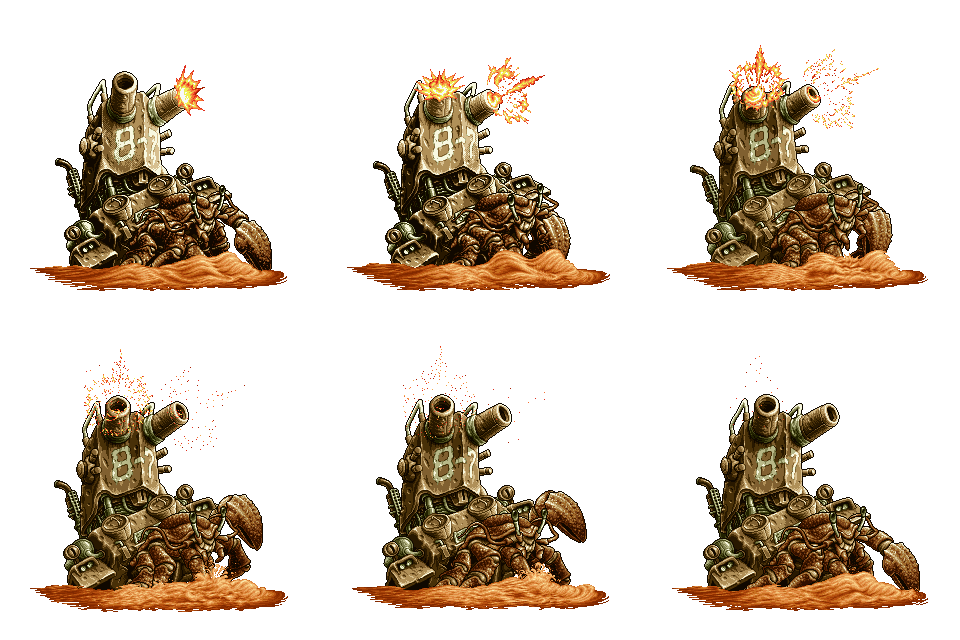
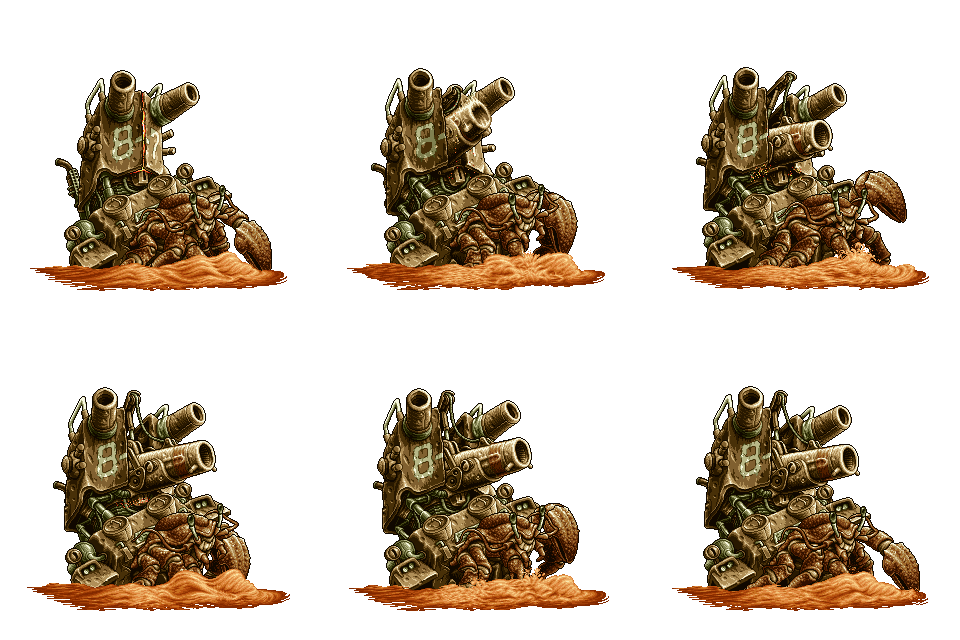
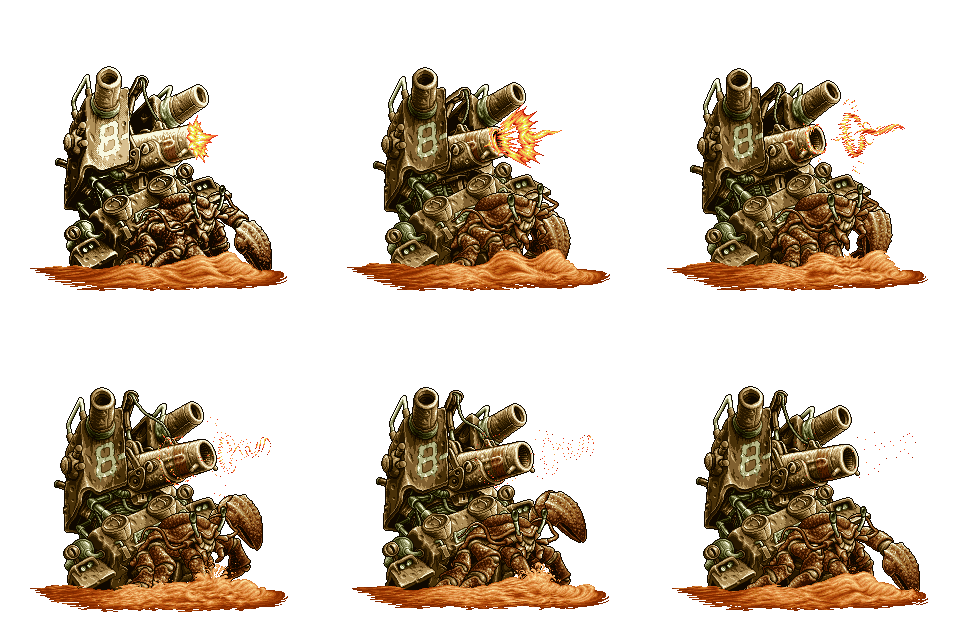
I refuse to believe that whoever made the art for metal slug did the sprites pixel by pixel,
I've tried to find behind the scenes or articles and I cant seem to find any.

Was phothoshop even available to these guys at that time?
What software did they use?
What method did they use, did they draw than scan the art and turn it into pixels?
The pixel alignment it's just to perfect.

I've read that the sprites and game was finished in a couple of months, and there was like one artist who created all the sprites.

Seriously, if anyone has any idea please let me know,
it's been bothering me for the longest.

Oh and please don't show me sprites made by some random guy,
I would really like to focus on that particular team at that time.
 
You do realize Photoshop is older than Metal Slug, right?

It most likely -was- done pixel by pixel, though I'm sure they did it by creating one sprite from scratch then editing that sprite to create the frames of animation. They might have had hand-drawn concept art to base it off of, but it was most certainly not scanned in to create the final result.
 
Having played Metal Slug I can only imagine it was done by magic, or in the most frame-by-frame, pixel-by-pixel way imaginable.
 
nice contribution man, way to go.

right, so they did use phothoshop, was it available for business at snk or irem at that time?
Pixel art is way older than Photoshop. It's been done on Amiga using Deluxe Paint for example. You don't really need photoshop's image manipulation features to draw that type of art, so it doesn't really matter all that much what they used. They certainly could have used Photoshop 3 which had layers support, which would make animation frames a lot easier.
Photoshop 3 came out in 1994, and Metal Slug came out in 1996. Photoshop was never some super exotic expensive software, a company like Irem/Nazca could have easily afforded it.
 
Maybe by the time Metal Slug came around they were using photoshop, but for much of the sprite-era of gaming, Deluxe Paint and an Amiga 3000 were basically industry standard tools for creating sprites across a variety of game machines.

And yes, they were drawn pixel by pixel from an artist.
 
And yes, they were drawn pixel by pixel from an artist.
That mystifies things a bit I feel. Pixel art was/is usually created in passes, where the first pass you could use wider brushes to paint broader shape, then use pixel size brush to draw in details, dither pattern brush to draw dithered colors, palette manipulation if you wanted to recolor certain portions of the sprite (i.e. no need to delete and re-color everything pixel by pixel all over again) There were things available that could speed the process up, but eventually, it's true that finishing veneer had to be done pixel by pixel by adding and removing detail across the whole picture.

Here's a good example of the steps involved:

TUTO_chap8_treewip.png
 
Graphicsgale like program with the Same onionskin option ?


d2.alternativeto.net/dist/s/0004b2e6-cd03-e011-aa71-0200d897d049_2_full.jpeg?format=jpg&width=1600&height=1600&mode=min&upscale=false
 
Maybe by the time Metal Slug came around they were using photoshop, but for much of the sprite-era of gaming, Deluxe Paint and an Amiga 3000 were basically industry standard tools for creating sprites across a variety of game machines.

And yes, they were drawn pixel by pixel from an artist.

Good post, and to expand on this in case you're curious, techniques for drawing sprite art were the same back then as they are now (roughing out a design and then cleaning it up). As an example of this, if you remove layers of objects that you're not normally meant to see, you'll sometimes see really rough looking versions of assets. EDIT3: Lord Error's post above is an even better example!

For more information on the teams themselves, it's mostly a big mystery thanks to the way credits worked in Japan at the time. Most of the team members are still hush hush on their real identities, so we may never know who they are or what they're working on now.

EDIT: I should probably mention that these are links to my blog, and I know it's faux pas to advertise yourself on GAF, but I felt it was relevant. If anyone wants it removed, I'd be happy to oblige.

EDIT2: I also wanted to add that judging by the concept art, the pixel art was probably done from scratch as one would expect, and not redrawn over something like a 2D drawing or 3D model, ala later games like Street Fighter III games.
 
So defensive in a metal slug sprite thread.

whew I need to ly dow


They probably made it exactly as you would have expected them to. Pixel by pixel.
 
That mystifies things a bit I feel. Pixel art was usually created in passes, where the first pass you could use wider brushes to paint broader shape, then use pixel size brush to draw in details, dither pattern brush to draw dithered colors, palette manipulation if you wanted to recolor certain portions of the sprite (i.e. no need to delete and re-color everything pixel by pixel all over again) There were things available that could speed the process up, but eventually, it's true that finishing veneer had to be done pixel by pixels by adding and removing detail across the whole picture.

yeah, but that's not really the question being asked. That's generally true for all pixel art, but he believes the quality of Metal Slug's art implies some sort of machine rasterization, like Digicell from Shiny used on Earthworm Jim and Aladdin.

That's not the case, Metal Slug is just good old fashioned pixel art, albeit of incredible quality.
 
Good post, and to expand on this in case you're curious, techniques for drawing sprite art were the same back then as they are now (roughing out a design and then cleaning it up). As an example of this, if you remove layers of objects that you're not normally meant to see, you'll sometimes see really rough looking versions of assets.

For more information on the teams themselves, it's mostly a big mystery thanks to the way credits worked in Japan at the time. Most of the team members are still hush hush on their real identities, so we may never know who they are or what they're working on now.

EDIT: I should probably mention that these are links to my blog, and I know it's faux pas to advertise yourself on GAF, but I felt it was relevant. If anyone wants it removed, I'd be happy to oblige.

EDIT2: I also wanted to add that judging by the concept art, the pixel art was probably done from scratch as one would expect, and not redrawn over something like a 2D drawing or 3D model, ala later games like Street Fighter III games.

I'm surprised your second blog post doesn't mention In The Hunt, as it was that team's last project at Irem and looks almost like a proto Metal Slug.
 
some sort of machine rasterization, like Digicell from Shiny used on Earthworm Jim and Aladdin.

Do you have any more information on this that I could read? I know Earthworm Jim 2 definitely had some funny business going on, but 1 seemed like it was cleaned up so well across each version that I almost can't believe this. I'm super interested in finding out more!

I'm surprised your second blog post doesn't mention In The Hunt, as it was that team's last project at Irem and looks almost like a proto Metal Slug.

Heheheh, I almost talked about it, but GunForce seemed like a more appropriate comparison, despite being earlier.
 
Way to go, everyone!

Honestly though, yeah, talent and hard work. Base sprites built upon with details. Frame by frame. Static objects painted in, just liking using the pencil in PS with no AA. Nearest neighbour filtering.
 
LOL, wtf. calm down.
I was only joking :P

Do you have any more information on this that I could read? I know Earthworm Jim 2 definitely had some funny business going on, but 1 seemed like it was cleaned up so well across each version that I almost can't believe this. I'm super interested in finding out more!
digicell I'm trying google this but I cant find anything related.

TUTO_chap8_treewip.png
[/QUOTE]
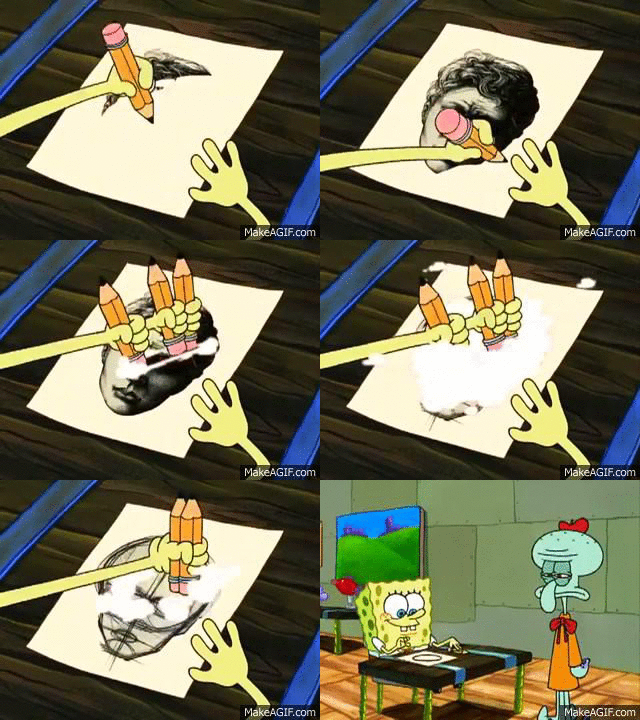
things radically change on the 8th step lol
kinda reminded me of this
424466_10150657860208465_129446698464_11289376_750679505_n.jpg
 
yeah, but that's not really the question being asked. That's generally true for all pixel art, but he believes the quality of Metal Slug's art implies some sort of machine rasterization, like Digicell from Shiny used on Earthworm Jim and Aladdin.

That's not the case, Metal Slug is just good old fashioned pixel art, albeit of incredible quality.
I see, and yeah, that's true. Even thought they did a very good job with it in EarthWorm Jim, the pixel alignment during the animation is not as good as in Metal Slug.

Although that doesn't necessarily mean that someone who's even better at cleaning up / pixelizing scanned art wouldn't be able to create something like that, maybe using scanned drawings as just a rough reference.
 
Do you have any more information on this that I could read? I know Earthworm Jim 2 definitely had some funny business going on, but 1 seemed like it was cleaned up so well across each version that I almost can't believe this. I'm super interested in finding out more!

Oh, I don't really have a central repository of links to hand out, but you are pretty mistaken about EWJ. The sprites were not cleaned up between ports, and that's actually a really big problem with the SNES port. The two machines run at different resolution, and the machine rasterization they employed (called Digicell animation) was configured for the Genesis resolution. As a result of minimal touchup, the sprites actually run way too fat on the SNES. EWJ SNES looks really weird when running on a CRT, like everything is way too fat.
 
That mystifies things a bit I feel. Pixel art was/is usually created in passes, where the first pass you could use wider brushes to paint broader shape, then use pixel size brush to draw in details, dither pattern brush to draw dithered colors, palette manipulation if you wanted to recolor certain portions of the sprite (i.e. no need to delete and re-color everything pixel by pixel all over again) There were things available that could speed the process up, but eventually, it's true that finishing veneer had to be done pixel by pixel by adding and removing detail across the whole picture.

Here's a good example of the steps involved:

TUTO_chap8_treewip.png

I've learned something today. Thank you.
 
Wow, any chance that this is what the metal slug Team used or a similar tech owned by snk or no go?

Not a chance. EWJ used a bunch of local western technologies, like Digicel from Dave Perry, and TUME for level design. TUME is "The Universal Map Editor" used by games like Mick and Mack Global Gladiators, Cool Spot, The Lion King, etc.

The team at Irem assuredly would not use those technologies.
 
Each sprite was limited to 15 colors so it must've been a big puzzle to put these old 16 bit characters together and have them animate while keeping all the colors of the character in perfect order.

There are ways to automate bitdepth reduction, and that's a large reason they used Deluxe Paint and an Amiga. You let the machine handle stuff like that.
 
Not a chance. EWJ used a bunch of local western technologies, like Digicel from Dave Perry, and TUME for level design. TUME is "The Universal Map Editor" used by games like Mick and Mack Global Gladiators, Cool Spot, The Lion King, etc.

The team at Irem assuredly would not use those technologies.

Well, Talent and work it is..............my respect for Metal slug has elevated beyond belief.
Way to go everyone!
 
Probably used Deluxe Paint 2 or something similar for when it was made. Likely hand illustrated, scanned, and then turned into pixel art by tracing over the animation frames. Sometimes you could skip the illustrated part if you were good enough. Also Autodesk Animator was very popular for pixel animation at the time.
 

That's actually a good illustration of why many people think they cannot draw. They draw things by drawing their logical components (head, eyes, mouth, body, legs, ...) as abstract representations (circles, points, ...). What they actually should draw are the raw shapes they perceive visually. These shapes may have no direct connection at all to the logical component they represent, but in sum they make up the complex visual structure that our brain can then decode into logical components. For instance, the horse's right front lag is actually decomposed into shapes like the upper visible triangle-like part, the straight diagonal rectangle-like part, the complex hoof, the shadow gradient, etc.
 
There are ways to automate bitdepth reduction, and that's a large reason they used Deluxe Paint and an Amiga. You let the machine handle stuff like that.

Yeah that makes sense. Also explains why so many Genesis/Neo Geo games have some ugly dithering as maximizing those limited colors was probably really tedious.
 
Even kofxii where they used a 3d model as a base for key frames, they still did a pixel by pixel pass for the final look. Good sprite work to this day still needs time and talent.

http://kofaniv.snkplaymore.co.jp/english/info/15th_anniv/2d_dot/creation/index.php

This is impressive, but wouldn't it have been a lot easier and less expensive to have animators draw the characters ala Skull Girls? Can't understand why they felt the need to bankrupt themselves with the high res pixel art approach. I mean for KOF14 I thought for sure they'd use the KOF12/13 sprites and simply add five or six new characters into the mix along with a few new backgrounds; the fact that they decided to completely abandon all of those assets and start from scratch in 3D is rather telling.
 
Top Bottom