• Hey Guest. Check out your NeoGAF Wrapped 2025 results here!

I think I'm in love! (with a knife?)

Status
Not open for further replies.

Flo_Evans

Member
The benchmade 943.

vhbyh3.jpg


Sweet lord this thing is amazing. I ordered this for an xmas present for my brother but now I can't give it to him. I might have to order another. I've seen benchmade knives in the glass cases at outdoor shops, but I've never actually handled one until I unpacked this one to inspect it. I have had many buck, case, swiss army, gerber, you name it knives over the years but this is the most amazing blade I have ever seen. Worth every penny!

If you have someone that loves camping or hunting or just plain stabbing things do them a favor and get one for them for xmas. But odds are you will end up keeping it for yourself. :D

Any other benchmade (or knife fans?)
 
Please elaborate. What's so great about this knife that makes it so superior to other knives? Also, how much is Benchmade paying you per post? :D
 
AVclub said:
Please elaborate. What's so great about this knife that makes it so superior to other knives? Also, how much is Benchmade paying you per post? :D

The smooth action, the special steel they use, the lifetime warranty, the hand assembly, ultra tight tolerances, the balance and way it feels in your hand. Seriously, just go to the store and ask to see one from the case. Might be slightly jingoistic but I also love the fact that is is made in the USA.

It feels more like a fine wristwatch than a knife. and I am not getting paid anything to post, just thought I would share. :P
 
Flo_Evans said:
The smooth action, the special steel they use, the lifetime warranty, the hand assembly, ultra tight tolerances, the balance and way it feels in your hand. Seriously, just go to the store and ask to see one from the case. Might be slightly jingoistic but I also love the fact that is is made in the USA.

It feels more like a fine wristwatch than a knife. and I am not getting paid anything to post, just thought I would share. :P


but how well does it handle cutting up your average sinewy drug addled prostitute?
 
StuKen said:
but how well does it handle cutting up your average sinewy drug addled prostitute?

I would imagine quite well, its as sharp as a barbers razor. Haven't had time to test it on hookers yet.

And no I don't wear a trench coat, I do have hobbies outside of gaming and message board posting that require a knife though :P

joshuagor44 said:
What do you do with it?

Cut shit? Jesus has GAF never been fishing or camping? :lol
 
Cornballer said:
This is my favorite:
2vx1ycy.jpg

I got that one and the set it comes in! They require a special sharpener to do them justice but after that they can cut through LIES!

Do yourself a favour and find a magnetized knife rack. No dulling slots, just a sleek hunk of metal that you can toss your knife at and it will stick, just like that badass Hatori Hanzo had in Kill Bill.
 
lunarworks said:
"Why a spoon, cousin?"
Dyno said:
Do yourself a favour and find a magnetized knife rack. No dulling slots, just a sleek hunk of metal that you can toss your knife at and it will stick, just like that badass Hatori Hanzo had in Kill Bill.
That's what I use at home. We have a vertical magnet with a bunch of knives on it. It looks rad. :D

It's a great knife - really well balanced and not too heavy. Just got it professionally sharpened and it's extremely sharp right now.
 
The only thing I could contribute to this thread is a gif of "The Presidio" where Sean Connery beats the shit out of a drunk with his right thumb.

...a gif I don't have. So...
 
Flo_Evans said:
The smooth action, the special steel they use, the lifetime warranty, the hand assembly, ultra tight tolerances, the balance and way it feels in your hand. Seriously, just go to the store and ask to see one from the case. Might be slightly jingoistic but I also love the fact that is is made in the USA.

It feels more like a fine wristwatch than a knife. and I am not getting paid anything to post, just thought I would share. :P

You do seem like you've been taken in by marketing a bit, though. It's hard to imagine handing a knife to someone and having them notice the "ultra tight tolerances" or "hand assembly" without reading a marketing brochure.
 
tokkun said:
You do seem like you've been taken in by marketing a bit, though. It's hard to imagine handing a knife to someone and having them notice the "ultra tight tolerances" or "hand assembly" without reading a marketing brochure.


Well I guess you just have to try one for yourself. It's really not that hard to tell the difference between something that has been stamped out on a machine and something made with care.

Perhaps this video will help. http://www.youtube.com/watch?v=POhAEhIAljs I din't make this, but it demonstrates the action quite nicely. :D
 
shunkramer.jpg


There are only 40 mastersmiths in the US. Of those 40 Bob Kramer is the only one to make kitchen knives. Pictured on top is one of his custom blades. His straight carbon chef’s knives start at $475 and the Damascus versions can run well over a thousand — if you can get one. Kramer is now so backlogged with orders for his hand forged knives that he is not taking new orders for the foreseeable future. This is the guy that helped rediscover the real lost art of Damascus steel. You know that story that you can toss a silk cloth in the air and cleanly cut though it? His knives do that.

Also pictured is his new line of knives mad by Shun. $1,499 for the set.

606129v1.jpg


I may have to do horrible things to get one of those knives.


623579v1.jpg

7" Santoku, just knife I've been looking for but at $340.

The New Yorker has a feature on Kramer and his knives.


081124_2008_p154.jpg


http://www.newyorker.com/magazine/toc/2008/11/24/toc_20081117
 
mac said:
http://chadwrites.com/blog/wp-content/uploads/2008/06/shunkramer.jpg

There are only 40 mastersmiths in the US. Of those 40 Bob Kramer is the only one to make kitchen knives. Pictured on top is one of his custom blades. His straight carbon chef’s knives start at $475 and the Damascus versions can run well over a thousand — if you can get one. Kramer is now so backlogged with orders for his hand forged knives that he is not taking new orders for the foreseeable future. This is the guy that helped rediscover the real lost art of Damascus steel. You know that story that you can toss a silk cloth in the air and cleanly cut though it? His knives do that.

Also pictured is his new line of knives mad by Shun. $1,499 for the set.

http://images.surlatable.com/surlatable/images/en_US/local/products/detail/606129v1.jpg

I may have to do horrible things to get one of those knives.


http://images.surlatable.com/surlatable/images/en_US/local/products/detail/623579v1.jpg

7" Santoku, just knife I've been looking for but at $340.

The New Yorker has a feature on Kramer and his knives.


http://www.newyorker.com/images/2008/11/24/p154/081124_2008_p154.jpg

http://www.newyorker.com/magazine/toc/2008/11/24/toc_20081117

Beautiful! I am still pretty pissed that someone stole my set of Henckels pro-s knives out of my car. But those are on a whole other level!
 
mac said:
http://chadwrites.com/blog/wp-content/uploads/2008/06/shunkramer.jpg[IMG]

There are only 40 mastersmiths in the US. Of those 40 Bob Kramer is the only one to make kitchen knives. Pictured on top is one of his custom blades. His straight carbon chef’s knives start at $475 and the Damascus versions can run well over a thousand — if you can get one. Kramer is now so backlogged with orders for his hand forged knives that he is not taking new orders for the foreseeable future. This is the guy that helped rediscover the real lost art of Damascus steel. You know that story that you can toss a silk cloth in the air and cleanly cut though it? His knives do that.

Also pictured is his new line of knives mad by Shun. $1,499 for the set.

[IMG]http://images.surlatable.com/surlatable/images/en_US/local/products/detail/606129v1.jpg[IMG]

I may have to do horrible things to get one of those knives.


[IMG]http://images.surlatable.com/surlatable/images/en_US/local/products/detail/623579v1.jpg[IMG]
7" Santoku, just knife I've been looking for but at $340.

The New Yorker has a feature on Kramer and his knives.


[IMG]http://www.newyorker.com/images/2008/11/24/p154/081124_2008_p154.jpg[IMG]

[url]http://www.newyorker.com/magazine/toc/2008/11/24/toc_20081117[/url][/QUOTE]

I thought the compounds needed for Damascus Steel were exhausted? Or something to that extent...
 
harSon said:
I thought the compounds needed for Damascus Steel were exhausted? Or something to that extent...

The original techniques where lost some time ago. Allot of "damascus" knives sold today are just different steel folded together then acid etched for appearance. They recently discovered (according to wikipedia at least) that real damascus steel has carbon nanotube structures in it. How the hell they where able to make carbon nanotubes in the 1500s is beyond me...
 
I'm not a big Benchmade fan. Some of what they produce is quality, but their intellectual property thievery and many cheap products turns me away.

Check out Spyderco. They are hard to beat in quality, form, or function. And the company itself has a very ethical track-record. They also produce a large portion of their line in Golden, Colorado, USA, Earth.

www.spyderco.com
 
Flo_Evans said:
If you have someone that loves camping or hunting or just plain stabbing things do them a favor and get one for them for xmas. But odds are you will end up keeping it for yourself. :D
If you know people who "love . . . just plain stabbing things", I really don't think you should get them a knife.
 
vultureparade said:
I'm not a big Benchmade fan. Some of what they produce is quality, but their intellectual property thievery and many cheap products turns me away.

Check out Spyderco. They are hard to beat in quality, form, or function. And the company itself has a very ethical track-record. They also produce a large portion of their line in Golden, Colorado, USA, Earth.

www.spyderco.com

I've had a few spyderco knives, they are great, but the plastic handles and general "fuglyness" of them turns me off.

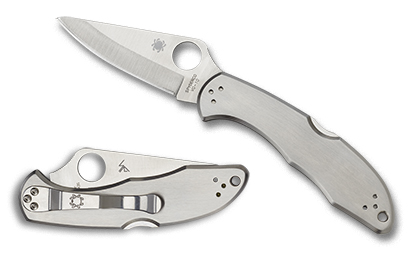
I actually had one of the stainless steel handled ones like this,

C11_M.jpg


but the balance was all wrong and it hurt your hands to hold it. I've also heard good things about Columbia River knives, but I've never had one.
 
but the balance was all wrong and it hurt your hands to hold it. I've also heard good things about Columbia River knives, but I've never had one.

I'm not a big fan of stainless handles. The "plastic" handles on Spyderco knives are made out of a material called FRN. It's lightweight and almost indestructable. It does feel cheap in the hand though, in my opinion.

I'd check out some of their G10 handled knives like the Military, Para-Military, or Caly3.

And I agree that they are fugly. When I started collecting knives, I thought that Spyderco knives were hideous, but then I used one and could appreciate how the form follows function.

Columbia River makes a decent knife. I also like Kershaw and Fallkniven. The Fallkniven U2 is a great little no nonsense knife that gets very sharp and stays that way for a while.
 
Flo_Evans said:
The original techniques where lost some time ago. Allot of "damascus" knives sold today are just different steel folded together then acid etched for appearance. They recently discovered (according to wikipedia at least) that real damascus steel has carbon nanotube structures in it. How the hell they where able to make carbon nanotubes in the 1500s is beyond me...

This is correct - the original Damascus steel is properly called Wootz, while most 'Damascus' steel that is sold today should be described as pattern-welded steel. Metallurgists have made strides in their attempts to recreate Wootz, but while most of the manufacturing techniques have been rediscovered, a lack of the special naturally-occurring iron ore has proved a major stumbling block.

Wootz was originally created in India around 300 BC. It was formed in a crucible from very specific iron ore mixed with charcoal and glass; and its production ceased when supplies of the unique ore dried up. It gained the nickname 'Damascus steel' because it became very popular in the Arab world. The Persians were renowned for using Wootz in the creation of fine swords, and were largely responsible for making the steel famous.

Wootz was prized for its ability to hold an edge whilst retaining toughness. When heat treating steel, one generally has to sacrifice one for the other: hard steel which holds an edge becomes brittle; tough steel which absorbs shock dulls quickly. Other cultures have dealt with this problem in different ways throughout history.

In Japan, exceptionally poor-quality raw materials lead to a highly complex process of refinement and hardening that created some of the most impressive sword blades in the world. Steel is folded repeatedly to remove impurities, and then the blade is differentially hardened. This allows the edge to retain sharpness, but the brittle steel is limited to the one area in which it is needed. The spine of the sword is left reasonably soft, and thus it absorbs shocks which might otherwise cause the blade to shatter. However the hard edges can be prone to chipping, which should then be polished out by a highly trained professional with a set of stones. The average samurai would probably have had some basic knowledge of polishing for use in the field; but the Japanese sword polisher was valued almost as highly as the smith, and he performed a vital role in the creation and proper maintenance of high-performance weaponry. This is still true today: it costs almost as much to have a Japanese sword correctly polished as it does to have it forged.

In the west, the Germanic tribes created pattern-welded steel. Rods of steel (and occasionally iron) containing different levels of carbon are welded together in parallel; then folded and twisted into a billet, which is then forged into a blade. This results in swords with soft, shock-absorbent cores and harder edges. The difference in hardness is less drastic than that of Japanese swords, so the edges dull more quickly. However they can be sharpened much more easily, and are less prone to chipping.

In the modern day, artisan bladesmiths make use of pattern-welding to create beautiful designs in their steel. When the steel is etched with acid, the hard steel darkens and becomes distinct to create contrasting patterns. With the right twists and folds, exceptionally complex designs are possible. However, contemporary heat treating techniques have rendered the functional qualities of pattern-welding redundant. The introduction of the blast-furnace in the 9th century caused the technique to die out almost completely - bladesmiths were finally able to create homogenous high carbon steel and they never looked back. These days, properly heat treated steel can be fine tuned via industrial processes to hold an edge while retaining shock resistance in a much less complex manner; though with regard to knives and swords, the best pattern-welded steel should offer equal performance to modern through-hardened steel in a blade.

The properties of Wootz, however, may be sufficiently unique to warrant its use alongside other modern steels; and it remains a curiosity to historians, artisans and engineers alike.

Here are some examples of the different types of non-homogenous steel. First of all, an image of true Wootz. The three images are taken from three antique blades, and each includes the mark of its respective maker. B and C are from two shamshirs, and A is from a knife made from a cut-down shamshir. C is pictured in full below.


20081205-qsu3w1d8smm349d3rrsmg2m3f4.jpg


20081205-rmrs311uaqxh38kmuq6rjdxnbc.jpg


Here is an example of a Japanese sword - made quite recently, in 1942, by master smith Tsukamoto Okimasa. The patterns in the steel (hada) are revealed through polishing, and these images display both the subtle activities caused by forge-folding and the wavy line (hamon) along the edge which signifies the harder steel.


20081205-eykay547pr4yg4tnywgxwjiynt.jpg


20081205-x5hx3mmpdujwwf71h9ar5bju9x.jpg


20081205-phg22ia3ujq18dr4ed2j97axsk.jpg


20081205-xwn4dqjkun8gccwbc6fip76cjd.jpg


This is a pattern-welded Viking sword made by the Czech bladesmith Patrick Bárta: a reproduction of a Norwegian sword made in 800 AD. The high-contrast patterned area which forms the shock-absorbing core denotes the most profound mixture of hard and soft steel: the acid etching darkens the hard steel and leaves the soft steel/iron areas light. The edges are more or less homogenous, but remain unetched. Note the subtle activities in the edge steel on either side of the core: they show the results of forge-folding similar to those seen on a Japanese sword.


20081205-86hbr3f356ihkhp73fs4afs2hr.jpg


20081205-8jx36qg5wiuf1w3rcfkh9q4gix.jpg


20081205-bedntqj3dchnak1wscsyfywk5h.jpg


Finally, this is an image displaying the cross-sections of several different types of ancient Germanic sword blades; all reproductions made by Patrick based on archaeological finds. Check out his website for many more photos of his work, as well as walkthroughs which detail the processes of his craft.

The image details the evolution of European pattern-welding. From left to right: blade with a hard edge, blade with a soft iron core, sandwich blade, proto-pattern-welded blade, two pattern-welded blades; and finally a pattern-welded blade with a soft iron core.



20081205-pej1px4d7j6xnyc7is942ktyi7.jpg
 
Aske- very cool post, thank you. That viking sword is amazing.
Flo_Evans: Next time I am at my local outdoor shop I'll definitely see how that knife feels. Been in the market for a nice folder.

On a somewhat related note:
Have any of you knife connoisseurs ever messed around with the Bugei Hissatsu? I know Bugei makes very high-quality forged swords but was curious about what you all thought of their modern design knife. Supposedly James Williams designed it.

Hissatsu Folder
Hissatsu
 
Status
Not open for further replies.
Top Bottom