• Hey Guest. Check out your NeoGAF Wrapped 2025 results here!

If we can create stars. Will the universe last forever?

Status
Not open for further replies.
I don't think any energy is being created in that scenario, unless you know of a study that proves otherwise?

There's no such thing as free energy. One of the consequences of the uncertainty principle is that small amounts of energy can be 'borrowed' from the vacuum in order to create particles, with the caveat that those particles are unstable and decay after a short time, thus giving the borrowed energy back. The more energy you borrow, the shorter you get to keep it, but you always have to return it sooner or later. Hence there is no net gain or loss, and energy is still conserved overall.
 
That's not how any of this works. Of course the universe is so far from heat death right now that it's not even something that you should be considering a solution to. Not that there is one.

Recycling energy. We save solar energy or material based energy to seed stars as old ones die off.

There is no such thing as an infinite energy machine. In fact, the process you describe would bring you closer to the heat death of the universe, not farther away.
 
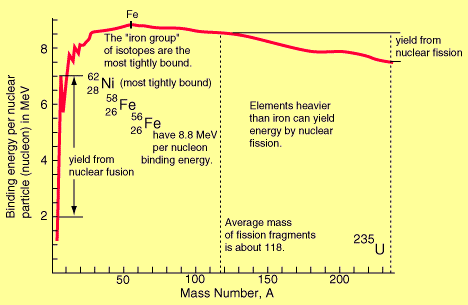
Even without getting in depth into physics or the nature of the universe, you can't create stars forever because fuel is not infinite. Stars are nuclear furnaces. They start with hydrogen and fuse it into heavier elements like carbon, but even the largest star can't fuse past iron. Once you hit iron, you're done. Heavier elements that exist in the universe are fused when a star explodes.

Isn't that because past iron fusion becomes endothermic?
 
Maybe, maybe not.

Definitely not because we require a certain amount of energy to live. Towards the end the density of usable energy will be too low to sustain any life and I expect that threshold to be reached a loooooooong time before the universe reaches its final state.
 
I think odds are not in our favor.

are those 13+ billion years since the bigbang not enough for any species to have evolved to the point of leaving at least some sort of mark in the sky for us to see?
IF a species has/will become capable of a feat like that and IF it is in a form we would recognize as artificial, any of them will take millions/billions of years to reach us because light only goes so fast. So, perhaps, but we will probably never see it.
 
I think odds are not in our favor.

are those 13+ billion years since the bigbang not enough for any species to have evolved to the point of leaving at least some sort of mark in the sky for us to see?

Perhaps a civilization gets just advanced enough to create virtual/simulated universes, and then they just escape to those? If consciousness is something mathematical that can be solved, then I see no reason why a civilization wouldn't eventually decide to do this.

I used to think that kind of future was silly...but the older I get, the more likely (and logical) it seems to be.

Energy in our universe is limited and Time is relative...but a simulated mathmatical universe (with a debug cheat) could theoretically have essentially infinite energy. And although the lifespan of a simulated universe (in our universe) would still be limited to the lifetime of ours....if you hooked your brain up to a virtual reality that ran for 100 trillion years, it would literally make no difference to anything within that simulation, and would essentially be no different than ours, which also has a foreseeable end due to heat death.


I personally am leaning towards the fermi paradox resolution that we don't see any aliens because any aliens that get advanced enough to master the laws of the universe...simply realize that fighting the laws of the universe isn't nearly as attractive as simply using them to your advantage.
 
I think odds are not in our favor.

are those 13+ billion years since the bigbang not enough for any species to have evolved to the point of leaving at least some sort of mark in the sky for us to see?

The distances are just so vast, and we can't even see the entire universe.

A very very long time from now even the light from distant galaxies will be pulled away faster than it can get to us, and there will be no way for astronomers of that time to prove that galaxies other than our own exist, even with the best equipment.
 
don't fuck up the cycle. the next universe in this space is probably relying on this one to do whatever it does. Or maybe an adjacent universe. Don't be selfish.

If you want to help, try figuring out the whole ascending to the next level of human existence thing.
 
If the universe is set to cool off and die.
What if we learned how to create and seed stars? Does that mean energy could perpetually exist?

At the center of each galaxy is a blackhole. Over time Galaxies collide and new galaxies, planets and stars emerge from the resulting collision and massive release of energies. Its highly probable that the point of impact is indeed the epicenter of the new major galaxy's blackhole.

You'll get your stars from this.
 
There's no such thing as free energy. One of the consequences of the uncertainty principle is that small amounts of energy can be 'borrowed' from the vacuum in order to create particles, with the caveat that those particles are unstable and decay after a short time, thus giving the borrowed energy back. The more energy you borrow, the shorter you get to keep it, but you always have to return it sooner or later. Hence there is no net gain or loss, and energy is still conserved overall.
This sounds like some kind of evil contract with the universe devil.
 
Get these guys onto it.

03a1.jpg
 
Yes.

According to the law of conservation of energy energy can never be destroyed or created. All the energy ever created and emitted by past and future stars will still exist in the universe. And according to Einstein's E = mc2, that energy can be converted back into the mass needed to seed stars.

So yes. It can be done. Theoretically.
 
Short-term we could send out self-replicating robots into the universe that turn all matter they find into new robots (with H tanks). Orchestrated to replentish a source nearby that can be used to form a new sun/fusion reactors.

But eventually you will run out of matter and we would need to find a way to turn energy into matter (that is not negative in net energy).

Then, in a closed system we will be left with increasing the efficiency of harvesting an artificial sun's energy as we will run out of it for aking new matter.
Probably can't use a robot fleet to harvest back all the photons diffused in the universe as the distances are too vast for it to be fast or effiecient enough (and whatever energy source the robots are using needs fuel as well).


Then, in the soup of diluted energy, as time has stopped existing due to entropy reaching it's final state, randomly something will happen that sparks a new Big Bang. But same natural laws within our universe bubble so it will all play out exercise exactly the same again and again.
 
Short-term we could send out self-replicating robots into the universe that turn all matter they find into new robots (with H tanks). Orchestrated to replentish a source nearby that can be used to form a new sun/fusion reactors.

But eventually you will run out of matter and we would need to find a way to turn energy into matter (that is not negative in net energy).

Then, in a closed system we will be left with increasing the efficiency of harvesting an artificial sun's energy as we will run out of it for aking new matter.
Probably can't use a robot fleet to harvest back all the photons diffused in the universe as the distances are too vast for it to be fast or effiecient enough (and whatever energy source the robots are using needs fuel as well).


Then, in the soup of diluted energy, as time has stopped existing due to entropy reaching it's final state, randomly something will happen that sparks a new Big Bang. But same natural laws within our universe bubble so it will all play out exercise exactly the same again and again.

Also a bunch of your robots after a large enough distance would never be able to get back to you because the expansion of space time is moving things faster away from us than lightspeed.
 
Also a bunch of your robots after a large enough distance would never be able to get back to you because the expansion of space time is moving things faster away from us than lightspeed.

But you can warp space. Put enough mass in the center of the universe and maybe you can warp it enough to get it to fold into itself making everything close enough to get to.
 
But you can warp space. Put enough mass in the center of the universe and maybe you can warp it enough to get it to fold into itself making everything close enough to get to.

No, you cannot. There is literally not enough matter in the whole Universe to do that. That is why it will expand forever, and not contract back. In fact, the expansion is accelerated because of Dark Energy.

On another note, there's no center to the universe either. All points are equivalent.
 
No, you cannot. There is literally not enough matter in the whole Universe to do that. That is why it will expand forever, and not contract back. In fact, the expansion is accelerated because of Dark Energy.
Dark energy and matter are patchworks to current cosmology/physics theories that we know aren't entirely on the mark, I'd say the jury will be out on that one for a while.
On another note, there's no center to the universe either. All points are equivalent.
A good analogy here is: Where is the center of the surface of a sphere? (The universe isn't a sphere, it's actually flat.)
 
Dark energy and matter are patchworks to current cosmology/physics theories that we know aren't entirely on the mark, I'd say the jury will be out on that one for a while.
While the particle composition of Dark Matter is unknown, the evidence for it is solid. Same with Dark Energy. Even though it is not understood microscopically, the gravitational behavior is known, so, based on the current data, we know the expansion will remain accelerated.
 
No, you cannot. There is literally not enough matter in the whole Universe to do that. That is why it will expand forever, and not contract back. In fact, the expansion is accelerated because of Dark Energy.

On another note, there's no center to the universe either. All points are equivalent.

Oh, ok, I didn't realize you invented the universe.
 
Also a bunch of your robots after a large enough distance would never be able to get back to you because the expansion of space time is moving things faster away from us than lightspeed.
Technically they're not moving so much as the distance between us and them is increasing faster than lightspeed.

And at the last part of entropy, what would the universe look like? Would black holes exist, or is that the point where even those have lost to entropy?
Imagine a water balloon hitting the ground. Water goes everywhere making a splash and a number of wonderful patterns due to the inherent chaos in the system. But over time the puddle evens out and slows down, before eventually becoming still. Until some external force interacts with it the puddle stays there, uniform and unchanging.

A dead universe is that stagnant pool of water.
 
Then, in the soup of diluted energy, as time has stopped existing due to entropy reaching it's final state, randomly something will happen that sparks a new Big Bang. But same natural laws within our universe bubble so it will all play out exercise exactly the same again and again.

Erm would that not mean we live our lives again? I doubt that is possible.
 
Yeah, you're welcome.

Seriously though, this is standard cosmology. Anybody can learn it.

Is your username and avatar a reference to Feynman's path integral formulation?

OT: No, as others have recommended, go read The Last Question, it's fantastic. On the whole both the entropy increases, and the energy density of the universe decreases. Under our current understanding of physics, there is no way to reverse this, and any energy expended to reverse the flow of entropy locally would be greater than the energy lost doing so. It's a cycle that ends in the heat death of the universe. Sad but true.

Luckily, this is a process that will take hundreds of billions of years to see noticeable effects. Without the decreasing of energy density, we wouldn't be here right now. Truly, we are living in the golden age of the Universe, where the energy density is low enough so a gamma ray burst or supernova doesn't kill us all, but high enough so that stars can form that support life.
 
The universe isn't set off to cool and die. It's constantly expanding faster than the speed of light.

We don't need to create stars because when they die, new one are formed
Isn't the argument behind heat death that the universe keeps expanding and matter will spread further apart so that there is less and less matter together? Basically, there is a fixed amount of energy in the universe, but it is getting spread across the expanding universe. Eventually it is spread so thinly that you can barely detect it.
 
Yes.

According to the law of conservation of energy energy can never be destroyed or created. All the energy ever created and emitted by past and future stars will still exist in the universe. And according to Einstein's E = mc2, that energy can be converted back into the mass needed to seed stars.

So yes. It can be done. Theoretically.

Is not that simple. Energy needs to be ordered in a very specific way for us to use it. Think of fuel for example. It is basically ordered energy. As time goes by, this energy gets disordered and nothing but energy itself can reorder it again. So yeah, energy does not get destroyed, but it does get disordered, which makes it useless.

And people here also forget that we are definitely not going to be here as the same species in millions of years. We (if we happen to survive) will be something else. Homo ----?
 
Simple answer is dunno . For now .
We have the entropy and heat death problem but then do we consider multi verses eternal inflation are those even valid how laws woke there can we transition etc etc blah blah too complicated for us to know for sure currently .
 
Couldn't we possibly use Dark Energy as a source of you know, energy, sometime in the distant future?

Have 2 objects far enough away from eachother that they'll feel the effects of Dark Energy pulling them apart, have them linked with -Something- and presto, you have a nice source of energy!

I need to expand on that -something- part, but otherwise I think it's doable...
 
Probable estimations put the number of stars in the [visible] universe at about 5-10x the number of all the grains of sand on all the beaches on earth combined.

http://io9.gizmodo.com/are-there-more-stars-than-grains-of-sand-on-the-earths-1471951896

So, if the low end estimate for the number of stars matches the high end estimate for the number of grains of sand, it’s the same. But more likely, there are 5 to 10 times more stars than there are grains of sand on all the world’s beaches.


So, there’s the answer. For some “back of the napkin” math we can guess that there are more stars in our Universe than there are grains of sand on all the beaches of Earth.

Oh, one more thing. Instead of grains of sand, what about atoms? How big is 10 sextillion atoms? How huge would something with that massive quantity of anything be? Pretty gigantic. Well, relatively at least. 10 sextillion of anything does sound like a whole lot.

If you were to make a pile of that many atoms, guess how big it would be? It’d be about four times smaller than a dust mite. Which means, a single grain of sand has more atoms than there are stars in the Universe.

tim-and-eric-universe-o.gif


3067128-3805410153-tumbl.jpg


images
 
Status
Not open for further replies.
Top Bottom