Could you elaborate? I never got the impression they were anything other than a logical continuation of the series' hallmarks.
SolidSnakex kinda covered the basics, but I'll elaborate as I feel there's a surprising amount wrong with these entries.
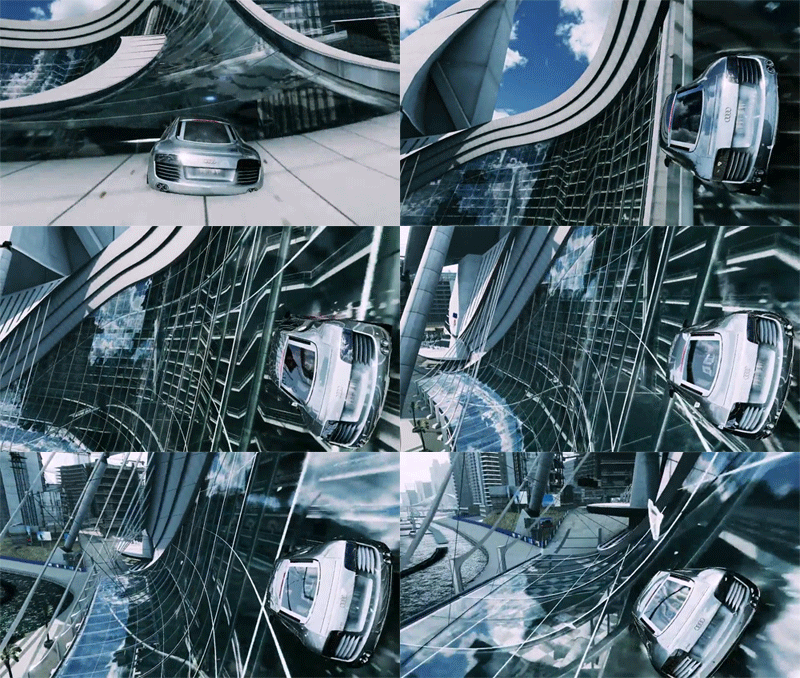
As SolidSnakex mentioned the drifting model was made incredibly easy to the point where it lacks any of the nuance of stronger Ridge Racer entries. In something like Type 4 for example (which was already drastically simplified) the longer you let off the gas before reapplying, the deeper/longer you drift will be. If you opt for too short a duration your car will grip the road again too early for you to clear the turn. Too long and you sacrifice a lot of speed (and will probably fishtail your way out of the corner). In RRV you can even let off the gas for a very short window before reapplying, and your car won't even drift, but kinda shift to the side slightly, allowing you to clear some moderate corners using mostly grip rather than wasting speed on drifts. Now... in RR6 (and 7) the drift is initiated simply by letting off the gas. There's no variation to the drifting style. The cars lock super-tight to the road so the angle of the drift is mostly unimportant. All that matter is that you are drifting at all, and that you pull yourself back to facing forwards at the end.
This wasn't even the real problem though. They took the boost mechanic introduced in the PSP games, and then added a new mechanic on top of it called "Ultimate Charge". This occurs when you enter a drift just as the effects of a boost have ended. It basically meant that after your first level 1 boost you were able to consistently maintain a boost throughout the entire race by simply selecting the correct boost level each time to ensure it always ends as you enter a new turn. This boost management is essentially the entire game. It's what determines your success or failure. Drift angle? Unimportant. Time off the gas? Unimportant. Racing line? Unimportant. Which level drift you use? Alpha and Omega. The only thing that truly matters in RR6 and RR7 is a mechanic that didn't even exist in the classics. People often complain about stuff like sprinting in Halo, or rage in Tekken... but the boost/charge combo in RR6/7 truly strips the game of any of its core design.
Also in a previous post in this thread, I said that Manx TT Superbike had the most ridiculous rubberbanding I've ever seen in a racer. That's actually not true... Ridge Racer 6 was the worst. The AI racers didn't have a boost meter... they simply had unlimited boosts whenever you were in front. They also
wouldn't boost if you weren't. I received a random Xbox Live message from someone who was stuck on the final 5 races of the campaign for days (I assume he found my profile on xbox360achievements or something). I told him two boost until he reached 4th place, don't boost again for the rest of the race (keeping a full 3 stock charged) and then boost heavily for the final 3 or so corners (the AI takes a little while to react to you passing them). He messaged me back within the hour to let me know he'd beaten all five races with that advice.
RR7's additional modifications just add to the insanity, although I didn't play all the way through that one as I was mostly burnt out on it ahead of time by RR6 (RR7 was more of a RR6 Hyper Fighting than an actual sequel). I had a full 1000/1000 in RR6, including the ridiculous "every race in every class with no collisions" stuff, and played for a couple hundred hours online, so with RR7 having inferior online (no voice chat?... really?), everyone I was playing with just ran back to RR6 after the first few days.
Now, despite how negative all the above sounds, I did really enjoy my time with it (especially the online community it had).. but RR6 is where the Ridge Racer we knew really died. People just didn't seem to notice for some reason.
Anecdotally I just remember my friend who loved Sega Rally more then I did move on to Gran Turismo and never look back and it worried me as I didn't get the appeal of GT. Outrun 2 not setting the world alight was more like the confirmation of my theory.
Sometimes all development focus in a genre moves onto a different sub-genre and that's why now I'm sometimes concerned when a new big thing comes along that I have little interest in.
I guess that makes some sense actually. Pre-GT Sega Rally was probably the most authentic racing experience available, so I can imagine many potential sim-racer fans would have been playing that up until the point where more complex simulations became available.