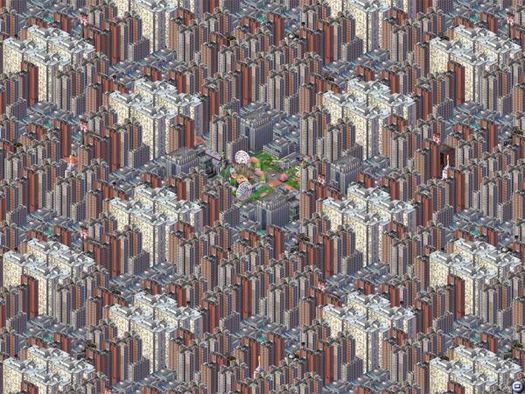
It's not about what they "CAN" be like it's about how they ARE. Most cities in the US and Canada are like the ones in SimCity. SimCity simulates what the majority of people experience when they visit or live in a city.
I strenuously disagree with this. I would say that most cities in the United States and Canada do not have well defined, separate, commercial, industrial, and residential sections. Most cities do not have railroads, most cities do not have airports. Very, very few cities have skyscrapers. Sim City is not offering some pure expression of how it is.
A lot of small towns in America do not have a single stop light. It is big news when a McDonald's moves in. You can describe a lot of small cities as 2 stop light towns.
The prototypical suburban city around where I live has almost no industrial sector at all.
Most of the non-built up landmass of the United States is either federally owned, protected land or land already set aside for agricultural use. Why doesn't Sim City simulate that as you build up suburbs, you encroach upon and pave over pasture and cropland? That is reality in the United States - not the build a city from scratch in a pristine wilderness thing that rarely happens (someone in this thread pointed out the purposeful building of Brasilia, to which you could add Washington DC. But it's supposed to be a city simulator, not a "Build a central-administrative-district simulator).
It seems to me the more hippies or more hippie culture a city has, the better public transportation it has.
Des Moines is half the size of my hometown in population but they have a much better transit system and even the public bikes you can rent from one location and then leave at another.
We just have a terrible bus system. And basically zero hippies or hippie culture.
I'm abusing the term 'hippie' but it's the best way I can think of to describe it.
Many, many towns and cities across America had well developed public transit systems in the very early 20th century. In Atlanta, for example, a lot of the best in-town neighborhoods were developed as street-car neighborhoods. The following statement is not hyperbole at all: the automobile manufacturers in America destroyed mass transit to encourage car culture. One of the reasons it's frustrating to hear people talk about car culture as an organic, natural thing - well, no, it's not. It's something that has been carefully cultivated and subsidized for decades. That doesn't mean we can't change, though!