• Hey Guest. Check out your NeoGAF Wrapped 2025 results here!

Lets discuss women during the victorian era

Status
Not open for further replies.
If you want to have a chuckle, read about hysteria amongst women in the 1800's. Long story short, if a woman was acting "hysterical" which could really mean fucking anything up to and including talking back to her husband, the cure was to head to the doctor and have him use a vibrator and/or dildo to bring her to orgasm to "cure" her. Trust me its worth reading.
 
43191815_3802492f91_o.jpg

HAWT
 
If you want to have a chuckle, read about hysteria amongst women in the 1800's. Long story short, if a woman was acting "hysterical" which could really mean fucking anything up to and including talking back to her husband, the cure was to head to the doctor and have him use a vibrator and/or dildo to bring her to orgasm to "cure" her. Trust me its worth reading.

I don't doubt that this isn't real, but a 1800's vibrator would be some steampunk shit.
 
looking glamorous on the outside payed its toll on the inside back in the 1800's. skinny jeans have nothing on rib constricting corsets and foot binding shoes.

And Adderall/Ritalin have nothing on daily contact with arsenic, lead, and mercury. It's amazing what a relatively small amount of time has elapsed since then and how much better off we are in terms of health. What is it, 5-7 generations?
 
If you want to have a chuckle, read about hysteria amongst women in the 1800's. Long story short, if a woman was acting "hysterical" which could really mean fucking anything up to and including talking back to her husband, the cure was to head to the doctor and have him use a vibrator and/or dildo to bring her to orgasm to "cure" her. Trust me its worth reading.
So, what is the name of this book?
 
Bear in mind, a lot of what we know (or think we know) about the Victorian era is filtered through the mainstream media at the time. (Books, newspapers, mostly)

It would be like judging the 1950s based on I Love Lucy, or the 1960s by later episodes of Leave it to Beaver.

But they had a lot of underground literature (aka porn) which tells the true story

For instance, a 11 volume supposed diary (just a link to the Wikipedia entry)

http://en.wikipedia.org/wiki/My_Secret_Life_(erotica)

Which funny enough, got a publisher jailed in the UK in the 1960s
 
yeah my history teacher discussed the effects of 1800's women and their super tight corsets. It really constricted their rib cages and internal organs permanently.


Overly restricting clothing was not exclusive in the US though. Chinese women were forced to wear small shoes that binded their feet permanently.

disgusting foot warning

edit: beaten by morma, but I posted a pic!

ahhh! ahhhh!!!!!
 
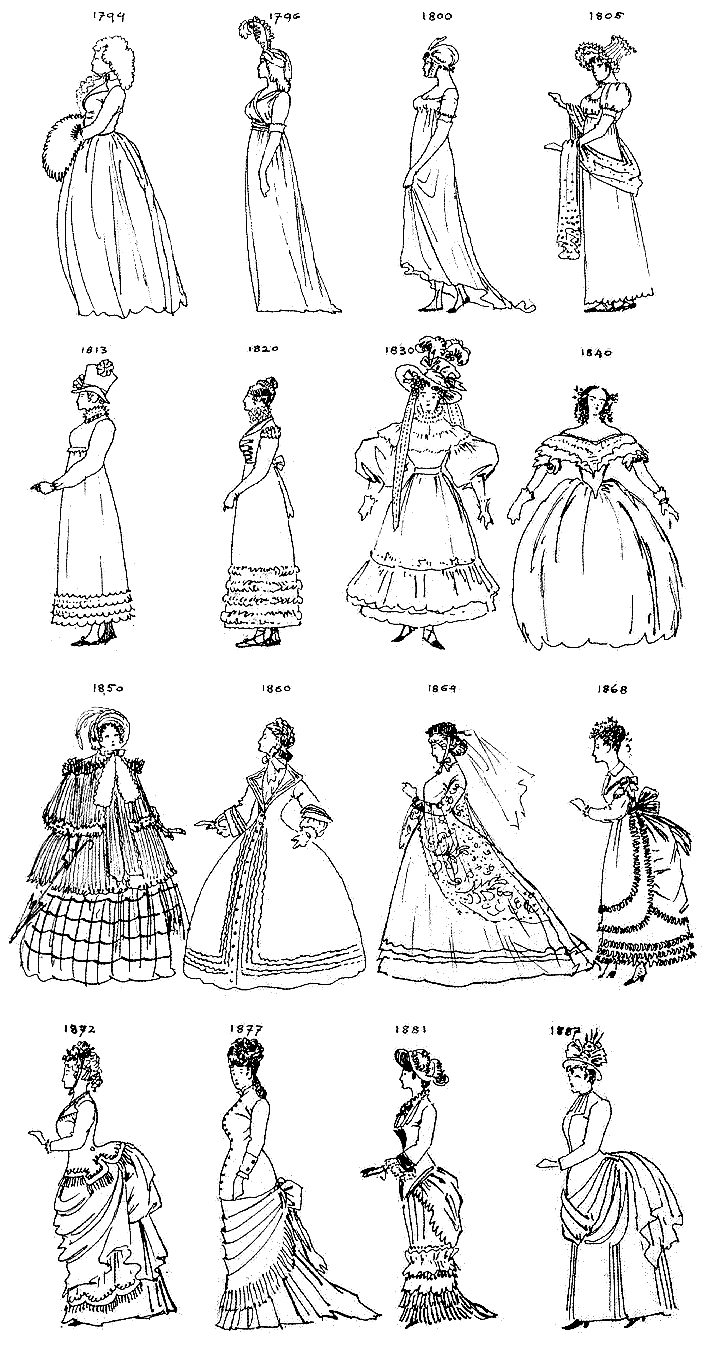
The evolution of the design is fun to look at though.

fashion2.GIF
Fashion during the revolution/napoleonic era was much better than by the end of the century. They didn't have problems to show their breasts. As time went by fashion became a lot more puritan, i mean just look at that 1850 dress, you could have a man in there and you'd never know :D
 
Is it true that anxious/moody women would be diagnosed with "hysterics" and the doctor would finger them until all the tension was relieved?
 
This was around the time doctors started curing female "hysteria" by basically giving female patients orgasms. Then they got tired of it and developed devices (vibrators) they could use at home.

I may be wrong, but I'm pretty sure that there is a film coming out soon about that very subject.
 
What kind of women in the 1800s? There are some interesting accounts of women in Workhouses around London floating about and some rather horrific tales of life in the Old Nichol (London's largest slum).
 
From what I've seen the ones with the tight corsets and cages to frame the dresses look the most uncomfortable. This is a modern recreation but I honestly can't imagine walking around in this shit. Obviously this is something in which you never get to actually sit the fuck down.

cage_crin2.jpg


bustleoldnew.jpg

They were intended to be as uncomfortable and impractical as possible, I think, because it meant that you were incapable of doing work and thus were not a dirty poor.
 
Anyone can say if on ancient times women did have more hygiene that on victorian times? I mean reading this here: http://en.wikipedia.org/wiki/Women_in_ancient_Sparta made me wonder.

19th Century Western cultures didn't shower or bathe much, if that's what you're asking. In fact, the concept of daily hygiene didn't really become mainstream thought until shampoo and soap industries started marketing it as such in the 1950s.
 
Anyone can say if on ancient times women did have more hygiene that on victorian times? I mean reading this here: http://en.wikipedia.org/wiki/Women_in_ancient_Sparta made me wonder.

Quite possibly.

Although hygiene standards took a nosedive in the middle ages so you'd have to go back to ancient times indeed.

Bill Bryson's books are full of little eyebrow-raising details about victorian times in general, give or take 100 years, and also in particular re. women at the time. A short history of private life is particularly good for this.

For example, did you know that medical knowledge of female health in the 1700s was so limited, that a woman managed to trick male doctors into thinking she had given birth to rabbits?

Or that in Victorian London, a third of women between 15 and 25 were prostitutes - and another third were servants?

It's interesting stuff.
 
I expect poor dental hygiene was a sign of wealth, having blackened teeth and whatnot was basically showing everyone you could afford to buy sugar and eat all kinds of luxuries, I know this is certainly true in earlier eras
 
Quite possibly.

Although hygiene standards took a nosedive in the middle ages so you'd have to go back to ancient times indeed.

Bill Bryson's books are full of little eyebrow-raising details about victorian times in general, give or take 100 years, and also in particular re. women at the time. A short history of private life is particularly good for this.

For example, did you know that medical knowledge of female health in the 1700s was so limited, that a woman managed to trick male doctors into thinking she had given birth to rabbits?

Or that in Victorian London, a third of women between 15 and 25 were prostitutes - and another third were servants?

It's interesting stuff.

I would take his books with a grain a salt. Remember that Bill Bryson is not a historian or scientist. His books can be quite unreliable regarding facts. He even presents some urban legends as facts, like glass being a liquid. Don't assume that everything in his books is true.
 
I would take his books with a grain a salt. Remember that Bill Bryson is not a historian or scientist. His books can be quite unreliable regarding facts. He even presents some urban legends as facts, like glass being a liquid. Don't assume that everything in his books is true.

Sure, he's no scientist or historian by his own admission so there's obvious room for error. I'd hope any errors aren't too frequent though. That would be a shame, as his books are great reads :/
 
Sure, he's no scientist or historian by his own admission so there's obvious room for error. I'd hope any errors aren't too frequent though. That would be a shame, as his books are great reads :/

A Google search suggests that there indeed frequent errors in his books. It's a shame because I loved A Short History of Nearly Everything and was planning to read A Short History of Private Life next.

Here's one review I found that criticizes the book's inaccuracy regarding the Victorian era:

Bryson’s 2010 “Short History of Private Life,” the newest of the author’s bestselling works, assumes the enormous task of documenting the development of domestic life from the earliest traces of human dwellings up to the present day. The Daily Telegraph’s review, which appears on the opening page of the book, rightly, but perhaps unintentionally, highlights the problematic readability of Bryson’s study: “[Bryson has] extracted the most arresting material [from 508 books] and turned the result into a book that, for all its winning randomness, is […] a genuine pageturner…None of these things, needless to say, are as easy as Bryson in his ever-genial way makes them seem.” The Economist’s review compliments Bryson’s on his “effortlessly digestible prose,” thanks to which “everyone will find something to surprise them.” The aspects of Bryson’s book that these reviews foreground as praiseworthy, namely its consistent tendency to prune historical documents for juicy and shocking facts that portray the people of the past as particularly inventive, primitive or conservative, become acutely problematic in his treatment of the Victorians. Due to his failure to complicate the most “arresting material” gathered from various sources, Bryson provides little new insight into the ways the Victorians functioned within their homes and instead generalises and re-inscribes the stereotypes of their “shocking” sexual prudery, excessive consumerism and social injustice that scholars have been working to deconstruct.

Bryson’s desire to make his subject seem “easy” is the cause of his frequent historical misrepresentations, especially when it comes to the role of middle-class women in the nineteenth century. Because of his decision to limit his portrayal of “the Victorians’” domestic habits to those of the very rich, who employed dozens of servants, he creates a rather un-nuanced dichotomy between victimised servants and their ruthless employers who had “exacting standards that generally only occur to people who don’t have to do the work themselves.”[1] While it is of course true that servants’ lives were hard and often thankless and that they could be powerless compared to their employers, Bryson creates the impression that servants were completely at the mercy of the “ceaseless whims of employers,” thus durably discrediting the intelligence and agency of both parties.[2] Although he admits that the smooth functioning of the household “depended on the organizational predispositions of the master, mistress, butler and housekeeper,” he entirely omits the role of the middle-class woman in domestic management.[3] Instead, he extensively criticises Thomas and Jane Carlyle for their complicated relationships with their servants, offering neither a counter-example, nor any description of the Carlyles’ life. Many scholars have shed light on the everyday duties of the middle-class woman in the nineteenth century, showing that their lives were very active. As Harold Bloom has argued, “the picture of the frustrated and bored Victorian wife and mother who cannot find any outlet for her talents is largely confined to the moneyed upper classes.”[4] Indeed, Ann Thwaite’s biography of Emily Tennyson, who was relatively wealthy, shows the countless tasks that the poet’s wife handled every day: “She paid the bills and subscriptions, kept the accounts, and dealt with the entire money side of the marriage most of the time. She found tenants for the various houses they came to own […]; she organised and supervised builders during the extensive additions that would be made in the years to come.”[5] Emily Tennyson had a very good relationship with her servants, giving them books and organising “treats and outings for them and [ignoring] as many faults as she could.”[6] Bryson’s snide statement that “in 1841, middle-class women everywhere were bored out of their skulls by the rigidities of life, and grateful for any suggestion of diversion,” seems wholly unfounded and, indeed, for him, the publication of Practical Instructions in Gardening for Ladies is enough proof of the idleness of women’s lives.[7]

In his chapter on “The Bedroom,” which deals with attitudes to sexuality, Bryson’s humour is less “self-deprecating” (The Economist) than simply mocking. For the sake of effect, Bryson presents texts that advocate sexual restraint exceptionally strongly, such as Mary Wood-Allen’s What a Young Woman Ought to Know (1898) and Sir William Acton’s The Functions and Disorders of the Reproductive Organs (1857), in order to argue that the Victorians had a “troublesome” relationship to sex. Bryson’s mocking observation that “within marriage, sex was of course sometimes necessary” becomes particularly cutting though little interjections like “sometimes” and “of course.” He further sarcastically comments that the penis ring was “science’s” “fortunate” response to the panicky Victorians’ fears that masturbation might be a health hazard. Having spent two pages establishing the extremes of Victorian prudery as the norm and having provided an illustration of a penis ring that takes up half a page, Bryson finally acknowledges that “not everyone agreed with these conservative views, it must be noted,” in a timid claim to historical accuracy.[8] He then spends half a page on François Lallemand’s and George Drysdale’s “philosophy of free love” before laboriously instituting Ruskin as the embodiment of prudery and frigidity.[9] He further asserts that “Victorian rigidities were such that ladies were not even allowed to blow out candles in mixed company, as that required them to pucker their lips suggestively.”[10] These are just a few examples of Bryson’s tendency to present the extraordinary as the conventional.

Evidently more interested in creating shock and surprise than a properly contextualised historical analysis, Bryson’s work cannot really be called a “History” because the author seems to neither have a historical rationale, nor does he seem to possess a sincere interest in the people whose homes he describes. Particularly within the contemporary media context, in which TV- and radio-shows have been presenting the lives and inventions of the Victorians to a wide audience, re-assessing worn-out stereotypes, Bryson’s work surprises through its lack of historical questioning and deliberate omission of current scholarly debates. While I cannot say that the book is altogether un-interesting, I am simply stunned at the way Bryson uses the Victorians as laughing stock to entertain, rather than educate, his readers.


http://myblogs.informa.com/jvc/2011/05/31/bestselling-the-victorians-bill-bryson’s-at-home/
 
Status
Not open for further replies.
Top Bottom