• Hey Guest. Check out your NeoGAF Wrapped 2025 results here!

perception of feathered dinosaurs in the West

Status
Not open for further replies.
Is is accepted that all of the major dinosaurs had some type of feathering?

Some of them existed tens of millions of years apart.

Seems crazy to think that some of the more armored ones would have feathering like stegosaurs and ankylosaurs. Along with Brontosaurus they seems to be missing common bird features like being digitigrade. Are they part of a branch that died off before the birding began?

Well the evidence isn't complete, while there are some studies that put the development of proto-feathers very early in the dinosaur lineage, the more conservative estimates put proto feathers only in the saurischian lineage, and most likely only among the theropods. While true feathers are only part of a subset of the theropods.

Now, the other question is how many feathers the organism had. Elephants have hair, but not very much of it. Many of the larger dinosaurs may have been the same, with the capacity to produce feathers, but without a considerable amount of them present.
 
Are just basing widespread japanese acceptance of feathers based on Power Ranger and Pokemon designs?

I mean, not like there are polls about this, but seems like a quick generalization...
 
Quetzalcoatlus is so bad ass.

sJrkunV.jpg
 
Okay so I finally used a minute to look at Wikipedia.

There are 2 groups of dinosaurs, Avian and Non-Avian. (Avian = Birdlike)

The Non-Avians went caput at the end of the Mesozoic Era(Extinction Event).

Whatever species survived are the Avian Dinosaurs because their descendants turned into birds during the Cambrian Explosion during the Paleozoic Era.

Despite this the Non-Avian dinos actually have certain things in common with modern birds, like their hip structure, whereas Avian dinos have a lizard hip.

In total it looks like the Extinction event killed off the Ornithischia(beaked dinos including stego,ankylo, pachycephs, tricera, iguanadons) and the Sauropods which include Brontosaurs. The survivors are the Therapods which include the famous carnivores.

So its a question of how early fuzz or protofeathers began.

Pretty crazy stuff
 
Okay so I finally used a minute to look at Wikipedia.

There are 2 groups of dinosaurs, Avian and Non-Avian. (Avian = Birdlike)

The Non-Avians went caput at the end of the Mesozoic Era(Extinction Event).

Whatever species survived are the Avian Dinosaurs because their descendants turned into birds during the Cambrian Explosion during the Paleozoic Era.

Despite this the Non-Avian dinos actually have certain things in common with modern birds, like their hip structure, whereas Avian dinos have a lizard hip.

In total it looks like the Extinction event killed off the Ornithischia(beaked dinos including stego,ankylo, pachycephs, tricera, iguanadons) and the Sauropods which include Brontosaurs. The survivors are the Therapods which include the famous carnivores.

So its a question of how early fuzz or protofeathers began.

Pretty crazy stuff
So protofeathers means that all these pictures where dinosaurs just look like giant birds are exaggersted and as uncorrect as the Jurassic Park dinosaurs?
 
OP, i think you're drawing conclusions from the relatively small sample size of dinosaur-like fiction in the West, versus the relatively large sample size of dinosaur-like fiction in Eastern or Japanese media.

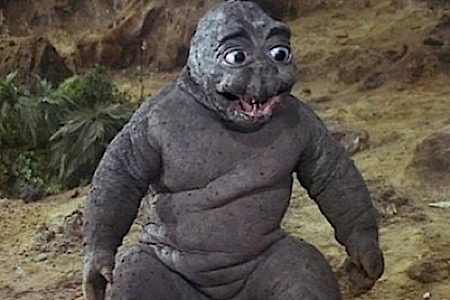
There are plenty of dinosaur-like creatures in Japanese media that do not have feathers. For instance, of the dozens of dinosaur like creatures in the Godzilla movies/media, very few of them have feathers And some of them look like this, a hairless man-baby:

23-Godzilla-Kaiju-Minilla.jpg


So, why are there more feathered dinosaur-like creatures in Japanese pop-media? Because there are more dinosaur-like creatures in Japanese pop-media than in the West.
 
Has their been scientific evidence that the bigger carnivores like T-Rex had feathers? I mean I've seen the fossils with the feather imprints from raptors and smaller bi-peds like Archaeopteryx, but never a T-Rex. I also don't think that the therapods (long-neck tanks) have any fossil evidence of feathers.

I don't mind dinosaurs having feathers at all as long as there's fossil evidence that that particular species had feathers.

Maybe I'm wrong, if anyone has any contradictory info please post.

I believe they found evidence of the younger t Rex having feathers and that they shed them as they grew older.

There are also evidence of some of the long neck titans having them, or at least quill like proto feathers and paleontologists are theorizing that they are very bright. They also found armor and schutes on many of them so they looked more like bright armored titans than the smooth skinned variety they are usually depicted as. Some even have them on thier tail so they don't act like bladed whips. Fucking cool.
 
There's currently no reason to think an adult T.rex would lose its feathers. The biggest reasoning people thought that for a while was that larger animals with feathers would become overheated but the discovery of Yutyrannus a few years ago, silenced that idea pretty soundly--Yutyrannus is a relatively close relative of Tyrannosaurus that was around 80 percent or so the size of Tyrannosaurus, but it was covered in feathers.

Of course it's entirely possible that Tyrannosaurus didn't have feathers, but there's no real compelling reason to think they didn't, either, and the only reason the idea that they're featherless is seen as the "default" option in this case is because that's just what people are used to.
 
Because people conflate facts with their personal ego and think "it's impossible that i know something that is now wrong"
 
So protofeathers means that all these pictures where dinosaurs just look like giant birds are exaggersted and as uncorrect as the Jurassic Park dinosaurs?

"Protofeathers" is a broad term. There were feathers that were basically fuzzy coverings (like the down of a baby bird), and feathers that were like regular feathers with a shaft and a bunch of fibers coming off of it (but not really connected in a coherent shape like modern bird feathers), and then fully vaned feathers like modern bird feathers, which some dinosaurs have been found have to have.
 
scales look way more bad ass

and toys are easier to make without feathers

so I can't seem them catching on in the west for a while, at least in popular portrayals of dinosaurs.
 
Makes sense, how else would he reach the grass with such tall body?

They are generally thought to eat from trees, hence the neck + size for reaching them. I would assume they would have to reach the ground for watering holes. Its also pretty widely held that they could not bend necks like we are accustomed to giraffes doing, so they probably just rotated their whole body.

But retrofitting a biblical verse seems far fetched. You could apply that to many creatures, like an elephant.

On a side note Giraffes have some hilarious poses for reaching the ground to get to grass.
 
I fully accept feathered dinosaurs. But this wouldn't look nearly as awesome with feathers

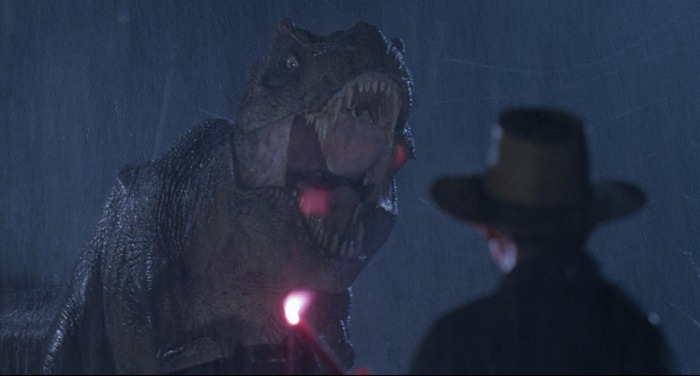
tyrannosaurusrex-03.jpg

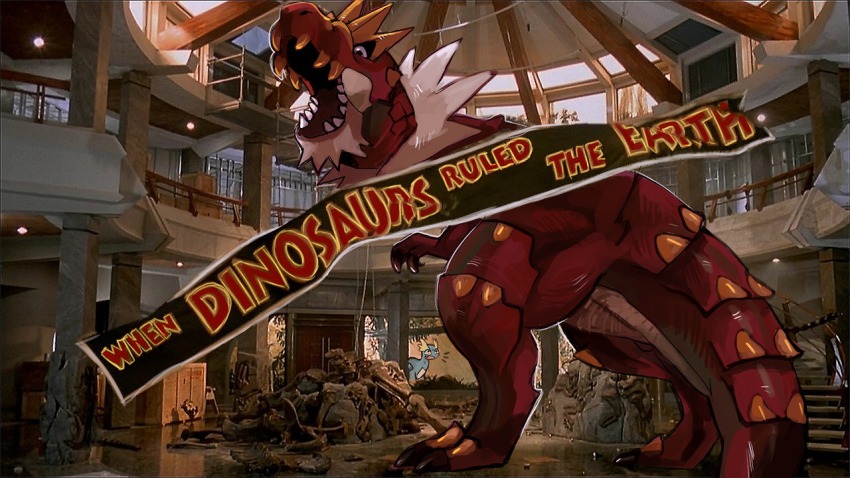
I dunno, Tyrantrum already works like that.

c9f.jpg


What doea that have to do with the time and expense of modeling realistic feathers? The zords don't have feathers and Torin's a suit.

I'm talking about how they have less budget yet recognize that feathered dinos exist, but it's merely an amusing thought and not really an argument.

OP, i think you're drawing conclusions from the relatively small sample size of dinosaur-like fiction in the West, versus the relatively large sample size of dinosaur-like fiction in Eastern or Japanese media.

There are plenty of dinosaur-like creatures in Japanese media that do not have feathers. For instance, of the dozens of dinosaur like creatures in the Godzilla movies/media, very few of them have feathers And some of them look like this, a hairless man-baby:

23-Godzilla-Kaiju-Minilla.jpg


So, why are there more feathered dinosaur-like creatures in Japanese pop-media? Because there are more dinosaur-like creatures in Japanese pop-media than in the West.

First off Minilla is shit. Second Godzilla isn't really supposed to be true towards dinosaurs anyway, and passes more off as a dragon anyway.
 
Feathers are often a sign of femininity (think feather boas). Dinosaurs are popular in large part because they a super predators, a status that humans often strive toward and admire which has very masculine connotations. For some, imagining a dinosaur with feathers dampens the hyper masculine hunter/warrior appeal of dinosaurs.
 
Feathers are often a sign of femininity (think feather boas). Dinosaurs are popular in large part because they a super predators, a status that humans often strive toward and admire which has very masculine connotations. For some, imagining a dinosaur with feathers dampens the hyper masculine hunter/warrior appeal of dinosaurs.

but I thought bald eagle is manly
 
Feathers are often a sign of femininity (think feather boas). Dinosaurs are popular in large part because they a super predators, a status that humans often strive toward and admire which has very masculine connotations. For some, imagining a dinosaur with feathers dampens the hyper masculine hunter/warrior appeal of dinosaurs.

But why doesn't that apply to birds?

 
Feathers are often a sign of femininity (think feather boas). Dinosaurs are popular in large part because they a super predators, a status that humans often strive toward and admire which has very masculine connotations. For some, imagining a dinosaur with feathers dampens the hyper masculine hunter/warrior appeal of dinosaurs.

Eh. There were a number of heraldry beasts that were feathered. Griffons and Eagles.most notably.

Sometimes the answers is the simplest - most depictions of feathered dinosaurs look silly.
 
Eagles can fly, their feathers have purpose. The ability to fly conveys nobility. Most flightless birds are the subject of humor; penguins, chickens, ostriches.

We're talking about contemporary western culture.

How else do we explain the whining about "ruined childhoods"?

But headdresses are also mostly adorned with feathers.

Also people making fun of ostriches are terrible.
 
You're telling me to believe that feathered dinosaurs existed... and *gasp* evolved into b..bu...birds? That's crazy talk!

creation-museum.jpg

... but it clearly eats leaves like a giraffe >.>


My problem is that we cant know what they reallllllllly looked like generally. At least with the traditional models, we kind of know the bone structure and can elaborate reliably to a degree.
 
Because the 90s transformed dinosaurs into entertainment products rather than things that once lived, so now people react like someone is changing Batman's cape to red.
 
Are just basing widespread japanese acceptance of feathers based on Power Ranger and Pokemon designs?

I mean, not like there are polls about this, but seems like a quick generalization...

+1

I have a strong feeling that many or most Westerners are aware of the idea of feathered dinosaurs but insist that it wasn't really like that.
 
Feathers are often a sign of femininity (think feather boas). Dinosaurs are popular in large part because they a super predators, a status that humans often strive toward and admire which has very masculine connotations. For some, imagining a dinosaur with feathers dampens the hyper masculine hunter/warrior appeal of dinosaurs.
Eagles can fly, their feathers have purpose. The ability to fly conveys nobility. Most flightless birds are the subject of humor; penguins, chickens, ostriches.
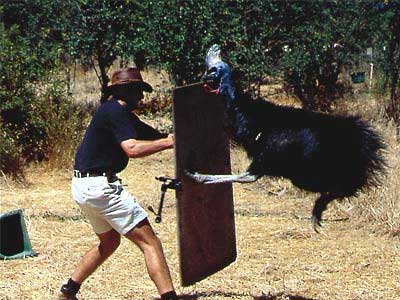
And then there's the cassowary.

cassowary-attack-2.jpg
 
Okay so I finally used a minute to look at Wikipedia.

There are 2 groups of dinosaurs, Avian and Non-Avian. (Avian = Birdlike)

The Non-Avians went caput at the end of the Mesozoic Era(Extinction Event).

Whatever species survived are the Avian Dinosaurs because their descendants turned into birds during the Cambrian Explosion during the Paleozoic Era.

Despite this the Non-Avian dinos actually have certain things in common with modern birds, like their hip structure, whereas Avian dinos have a lizard hip.

In total it looks like the Extinction event killed off the Ornithischia(beaked dinos including stego,ankylo, pachycephs, tricera, iguanadons) and the Sauropods which include Brontosaurs. The survivors are the Therapods which include the famous carnivores.

So its a question of how early fuzz or protofeathers began.

Pretty crazy stuff

Uhh...I'm having trouble parsing what you typed here. The two groups of dinosaurs (which pretty much split right at the bottom of the family tree) are the Saurischia (lizard hipped) and the Ornithischia (bird hipped). The lizard hipped dinos had a forward thrusting pubic bone that large muscles attached to. The bird hipped dinos had a hip structure with the pubic bone recessed toward the spine and looked superficially bird like. Other than the Sauropods, every family of Saurischia was predatory. Every family of Ornithischia was mostly herbivorous (and the structure of their hips with the receded pubic bone was likely to make room for more intestinal tract since plants are tough to digest).

Proto feathers (hollow hair like structures) are present in both dino lineages. These structures show up as quill like in some Ornithischia like the early ceratopsians (notably Psittacosaurus ) and quite early on develop into advanced feathers in the Saurischia line.

Modern birds are members of the maniraptora dinosaur family which includes the famous velociraptor. Interestingly, the pubic bone in many groups within this family is reversed and pushed back towards the spine, and shows where the bird hip structure got its start.

Also, in the T-rex family, early Tyrannosaurs like Dilong were fully feathered, and giant tyrannosaurs like Yutyrannus (which was 30 feet long) were also covered in long shaggy feathers. T-rex itself could indeed have been fully feathered. Considering it was a North American dinosaur and it could get very cold, even snow while rex was around, it might, at the very least, have sported a winter coat.

The only group of dinosaurs to survive into modern days are the Neornithes. When we say "non-avian dinosaurs" we are just saying any dinosaur not a member of Neornithes.
 
I'm no scientist but why is it believed that Dinosaurs are closer to birds then lizards we see today. I mean reptiles have teeth and birds don't right? So if some found dinosaurs have teeth then why do we want to classify them as having features. I'll accept what the people who actually put in the work are saying and lets me honest, most animals are sexier when covered with fur or feather. Who in the animal kingdom is going after the hairless animals? When it comes time to mate, everyone whose getting laid whips out the plumage and the hairless ones can go try to make their best swimming lap ~alone~. So yes, I'm fine with features but my ignorance strongly believes that dinosaurs with teeth didn't have them.
 
I'm no scientist but why is it believed that Dinosaurs are closer to birds then lizards we see today. I mean reptiles have teeth and birds don't right? So if some found dinosaurs have teeth then why do we want to classify them as having features. I'll accept what the people who actually put in the work are saying and lets me honest, most animals are sexier when covered with fur or feather. Who in the animal kingdom is going after the hairless animals? When it comes time to mate, everyone whose getting laid whips out the plumage and the hairless ones can go try to make their best swimming lap ~alone~. So yes, I'm fine with features but my ignorance strongly believes that dinosaurs with teeth didn't have them.

Because a lot of new evidence within recent years has pointed towards therapodic dinosaurs having feathers, imprints were found in fossils, China has a whole bunch of them. Connect that with their hipbone structures and voila. This is just generally speaking. I'm sure someone has a more indepth answer than this.
 
I'm no scientist but why is it believed that Dinosaurs are closer to birds then lizards we see today. I mean reptiles have teeth and birds don't right? So if some found dinosaurs have teeth then why do we want to classify them as having features. I'll accept what the people who actually put in the work are saying and lets me honest, most animals are sexier when covered with fur or feather. Who in the animal kingdom is going after the hairless animals? When it comes time to mate, everyone whose getting laid whips out the plumage and the hairless ones can go try to make their best swimming lap ~alone~. So yes, I'm fine with features but my ignorance strongly believes that dinosaurs with teeth didn't have them.
Reptiles are kinda odd because they're a paraphyletic group that excludes some clades (Specifically mammals and birds). Even though alligators and lizards look similar, an alligator is more closely-related to a bird than a lizard. The two closest relatives of extinct dinosaurs today are birds (which technically are dinosaurs) and crocodilians.

We know birds evolved from theropod dinosaurs because of similar skeletal structures and the evolution of birdlike traits such as feathers and a wishbone.

Many early birds had teeth, but eventually birds evolved into the toothless guys we know today. Claws on the forelimbs also mostly disappeared, though young hoatzins today still have wing claws to help them climb trees.
 
I'm no scientist but why is it believed that Dinosaurs are closer to birds then lizards we see today. I mean reptiles have teeth and birds don't right? So if some found dinosaurs have teeth then why do we want to classify them as having features. I'll accept what the people who actually put in the work are saying and lets me honest, most animals are sexier when covered with fur or feather. Who in the animal kingdom is going after the hairless animals? When it comes time to mate, everyone whose getting laid whips out the plumage and the hairless ones can go try to make their best swimming lap ~alone~. So yes, I'm fine with features but my ignorance strongly believes that dinosaurs with teeth didn't have them.

Basically anatomical features. Birds have a lot of unique features, like air sacs in their bones, hollow bones, wishbones, feathers, so on and so forth and the only place we see these features both fully developed or in more primitive forms is within dinosaurs. We know the dinosaur family tree pretty well. We know which groups are more or less closely related.

Here's something interesting. There are two modern animal groups mostly closely related to the extinct dinosaurs. Birds, which are themselves dinosaurs, and crocodiles (and their family which includes alligators, etc). Crocodiles come from the archosaur family. Dinosaurs also come from the archosaur family. Same roots which sprouted different family trees. If you look at crocodiles and birds at a genetic level, they are closer to each other than crocodiles are to lizards, turtles, or anything else stuffed under the junk "reptile" category. Simply put. Crocodiles are dinosaur cousins. They are close kin to birds, but only very distantly related to anything else.

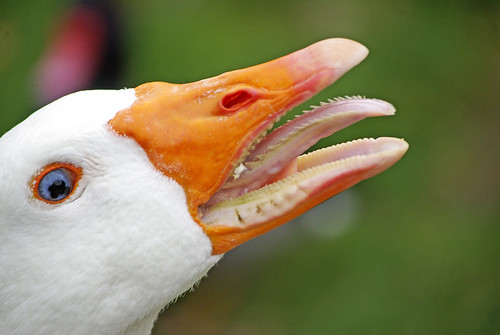
Finally, on the matter of teeth. Birds have the genes to make teeth, these genes are simply not expressed any more (primitive birds had teeth). Through genetic manipulation in chickens, we have gotten these genes to work again, though not very well, resulting in chickens with teeth.
 
I know that there's philosophical stuff is getting put up, but I think it just generally comes down to dinosaurs no longer having much of a presence in the West. Jurassic Park 3 and Turok from Disney are the last major strides for dinosaurs in entertainment that both began incorporating feathers as such theories began to take serious roots in the field. Since then, nothing really has encouraged any push to continue the trend to modern findings.

As such, there's been nowhere near as much interest in the public space to be educated on it, and paleostudies outside of geology aren't significant to encourage more minds to get into the field. I remember books on dinosaurs being extremely commonplace throughout the 90s, even prior to Jurassic Park. Early 2000s did ok too as JP continued a bit and people were enraptured by Sue with her more or less complete state on display to the public, but after that nothing.

So one may bring up and ask about Jurassic World releasing this year. Given that the dinosaurs in JP started out without feathers and in combination with the use of amphibian DNA, 'hair-less' dinosaurs wouldn't have much of a place outside of perhaps species not already shown in the first film that this seems to relying heavily on to the point of including the original t-rex herself.

Not to mention, as other elements of the film were concerned, the feathered raptors in JP3 were a rather poor attempt to incorporate modern findings to where I think they found further reason to fall back to what they did in the first two films.

There's also some hesitation in the idea that something with feathers could look just as/more scary than something with scales. I've seen some good concept art in the past, but it's been a struggle. Feel like more of those folks should visit some geese, cassowaries, and macaws to learn how mean these things can be.

Finally, yes, a large part of it is hesitation to move away from the traditional appearances due to both marketing and design. Fears of consumers rejecting the feathered look either due to nonconformity or nonrecognition. Feathers requiring more work to be convincing than skin/scales.
 
I don't actually think there is a perception about feathered Dinosaurs in the west, most average people probably still believe that Jurassic Park 1 is the absolute height of dinosaur depictions in our culture because they're quite ignorant of both the study of evolution and paleontology, and who can blame them?
JP1's designs are so pervasive throughout our culture, one literately can't get away from them unless you're a paleobuff specifically looking for credible scientific studies and great paleoart; a lot of mainstream animators/film makers/video game designers/etc. simply regurgitate outdated and inaccurate JP1 designs (and in the case of Pterosaurs,even older designs from even older more outdated pieces of media) because that's really all they know and that's all they're willing to study. This effects the layman perception of what a Dinosaur looks like because people often soak up the concepts they learn about in entertainment and develop assumptions based of what was casually fed to them.

Tbqh, the only people who actually complain about feathered dinosaurs are trolls looking for a good laugh and a vocal minority of nimrods who actually do think science is "ruining their childhood" because feathers are girly/not scary or whatever.
When I step back and look at the big picture it doesn't really seem like the general public gives a hoot about feathers on dinosaurs, and would probably be somewhat surprised by the sight of a fuzzy dromaeosaurid leaping onto their screens; the reaction probably wouldn't be strongly negative or positive.


I'm no scientist but why is it believed that Dinosaurs are closer to birds then lizards we see today. I mean reptiles have teeth and birds don't right? So if some found dinosaurs have teeth then why do we want to classify them as having features.
...
So yes, I'm fine with features but my ignorance strongly believes that dinosaurs with teeth didn't have them.

Lots and lots of fossil evidence that shows a slightly "murky" but otherwise intelligible evolutionary line of decent.
Also, non-avian theropod dinosaurs share many morphological similarities with true birds; both non-avian dinosaurs and birds tend to have Long bendy S-shaped necks, similar digit/hand structure, a semi-lunate carpal, an erect digitigrade stance, four chambered hearts, coats of feathers (for warmth, display, etc.), a complex air sack system, and sturdy "hollow" bones.

Not having teeth doesn't mean much (plenty of dinosaurs had beaks, and so did their cousins the pterosuars); teeth were probably lost in order to aid with flight and give birds better access to more exploitable feeding niches, birds still have a recessive trait for teeth in their DNA.
Besides being diapsids/"reptiles" and having a common ancestor at some point in time, the giant successful groups of Squamata (Lizards and Snakes) and Dinosauria are very distinct and separate from each other.

 
Status
Not open for further replies.
Top Bottom