

-
Hey Guest. Check out your NeoGAF Wrapped 2025 results here!
You are using an out of date browser. It may not display this or other websites correctly.
You should upgrade or use an alternative browser.
You should upgrade or use an alternative browser.
PlayStation generates higher operating profit than Nintendo since 2024
- Thread starter Merline
- Start date

CentralScrutinizer
Member
You get the privilege to buy Fairgames next year.Congratulations to the shareholders.
How does this benefit me?

IntentionalPun
Ask me about my wife's perfect butthole
I think the PS5 is a great piece of kit. Still hard to believe they sold the DE for $400 at launch, best deal in gaming really and still is when you can get one on sale.
Biggest rip-off for me this generation that I'm sure has generated billions of profit for Sony over the last 5-6 years is them locking out DS4 controllers from working on PS5 games.
Combined with how quickly the 2 original DualSense we had broke, and a third replacement (we have 2 PS5s) I've been pretty demotivated to use the platform.
Over $200 replacing broken controllers and the 2 we have left have batteries that barely last more than an hour of gaming. Hell if they have a full charge and we just leave them sitting there not touched they'll be dead by the end of a 2 hour movie.
Biggest rip-off for me this generation that I'm sure has generated billions of profit for Sony over the last 5-6 years is them locking out DS4 controllers from working on PS5 games.
Combined with how quickly the 2 original DualSense we had broke, and a third replacement (we have 2 PS5s) I've been pretty demotivated to use the platform.
Over $200 replacing broken controllers and the 2 we have left have batteries that barely last more than an hour of gaming. Hell if they have a full charge and we just leave them sitting there not touched they'll be dead by the end of a 2 hour movie.
How does this benefit me?
you will get another price increase in games and hardware, in what could be the worst generation ever.
Last edited:


thicc_girls_are_teh_best
Member
Congratulations to the shareholders.
How does this benefit me? I will still not get a new Wipeout or Motorstorm.
F A C T S.
I'm tired of playing corporate bean counter for corporations, especially when, as you said, it results in nothing of added value for customers. Is the PS5 getting a slew of new in-demand features after that $150/$200 price cut for the models? PS+ is still the exact same it's always been after its last price hike. Seems like studios like Bungie are benefiting from those increased profits by staying open well longer than they deserve while more deserving studios like Bluepoint get shut down.
Anybody getting moist or nutting to corporations generating their revenue or profits needs to reassess their priorities.
If there's one company that could give Nintendo real competition in the handheld market, it's PlayStation. Sony already has one of the biggest gaming ecosystems in the world and a huge global audience. They wouldn't need to sell 100 million handhelds to become a problem for Nintendo either. Even 40-50 million units would already be enough to create serious competition and give Nintendo some real headaches in the portable gaming space.
The SIE that could've genuinely taken Nintendo on in the portable space akin to PSP, is dead. They aren't here anymore, and haven't been for a while. So I don't know what copium you're smoking, but whatever the next PS portable is, will not be threatening Switch 2 in any way, shape, or form.
If anything, SIE'll need to worry about standing out against something like the Steam Deck 2, let alone Nintendo, because it's things like Steam Deck 2 where there's going to be 90% game library overlap if not more. Speaking of which, that's the main reason thinking SIE can challenge Nintendo in the portable space is laughable: what games do SIE have that'll accomplish it?
They don't have a Mario Kart, they don't have a Smash Bros., they don't have a 3D Mario (well, Astro Bot hits that quality-wise but not sales-wise), they don't have a Zelda, they don't have a Pokemon, they don't have a Tomadachi, they don't have a Pokopia, they don't have an Animal Crossing, they don't have a Splatoon etc. Every single Nintendo game I just listed is a genuine exclusive to Nintendo's own system; IF SIE have any equivalents remotely close to them in terms of demographics and market cache, they are mainly 3P games, and are also available on PC and most cases Xbox too, even Nintendo in some cases.
Versions of GOW or TLOU running on a portable aren't gonna do shit for PlayStation in Japan, that's just the honest truth, and aside from Team Asobi and arguably Polyphony (I think GT would be of some benefit), they don't have the studios capable of making things to match the Nintendo IP I mentioned, either. Even if they technically might in a case like Media Molecule, well that studio won't likely pitch anything in that style ever again. Insomniac meanwhile are on Mahvel duty for the next decade and MAYBE might squeeze out another R&C sometime in 2030 or later, IF it even happens.
Is Nintendo more efficient or are they just more conservative? To me, both Nintendo and PlayStation are doing incredibly well overall in the gaming space. Both have some issues here or there, but overall are doing great. And you can't call making all-time profits "bleeding like a pig". It's objectively untrue.
It's both, but the thing is part of being more efficient at many times will involve being more conservative in your spending. How do you think rich people continue to remain rich, by spending everything they make? No, they spend just a bit, and may splurge once in a while, but they're putting most of their money into stocks, into savings, into other investments. A lot of these tech CEOs can afford Versace and Gucci clothes, but they're wearing Vans sneakers and simple Polo t-shirts.
That's partly to appear more "relatable" (doesn't really work), partly because they know spending frivolously on that type of stuff means nothing. If you were to ask me, to speak objectively as to who's doing better between Nintendo and SIE, the answer would be Nintendo. Nintendo isn't taking on near $1 billion in impairments from a failing acquisition, they haven't wasted hundreds of millions on failed GAAS titles, they haven't shut down fan-favorite single-player game studios, they didn't compromise their identity by porting all or almost all of their current-gen releases to another platform like PC, they didn't do a $150/$200 price hike within a week or two of announcement (or at all), they haven't lost most of their close-knit 3P deals for games exclusivity, they haven't released almost $600 peripherals that were abandoned after a year, they haven't had the majority of their games questioned (either rightly or wrongly) on matters of trend-chasing, player health, or political agendas, etc.
When you look at things in totality, beyond just whatever revenue or profits are being pulled in, SIE have bungled this generation in ways I never thought would have ever been possible for them. To say my faith in their decision-making in areas that matter to me as a gamer has been eroded, is an understatement. And that doesn't absolve Nintendo of any of their flubs because they've had a few themselves. But compared to SIE, they're practically stainless. Only Microsoft have screwed up and fumbled the bag worst than SIE this gen among the Big Three, but nowadays we are talking about 1-2 degrees of separation between them and SIE. That's on a 10-point scale: even early in this gen it was six or higher in SIE's favor, and prior to this gen? Hell, you'd of needed to make the scale larger because that's how much better SIE were handling things on all fronts compared to Microsoft, especially from 2016-2020.
That SIE, frankly, doesn't exist anymore.
Maybe not stupid, but the relevance doesn't seem to have much value, beyond the stock price for investors. To me, what's better.......?
- Making $100 Billion in Revenue, $10 Billion in Profit, for a 10% Profit Margin
- Making $175 Billion in Revenue, $12.25 Billion in Profit, for a 7% Profit Margin
It's hard to look at either and think that either one is doing badly. And you're right, it's totally irrelevant to the question of which company is in better shape.
Objectively, the former. If you took the performance of the former and scaled everything linearly, you'd make $20 billion in profit at $200 billion revenue and still retain a higher profit margin. Or $17.5 billion in profit on $175 billion revenue, same 10% profit margin. That is objectively better than the latter where you have 7% profit margin and $12.25 billion profit on $175 billion revenue.
Any shareholder would answer the same way, speaking objectively, since both involve numbers with a clearly-defined functional relationship between those numbers.
Last edited:

StreetsofBeige
Gold Member
Not even congrats to shareholders. Here's their 5 year chart. Stock has dropped 30% since November. And if anyone looked at their all time chart, the stock price was higher during the dot com craze in 2000. You would made more money on the stock if you put in your money into a 1-2% savings account. You woildnt even make good money off a dividend since their div payout is almost 0.Congratulations to the shareholders.
How does this benefit me? I will still not get a new Wipeout or Motorstorm.
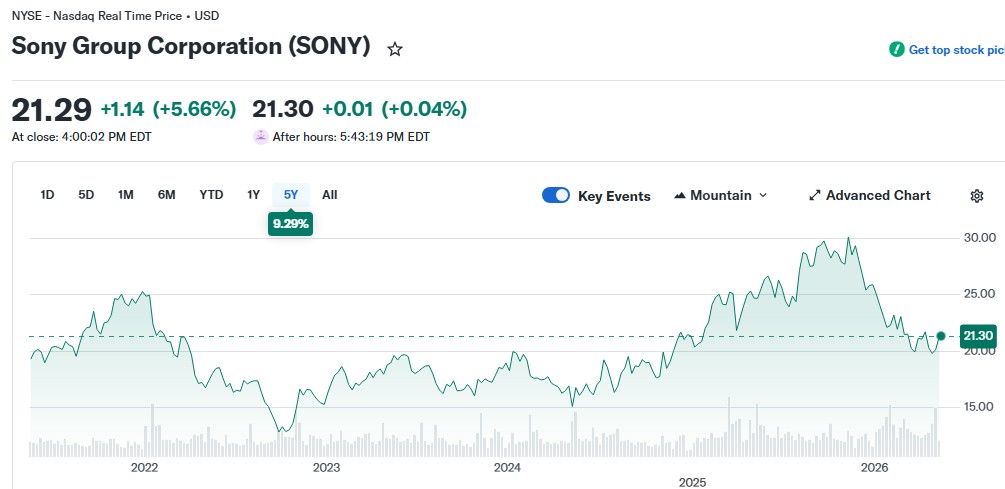
Last edited:
PauloRoberto
Member
To be honest, Sony and Nintendo are not good companies to bet your money as a shareholder... i mean, a sneeze can make those shares fall like it's the end of the world! :-DNot even congrats to shareholders. Here's their 5 year chart. Stock has dropped 30% since November. And if anyone looked at their all time chart, the stock price was higher during the dot com craze in 2000. You would made more money on the stock if you put in your money into a 1-2% savings account. You woildnt even make good money off a dividend since their div payout is almost 0.
Of course you can operate in debt, humans and corporations do it . You're missing my point of flexibilityAnd this is another wrong way to look at these large companies, 10b debt is not like if Sony makes a billion they go pay it back, for these large companies debt is an investment against an asset (usually their stock price) and as long as they keep that afloat the debt is a good thing
(acquisitions, new studios, buy a new headquarters/ Plants etc). To incur more debt can give you a lower rating as a Corporation and lower your credit score. Which effects you being able to borrow more money. Which can effect your Stock value and projections. If Nintendo had 10 billion in debt and in this situation their stock would be even lower. Cause they are a 99% purely Videogame Entertainment Company only. This is the only way they make money.
Lets see how much Hollywood Movie Nintendo division vs Videogame Nintendo division brings in over the next decade.

mckmas8808
Mckmaster uses MasterCard to buy Slave drives
I guess that 30% on games you have no expenses in beyond serving the downloads really adds up.
Which is why selling many consoles matters. And why Xbox's "This is an Xbox" idea was stupid.
mckmas8808
Mckmaster uses MasterCard to buy Slave drives
It's both, but the thing is part of being more efficient at many times will involve being more conservative in your spending. How do you think rich people continue to remain rich, by spending everything they make? No, they spend just a bit, and may splurge once in a while, but they're putting most of their money into stocks, into savings, into other investments. A lot of these tech CEOs can afford Versace and Gucci clothes, but they're wearing Vans sneakers and simple Polo t-shirts.
That's partly to appear more "relatable" (doesn't really work), partly because they know spending frivolously on that type of stuff means nothing. If you were to ask me, to speak objectively as to who's doing better between Nintendo and SIE, the answer would be Nintendo. Nintendo isn't taking on near $1 billion in impairments from a failing acquisition, they haven't wasted hundreds of millions on failed GAAS titles, they haven't shut down fan-favorite single-player game studios, they didn't compromise their identity by porting all or almost all of their current-gen releases to another platform like PC, they didn't do a $150/$200 price hike within a week or two of announcement (or at all), they haven't lost most of their close-knit 3P deals for games exclusivity, they haven't released almost $600 peripherals that were abandoned after a year, they haven't had the majority of their games questioned (either rightly or wrongly) on matters of trend-chasing, player health, or political agendas, etc.
When you look at things in totality, beyond just whatever revenue or profits are being pulled in, SIE have bungled this generation in ways I never thought would have ever been possible for them. To say my faith in their decision-making in areas that matter to me as a gamer has been eroded, is an understatement. And that doesn't absolve Nintendo of any of their flubs because they've had a few themselves. But compared to SIE, they're practically stainless. Only Microsoft have screwed up and fumbled the bag worst than SIE this gen among the Big Three, but nowadays we are talking about 1-2 degrees of separation between them and SIE. That's on a 10-point scale: even early in this gen it was six or higher in SIE's favor, and prior to this gen? Hell, you'd of needed to make the scale larger because that's how much better SIE were handling things on all fronts compared to Microsoft, especially from 2016-2020.
That SIE, frankly, doesn't exist anymore.
Come on bro. I feel what you're saying but the bolded is WILD!!!!!!! And you know it lol.
Objectively, the former. If you took the performance of the former and scaled everything linearly, you'd make $20 billion in profit at $200 billion revenue and still retain a higher profit margin. Or $17.5 billion in profit on $175 billion revenue, same 10% profit margin. That is objectively better than the latter where you have 7% profit margin and $12.25 billion profit on $175 billion revenue.
Any shareholder would answer the same way, speaking objectively, since both involve numbers with a clearly-defined functional relationship between those numbers.
That's the thing.....you can't just linearly scale things like that in the real world. If Nintendo could, they would. I know a shareholder would answer it the way you did, because they only care about the stock price. But we gamers shouldn't "ONLY" care about stock prices. We aren't bean counters.
Last edited:

LyricalShrike
Member
Now do operating margin and see why your take is myopic.

Men_in_Boxes
Snake Oil Salesman
God Bless this man.

Buggy Loop
Member
Is Nintendo more efficient or are they just more conservative?
Interpret it like you want, the result is roughly this
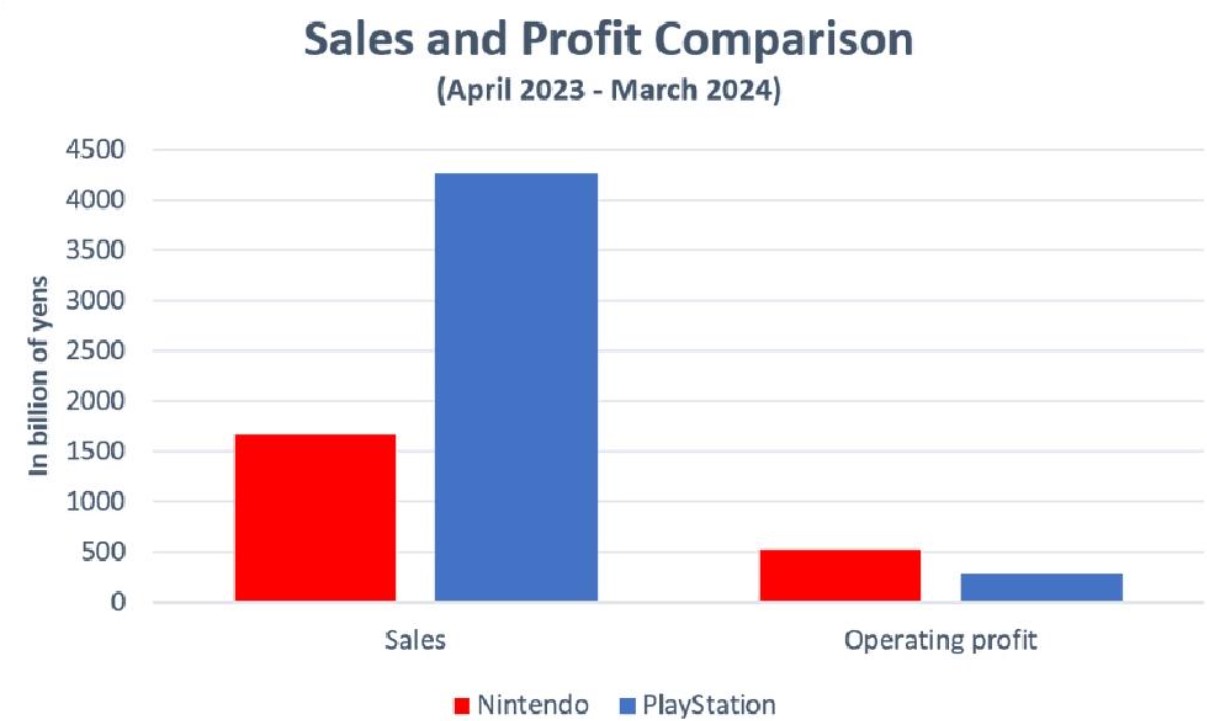
To me, both Nintendo and PlayStation are doing incredibly well overall in the gaming space. Both have some issues here or there, but overall are doing great. And you can't call making all-time profits "bleeding like a pig". It's objectively untrue.
You can have the highest revenue, lose ~93% of it after you count all that remains and still have the highest operating profit, but you're still bleeding like a pig.
And is looking at things like "investors" the right viewpoint to have? I think many would argue that investors can hold stupid viewpoints when analysing companies.
Investors have scrutinized PlayStation business due to lower operating profit margins despite high revenue. It can tell something is inherently heading in the wrong direction, inefficiency IT structure/software, declining hardware demand, rising production costs, too high acquisition costs, lower first party software sales, bloated, etc. Things that investors look at to see if they pull out.
Sony is trying to improve this of course. To know if the new high operating profits is because they're patching up the open wound, or just because they got high revenue but still bled like previous years, we need revenue for that.
Last edited:
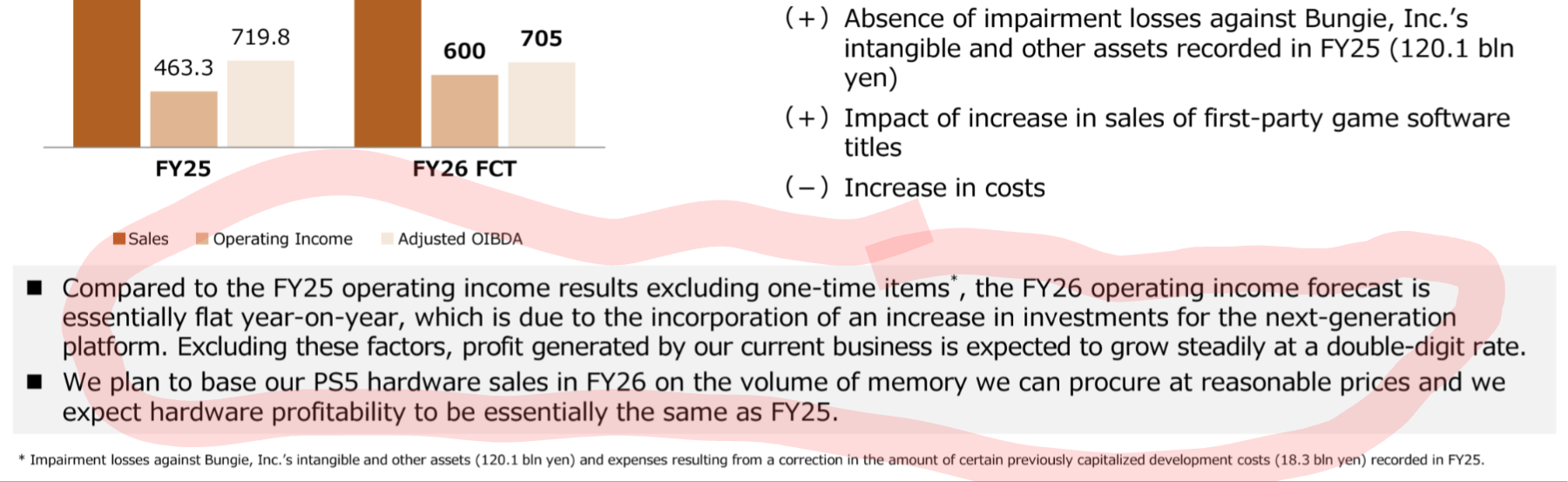
The R&D for the next gen starts right after the new console is released, so by your logic, an company is ALWAYS on an transition period.
It's in the financial report

th4tguy
Member
Not a companion device if it doesn't require another console to play. It's a different play style but Sony only has to deliver games once for both standalone and handheld to be able to play independently.I don't think it will because they're going for two different things. The Switch is Nintendo's primary platform. The PS handheld is going to be a companion device (like the SteamDeck or the Portal) that just plays your PS library. Sony's metric of success for the portable will be reasonable low because the primary system will be the PS6.
It's a way to grow their market share.

AmuroChan
Member
Not a companion device if it doesn't require another console to play. It's a different play style but Sony only has to deliver games once for both standalone and handheld to be able to play independently.
It's a way to grow their market share.
When I say companion, I just meant it'll be the secondary device as most PS gamers will have the PS6 as their primary.
And the R&D starts right after the new console launches. You can babble all you want, and the company will surely call it transition period any time of the day.It's in the financial report
You're just talking to be talking at this point.And the R&D starts right after the new console launches. You can babble all you want, and the company will surely call it transition period any time of the day.
With Nintendo you pay more and get less. Ergo, higher profit margins.I'd hope Sony's gaming division would make more profit considering their gaming division makes about $30B sales. Double Nintendo's $15B.
That chart would be wildly different if it was operating profit %. Sony would probably be last.

Felessan
Member
That is unlikelyYou're comparing Nintendo transitioning periods to Playstation peak years lol.
Take a look at Switch Vs PS4 trend and it will be the same at the end.
A lot of Switch era high profits came from selling hardware at hefty profit. It's no longer a case and on software side Sony get's more revenue/profit than Nintendo, so unless Nintendo significantly grow it's revenue, that is highly unlikely as consumer base already there and with current price levels unlikely grow substantially, revenue/profit will continue to lag behind Sony.
Transition period is not only R&D. And R&D is not only chip making. Preparation to launch include actual start of production of components and readying assembly lines - and this part also takes money.And the R&D starts right after the new console launches. You can babble all you want, and the company will surely call it transition period any time of the day.
Looking at past generations - costs tends to accelerate near the launch of new hardware.

yurinka
Member
Now you get why the Spanish sales rankings are important

Despite all these they keep increasing their profits, because their revenue also highly grows.
Sony has been paying many acquisitions since 2021, growing most of their existing teams since 2020, starting to release their mobile games, highly growing their movies & tv shows business and also expanding to PC and other consoles. In these few years they also released devices like PSVR2 and PlayStation Portal and increased their amount of games under development to record levels. They also spent record investments in 2nd and 3rd party deals.You're comparing Nintendo transitioning periods to Playstation peak years lol.
Despite all these they keep increasing their profits, because their revenue also highly grows.
Last edited:

Thebonehead
Gold Member
Sony isn't going to invest massive amounts of money into developing a new handheld just for it to support a tiny fraction of PS5 games. That wouldn't make much sense from either a business or platform strategy perspective.
Oh Puff
Trot off back to IconEra

ShaiKhulud1989
Gold Member
Half of this thread is a salt mine, another half is a salt mine that can barely count.
Both Sony and Nintendo are very diverse and healthy platforms and can weather the oncoming supply challenges which is a good news for our hobby in the end. That's my main takeaway.
This isn't a dick measuring contest, and in the end Zelda movie is being made by Sony pictures and everyone is happy with yet another stable revenue stream.
Both Sony and Nintendo are very diverse and healthy platforms and can weather the oncoming supply challenges which is a good news for our hobby in the end. That's my main takeaway.
This isn't a dick measuring contest, and in the end Zelda movie is being made by Sony pictures and everyone is happy with yet another stable revenue stream.

Radical_3d
Member
Si… even if they'd sell 20mill consoles per year both companies could tank the price increase and still have profits. Disgusting.

Hudo
Member
My condolences to the shareholders.Not even congrats to shareholders. Here's their 5 year chart. Stock has dropped 30% since November. And if anyone looked at their all time chart, the stock price was higher during the dot com craze in 2000. You would made more money on the stock if you put in your money into a 1-2% savings account. You woildnt even make good money off a dividend since their div payout is almost 0.
mckmas8808
Mckmaster uses MasterCard to buy Slave drives
Interpret it like you want, the result is roughly this
Investors have scrutinized PlayStation business due to lower operating profit margins despite high revenue. It can tell something is inherently heading in the wrong direction, inefficiency IT structure/software, declining hardware demand, rising production costs, too high acquisition costs, lower first party software sales, bloated, etc. Things that investors look at to see if they pull out.
Sony is trying to improve this of course. To know if the new high operating profits is because they're patching up the open wound, or just because they got high revenue but still bled like previous years, we need revenue for that.
I get what you're saying, but as a gamer that wants the best for the industry as a whole......it doesn't say that either Nintendo or Playstation is better than the other. There are many things that Nintendo refuses to do, because they don't want their profit margins hit. That's great for investors, but is also bad for gamers.
Ultimately, both Nintendo and Playstation are doing great but have different headwinds to figure out over the next 3 years. But that's part of the job of an Exec. It comes with the territory.

Men_in_Boxes
Snake Oil Salesman
 mckmas8808
You take back everything you said about Sir Jim Ryan right now!
mckmas8808
You take back everything you said about Sir Jim Ryan right now!PauloRoberto
Member
I believe Nintendo is so traumatized with WiiU that this behavior is understandable...I get what you're saying, but as a gamer that wants the best for the industry as a whole......it doesn't say that either Nintendo or Playstation is better than the other. There are many things that Nintendo refuses to do, because they don't want their profit margins hit. That's great for investors, but is also bad for gamers.

DEAD ORIGINAL
Member
Been asking that since 360 endedWhere's xbox?
mckmas8808
Mckmaster uses MasterCard to buy Slave drives
HAHAHA, no chance. Jim Ryan basically handed PlayStation the shovel to dig its own grave. I'm not giving him credit for taking over during a historic hot streak while PlayStation was already on an incredible trajectory. Now you've got Nishino undoing what feels like 70% of the major initiatives Ryan put in place when he was CEO. Jim did a few things great. One being making Xbox's life HORRIBLE during the ABK purchase.
I believe Nintendo is so traumatized with WiiU that this behavior is understandable...
You are 1 million percent correct! And I don't fault them one bit for it.
Men_in_Boxes
Snake Oil Salesman
I worry PlayStation will go through a 10 year period of the greatest success the company has ever seen and both Sir Jim Ryan and Sir Herman Hulst will not recieve the lavish praise they deserve.HAHAHA, no chance. Jim Ryan basically handed PlayStation the shovel to dig its own grave. I'm not giving him credit for taking over during a historic hot streak while PlayStation was already on an incredible trajectory. Now you've got Nishino undoing what feels like 70% of the major initiatives Ryan put in place when he was CEO. Jim did a few things great. One being making Xbox's life HORRIBLE during the ABK purchase.
You are 1 million percent correct! And I don't fault them one bit for it.
Physiognomonics
Member
Only if you judge success by the money they make from 3rd party games. How is that relevant to us? And that success will not be thanks to the people you mentionned as they were/are about 1st party mainly.I worry PlayStation will go through a 10 year period of the greatest success the company has ever seen and both Sir Jim Ryan and Sir Herman Hulst will not recieve the lavish praise they deserve.
Playstation greatness is a thing of the past for most of us. Just admit it. We do not care if Playstation becomes the next Steam, a platform dedicated to taking their 30% share from true talented 3rd party developers (and that will not happen, not with their shitty store anyways).
The latest victim of PS bad management has been Housemarque. They raised the budget of their game (that probably all went into the story and the actors), forcing them to sell more games so they had to target a more mainstream audience, and no surprise, making a worse game than Returnal. Gameplay is still great but there is a bad taste all around the whole cast of characters and their damned modern stories. Nobody is liking any of the characters or their story, like it's awful. After daddy simulator which we can actually like, Saros is the cuck simulator of the Internet and nobody likes him. And this is one the main reasons with the high price that it is not selling well.
Playstation as a 1st party publisher has completely lost the plot since they moved to California.
Last edited: