• Hey Guest. Check out your NeoGAF Wrapped 2025 results here!

Replacement Vita: OLED or LCD

Steel

Banned
I stepped on my vita earlier and broke the screen(yeah...). At first I thought to just replace the screen like I did with my psp a couple times, but as it turns out the fact that they fused the screen with the touch part of it makes it unwise to replace. So I've decided to buy a new vita. Question is in the title, should I go with the OLED or LCD?

Keep in mind, I already have a Nyko power grip accessory for the Vita 1000, so I'm leaning toward getting another 1000 but I'm not convinced about it(And I'm not entirely sure about whether or not the power grip I have won't work with the 2000, doubt it but I dunno).

Also some tips on how to deactivate my broken screen vita would be nice(I can't do the online remote deactivation).
 
My existing accessories are what pushed me towards getting another OLED one when my Vita got stolen.

If you can't deactivate online, you'll have to call Sony Support and have them do it for you.
 
I've only ever played on the LCD vita, but I'm told the battery life is a lot better than the first model. Maybe that is more important than the screen quality? A lot of people seem to love the OLED screen more, though.
 
If you have the power grip and didn't mind that set up go with the OLED. If you wanted to use it without any extra accessories id say go LCD. Being smaller with better battery life were big boons for me
 
Own both, the slim is better in every aspect except the screen. The LCD isn't bad but if you hold them both next to each other, the difference feels like night and day. Because of the screen, I still mainly use the OLED model, which also feels more premium in my opinion.
My thrustmaster hardcase also doesn't fit tightly around the slim because they changed the layout a little bit.

Even though I prefer the OLED, I think most people would go with the slim model.
 
I'd go for the Vita-2000 if you prefer more natural colours. I'll repost what I said before about the display:

The LCD is better. OLED tech has come a long way since Vita's second gen Super AMOLED Plus panel, which is equivalent to what was in the Galaxy S II, so oversaturated colours, an inaccurate white point (whites look like blues), screen grain/Mura and burn-in. The OLEDs of today, like in the Galaxy Note 4, have caught up with LCDs where they fell behind before, but the one in Vita-1000 just isn't great by today's standards and is certainly a first/second generation product.

Here's a quantitative analysis of the Vita-1000 display, you can see it doesn't produce natural colours, has a white point that's completely off the charts and very low brightness of 117 nits. Today's smartphones hover around 600 nits. Bear in mind that that display review was from 2012, and things have moved on even further since then. What was once an impressive display just isn't anymore.

By comparison Vita-2000's LCD display produces much more accurate colours (a subjective comparison with my iPhone 5s shows they are very similar, the the iPhone 5s display is well calibrated), very good viewing angles and it's brighter outdoors. My only criticism with it is that the backlighting is uneven along the bottom, which is noticeable when the screen's displaying white colours. Also, it would be nice if Sony bonded the glass with the screen itself, something I wish Nintendo did with the New 3DS XL (which itself has a much improved screen over the old 3DS XL)

Of course, whether you'll miss the OLED display of the original depends on whether you prefer oversaturated colours to natural ones. I prefer seeing my games as designers intended them -- especially the many ports -- so I really like the Vita-2000's display.

The colour difference isn't down to whether it's OLED or LCD at all, rather it's down to Sony calibrating Vita-2000's display better. It would be nice if Sony pushed out an update that allowed us to choose colour calibration for the original model. Nokia did the same for their Lumia smartphones -- I had a Lumia 820 and while its OLED display shipped with oversaturated colours, an update allowed me to select a calibration setting that made it display natural colours.


For further reading, check out this DisplayMate article on how OLED display tech had evolved between the Galaxy S III and the Galaxy S4, comparing both with the (at the time in 2012) best-in-class LCD of the iPhone 5. Note that the Galaxy S III's OLED is a generation ahead of Vita-1000's.

"The Galaxy S4 continues the rapid and impressive improvement in OLED displays and technology. The first notable OLED Smartphone, the Google Nexus One, came in decidedly last place in our 2010 Smartphone Display Shoot-Out. In a span of just three years OLED display technology is now challenging the performance of the best LCDs. Each have their own particular strengths and weaknesses, but if you scan our color coordinated Comparison Table, both displays and technologies perform quite well and look quite good and comparable overall – we’ll see how they both evolve and improve in the next generation, which we consider next…"

---

If that seems cool to you, then the rest of the Vita-2000 is just much nicer: the screen's covered in glass instead of cheap plastic, the screen is oleophobic (so it makes wiping fingerprints off really easy), battery life is massively improved, lasting as long as 8 hours in some cases if you play less visually intensive games like Danganronpa, it's thinner and lighter thus easier on the hands, it has micro USB instead of a proprietary connector, the START/SELECT/HOME buttons are massively improved.
 
I'd just stick with the OLED TBH, especially if you already have the Nyko power-grip. The prices are generally the same and with the power-grip alleviating the 1000s biggest flaw (battery life) I'd just go with the better screen.
 
Regarding the deactivation, try calling the hotline.

Of course, whether you'll miss the OLED display of the original depends on whether you prefer oversaturated colours to natural ones. I prefer seeing my games as designers intended them -- especially the many ports -- so I really like the Vita-2000's display.

So what if the game designers already factored in the look of the OLED when designing the content? There is a reason there is a switch for displaying PSP content in PSP color scheme in the emulator.
 
Oled I just love those colors too much, and I'm pretty sure you can log on to your account via PC and deactivate systems there I did it that way for my broken ps3 that I replaced
 
Own both, the slim is better in every aspect except the screen. The LCD isn't bad but if you hold them both next to each other, the difference feels like night and day. Because of the screen, I still mainly use the OLED model, which also feels more premium in my opinion.

I think the 2000 model is more premium, and not just from a personal standpoint.

The garish fake plastic chrome around the sides has gone, the plastics don't creak easily, and the touchscreen's covered in glass, not cheap, smeary plastic from the pre-iPhone era. The 2000 just feels like a more modern device, and the way it combines a white/black bezel with coloured backs is really nice, and reminiscent of how Apple does things.
 
So what if the game designers already factored in the look of the OLED when designing the content? There is a reason there is a switch for displaying PSP content in PSP color scheme in the emulator.

They don't, that's why the Vita-1000 oversaturates everything. If they did factor in the look of the OLED, it would produce colours consistent with how they'd appear on a well calibrated display, like an iPhone 5/5s/6, iPad 3/4/Air/Air 2 or a Surface Pro 2.

This is especially true for ports, and with the Vita TV and Vita-2000 out there in Japan, the userbase has been split anyway.

---

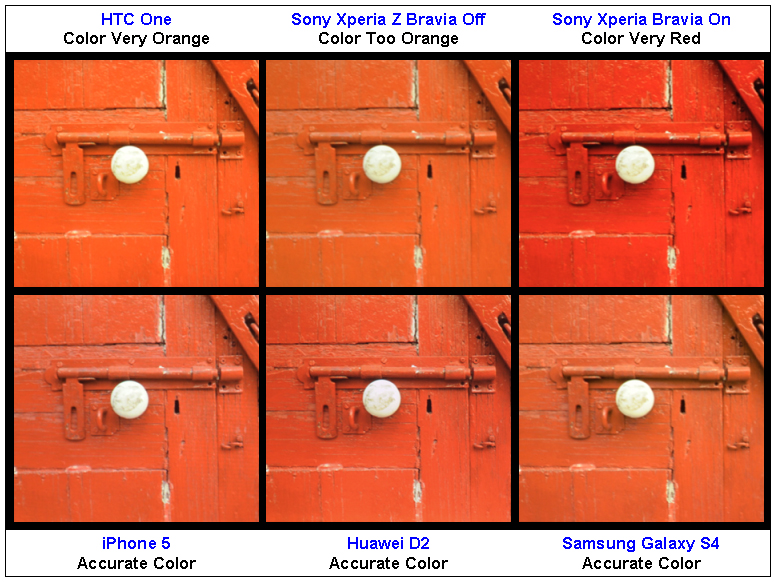
Generally speaking, a good test is to load this image up on your Vita-1000 and/or Vita-2000, then to compare it to the same image on a device with a well calibrated display, like an iPhone 6, iPhone 5s, Surface Pro 3, iPad 4/Air/Air 2 (not the Mini), Nexus 5, or a Galaxy S4/5/Note with the professional photo/movie colour profile mode on.

If you've got the hardware, please post results (a photo of both displays -- Vita next to well-calibrated iPad or whatever -- showing the same image)

Direct link: http://www.displaymate.com/Color_13.jpg

Color_13.jpg


From what I see on my Vita-2000, it's similar to the "accurate colour" of the phone displays along the bottom, whereas the Vita-1000 is more like the Xperia with Bravia Engine on.

---

Really though, the difference in colours isn't whether the display is LCD or OLED, it's more down to how Sony have calibrated Vita-2000's display better than Vita-1000's. Other manufacturers are learning: the Nexus 5 had accurate colours where the Nexus 4 did not. But our eyes have been trained to think oversaturated colours are 'normal' since they pop out and wow the average consumer in the store, and that a well calibrated display is undersaturated when they aren't -- that's just how they should look.
 
My own experience with the OLED and LCD screen is definitely substantiated by Toadthemushroom's post. There's a greater variety of natural colours on the LCD screen, whereas the OLED's dark colours do have a richer quality. Overall, I'd side with the LCD screen.

It has to be stressed that the form factor of the 2000 is vastly superior to the 1000. The thickness of the console has almost been halved, and it's much lighter and more comfortable to hold for long play sessions. Speaking of long play sessions, they're longer too, since the battery is improved also, with an extra hour of operating time accounted for. There's also 1GB of internal memory, which isn't much, but it means you can get more out of your Vita storage.
 
I had a good 5 months between Vita's, so the OLED wasn't burned into my fresh memory when I grabbed and LCD, and I didn't notice a distinct difference. The LCD seemed more than adequate. I think the colors look a bit more accurate and aren't over-saturated, although with that said, the blacks and whites don't "pop" as much on the LCD.

The biggest difference though is easily in both the weight and the battery life with the LCD model. So much lighter and the battery life amazes me. Seems much longer than even Sony's estimates. For those reasons, it easily tips the scale to the LCD model, even if there is debate on the screen quality.

There is a different model Nyko grip if you're interested in that. I had one for my 1000 and haven't gotten one yet for my 2000 (I'm weary on the quality as my battery died in the 1000 Nyko model, although the grip was nice). My hands don't cramp as much on the 2000 and the battery life hasn't been a concern yet.
 
I went with the 2000. The screen looks great and apparently has a much longer life than the OLED.

That + the built-in memory (allows for swapping cards easily), battery life, and micro USB charger is a no brainer.
 
Having owned 3 OLEDs and 2 LCD, I'd recommend LCD. OLED screen is a little better, and the build quality of the 1000 is also more premium(my 2000 has a case creak in a weird spot on the bottom of it).

However, the many negatives the OLED has compared to the LCD make it an easy choice. The battery on my OLED one dies constantly, and you need their proprietary charger to charge it. My LCD battery seems to last forever, and uses the same charger that my phone uses so I have tons of them already. The select, start, and PS buttons are actually easy to press buttons on the LCD while on OLED they are flat and somewhat difficult to find/press. The difference in weight is substantial. The LCD model can be purchased new, while OLED you'll need to buy used.
 
Here are some colour comparisons (thanks to Guess Who and Rukes:

Vita-2000 next to a well calibrated iPad:
FaK.jpg

EaK.jpg


Vita-1000 next to a Vita-2000 and the source image -- note how the Vita-1000 oversaturates the colours relatively speaking

Source:
7BHCaF9.jpg


Vita-2000
GSdyGFK.jpg


Vita-1000
wMkusKO.jpg


Which model you should go for will be down to your personal preference, but if you prefer natural colours go for the Slim. Meanwhile, if you prefer everything to look more saturated, then make sure it's worth the trade-off for the Slim's over improvements.

It must be noted though that the Vita-2000 *does* show saturated colours and make colours pop.

The difference is, it only does it when the colours are meant to look like that. Persona 4 looks fantastic and pops out of the screen on the Vita-2000's LCD, as do Danganronpa and Project Diva F 2nd. But the grass in, say, Atelier Meruru is no longer a glowing neon green as on the Vita-1000's OLED, instead looking as it should.
 
The OLED looks amazing, except when the screen is nearly all black, then you have some issues (something about the glue behind the screens globbing). It is minor, but still there.. At least my launch Vita and my wife's year two Vita have them. Still better, to my eyes, than an LCD, though ( I should note that I prefer the saturation, noted above, in gaming).
 
I'd go for the Vita-2000 if you prefer more natural colours. I'll repost what I said before about the display:

The LCD is better. OLED tech has come a long way since Vita's second gen Super AMOLED Plus panel, which is equivalent to what was in the Galaxy S II, so oversaturated colours, an inaccurate white point (whites look like blues), screen grain/Mura and burn-in. The OLEDs of today, like in the Galaxy Note 4, have caught up with LCDs where they fell behind before, but the one in Vita-1000 just isn't great by today's standards and is certainly a first/second generation product.

Here's a quantitative analysis of the Vita-1000 display, you can see it doesn't produce natural colours, has a white point that's completely off the charts and very low brightness of 117 nits. Today's smartphones hover around 600 nits. Bear in mind that that display review was from 2012, and things have moved on even further since then. What was once an impressive display just isn't anymore.

By comparison Vita-2000's LCD display produces much more accurate colours (a subjective comparison with my iPhone 5s shows they are very similar, the the iPhone 5s display is well calibrated), very good viewing angles and it's brighter outdoors. My only criticism with it is that the backlighting is uneven along the bottom, which is noticeable when the screen's displaying white colours. Also, it would be nice if Sony bonded the glass with the screen itself, something I wish Nintendo did with the New 3DS XL (which itself has a much improved screen over the old 3DS XL)

Of course, whether you'll miss the OLED display of the original depends on whether you prefer oversaturated colours to natural ones. I prefer seeing my games as designers intended them -- especially the many ports -- so I really like the Vita-2000's display.

The colour difference isn't down to whether it's OLED or LCD at all, rather it's down to Sony calibrating Vita-2000's display better. It would be nice if Sony pushed out an update that allowed us to choose colour calibration for the original model. Nokia did the same for their Lumia smartphones -- I had a Lumia 820 and while its OLED display shipped with oversaturated colours, an update allowed me to select a calibration setting that made it display natural colours.
Honestly, the obsession with "natural" colors always seems to result in ignoring the proper benefits of the OLED screen versus the LCD model. Yes, the OLED in the Vita is behind modern OLED screens but it still wipes the floor with any LCD in terms of motion resolution and black level.

If we're comparing the 1000 to the 2000 it's obvious that the 2000 screen displays significantly more blur in motion. This is more important than natural colors for a game system, I believe.

Another critical difference is the black level. The OLED screen appears completely black in all but the darkest of rooms and, even then, it glows only slightly. Modern OLED displays have pushed this even further, of course, but it's far beyond what you get with the LCD in the 2000 model. Even in a moderately bright room you can start to see the backlight glowing on dark imagery.

I feel those two elements are far more critical to picture quality for Vita software than more natural colors. That doesn't even take into account the wider viewing angles of the OLED display.

Looking at the review you linked to I feel they completely miss out on these important elements. Simply testing gamma, color accuracy, color temperature and the like doesn't cut it. Those are important elements to consider, especially when a display cannot be adjusted manually, but they are far from the ONLY aspects that need to be covered. They ignore the real benefits of OLED. For a phone those benefits are less important but on a dedicated gaming system? They're very important.
 
Honestly, the obsession with "natural" colors always seems to result in ignoring the proper benefits of the OLED screen versus the LCD model. Yes, the OLED in the Vita is behind modern OLED screens but it still wipes the floor with any LCD in terms of motion resolution and black level.

If we're comparing the 1000 to the 2000 it's obvious that the 2000 screen displays significantly more blur in motion. This is more important than natural colors for a game system, I believe.

Another critical difference is the black level. The OLED screen appears completely black in all but the darkest of rooms and, even then, it glows only slightly. Modern OLED displays have pushed this even further, of course, but it's far beyond what you get with the LCD in the 2000 model. Even in a moderately bright room you can start to see the backlight glowing on dark imagery.

I feel those two elements are far more critical to picture quality for Vita software than more natural colors. That doesn't even take into account the wider viewing angles of the OLED display.

Looking at the review you linked to I feel they completely miss out on these important elements. Simply testing gamma, color accuracy, color temperature and the like doesn't cut it. Those are important elements to consider, especially when a display cannot be adjusted manually, but they are far from the ONLY aspects that need to be covered. They ignore the real benefits of OLED. For a phone those benefits are less important but on a dedicated gaming system? They're very important.

Agreed, they are important. I'd debate the black levels though -- they would fall under the debate about colours. I *love* OLED's deep black levels -- particularly when software is designed for them, like the Apple Watch and Windows Phone 7's UI -- but overall they basically up the contrast ratio, which is infinite for OLED because blacks are zero. Vita-2000's blacks could certainly be better for an LCD, but they are still decent.

However, the OLED has other significant flaws, being an early gen OLED. Things like screen grain/MURA, where colours have this grainy look to them. If you're wondering what I mean, it's especially noticeable on the Settings app, and even the default dark blue home menu background.

There's also the issue of burn-in, where some Vita users have had UI/HUD elements permanently burned into their display. If you're playing a particular game a lot with a static UI, or using Vita's web browser a lot, it's easy to see bits of it being burned into your display over time.

Vita's second gen OLED display also has an RGB subpixel arrangement, which is nice, so no PenTile, but it's also a con: with OLED, blue subpixels degrade faster than the green and red ones, making the colours displayed on-screen degrade and shift over time. This is why Samsung moved back to a PenTile arrangement for the Galaxy S3 and beyond -- they wanted to make sure that the quality of the screen didn't degrade before users upgraded to a new phone.

---

So overall, it really is a story of trade-offs, but I believe the mature LCD tech in the Vita-2000 is better. Modern OLED displays are really, really good, challenging and even exceeding the best LCDs -- good enough that even Apple is using OLED for the Apple Watch. But Vita-1000's OLED is from the days where OLED had a lot of catching up to do, and just doesn't cut it in my eyes.

If a Vita-3000 used either a higher end LCD or a modern OLED panel, that was well calibrated, then we'd be over the moon. I'd buy one.

As for the colour calibration argument, it is still an important one. By not valuing good colour calibration, what sort of message are we sending out to Sony? We know Morpheus will use a modern OLED panel, now the ball is in Sony's court to ensure the thing ships correctly calibrated, so we can see games as designers intended them to look, not games which have been unnecessarily oversaturated.
 
I had both a 1000 and a 2000 at one point, but ended up ditching the 1000 when I got a chance to trade it in for another 2000 and pay very little difference in cash for it.

Opinions are going to vary on the screen (I still like the way OLED looks and you can't beat those black levels, although the LCD screens look sharper), but the 2000 is much lighter, more ergonomic, and has better battery life in comparison to the 1000. I would just go with a replacement 2000 model; if you don't have an OLED model to compare the 2000's LCD to, you're probably not even going to notice the difference.
 
I'd say 2000 unless you find the screen offensive to look at (which some people do). The screen doesn't bother me personally, and it's hard to argue with a) lighter, b) better battery life, and c) micro-USB instead of a proprietary cable. I still have both Vitas and it's a little surprise every time I pick up the 1000 again, you really feel the added weight. Not enough to make it horribly uncomfortable or anything, but the difference is noticeable.
 
So overall, it really is a story of trade-offs, but I believe the mature LCD tech in the Vita-2000 is better. Modern OLED displays are really, really good, challenging and even exceeding the best LCDs -- good enough that even Apple is using OLED for the Apple Watch.
It's odd to read "challenging the best LCDs" when I feel they've far far FAR exceeded the technology even at this relatively early stage.

Motion smearing and visible backlighting are simply too great to ignore and detract from any positive element the displays may otherwise offer for gaming.

Speaking specifically about the Vita 2000, though, it's really a tough thing as, while I very much disliked the screen, every other element of the system has been improved. It's more comfortable to hold, feels more pleasant in the hand, features louder audio output, is lighter, and generally feels like an improved product.
 
It's odd to read "challenging the best LCDs" when I feel they've far far FAR exceeded the technology even at this relatively early stage.

Motion smearing and visible backlighting are simply too great to ignore and detract from any positive element the displays may otherwise offer for gaming.

Speaking specifically about the Vita 2000, though, it's really a tough thing as, while I very much disliked the screen, every other element of the system has been improved. It's more comfortable to hold, feels more pleasant in the hand, features louder audio output, is lighter, and generally feels like an improved product.

Too bad the button shapes changed otherwise you might be able to frankenstien the 2 together. That be a fun experiment with someone with a two broken vita's. As long as the 2000 broke the screan and the 1000 broke something else.
 
Too bad the button shapes changed otherwise you might be able to frankenstien the 2 together. That be a fun experiment with someone with a two broken vita's. As long as the 2000 broke the screan and the 1000 broke something else.
I've looked into it but it seems impossible.

The screens are fused to the front panel, for one thing, and the connectors themselves apparently have a different pinout and placement.

I suppose there could be a way to make it work but it would be very difficult and could result in ruined hardware. I enjoy modding handhelds so it's disappointing. I would definitely have swapped in an OLED display if it were possible.
 
You all make good points especially Dark and Toad. You're making it a bit of a hard decision on which one to get especially considering that before my vita broke I was kinda planning on getting a 2000 at some point anyway. At the same time I always liked how the OLED screen contrasted with all the other LCD screens I owned and the distinction strengthened the experience. I'm also curious as to what a black vita 1000 would be like having owned a white one for so long(I really really hate having a white border to a screen, messes with contrast).

On the other hand I really hate buying used hardware that has a screen, but there's no choice with the 1000 at this point. Then again the better battery life of the 2000 is also irrelevant because of my Nyko power grip which added quite a few hours to my 1000.


In the end I think I'm going with the OLED again though. Thanks for you input everyone.
 
You all make good points especially Dark and Toad. You're making it a bit of a hard decision on which one to get especially considering that before my vita broke I was kinda planning on getting a 2000 at some point anyway. At the same time I always liked how the OLED screen contrasted with all the other LCD screens I owned and the distinction strengthened the experience. I'm also curious as to what a black vita 1000 would be like having owned a white one for so long(I really really hate having a white border to a screen, messes with contrast).

On the other hand I really hate buying used hardware that has a screen, but there's no choice with the 1000 at this point. Then again the better battery life of the 2000 is also irrelevant because of my Nyko power grip which added quite a few hours to my 1000.


In the end I think I'm going with the OLED again though. Thanks for you input everyone.
I don't know how you feel about collecting but the Vita 1000, being discontinued, isn't going to become more common over time. I feel like, if you're really into the Vita, it's worth having a 1000 around. I own a 1000 and 2000 myself and, while I love the feel of the 2000, I still use the 1000 as my main unit. The type of 60 fps games I play the most on Vita definitely just look much nicer on an OLED display.
 
I've looked into it but it seems impossible.

The screens are fused to the front panel, for one thing, and the connectors themselves apparently have a different pinout and placement.

I suppose there could be a way to make it work but it would be very difficult and could result in ruined hardware. I enjoy modding handhelds so it's disappointing. I would definitely have swapped in an OLED display if it were possible.


Fused could definately be gotten around with some trial and error. Aka if you aren't afraid to lose a screen or 10 but yeah different pinout and placement for the connectors would be a show stopper
 
If we're comparing the 1000 to the 2000 it's obvious that the 2000 screen displays significantly more blur in motion. This is more important than natural colors for a game system, I believe.

Really? This is the first time I hear about this. Is the difference really that noticeable?

I've been on the fence on "upgrading" from a 1000 to a 2000 for a while now because I hate the ergonomics of the 1000, but this sounds like a pretty significant issue, much more so than the inferior black levels which weren't a deal breaker to me.
 
Im always hesitant to buy an 'Upgrade' that only exists basically because the company was trying to drive down their costs.

And how much better is the battery? I've always been happy with the battery life of the 1000.
 
Really? This is the first time I hear about this. Is the difference really that noticeable?

I've been on the fence on "upgrading" from a 1000 to a 2000 for a while now because I hate the ergonomics of the 1000, but this sounds like a pretty significant issue, much more so than the inferior black levels which weren't a deal breaker to me.
The blurring on the 2000 isn't terrible but it's very typical of a modern 60 Hz LCD. Images scrolling across the screen lose detail while in motion. If you don't mind the blurring on, say, an iPhone or another mobile device, it shouldn't be a huge problem for you but it is definitely not as fast as the OLED display. It's especially noticeable with side scrolling 60 fps titles.

Whether it bothers someone will vary from person to person but it IS a downgrade in that regard.

And how much better is the battery? I've always been happy with the battery life of the 1000.
Seems like it gets an extra hour or so. I always thought the 1000 had good battery life as it is so the improvement on the 2000 is more of a bonus than a dramatic improvement.

The speakers, though, are significantly louder on the 2000. It's a strange, unexpected difference.
 
The blurring on the 2000 isn't terrible but it's very typical of a modern 60 Hz LCD. Images scrolling across the screen lose detail while in motion. If you don't mind the blurring on, say, an iPhone or another mobile device, it shouldn't be a huge problem for you but it is definitely not as fast as the OLED display. It's especially noticeable with side scrolling 60 fps titles.

Whether it bothers someone will vary from person to person but it IS a downgrade in that regard.

Interesting. Can anybody else here with experience with both models weight it on their opinion towards motion blur on the 2000?

Wish I could try a 2000 without buying one first, but I've never seen any Vita 2000 demo units anywhere ever, and all of my Vita owning friends also own only a 1000.
 
Interesting. Can anybody else here with experience with both models weight it on their opinion towards motion blur on the 2000?

Wish I could try a 2000 without buying one first, but I've never seen any Vita 2000 demo units anywhere ever, and all of my Vita owning friends also own only a 1000.

There is a slight motion blur on the 2000 compared to the 1000, but most people won't notice it due to not being aware of it. It's something you normally cannot see it, but once you do, you cannot unsee it.

I only notice it on games with fast panning, fast-moving objects. Like the Project Diva where it just annoys me for some songs.
 
There is a slight motion blur on the 2000 compared to the 1000, but most people won't notice it due to not being aware of it. It's something you normally cannot see it, but once you do, you cannot unsee it.

I only notice it on games with fast panning, fast-moving objects. Like the Project Diva where it just annoys me for some songs.

Oh no!! Project Diva was one of the main reasons for me wanting a Vita 2000, so I can play drawn-out sessions without tiring my hands from the crappy ergonomics and weight of the 1000.
 
Purchase a white OLED and bask in the fact that you will have the sexiest looking console ever made! Like 2983697298 people have said, the screen is incredible on the 1000 but the battery life is so much better on the 2000...I'm a couch "portable" gamer though and not a commuter so...
 
Oh no!! Project Diva was one of the main reasons for me wanting a Vita 2000, so I can play drawn-out sessions without tiring my hands from the crappy ergonomics and weight of the 1000.

There is a darkstalkers picture floating around somewhere showing the motion blur differences between the two
 
As the owner of 3 OLED versions and one LCD Vita I'd say it doesn't really make much of a difference to be honest.

What does make a difference is how the system feels overall, and in that regard I will easily give the nod to the 2000.
 
I say it depends on where you play. I personally play on vita in the dark before sleeping and I think OLED is better suited for it because of the black levels. But if you're gonna treat it more of a portable console, I think the 2000 is the way to go
 
Top Bottom