• Hey Guest. Check out your NeoGAF Wrapped 2025 results here!

Rosetta spacecraft pulls alongside comet - landing on comet in November

Status
Not open for further replies.
A shirt with half naked people on it isn't appropriate for the work place. That was a staggeringly bad case of judgment on his behalf. It's tacky at best and sexist at worst.


@Philae2014): I feel asleep

@Philae2014): "@ESA_Rosetta I’m feeling a bit tired, did you get all my data? I might take a nap…"

"THE COMET HAVE STARTED TO MOVE!"
 
feed said:
Engineers update on Mupus on Philae Twitter :

Results (1) First off: some reported MUPUS results as found in media are wrong. They never asked us.

Results (2) MUPUS TM worked fine throughout the whole timeline and sees a very cold steep wall in front of us

Results (3) TM sees clear diurnal temperature signal. Around local noon direct sunlight on that wall caused a steep temperature increase...

Results (4) ... and also steep temperature drop shortly after. Data indicate low thermal diffusivity and fluffy substance
Apparently they've bounced into an orifice of a furry, hibernating alien.
 
It's happening people. We're about to cross the threshold.

There will soon be more posts in the thread about what shirt one of the scientists was wearing than there are in the one about the actual landing on the comet.

What a time to be alive.
 
You know what boggles my mind?

Thinking on where that asteroid came from.

Wish they could get deep samples of the minerals and send back the chemical breakdowns and all that jazz. Would be fascinating

Why don't think try and land on Haley's Comet? We know its path and when it will be pretty close to us on each time around and all that
 
Why don't think try and land on Haley's Comet? We know its path and when it will be pretty close to us on each time around and all that
50 years from now there's probably going to be another Armada. Until then the comet is pretty much out of our reach.

It's happening people. We're about to cross the threshold.

There will soon be more posts in the thread about what shirt one of the scientists was wearing than there are in the one about the actual landing on the comet.

What a time to be alive.
Arrrrrrrrrrgh. I volunteer to be shot up there to put the lander upright. No return ticket required.

I kinda wanna start some crowd funding to donate the dude the most comprehensive collection of the most offensive shirts produced on this planet, certified by the Guinness book and all. Would it be harassment? Yeah. However, from then on he could rightfully wear any shirt he wanted, or even none at all, and people would still be relieved. "Oh well, at least it's not the one with Hitler banging Anne Frank today!"

Anyway. Science. Fuck yeah. Thread views be damned.
 
feed said:
Results (10) The depth sensor shows some up and down but no progress. The control loop increased to power setting 2
Results (11) depth sensor still shows no progress. Control loop goes to power setting 3. Still no progress!
Results (12) This means that the stuff is really hard! A very interesting finding, not visible from orbit!
Results (13) We have a secret power setting 4. Nicknamed "desperate mode". Beyond the design specs. We activated it
Results (14) Still no progress. The hammer gave up and failed after 7 minutes. Jerzy was right. We were desperate, activated, were punished
Results (15) Surface must be >2 MPa hard! The comet remains surprising bizarre and uncooperative
Results (16). To put this into perspective: MUPUS performed beautifully inside the specifications. The comet failed to cooperate
Results (17) The loss of subsurface data is sad. The detection of this very hard crust is a great find the orbiter couldn't have done
So apparently they kept cranking the hammer up, made no progress, and the hammer broke.

feed said:
MUPUS data (readings from depth sensor, hammer performance and thermal data) will take months to properly analyse, but initial conclusions are all indicative to hard surface.

The hammer is "dead and destroyed", meaning that MUPUS cannot resume attempting to break surface in the future, should Philae recharge. Therefore, they will not be able to get sub-surface measurements.

If I'm understanding this correctly though, according to the following (ancient geocities!) table, 2 MPa is super weak as rocks go. Was there some expectation that a comet would be very weak?
http://www.oocities.org/unforbidden_geology/rock_properties.htm
 
You know what boggles my mind?

Thinking on where that asteroid came from.

Wish they could get deep samples of the minerals and send back the chemical breakdowns and all that jazz. Would be fascinating

Why don't think try and land on Haley's Comet? We know its path and when it will be pretty close to us on each time around and all that

Probably came from the Kuiper Belt and its contents would be similar to minerals around here.

The Earth is made up of asteroids and comets a gazillion years ago.
 
You know what boggles my mind?

Thinking on where that asteroid came from.

Wish they could get deep samples of the minerals and send back the chemical breakdowns and all that jazz. Would be fascinating

Why don't think try and land on Haley's Comet? We know its path and when it will be pretty close to us on each time around and all that

The orbit of Haley's Comet goes out past Uranus, and is also at an inclination of 162 degrees. By contrast, 67P's orbit goes only just past Jupiter and at a nearly flat, 7 degree inclination. Getting Rosetta to 67P is child's play by comparison.
 
Oh dear.

With its batteries depleted and not enough sunlight available to recharge, Philae has fallen into 'idle mode' for a potentially long silence. In this mode, all instruments and most systems on board are shut down.

"Prior to falling silent, the lander was able to transmit all science data gathered during the First Science Sequence," says DLR's Stephan Ulamec, Lander Manager, who was in the Main Control Room at ESOC tonight.

"This machine performed magnificently under tough conditions, and we can be fully proud of the incredible scientific success Philae has delivered."

Contact was lost at 00:36 UTC / 01:36 CET, not long before the scheduled communication loss that would have happened anyway as Rosetta orbited below the horizon.

From now on, no contact would be possible unless sufficient sunlight falls on the solar panels to generate enough power to wake it up.

The possibility that this may happen was boosted this evening when mission controllers sent commands to rotate the lander's main body, to which the solar panels are fixed. This may have exposed more panel area to sunlight.

The next possible communication slot begins on 15 November at about 10:00 UTC / 11:00 CET. The orbiter will listen for a signal, and will continue doing so when its orbit enables communication visibility in the future.

However, given the low recharge current available from the solar cells, it is considered unlikely that contact with Philae will be established in the coming days.

The hugely successful Rosetta mission will continue, as the spacecraft tracks comet 67P/C-G on its journey to the Sun. Rosetta is the first spacecraft to rendezvous with and orbit a comet and has already returned incredible scientific data.

http://blogs.esa.int/rosetta/2014/11/15/our-landers-asleep/

Fortunately, it did manage to complete its main mission before hibernation.
 
Well, if it achieved all of its main goals, then there's nothing to be sad about.

Everybody would have loved a long extended Mars Rover situation, but beggars can't be choosy. We can already count ourselves lucky the lander didn't bounce off into the void or land upside down uselessly afterwards.

So, good job so far, little Philae, and sit tight. Maybe the sun will wake you in time before the comet throws you off.
 
Is there a chance it might be able to slowly charge over several days and then wake up, and repeat the cycle?
From here:
A lot of people have been asking me whether the tiny amount of sunlight reaching the solar panels now would be enough to recharge the battery, given enough time. Lommatsch put that idea to rest.

"It is very unlikely right now. We have 1.5 hours [of sunlight] at less than 1 watt, and 20 minutes of 3 or 4 watts. The lander needs 5 watts to boot....In order to charge the secondary battery, we have to heat it to 0 degrees Celsius. We need about 50-60 watt-hours a day in order to reach 0 degrees and still have daylight left to charge the battery. So it doesn't look that great. What we could hope for is if we are closer to perihelion, near 1 AU, maybe we could have enough energy on our one solar panel, maybe every once in a while. Having [a communication] link requires additional power again."
Landing near that cliff was really unfortunate, it seems.
 
A lot of things about the whole mission is easily for the record books. Sucks they couldn't get the ideal scenario but just getting to where they are now is a great accomplishment.

On one end it sucks the lander didn't land in an ideal spot. And at least now they know the comet isn't like dealing with a regular rock. Need some heavier duty hardware and probably a uranium power source instead of going solar. In a nutshell this mission easily set new standards if they want to send another probe to a comet or even an asteroid.
 
Yeah, finding out the comet was harder than expected makes me wonder if the harpoons wouldn't have just deflected off of it anyways
 
Yeah, finding out the comet was harder than expected makes me wonder if the harpoons wouldn't have just deflected off of it anyways
Given their (lack of) luck over the entirety of the mission I think they just found the one single chunk of naturally occurring tempered Titanium-Tungsten alloy in the entire solar system to pound their hammer against.

Seriously though, compacted ice can be surprisingly hard. Water ice can reach around 60MPa on Earth, and if my physics and chemistry teachers didn't lie to me, ice changes into several configurations depending on the circumstances which vastly impacts its physical properties. It's a hot mess if memory serves right. So who knows what kind of freaky space ice is sitting in/on comets.

Anyway, Philae only came with a 2MPa hammer. Sucks for the team, but still, that was a discovery in itself. Comets can be hard. Noted.

 
Its odd, feeling disappointed that everything didn't go perfect, but it remains an extraordinary amazing feat. Hats off to the people behind it.
 
Given their (lack of) luck over the entirety of the mission I think they just found the one single chunk of naturally occurring tempered Titanium-Tungsten alloy in the entire solar system to pound their hammer against.

Seriously though, compacted ice can be surprisingly hard. Water ice can reach around 60MPa on Earth, and if my physics and chemistry teachers didn't lie to me, ice changes into several configurations depending on the circumstances which vastly impacts its physical properties. It's a hot mess if memory serves right. So who knows what kind of freaky space ice is sitting in/on comets.

Anyway, Philae only came with a 2MPa hammer. Sucks for the team, but still, that was a discovery in itself. Comets can be hard. Noted.


That's the weird thing to me. Like the chart I linked earlier said, 2 MPa is super SOFT as rocks go, especially if water ice can be far harder. Did they have reason to believe a comet surface would be softer than ice? Maybe it wasn't feasible to include tougher hardware.
 
That's the weird thing to me. Like the chart I linked earlier said, 2 MPa is super SOFT as rocks go, especially if water ice can be far harder. Did they have reason to believe a comet surface would be softer than ice? Maybe it wasn't feasible to include tougher hardware.
Don't quote me on that, but I think I've read that the latter is true some months ago. They always just "hoped" more or less that the comet would be rather soft, so the option of taking subsurface samples was always more a "nice to have" than anything else.
 
That's the weird thing to me. Like the chart I linked earlier said, 2 MPa is super SOFT as rocks go, especially if water ice can be far harder. Did they have reason to believe a comet surface would be softer than ice? Maybe it wasn't feasible to include tougher hardware.
Well, according to this (PDF) they expected to find a porous ice-dust mixture. It was there... only, right below it was rock, or ice.
Plus, you have to keep the nearly zero-g environment in mind. You just can't go swinging around huge weights willy nilly if you're only anchored to the comet with two harpoons and three screws. Also, as usual, there's some rather harsh power and weight limits on a spacecraft. The entire instrument had to make do with 1.5 watts at best and couldn't weigh more than two kilograms.
 
Well, according to this (PDF) they expected to find a porous ice-dust mixture. It was there... only, right below it was rock, or ice.
Plus, you have to keep the nearly zero-g environment in mind. You just can't go swinging around huge weights willy nilly if you're only anchored to the comet with two harpoons and three screws. Also, as usual, there's some rather harsh power and weight limits on a spacecraft. The entire instrument had to make do with 1.5 watts at best and couldn't weigh more than two kilograms.
Thanks for the link!
 
So are the chances good it'll boot up again?
Even if it does, with the hardness of the comet, could it anchor itsef in properly?
 
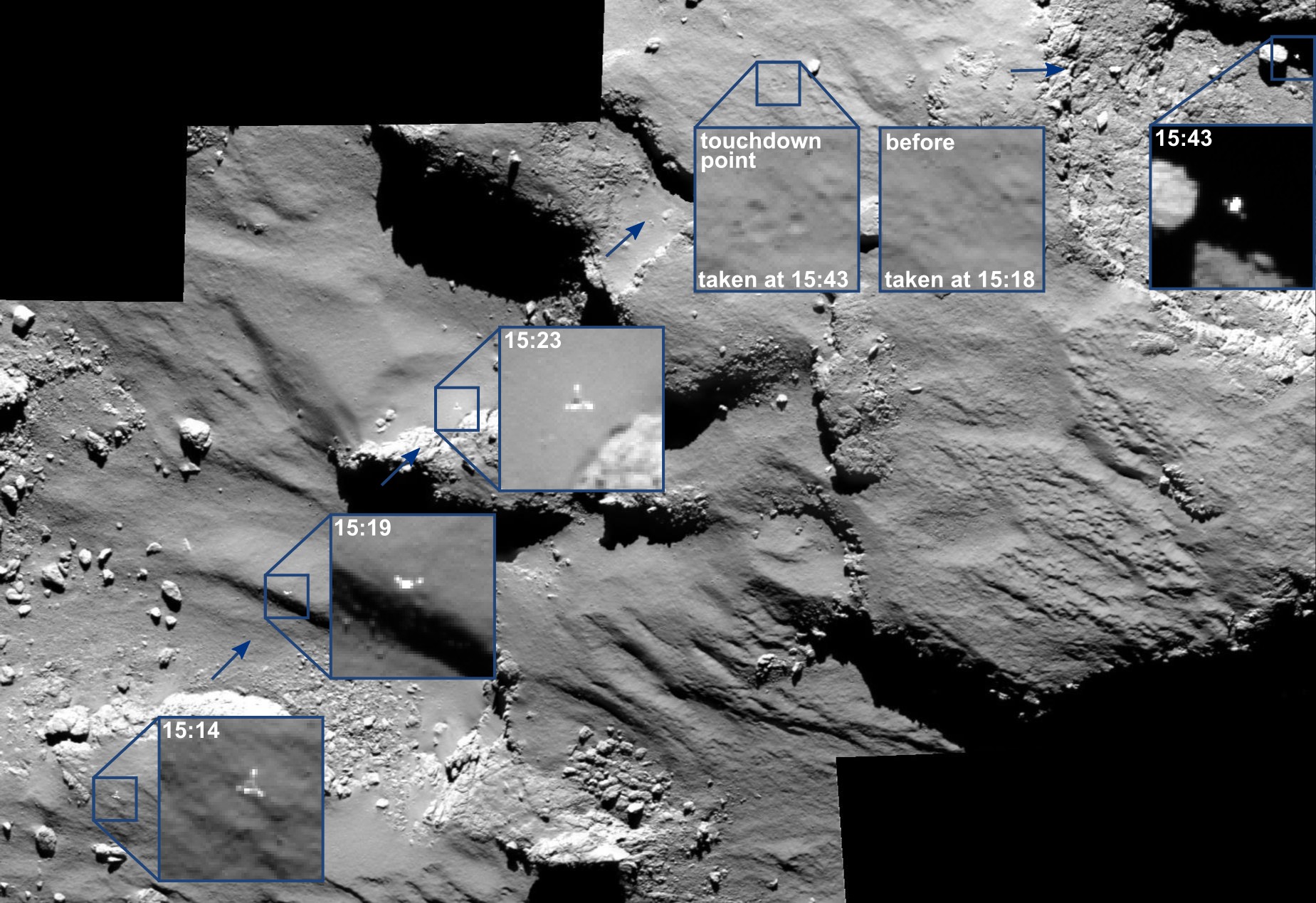
Absolutely stunning image:

OSIRIS_spots_Philae_drifting_across_the_comet.jpg

The mosaic comprises a series of images captured by Rosetta’s OSIRIS camera over a 30 minute period spanning the first touchdown. The time of each of image is marked on the corresponding insets and is in GMT. A comparison of the touchdown area shortly before and after first contact with the surface is also provided.

http://blogs.esa.int/rosetta/2014/11/17/osiris-spots-Philae-drifting-across-the-comet/
 
The mosaic comprises a series of images captured by Rosetta’s OSIRIS camera over a 30 minute period spanning the first touchdown. The time of each of image is marked on the corresponding insets and is in GMT. A comparison of the touchdown area shortly before and after first contact with the surface is also provided.

http://blogs.esa.int/rosetta/2014/11/17/osiris-spots-Philae-drifting-across-the-comet/

so awesome !

the area where the landing first failed would have been perfect... but all things considered we were pretty lucky to get some data from the lander at all, it was so close to crash into the cliff where it finally stabilized or could have just flied away after bouncing off the first time, whatever data we got from this is already a huge success, I mean 2004 tech landing on a comet for the 1st time ever with only some hiccups during landing (maybe unexpected surface composition), the rest was flawless. Bodes well for future missions, so proud of the people in charge.
 
Absolutely stunning image:


The mosaic comprises a series of images captured by Rosetta’s OSIRIS camera over a 30 minute period spanning the first touchdown. The time of each of image is marked on the corresponding insets and is in GMT. A comparison of the touchdown area shortly before and after first contact with the surface is also provided.

http://blogs.esa.int/rosetta/2014/11/17/osiris-spots-Philae-drifting-across-the-comet/

Of all places it could land. That mofo!
 
Absolutely stunning image:


The mosaic comprises a series of images captured by Rosetta’s OSIRIS camera over a 30 minute period spanning the first touchdown. The time of each of image is marked on the corresponding insets and is in GMT. A comparison of the touchdown area shortly before and after first contact with the surface is also provided.

Talk about bad luck! Of all the places on the comet it landed into the shadow.
 
It's happening people. We're about to cross the threshold.

There will soon be more posts in the thread about what shirt one of the scientists was wearing than there are in the one about the actual landing on the comet.

What a time to be alive.

:'(
 
Are there any space forums or other sites that people can recommend?

www.nasaspaceflight.com <- More focused on rockets and human spaceflight (not just nasa - the name is misleading). Full of industry insiders and well-informed laymen. Very strict moderation so has an excellent signal:noise ratio.

http://www.unmannedspaceflight.com/ <- Just the missions. No rocket talk and no astronauts. Not as busy as NSF, but more in-depth when it comes to the probes and science.

What happens with Rosetta now? Will it just travel on and on?

It will continue orbiting the comet. Rosetta is the main event, really. Despite the drama of landing, it's the orbiter that will be doing the most science. The comet will arrive at Perihelion (closest approach to the sun) by August next year. As it does so, it will "wake up" and start throwing off loads of dust and gas, thus forming the characteristic tail. Rosetta will be watching all this from right inside the cloud. It's unknown territory and very exciting :)
 
www.nasaspaceflight.com <- More focused on rockets and human spaceflight (not just nasa - the name is misleading). Full of industry insiders and well-informed laymen. Very strict moderation so has an excellent signal:noise ratio.

http://www.unmannedspaceflight.com/ <- Just the missions. No rocket talk and no astronauts. Not as busy as NSF, but more in-depth when it comes to the probes and science.


It will continue orbiting the comet. Rosetta is the main event, really. Despite the drama of landing, it's the orbiter that will be doing the most science. The comet will arrive at Perihelion (closest approach to the sun) by August next year. As it does so, it will "wake up" and start throwing off loads of dust and gas, thus forming the characteristic tail. Rosetta will be watching all this from right inside the cloud. It's unknown territory and very exciting :)

Cool, so we stll have something to look forward to.
 
Wouldn't it have made more sense to keep the solar panels in orbit and just send the electricity by cable?
 
Wouldn't it have made more sense to keep the solar panels in orbit and just send the electricity by cable?

I think I read this being discussed somewhere (though more in the context of keeping Rosetta above Philae so there were no communication blackouts), but there is no geostationary 67P-stationary stable orbit. Rosetta would have to be really far out, out of the comet's sphere of influence.
 
Rosetta Probe Discovers Organic Molecules on Comet

The probe that landed on the surface of a comet has discovered organic molecules, the most rudimentary building blocks of life, according to the German agency involved in the mission.

An instrument aboard the Philae lander detected the molecules after “sniffing” the comet’s atmosphere. An organic compound is one whose molecules contain the carbon atom, the basis of life on earth.

Scientists are analyzing the data to see whether the organic compounds detected by Philae are simple ones—such as methane and methanol—or a more complex species such as amino acids, the building blocks for proteins. A drill on Philae also obtained some material from the comet’s hard surface, but data about organic molecules from that experiment have yet to be fully analyzed.

WSJ link
 
Status
Not open for further replies.
Top Bottom