

• Hey Guest. Check out your NeoGAF Wrapped 2025 results here!

Sony Dev Explains Why PS VR Screen Is Crisper Than The Others

One thing I have been wondering is how well PC games will utilize high end hardware with VR.

Traditionally, PC games have scaled across the range of hardware through a mixture of resolution, framerate, and visual effects. With VR, though, it seems like you will have a fixed framerate and resolution, right?
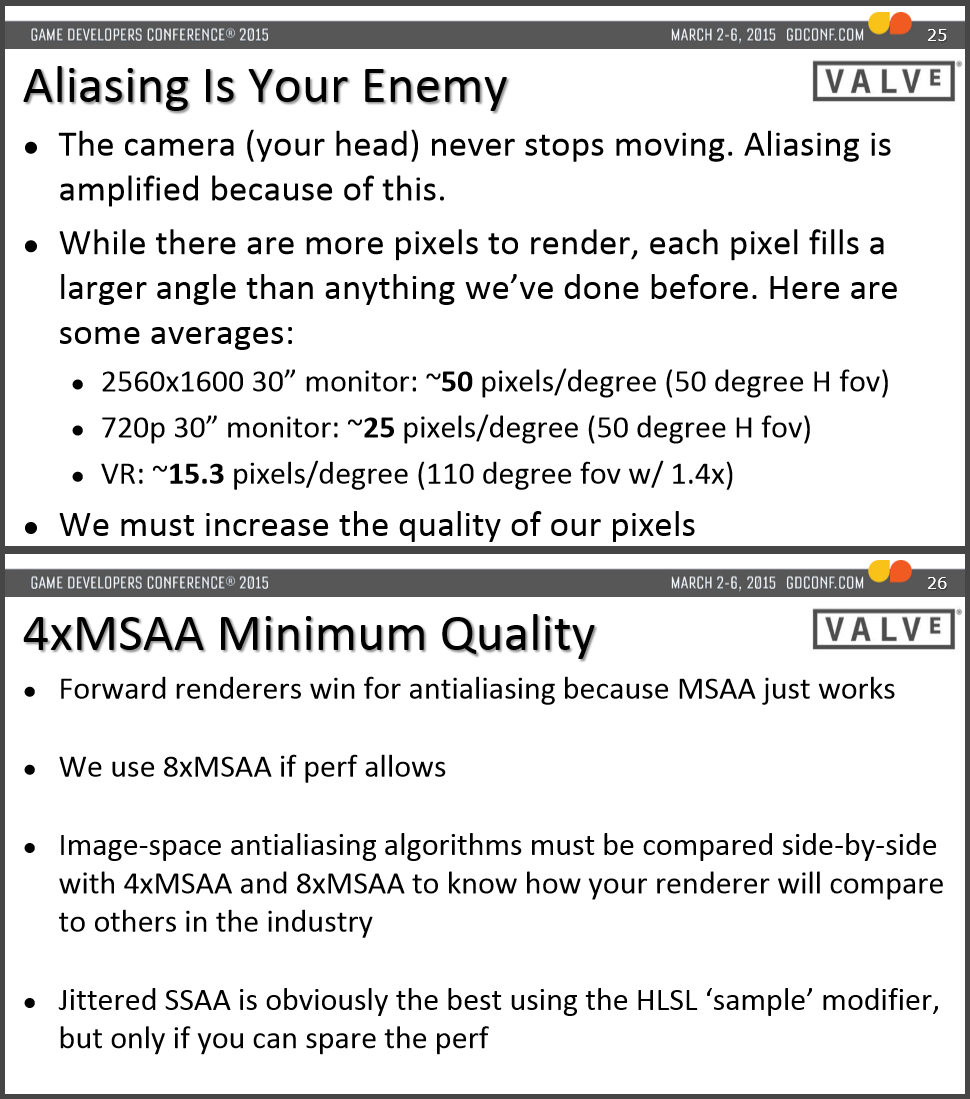
If anything, the most traditional (and basically always available) scaling factor -- that is, image quality -- will be far more significant in VR than on screen.

vr_aliasingyuqks.png


As such, also from personal experience with various devices, I am convinced that you'll be able to pour insane GPU resources into VR to immediate and significant effect even for very simplistic games.

But i do think the launch titles will end up looking identical.....
Well, you're wrong. A mid- to high end PC will be able to render the same title at significantly higher IQ, and due to nature of VR this difference will manifest immediately and visibly to the user.
 
So you're arguing with a thread title instead of reading properly into the Q&A.

The quote even says "Not every 1080P screen is the same."
Yeah, i am arguing with the thread title. Also arguing with a certain style of cross thread posting regarding PS VR.
 
I agree, the OP should have been more clear that the question was comparing specifically to DK2, not to the consumer Rift or Vive. The question was basically, how can the PSVR look better than Oculus' Dev Kit 2 when it's the same single-screen resolution. I had to watch the video interview to get that, it wasn't mentioned in the article the OP linked or elsewhere in this thread.
 
Well, you're wrong. A mid- to high end PC will be able to render the same title at significantly higher IQ, and due to nature of VR this difference will manifest immediately and visibly to the user.

The Rift and the Vive have increased rendering costs due to the higher resolution panels so I highly doubt that the difference is going to be as big has you think, especially on a mid range PC. The solution that Sony chose for eliminating screen door has no processing penalty and I think that that's why nothing stands out graphically between the headsets.
 
This whole thread must be a new record in misinformation. If you don't know what you're talking about it's better to keep your mouth closed, or at least ask.

Striped RGB is a good thing, but it does not equal 33% better resolution. If that's what you get out of Sony's pr-mouth then you're a gullible one.

And ffs "Oculus" does not equal all the devkits and the consumer version in one! It's like saying PS1 PS3 and PS3 are the same. Specify what you're talking about.
 
Please start selling this to phone manufacturers. I've been waiting for RGB OLED on a cell phone for fucking years. Pentile is nothing but trash.
 
This whole thread must be a new record in misinformation. If you don't know what you're talking about it's better to keep your mouth closed, or at least ask.

Striped RGB is a good thing, but it does not equal 33% better resolution. If that's what you get out of Sony's pr-mouth then you're a gullible one.

it does when the screen is that close to your face. The most important thing is eliminating SDE, and from the toms hardware guys impressions, SDE was imperceptible on the PSVR.
 
Please start selling this to phone manufacturers. I've been waiting for RGB OLED on a cell phone for fucking years. Pentile is nothing but trash.

There have been already. They stopped using them because they weren't worth the effort. They opted instead for increasing pixel density.

I also suspect that the lifetimes on a RGB stripe OLED screen aren't that good (particularly on the blues).

is this post-crescent bay? because that definitely had a screen door effect when i used it

Yes. Both the nearly CV1 and the Vive.
 
I've seen mixed impressions about PSVR but enough good impressions to think that PSVR is hardly going to be some 3rd rate version of VR. The fact that many games like Battle zone, The Assembly or Eve Valkyrie are being made for PSVR as well as Oculus/Vive shows it is capable enough. It will be similar to the usual difference in terms of PC pushing some nicer graphics, but not generationally different experiences.

PSVR seems more than good enough as an introduction to VR for the vast majority of consumers and its still going to be hands down the easiest and most cost effective way to 'get' VR for the average person.

I can't wait!
 
There have been already. They stopped using them because they weren't worth the effort.

I also suspect that the lifetimes on a RGB stripe OLED screen aren't that good (particularly on the blues).

One device did (a tablet). I've never seen an instance where the blues have ever faded on an OLED of any kind. Never seen any concrete evidence on it, it's always been a myth to me. bring these screens to phones!! :O

:pitchforks:

srsly tho :''(
 
If in VR all you did was watching a static image with certain colors.. perhaps. Just stop it.

Edit: and now sde.. if your goal is to reduce sde you increase pixel fill, not sub pixels!

The interviewer seems to think that the SDE is imperceptible. Mark explains that sony chose to decrease the SDE by lessening the space between the pixels, and that the optics play a part in it as well. That was the explanation he gave to the guy, so unless you show me some compelling evidence that proves otherwise, i'm not really inclined to believe you over someone with proven credentials.
 
The interviewer seems to think that the SDE is imperceptible. Mark explains that sony chose to decrease the SDE by lessening the space between the pixels, and that the optics play a part in it as well. That was the explanation he gave to the guy, so unless you show me some compelling evidence that proves otherwise, i'm not really inclined to believe you over someone with proven credentials.
The interviewer's reference point can also just be bad.
 
War has changed. It used to be colors. Then, it was polygons. Finally, pixels have gave way to SUBPIXELS. GAF will never be the same after this news.
 
One device did (a tablet). I've never seen an instance where the blues have ever faded on an OLED of any kind. Never seen any concrete evidence on it, it's always been a myth to me. bring these screens to phones!! :O

:pitchforks:

srsly tho :''(

The phone that comes to mind is the Galaxy note 2, which did have RGB stripes.

I bet you've never seen it fully degraded. However even a small change can ruin the colour balance on screens. I've seen OLED screens that have suffered burn in too.
 
The interviewer seems to think that the SDE is imperceptible. Mark explains that sony chose to decrease the SDE by lessening the space between the pixels, and that the optics play a part in it as well. That was the explanation he gave to the guy, so unless you show me some compelling evidence that proves otherwise, i'm not really inclined to believe you over someone with proven credentials.

This is a 180 from the "huh" to my reply which together with durante's reply says exaxtly this. So how come your words are oddly suggesting that I disagree with myself? Are you confused? Or did I misunderstand you in some way?
 
This is a 180 from the "huh" to my reply which together with durante's reply says exaxtly this. So how come your words are oddly suggesting that I disagree with myself? Are you confused?

The "huh" was before the edit, but you are confusing no doubt about that.
 
If in VR all you did was watching a static image with certain colors.. perhaps. Just stop it.
I have a DK2 (and 1) and I agree with this - I know some people have an utter hatred for all things pentile, even without having tried them out, but on the DK2 the only problem I experienced due to pentile is the static orange hud in Elite Dangerous being hard to read text on. I changed the hud to cyan, problem went away.

SDE wasn't noticeably affected by being pentile, it was more a resolution issue with the colors.
 
The "huh" was before the edit, but you are confusing no doubt about that.

But wait, I wrote that ypu decrease sde with pixel fill (and a diffuser like durante's wrote). And then you replied to me with the exact same information as if it was refuting my post. So you tell me what's going on here.. because yes now I'm really confused about what your point was..
 
Well, you're wrong. A mid- to high end PC will be able to render the same title at significantly higher IQ, and due to nature of VR this difference will manifest immediately and visibly to the user.

Just curious, what would you label as mid to high end when talking about VR? I'm guessing the tech that will be available at the time rather than right now? Not arguing your point as I agree, but generally trying to get a feel for what you'd expect to run VR well since you gotta have a way better handle on it than I do.

I also wonder how much more capable some of these older system would actually be too had driver support not been dropping off on some of the older cards now like Kepler.
 
But wait, I wrote that ypu decrease sde with pixel fill. And then you replied to me with the exact same information as if it was refuting my post. So you tell me what's going on here.. because yes now I'm really confused about what your point was..

well then let me break it down for you buuuuudy. RGB display each pixel is the same size so then you have less space between the pixels vs pentile. If you read the original post, I said that the RGB display has advantages due to that fact, and judging by the interviewers impressions.
 
Are people really doubting how much better PC VR games can potentially look? If a major Sony title gets the Morpheus treatment I may very well spring for one, but extra CPU and GPU power can always be harnessed to better the overall look, even if it's "just" brute-forcing your way to better IQ. And better IQ makes a huge difference.
 
Are people really doubting how much better PC VR games can potentially look? If a major Sony title gets the Morpheus treatment I may very well spring for one, but extra CPU and GPU power can always be harnessed to better the overall look, even if it's "just" brute-forcing your way to better IQ. And better IQ makes a huge difference.

I don't doubt that for sure, but I don't think the difference between the launch titles and devices will be all that pronounced starting out. That seems to get certain people riled but it's what I think.
 
Sony OLEDS are fantastic. I bought a HMZ-T1 off of a Gaffer a few years ago and the quality was amazing. Can't imagine how good they are now.
 
I agree, the OP should have been more clear that the question was comparing specifically to DK2, not to the consumer Rift or Vive. The question was basically, how can the PSVR look better than Oculus' Dev Kit 2 when it's the same single-screen resolution. I had to watch the video interview to get that, it wasn't mentioned in the article the OP linked or elsewhere in this thread.

Thanks for pointing that out. The OP was misleading.
 
Same resolution screen? I think?

Sony's screen tech alleviates some issues associated with lower resolution screens.

It should be a given that it's better than a year old devkit using a standard phone screen. But it seems like it was a fairly innocuous conversation in the actual interview that's being a bit misrepresented in the article linked in the thread, which makes no mention of DK2.
 
Pc is not magic, but I can bruteforce adding more compute power as needed.

Well, sure, but you're just pushing that as an 'issue' for PS4, when in reality it's not just an 'issue' but also one of the best selling points for the PSTV -- many (most, most likey) consumers have no interest in chasing tech to get their VR. Doing so gives up all the advantages PSTV has -- plug and play, price, ease of use, consistent experience.

Obviously the PS4 is fixed tech. So yes, your ever more powerful PC is more powerful. That isn't going to change, and while it's an 'advantage' it's also a disadvantage, because with that power comes price and complexity that many people have no interest in.
 
I can't wait to test these myself in home to get a clear comparison. I can't understand how a PS4 could be identical to PC VR with a minimum of a 290x.
 
Just curious, what would you label as mid to high end when talking about VR?
Well, I'd say mid-end for VR right now is a 970 and above (remember that's >2x PS4 level). There's really no upper limit on the high-end. Probably by VR release, high-end single GPUs will be around the 5-6 times PS4 performance level, and you should be able to get really good scaling out of 2 such GPUs for VR (if you are insane and/or rich).

Not arguing your point as I agree, but generally trying to get a feel for what you'd expect to run VR well since you gotta have a way better handle on it than I do.
It all comes down to software and expectations. I have no doubt that with a 970 and a decently fast CPU you'll be able to have pretty good VR experiences. I mean, that's the setup I plan to use until late 2016.

But I also don't doubt that people with, say, a 980ti (or even 2 of them) will achieve significantly better IQ in VR, and that this difference will be obvious. At 15 pixels per degree every AA sample counts.
 
Well, I'd say mid-end for VR right now is a 970 and above (remember that's >2x PS4 level). There's really no upper limit on the high-end. Probably by VR release, high-end single GPUs will be around the 5-6 times PS4 performance level, and you should be able to get really good scaling out of 2 such GPUs for VR (if you are insane and/or rich).
Mid-end? Oculus says that's the lowest end, the minimum spec developers should target.
 
well then let me break it down for you buuuuudy. RGB display each pixel is the same size so then you have less space between the pixels vs pentile. If you read the original post, I said that the RGB display has advantages due to that fact, and judging by the interviewers impressions.

God dag mann øksaskaft.. You are obviously hell bent on arguing something I never wrote.

Anyway, pentile wasn't a general issue even on the DK2 except in combination with a static HUD in certain colors. And some of this with pixel fill you csn fix with a diffuser anyway. The resolution itself was a much bigger issue. And that's why I'm not that excited over the 2160x1200 resolution in the Vive and Rift even though it's a jump over the 1920x1080 in the PSVR.

One easy way to increase both sub pixel resolution and pixel fill is to increase the overall display resolution.
 
Well, I'd say mid-end for VR right now is a 970 and above (remember that's >2x PS4 level). There's really no upper limit on the high-end. Probably by VR release, high-end single GPUs will be around the 5-6 times PS4 performance level, and you should be able to get really good scaling out of 2 such GPUs for VR (if you are insane and/or rich).

It all comes down to software and expectations. I have no doubt that with a 970 and a decently fast CPU you'll be able to have pretty good VR experiences. I mean, that's the setup I plan to use until late 2016.

But I also don't doubt that people with, say, a 980ti (or even 2 of them) will achieve significantly better IQ in VR, and that this difference will be obvious. At 15 pixels per degree every AA sample counts.

That's incredibly reassuring to hear. I've been banking on the Pascal cards to be the go to card for high end VR for a year or two now. Intending to get the X80 equivalent paired with a 4790k to hopefully last me a few years. I'm starting to feel quite comfortable about that choice now. Thanks for the info!
 
Top Bottom