• Hey Guest. Check out your NeoGAF Wrapped 2025 results here!

The Burqa debate - has the west got it wrong?

Status
Not open for further replies.

Machina

Banned
a3a151ea3f6ac9ab4e6cf92e8e877dd6


88905c481bc9c33ebaeb8cb7a154946d


ba30dc697ba7d8e5b0f2fa0063c80431


http://www.news.com.au/world/middle...r/news-story/31dc3c1bdc3915990d8041d6d6f04944

This town gets liberated from ISIS, and the first thing the women do is remove their Niqabs. The general opinion in the west is that wearing a head veil is a matter of choice, yet these women seem to be making a very specific one.

Discuss? I wanted to make first post longer but I'm at work.
 
When you are allowed to make a choice specific choices should be allowed too.

The problem is what France did, forbidding choices.
 
http://www.news.com.au/world/middle...r/news-story/31dc3c1bdc3915990d8041d6d6f04944

This town gets liberated from ISIS, and the first thing the women do is remove their Niqabs. The general opinion in the west is that wearing a head veil is a matter of choice, yet these women seem to be making a very specific one.

Discuss? I wanted to make first post longer but I'm at work.


When you are allowed to make a choice specific choices should be allowed too.

The problem is what France did, forbidding choices.


Yes but at the same time, it was for security purpose. Which means Burqa isn't the only forbidden thing. You basically can't cover your entire face, even with these:
0047_passe_montagne_grand_froid-z.jpg


I don't think we can compare the situation in a country in war, in an occupied territory where it was mandated by the "local law"... and the west, in peaceful, liberal countries. Also, matter of choice, it's more like a matter of specific case basis. Some women are forced, some aren't.
 
I imagine in regions of extreme and fanatical sexism the clothing becomes a sign of that oppression. Meanwhile in lands of better (though not perfect) equality the same clothing may be seen as a sign of religious or cultural freedom. These are very different situations in context.
 
This town gets liberated from ISIS, and the first thing the women do is remove their Niqabs. The general opinion in the west is that wearing a head veil is a matter of choice, yet these women seem to be making a very specific one.

Discuss? I wanted to make first post longer but I'm at work.

The article also mentions Men who shaved off their beards, free from Isis' decree that all men stop shaving in accordance to Sharia law.

If someone wants to grow a beard, they should be able to, not forced to. Since there are those who are/were forced, it's understandable it can be seen as a symbol of oppression.
 
I mean, the notion that something is a choice isn't negated by the existence of a scenario in which certain people are being forced to wear one.

I know people on both sides, those who are forced and those who wear it willingly.
 
Yes but at the same time, it was for security purpose. Which means Burqa isn't the only forbidden thing. You basically can't cover your entire face, even with these:
0047_passe_montagne_grand_froid-z.jpg


I don't think we can compare the situation in a country in war, in an occupied territory where it was mandated by the "local law"... and the west, in peaceful, liberal countries. Also, matter of choice, it's more like a matter of specific case basis. Some women are forced, some aren't.

What if you're at a costume party or halloween where you want to cover your face with a mask?
 
I mean, when there's significant cultural, social, and familial pressure to dress in a certain traditional way, it becomes a more complex matter than individual women deciding what they feel like wearing, from a range of equal options. There are social consequences and sometimes actual danger associated with their choice of dress. They don't live in a vacuum. No one does.
 
The women in that town were forced to wear that clothing by ISIS. The point is that a woman should be free to decide whatever the hell type of clothing she wants to wear. Thus the Muslim women in that town should be free from wearing Burqas and the Muslim women in France should be free to wear Burqas if they want to.
 
Generally speaking I doubt many women would want to wear them. Men force them. And men force them not to wear them when they arrive to the west. I see the whole debate as in "for or against" to be highly sexist at its core, equally on both sides. There is nothing inherently wrong with the cloth itself, just the reasons it's being worn (or not).
 
I imagine in regions of extreme and fanatical sexism the clothing becomes a sign of that oppression. Meanwhile in lands of better (though not perfect) equality the same clothing may be seen as a sign of religious or cultural freedom. These are very different situations in context.

I very much agree with this post.

Context is super important when it comes to stuff like this.
 
I imagine in regions of extreme and fanatical sexism the clothing becomes a sign of that oppression. Meanwhile in lands of better (though not perfect) equality the same clothing may be seen as a sign of religious or cultural freedom. These are very different situations in context.

This. I don't think it's really that complicated a debate. It really depends on the level of fanaticism or how deeply non-secular the area is as those reflect the people's attitudes towards these types of things
 
Ok so a couple things.

I come from a Muslim house and even I don't think that the majority of women who wear the niqab wear it by choice. I don't know where you got the belief that most westerners consider it a matter of choice. That's not to say that they're aren't women who actually do where it because they want to, but I seriously have a hard time believe that most westerners think all Muslim who wear it do it independently. (Edit: rereading the OP I see you might've meant that westerners believe the hijab is a matter of choice, not the niqab. It's different but I don't know how most other westerns view the hijab)

Secondly, argue all you want to about whether a hijab is used to oppress women or empower them, but the niqab is definitely used as a tool to keep women down in many cases. The Qur'an never even says women are required to wear such a concealing wardrobe. The entire thing is completely unnecessary. There are literally Muslim men out there who treat their wives and daughters like objects.

Third, it just isn't practical for day-to-day life. Identifying individuals is important and the niqab basically disguises whoever wears it.

And I'm not proposing all countries ban it or something. I'm all for freedom of religion. I've known probably 200 Muslim women who've worn the hijab and I've never once questioned or criticized them for it. Ive heard many stories about how it's a symbol of modesty and was a choice. I 100% can understand that. I can't, however, believe that the women who wear the niqab do something that the religion doesn't even call for.

Sorry this is a little bit rant-y but I just feel strongly about the niqab.
 
I imagine in regions of extreme and fanatical sexism the clothing becomes a sign of that oppression. Meanwhile in lands of better (though not perfect) equality the same clothing may be seen as a sign of religious or cultural freedom. These are very different situations in context.

What about regions of extreme and fanatical sexism in lands of better equality?

e.g. French banlieus, areas around Brussels
 
What about regions of extreme and fanatical sexism in lands of better equality?

e.g. French banlieus, areas around Brussels

I would need an example of someplace I'm familiar with. I know less about France than I do nuclear physics, and I ain't particularly educated in nuclear physics.
 
Ok so a couple things.

I come from a Muslim house and even I don't think that the majority of women who wear the niqab wear it by choice. I don't know where you got the belief that most westerners consider it a matter of choice. That's not to say that they're aren't women who actually do where it because they want to, but I seriously have a hard time believe that most westerners think all Muslim who wear it do it independently. (Edit: rereading the OP I see you might've meant that westerners believe the hijab is a matter of choice, not the niqab. It's different but I don't know how most other westerns view the hijab)

Secondly, argue all you want to about whether a hijab is used to oppress women or empower them, but the niqab is definitely used as a tool to keep women down in many cases. The Qur'an never even says women are required to wear such a concealing wardrobe. The entire thing is completely unnecessary. There are literally Muslim men out there who treat their wives and daughters like objects.

Third, it just isn't practical for day-to-day life. Identifying individuals is important and the niqab basically disguises whoever wears it.

And I'm not proposing all countries ban it or something. I'm all for freedom of religion. I've known probably 200 Muslim women who've worn the hijab and I've never once questioned or criticized them for it. Ive heard many stories about how it's a symbol of modesty and was a choice. I 100% can understand that. I can't, however, believe that the women who wear the niqab do something that the religion doesn't even call for.

Sorry this is a little bit rant-y but I just feel strongly about the niqab.

I don't know how much you know about what happened in the west after France banned the burqa, but the debate was heated. Liberals considered it a matter of personal choice just universally, while the conservatives treated it like yet another chance to kick Islam in the groin.

I'm on the fence personally. I find all of the veil types that hide the face and neck to be unacceptable. What's a human right if not the right to see someone's face when you speak to them? Or the right to express yourself properly, not only through voice but also through body language as well. The Hijab, I have absolutely no problem with. I don't care what color your hair is, I just want to see your face when I interact with you.

It's clearly a touchy discussion, one that heads straight for the roots of Islam and drags it into the spotlight once again. We all know how that turns out. I just find it interesting that there is no other religion on earth that mandates the concealment of women in such a way. It doesn't do Islam much credit in the public eye, If I'm honest.
 
This town gets liberated from ISIS, and the first thing the women do is remove their Niqabs. The general opinion in the west is that wearing a head veil is a matter of choice, yet these women seem to be making a very specific one.

Discuss? I wanted to make first post longer but I'm at work.

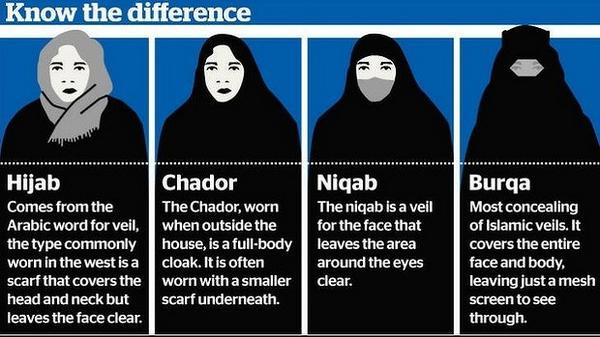
You've gone from Burqa to Niqab to head veil. Do you understand the terms you're using?
 
I don't know how much you know about what happened in the west after France banned the burqa, but the debate was heated. Liberals considered it a matter of personal choice just universally, while the conservatives treated it like yet another chance to kick Islam in the groin.

I'm on the fence personally. I find all of the veil types that hide the face and neck to be unacceptable. What's a human right if not the right to see someone's face when you speak to them? Or the right to express yourself properly, not only through voice but also through body language as well. The Hijab, I have absolutely no problem with. I don't care what color your hair is, I just want to see your face when I interact with you.

It's clearly a touchy discussion, one that heads straight for the roots of Islam and drags it into the spotlight once again. We all know how that turns out. I just find it interesting that there is no other religion on earth that mandates the concealment of women in such a way. It doesn't do Islam much credit in the public eye, If I'm honest.

The hijab isn't even mandated either. Women are just supposed to dress "modestly". Never read the Bible or Torah but I wouldn't be surprised if they included a part about something similar.

You've gone from Burqa to Niqab to head veil. Do you understand the terms you're using?

For all conversational purposes ITT, a niqab and burqa are the same thing. Head veil doesn't describe anything specific.
 
I think those muslim clothes that cover the face should be banned in the west, as they make any integration completely impossible. Even if woman says it's her choice, it's one of those cases when goverment has to do good for people even against their own will.

Banning hijabs and burkinis seems to be overkill though and smells like pandering to voters.
 
Going by OP's logic, beards should be banned too since there were men happily shaving them off from that very same town. Unfortunately, the irony of these bans in response to other bans is lost on the OP.
 
I'm against banning burqas, but it's naive to think that many women that wear it in western countries aren't forced/pressured into wearing it.

I just don't think you solve the underlying problems by banning Burqas.

What about regions of extreme and fanatical sexism in lands of better equality?

e.g. French banlieus, areas around Brussels

Jep, there are quite a few city parts in europe that are much more conservative than your average muslim country.
 
I think those muslim clothes that cover the face should be banned in the west, as they make any integration completely impossible. Even if woman says it's her choice, it's one of those cases when goverment has to do good for people even against their own will.

Banning hijabs and burkinis seems to be overkill though and smells like pandering to voters.

I've never understood why different cultures need to be intergrated. Why cant we learn to accept the differences? If you moved to,say, India for example, would yougive up your culture?

Also, forcing people to live like you seems like it woud divide and antagonize rather then integrate.
 
I've never understood why different cultures need to be intergrated. Why cant we learn to accept the differences? If you moved to,say, India for example, would yougive up your culture?

Also, forcing people to live like you seems like it woud divide and antagonize rather then integrate.
Because multiculturalism doesn't work. Simple as that. It leds to tensions, crime and discrimination.

The only exceptions are countries that were from the start multcultural and built by immigrants. But in Europe what you have are nations often thousand years old that were homogenous for most of their history. If you throw into such a homogenous mass a group of people with completely different culture and values they will be completely screwed over. They just won't be accepted as a part of society. Not fully at least.

Also..I belive country is it's society more than it's terrain. If you don't want to integrate into society why are you even coming to that country? What's the point? And you can't allow alien cultures to remain completely unchanged when moved into western society anyway. I mean..will you allow people to marry to 9 years old girls in EU just because it's part of migrant culture? Or allow female genital mutilation? Of course not. Those are extreme examples, but they show that no country, no matter how tolerant, is able to accept every part of culture of people who come in. They will have to abandon some of it.
 
I always thought that reason women have to cover themselves and their face in Islam was "so that they won't tempt men". Women have to do that, because in that system it is believed that women are the source of sin.

I may have understood something wrong, perhaps that is only believed by certain variations of Islam. But I can't support having women wear a clothing like that. It's not much of a choice when cultural and peer pressure is immense.
 
I've never understood why different cultures need to be intergrated. Why cant we learn to accept the differences? If you moved to,say, India for example, would yougive up your culture?

Also, forcing people to live like you seems like it woud divide and antagonize rather then integrate.

"Integration" is a vague concept that can mean anything, but what's the point of moving to a country if you don't adapt to the local culture ? It doesn't mean getting rid of your own roots, most people immigrating to a country bring their own practices that sometimes (frequently) melt into the general culture, that's also what many people mean with "integration".
 
I don't know how much you know about what happened in the west after France banned the burqa, but the debate was heated. Liberals considered it a matter of personal choice just universally, while the conservatives treated it like yet another chance to kick Islam in the groin.

I'm on the fence personally. I find all of the veil types that hide the face and neck to be unacceptable. What's a human right if not the right to see someone's face when you speak to them? Or the right to express yourself properly, not only through voice but also through body language as well. The Hijab, I have absolutely no problem with. I don't care what color your hair is, I just want to see your face when I interact with you.

It's clearly a touchy discussion, one that heads straight for the roots of Islam and drags it into the spotlight once again. We all know how that turns out. I just find it interesting that there is no other religion on earth that mandates the concealment of women in such a way. It doesn't do Islam much credit in the public eye, If I'm honest.
Freedom is just that, freedom. Your desire to see someone's face when they talk does not supersede that persons right to wear the clothing of their choice.

Your concept of human rights seems all types of fucked up.
 
I've never understood why different cultures need to be intergrated. Why cant we learn to accept the differences? If you moved to,say, India for example, would yougive up your culture?

Also, forcing people to live like you seems like it woud divide and antagonize rather then integrate.
Integration doesn't mean throwing away your own culture totally, but to adapt yourself for a life in another society, where some customs and the way of life might not totally align with your own views. It is then not up to the receiving country to adapt, it is up to you.

As for the burqa, I think it should be banned. It is a sign of oppression, and that oppression happens in Western countries also. Just not from a terrorist groups, but from family and communities.

Freedom is just that, freedom. Your desire to see someone's face when they talk does not supersede that persons right to wear the clothing of their choice.

Your concept of human rights seems all types of fucked up.
We put limitations on freedom every day. It has good reasons and this might be one of them, depending on your own viewpoint.
 
As for the burqa, I think it should be banned. It is a sign of oppression, and that oppression happens in Western countries also. Just not from a terrorist groups, but from family and communities.

Isn't banning clothing a sign of oppression? How about we stop telling women what they can and can't wear, and focus on supporting them in their decisions and not those who try imposing otherwise.
 
Integration doesn't mean throwing away your own culture totally, but to adapt yourself for a life in another society, where some customs and the way of life might not totally align with your own views. It is then not up to the receiving country to adapt, it is up to you.

As for the burqa, I think it should be banned. It is a sign of oppression, and that oppression happens in Western countries also. Just not from a terrorist groups, but from family and communities.

I personally think black woman straightening their hair is often a sign of cultural pressures to adapt to white normative values that are forced through the dominate position of white people in American society.

Should we as Americans also ban black people from straightening their hair to alleviate a influenced cultural oppression? Where does this line get drawn?
 
I don't agree with banning them or forbidding choice but I do wish they would just fall out of fashion, for lack of a better term. Even if it is by 'choice' in my opinion it is an out-dated remnant of a horribly patriarchal and oppressive religion for women.
There is definitely an element of societal pressures even when it is by choice IMHO.
 
Isn't banning clothing a sign of oppression?
You can view it that way. There certainly is no perfect way to handle this, so there will always be discussion around it. I feel some limitation on that freedom here, to protect someone against a worse oppression is not that bad.

Note I am not talking about hijabs, just the burqa and niqab.

By6gpdtCQAAa20-.jpg


I personally think black people straightening their hair is often a sign of cultural pressures to adapt to white normative values that are forced through the dominate position of white people in American society.

Should we as Americans also ban black people from straightening their hair to alleviate a forced cultural oppression? Where does this line get drawn?
Totally different things I am not even getting into.
 
Isn't banning clothing a sign of oppression?

Somewhat. But we do it anyway. And not just with burquas. You can't run naked on the streets. And in some EU countries wearing swastikas is also illegal. Then we have the wok dress codes. Some restaurants won't let you in without a proper respectable clothes. And you can't enter a lot of churches in sandals and shorts.
There have never been a thing like complete freedom of clothing.
 
I personally think black people straightening their hair is often a sign of cultural pressures to adapt to white normative values that are forced through the dominate position of white people in American society.

Should we as Americans also ban black people from straightening their hair to alleviate a forced cultural oppression? Where does this line get drawn?

What a false equivalent...

Using a hair straightener vs only being seen in public with your eyes visasable...
 
Totally different things I am not even getting into.

Is it?
What a false equivalent...

Using a hair straightener vs only being seen in public with your eyes visasable...

Cut from the same cloth.

Make the case then. Why is one arbitrary line justified to alleviate cultural pressures and not the other? Black people having to bend to normative pressures of the dominate white culture is a very real thing.
 
I've never understood why different cultures need to be intergrated. Why cant we learn to accept the differences? If you moved to,say, India for example, would yougive up your culture?

Also, forcing people to live like you seems like it woud divide and antagonize rather then integrate.

If i move permanently to india i know that i'll have to adopt some local customs to get along with the local population. Starting with learning the local language, how to greet people, ect.

The clash starts, when you start doing things that are banned/frowned upon in your new country. Who has to compromise? How? On what things? These conflicts are unavoidable and will happen, especially if immigraiton on a larger scale occurs.

It can be on smaller things like the way that is considered "cruel" to slaughter an animal to things like genital mutilation or forced marriage. There's no easy way to solve these conflicts and immigrants are, rightly imo, expected to adapt to local customs to some degree.
 
You can view it that way. There certainly is no perfect way to handle this, so there will always be discussion around it. I feel some limitation on that freedom here, to protect someone against a worse oppression is not that bad.

Using oppression to fight oppression is one of the most arse backwards suggestions one could make.

Again, how about empowering women instead of legislating what they can or can't wear.
 
I don't agree with banning them or forbidding choice but I do wish they would just fall out of fashion, for lack of a better term. Even if it is by 'choice' in my opinion it is an out-dated remnant of a horribly patriarchal and oppressive religion for women.
There is definitely an element of societal pressures even when it is by choice IMHO.
I loved how Ataturk has made people not weir veils in Turkey. He made it obligatory for prostitutes to wear them. Thus veils became quickly associeated with prostitution. The most devout people were the first to stop wearing them :D

Such a clever way to do this, altough impossible to implement in country where majority isn't muslim.
 
Is it?


Cut from the same cloth.

Make the case then. Why is one arbitrary line justified to alleviate cultural pressures and not the other? Black people having to bend to normative pressures of the dominate white culture is a very real thing.

Because straightened hair doesn't stop black woman from functioning like equal in modern american society. In fact it makes it easier. Meanwhile burquas forever doom them into the role of outcasts.
 
For those who can't conceive of it being something someone would willingly choose look up Zunera Ishaq. Lady fought to wear a full veil all the way up to the Canadian Supreme court and won. Choices is choice and freedom means being able to make those choices.
 
So you're oppressing with one hand and empowering with the other? I really don't see how you plan to make that work. Can you provide examples where it has been done?
France has banned these things in public places. I'm sure they have some programs running to help Muslim women at the same time.
 
Status
Not open for further replies.
Top Bottom