
That is the area differential and does produce the given integral. Good insight.
So what is the radius in this case then?

That is the area differential and does produce the given integral. Good insight.
So what is the radius in this case then?
what you found:
\sqrt(p(\theta)^2 + p'(\theta)^2) = r
Gives: 1/2 int(p(\theta)^2 + p'(\theta)^2 d\theta) {d\theta is the differential} [edit]
matching the given, considering the limits of integration.
Ohhh, okay...but the other part that was bothering me is that I get p(theta)^2 + p'(theta)^2, but it should be p(theta)^2 - p'(theta)^2. Is that just a typo in the problem?
No, I am not going to assume there is typo. Your teacher "doesn't like the notation," so I must assume there are no errors as she has taken the time to decide the notation sucks. The difference, as opposed to the sum, is likely going to come from the trigonometry between the two triangles. You don't want to use theta, but rather the angle that leads to the point where the line is tangent to the curve. I feel like all the pieces are here but cannot put the together properly. In all honesty, I didn't realize the integrands were different at first but even the closeness of the answer leads me to believe that there is only one step missing. I believe that step involves the other angle and some trig (I can imagine you are reading this like "no shit sherlock," but I don't have anything hidden up my sleeve that would part the clouds here).Ohhh, okay...but the other part that was bothering me is that I get p(\theta)^2 + p'(\theta)^2, but it should be p(\theta)^2 - p'(\theta)^2. Is that just a typo in the problem?
Okay guys, I need some help from analysis gaf.
How do you prove that the convex cone of a compact set not including 0 is a closed set? I mean, I intuitively know it is true, I would just like a rigorous proof.
what math class is that troll?
so hey yo guys, so i'm in introductory algebra class and i have a question...
im pretty confident with solving linear equations or whatever, ending up with something like x = 3 at the end, yay.
but when i end up with 0 = 3, what is that? or 3 = 3?
i remember professor saying something about it in class, like one is "no solution" and one is "all real numbers" or something, but which is which? i can't find anything in my textbook about it.
I think coefficient matrices and ref will just further confuse someone in introductory algebraA system of Linear Equations will have: one, none, or "infinite" solutions.
Consider that each equation is a defined relationship and you are seeking the values that satisfy that relationship (inclusive of all equations considered). I reccommend setting up the a "coefficient matrix" and finding the "reduced echelon form." It might seem a little alien, if you don't know what I mean; but it saves time and keep s things clean (depending on the linear system).
[edit] maybe graphically is a better representation. Think of the graphs of each equation and you are seeking where they intersect. A "linear equation" is an equation for a line. Think how two lines can cross, be parallel, or exist "on/as the same line."

Very helpful Ander, thanks man!!! I've got a test tomorrow, feel pretty confident about most of it. I haven't been in a math class in like 10 years, I never even passed a math class in highschool .. the fact that i'm like six weeks into this one and doing pretty well is cool.
https://oli.cmu.edu/jcourse/webui/guest/join.do?section=logic
Its a whole course online, free. You don't have to register, but your work will not be saved.
The site takes a little digging to find what you need, Modus Tollens is on Page 92, and Natrual Deduction is not a topic in its own right. There are examples at the bottom of most of the course pages (that I looked at).
Your best bet might be heading to the librabry and checking out a book full of problems to work, ideally one with solutions for reference.
As a tip to you or anyone else that doesn't know (maybe you do):
google searches can be limited by adding site:.edu (or whatever .de // .org // neogaf.com)
and this will limit searches to the given restriction (file: works too).
I looked briefly and my search terms brought up a lot of syllabi for
"Natural Deduction"+"Practice Exercises" site:.edu
Yes but it is such a powerful technique I don't think it hurts to toss it out. You did a great job breaking it down, and I will concede that time will not be best spent between now and the test setting up single variable coefficient matrices (good luck dude).I think coefficient matrices and ref will just further confuse someone in introductory algebra
Meh, no problem. You must work for a better World now or be damned to an eternity of confusing notation!Thank you.
I've since looked into the material offered in this thread and it has helped immensely.
Here's a problem that has me stumped:
Find all functions f : Z -> Z with the property that for any 3 integers a, b, c such that a+b+c = 0, the following equation holds:
f(a)^2 + f(b)^2 + f(c)^2 = 2f(a)f(b) + 2f(a)f(c) + 2f(b)f(c)
I played around with this briefly, just rewriting the equations. Are (a,b,c): distinct or is there only the restrictions: a+b=-c or a+c = -b or b+c=-a ?
Is the given map defined, bijective... etc?
This is a good one to think about, I'm sure I will be distracted by it at the wrong time today.
I decided to google it, matholympiad.org discussed at link. The internet is a crutch.
[edit:] and grats coldvein
Indeed.boo, shame on you
Never ever thought I would post here...
I was in a math competition, and this is the one I couldn't get:
3x - x^3 = (x+2)^1/2 (Im supposed to solve in real numbers)
Would anyone know how to do this?
eh I was looking for a step by step solution but I suppose that for a problem like this I wont get it online so easily. Thanks though.
You can sign in with facebook and get three free step by step solutions a day if that helps!
my first thought is to square both sides, giving you a 6th degree polynomial which is missing its 3rd and 5th degree terms. Higher order polynomials with missing terms frequently have clever factorizations. for example, take out the x^2 and x terms, then you have degree 6, 3, and 0 terms in one poly, and degree 2, 1, and 0 in another poly. factor each of these as quadratics and see if it leads anywhere.Never ever thought I would post here...
I was in a math competition, and this is the one I couldn't get:
3x - x^3 = (x+2)^1/2 (Im supposed to solve in real numbers)
Would anyone know how to do this?


cpp_is_right_as_usual
Please do not enter into a habit-of-mind such as "I am too good to ask for help." I don't know the depth of this competition but no one could derive all of mathematics within a lifetime. "We all stand on the shoulders of giants." Anyone that looks down on someone for asking for help is just a pompous asshole.
. did you factor that by hand? it looks a little tricky, but i havent tried yetNo, I'm a lazy bastard. Maple.usually my first idea isnt right though
I'd square both sides and it works out pretty easily.
I'd square both sides and it works out pretty easily.
Forgot to hit refresh when I opened Safari on my iPhone. Beaten like no other.
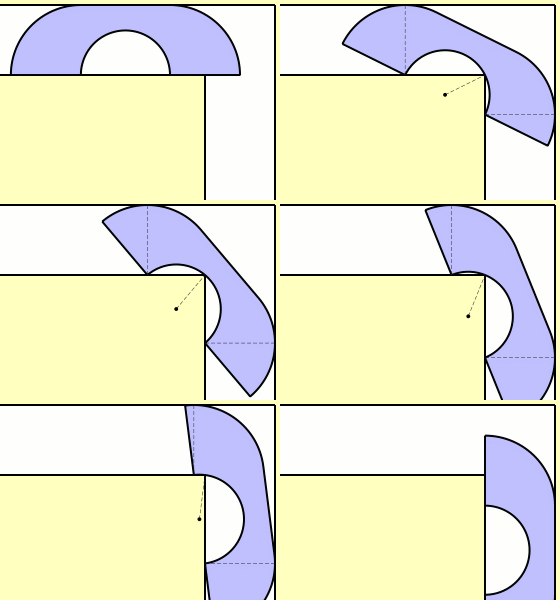
Above problem: relative motion with a "complex" shape. Damn I don't even want to begin trying that.

cpp_is_right_as_usual
Please do not enter into a habit-of-mind such as "I am too good to ask for help." I don't know the depth of this competition but no one could derive all of mathematics within a lifetime. "We all stand on the shoulders of giants." Anyone that looks down on someone for asking for help is just a pompous asshole.
I'm still looking at it and I don't agree that it works out very easily after you square both sides. For starters, since you've squared both sides you have to consider the case that LHS = RHS as well as the case that LHS = -RHS. Even if that weren't true though, It's not obvious how to factor the 6th degree polynomial. And even if you do manage to factor the polynomial, you have to make sure you check each solution back in the original equation due to the signs. For example, x-2 is a factor of the 6th degree polynomial that you get when you start with LHS = RHS, but x=2 is not one of the roots of the original equation.
But, since you have that x-2 is a root of LHS = RHS, you can always do the long division and find out that
(x-2)(x^5+2 x^4-2 x^3-4 x^2+x+1) = 0
But then you're stuck again trying to factor this 5th degree polynomial that has no rational roots, so good luck.
So I think that perhaps the squaring both sides approach may not be right, and there may be some other analysis and/or substitution that you can do first to transform the problem.
I'll look at it more later.
BTW, what math competition was this?
Here is what I put together, seeing you wouldn't let it go.
Squaring both sides would just require more work than is necessary (but so is arguably writing this stuff out when CAS can break it apart in the blink of an eye), here is where I got:
[edit 3:] changes made... this is a lot more challenging than i initially gave it credit. I too would be interested in where this problem came from. They have some great test-writers.
I love this type of distraction but I have check back later.
I'll try your method and see what I can come up with. However, your method isnt matching what wolfram said was the answer.
Careful how you interpret wolfram. I'm going to guess that when you plugged it into Wolfram, you were under the impression there was only 1 real root, right?
I'm beginning to think that any solution involving factoring is going to be a dead end.
It should be 3, no?
And yeah, if only you've seens all the methods Ive done. I probably tried this problem 6 times...
Yea it's 3, but the first time I punched it into wolfram alpha it showed 1 real root and 2 complex roots. But then if you ran simplify on the complex roots, the imaginary parts all disappeared. Now when I punch them in it shows them all as real.
I managed to prove that there are exactly 3 real roots, as well as finding the intervals that they lie in, but I'm not sure how to solve for them explicitly.
The fact that Wolfram's solution is in the form of expressions involving imaginary numbers leads me to believe that on the off chance that there actually is a trick involved, it must involve an inverse trig substitution of some kind.

While thinking about this problem, I just stumbled across a group of identities which I feel could be extremely useful for certain types of problems.
[...] Wonder if it's known, lol

Are you sure that the left-most root is -phi? When I calculate it numerically I get approximately -1.80194
Or type FFS. (changed sign)So in summary: problem is broken, but at least now I can quit working on it

It could be but I'm not sure. I think it is just ridiculously difficult. I am assuming that you didn't have access to a graphing calculator on the test (non-CAS). Here is how I came to factor (after squaring both sides):
