• Hey Guest. Check out your NeoGAF Wrapped 2025 results here!

The Math Help Thread

Status
Not open for further replies.
It is easy to show that if diam(G) is infinite, then diam(G(complement))<=2, so consider the case where G has a geodesic of length 4, say A-B-C-D-E. Note that no other edges on this set of vertices can be in G, so they are all in the complement. If G has no other points you are done. If it has another point X, then X can only connect to vertices that are at most two apart.from each other, in which case there will be paths of length at most 2 from X to any vertex in the complement. If there is another vertex Y in G, then you can check that d(X,Y)<=2 in the complement as well by considering how X and Y can connect to each other and the five geodesic vertices in G.

There is probably some clever way of doing all this without an explicit construction, but it's been a while since I've done any graph theory and I don't recall what theorems may be available..

Thank you. I finally understood it.
 
I have another problem I need help on. I couldn't find any good examples that would help me understand this problem.

Show that 2x + log_2x is Theta(x).
log_2x is log base 2 of x.
 
I got two problems with functions, composition.

The first one is:
f: X &#8594; Y, g: Y &#8594; Z
Let f and g be injective, then g&#8728;f is injective as well. (Sorry, I am translating from German)
Proof:
Be x of X.
(g &#8728; f)(x) = g(f(x))
= g(y)
= z
I know that the function f is injective, therefore a y of Y exists for f(x)=y. So I can put y instead of f(x). We know that x has a y in the codomain/image for f(x), and we know that y is of Y, the domain/preimage for the g-function. Because g is injective, we know that every y of Y has a z of Z. So I showed that the composition g &#8728; f is injective as well. It cannot be that easy, can it?

If it's easy, do I not use the exact same way to show "Let f and g be surjective, then g&#8728;f is surjective as well."?

The other thing is the exercise: "ƒ: M &#8594; N. Is f injective, so is |M| <= |N|". Any idea how to prove it? Should I do a contraposition with |M| > |N|, f is not injective? In that case, I still have no clue. :/
 
I got two problems with functions, composition.

The first one is:
f: X &#8594; Y, g: Y &#8594; Z
Let f and g be injective, then g&#8728;f is injective as well. (Sorry, I am translating from German)
Proof:
Be x of X.
(g &#8728; f)(x) = g(f(x))
= g(y)
= z
I know that the function f is injective, therefore a y of Y exists for f(x)=y. So I can put y instead of f(x). We know that x has a y in the codomain/image for f(x), and we know that y is of Y, the domain/preimage for the g-function. Because g is injective, we know that every y of Y has a z of Z. So I showed that the composition g &#8728; f is injective as well. It cannot be that easy, can it?

You didn't really show that f(g(.)) is injective. You only really showed that your functions are functions:
"I know that the function f is injective, therefore a y of Y exists for f(x)=y."
- you know that, because f is a function -- not because it's injective.
For injectivity you need to show that for every z in Z there's at most one x in X where g(f(x)) = z. You didn't show that there can be no other x that leads to the same z.

Try to stick closely to a definition of injectivity.

Proof by contradiction:

g injective: Vy1,y2: g(y1)=g(y2) => y1=y2
f injective: Vx1,x2: f(x1)=f(x2) => x1=x2

to show: Vx1,x2: g(f(x1))=g(f(x2)) => x1=x2

assumption: Ex1,x2 : x1!=x2 : g(f(x1)) = g(f(x2))

g(f(x1)) = g(f(x2))
with g(y1)=g(y2) => y1=y2
=> f(x1)=f(x2)
with f(x1)=f(x2) => x1=x2
=> x1=x2
! (contradiction)
 
I got two problems with functions, composition.

The first one is:
f: X &#8594; Y, g: Y &#8594; Z
Let f and g be injective, then g&#8728;f is injective as well. (Sorry, I am translating from German)
Proof:
Be x of X.
(g &#8728; f)(x) = g(f(x))
= g(y)
= z
I know that the function f is injective, therefore a y of Y exists for f(x)=y. So I can put y instead of f(x). We know that x has a y in the codomain/image for f(x), and we know that y is of Y, the domain/preimage for the g-function. Because g is injective, we know that every y of Y has a z of Z. So I showed that the composition g &#8728; f is injective as well. It cannot be that easy, can it?

If it's easy, do I not use the exact same way to show "Let f and g be surjective, then g&#8728;f is surjective as well."?

The other thing is the exercise: "ƒ: M &#8594; N. Is f injective, so is |M| <= |N|". Any idea how to prove it? Should I do a contraposition with |M| > |N|, f is not injective? In that case, I still have no clue. :/
I'm a bit lost with your first proof. An injective function is one that if f(x)=f(y) then x=y, which essentially means that every input generates a different output. Then, you should try to prove that (g &#8728; f)(x)=(g &#8728; f)(y) means that x=y. In any case, the proof is very straightforward so don't worry about it.

For the surjective one, you should prove that for every "y" in the codomain you have an "x" in the domain such that f(x)=y. This is kind of similar to your first proof actually.

For the final one, injective means that every value in the domain has an unique image. If you use contradiction you should do the proof easily!
 
The other thing is the exercise: "ƒ: M &#8594; N. Is f injective, so is |M| <= |N|". Any idea how to prove it? Should I do a contraposition with |M| > |N|, f is not injective? In that case, I still have no clue. :/

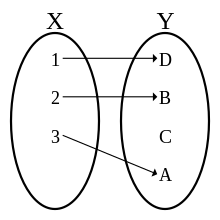
Starting with |M| > |N| is a good idea. Draw two small sets of numbers with |M| > |N| similar to this graphic:
220px-Injection.svg.png


Then try to use the definition of injectivity to show that the funciton cannot be injective.
 
Question about Integration in Calculus gentlemen. We have the integral of 1/x sqrt(x) dx with the limits [4,16]. This is supposed to be a simple problem, but for some reason I'm not understanding the answer. Any help?
 
Question about Integration in Calculus gentlemen. We have the integral of 1/x sqrt(x) dx with the limits [4,16]. This is supposed to be a simple problem, but for some reason I'm not understanding the answer. Any help?

You can put those two xs together, (x^-1)(x^(1/2))
 
Okay, probability question.

Let X be a gamma random variable with a mean 2 and a variance 1. What is E[1/X]?

First, you need to calculate the distribution function of 1/X. Using a known theorem you can prove that, if Y = 1/X, then:

f_Y(x) = f_X(1/x)*1/x^2

Then, simply calculate E(1/X) by definition.

As a hint, for the integral it's useful to do the substitution 1/u and then manipulate the integral so that you get the mean of a Gamma function.
 
First, you need to calculate the distribution function of 1/X. Using a known theorem you can prove that, if Y = 1/X, then:

f_Y(x) = f_X(1/x)*1/x^2

Then, simply calculate E(1/X) by definition.

As a hint, for the integral it's useful to do the substitution 1/u and then manipulate the integral so that you get the mean of a Gamma function.

Sorry, is that (1/x)^2 or 1/(x^2)? Also, do you know the name of that theorem you used?

The reason I ask is because I used
E(g(x)) = integral(g(x)*f_X(x) dx) so the becomes
E(1/x)=integral((1/x)*f_X(x) dx)
And I ended up with an answer that seems reasonable. I've got E(1/x)=2/3.
 
Sorry, is that (1/x)^2 or 1/(x^2)?

Both are the same!

Also, do you know the name of that theorem you used?

You can find it here under change of variables: http://en.wikipedia.org/wiki/Probability_density_function .

The reason I ask is because I used
E(g(x)) = integral(g(x)*f_X(x) dx) so the becomes
E(1/x)=integral((1/x)*f_X(x) dx)
And I ended up with an answer that seems reasonable. I've got E(1/x)=2/3.

This is also true, but I think it comes as a conclusion of the above theorem rather than just by definition, which is why I went the long way with my response above haha. The result seems correct by the way.
 
Both are the same!


You can find it here under change of variables: http://en.wikipedia.org/wiki/Probability_density_function .


This is also true, but I think it comes as a conclusion of the above theorem rather than just by definition, which is why I went the long way with my response above haha. The result seems correct by the way.

Gah! I was so concerned with the distinction, I didn't even realize it didn't exist! Thanks so much for the help! This transformations part is the one thing I'm constantly messing up on, but I'm starting to get it. Thanks a ton!
 
I can't figure out the answers to this for the interval [0, 2pi]

3 sin 2x = &#8722;4.5 cos x

I came up with 5.4351 and 3.9897 but those aren't correct.

I figure I can't use the double angle for the left side to make it 6sinxcosx = -4.5cosx which would be 6sinx = -4.5, but that isn't working.

Edit: Wolfram tells me theres 4 values for x here within that interval. Where did I go wrong and lose possible solutions? The two I mentioned are correct, but was missing two. No idea how to get those.
 
I can't figure out the answers to this for the interval [0, 2pi]

3 sin 2x = &#8722;4.5 cos x

I came up with 5.4351 and 3.9897 but those aren't correct.

I figure I can't use the double angle for the left side to make it 6sinxcosx = -4.5cosx which would be 6sinx = -4.5, but that isn't working.

Edit: Wolfram tells me theres 4 values for x here within that interval. Where did I go wrong and lose possible solutions? The two I mentioned are correct, but was missing two. No idea how to get those.

Your cancellation is only valid when cos(x) != 0.
 
Question about complex numbers:
4th root of -32-9i

I know how to solve it with the trigonometric method ( r(cos(x)+isin(x)) ).

But there was this other method for square roots:
sqrt(a+bi) = x+yi
a+bi = x^2-y^2+2xyi

{ x^2-y^2=a
2xy=b }

[...]

---
I was wondering if it's feasible to use that second method to solve 4th root of -32-9i? I think I have to but I might be reading the assignment wrong.
 
Thanks for the help last time.

Next topic is I am unsure is about to prove if something is a group.
Be G1, G1 groups, so be on G = G1 x G1 follow operation explained:
(g1, g2) * (h1, h2) := (g1 * h1, g2 * h2)
Show that G is a group. G is commutative if and only if G1 and G2 are commutative.

Let us prove if G fulfills the group axioms.
(G1/associativity) We have to show that
a*(b*c)=(a*b)*c

Be g1, h1, i1, j1, k1, l1 Elements of G1
and g2, h2, i2, j2, k2, l2 Elements of G2

((g1, g2) * (h1, h2)) * (((i1,i2)*(j1,j2))*((k1,k2)*(l1,l2))) = (((g1, g2) * (h1, h2)) * ((i1,i2)*(j1,j2)))*((k1,k2)*(l1,l2))

After a few steps(Using the operation several times), I'm getting to this:
(g1*h1*i1*j1*k1*l1, g2*h2*i2*j2*k2*l2) = (g1*h1*i1*j1*k1*l1, g2*h2*i2*j2*k2*l2)

I have shown that the group fulfills the first axiom.

(G2/ neutral element)
I already know that G1, G2 are groups and fulfilling the axioms. Therefore I know that neutral element exists in both.

Be e1 neutral Element of G1 and e2 neutral Element of G2.
(e1, e2) * (e1, e2) = (e1*e1, e2*e2) = (e1, e2) Element of G.

We know that a*e=a. Therefore: e*e=e. We are applying it on the group operation and it shows that e1, e2 are Elements of G. Second axiom is proved.

(G3/inverse)
My method is pretty analog to showing that the neutral element is an Element of G.
G1, G2 are groups which are fulfilling the group axioms.

Be g1^-1, e1 Elements of G1, and g2^-1, e2 Elements of G2. e1, e2 are the neutral elements of each specific group:

(g1^-1, g2^-1) * (e1, e2) = (g1^-1 * e1, g2^-1 * e2) = (g1^-1, g2^-1) Element of G.

Am I allowed to do it? I do not think so. How should I know that g1^-1 is the inverse of something? Or should I do this instead:
g1, g1^-1 Elements of G1, and g2, g2^-1 Elements of G2:
(g1, g2) * (g1^-1, g2^-1) = (g1 * g1^-1, g2 * g2^-1) = (e1, e2)
For the last part, I have no clue how to approach it. Contraposition? Showing that G is commutative and G1 and G2 aren't?
 
Question about complex numbers:
4th root of -32-9i

I know how to solve it with the trigonometric method ( r(cos(x)+isin(x)) ).

But there was this other method for square roots:
sqrt(a+bi) = x+yi
a+bi = x^2-y^2+2xyi

{ x^2-y^2=a
2xy=b }

[...]

---
I was wondering if it's feasible to use that second method to solve 4th root of -32-9i? I think I have to but I might be reading the assignment wrong.
You could do that in theory, but you get a system of quartic equations that isn't worth the trouble, in my opinion. Applying de Moivre's theorem seems like a much saner way to go. Alternatively, you could get the two square roots of -32-9i, then get the two square roots of each of those, which gives the four 4th roots of -32-9i.
 
Thanks for the help last time.

Next topic is I am unsure is about to prove if something is a group.

For the last part, I have no clue how to approach it. Contraposition? Showing that G is commutative and G1 and G2 aren't?

I'm not sure I follow your proofs for parts 1-2. Here's my version of part 1, for comparison. Let a,b,c be elements of G1 and x,y,z be elements of G2. Then

(a,x)( (b,y)(c,z) ) = (a,x)( (bc,yz) ) = (a(bc),x(yz))
= ((ab)c, (xy)z) = (ab,xy)(c,z) = ( (a,x)(b,y) )(c,z)

The first, second, fourth, and fifth equalities are by the definition of the group operation in the direct product G1 x G2. The third equality follows by application of the associative property in G1 and G2 to each component.

Part 2 is an exercise for the reader.

Part 3: if (g1, g2) is an arbitrary element of G1 x G2, we claim that (g1^{-1}, g2^{-1}) is its inverse. We can easily check that this is both a left and a right inverse:

(g1,g2)(g1^{-1},g2^{-1}) = (g1 g1^{-1}, g2 g2^{-1}) = (e1, e2)
(g1^{-1},g2^{-1})(g1,g2) = (g1^{-1} g1, g2^{-1} g2) = (e1, e2)

Since (e1,e2) is the identity element as shown in part 2, it follows that (g1^{-1}, g2^{-1}) is the inverse for (g1, g2).


To show commutativity assuming G1 and G2 are commutative, start with two arbitrary elements (a,x) and (b,y) of G1 x G2, apply the definition of the group operation, then apply the commutative property of G1 and G2 to each of the components. It is a similar idea to the proof of part 1.
 
A lot of help
Thanks. You helped me a lot to understand the exercise correctly. I did the mistake thinking that the operation is the element of G. I always was confused that (g1*h1, g2*h2) should be the element of G, but that's just the operation. I did not really dive into your solution and tried it for myself.

For part 2, we have to proof that a neutral Element exists.
Be g1, e1 Elements of G1, g2, e2 Elements of G2. (e1, e2 the neutral Element for the specific group G1, G2)

(g1, g2) * (e1, e2) = (g1*e1, g2*e2) = (g1, g2) = (e1*g1, e2*g2) = (e1, e2) * (g1, g2)

We have shown that the neutral Element of G is (e1, e2).

For part 4:
Be g1, h1 Elements of G1, g2, h2 Elements of G2

(g1, g2) * (h1, h2) = (g1 * h1, g2 * h2) = (h1 * g1, h2 * g2) = (h1, h2) * (g1, g2)
 
For part 4:
Be g1, h1 Elements of G1, g2, h2 Elements of G2

(g1, g2) * (h1, h2) = (g1 * h1, g2 * h2) = (h1 * g1, h2 * g2) = (h1, h2) * (g1, g2)

Notice that the question is "if and only if", so you also have to prove that if G is conmutative, then both G1 and G2 are too. It's pretty direct and similar to the above proof.

EDIT: You can even take it immediately from the proof you already wrote in any case haha.
 
So I'm struggling to understand something which I can't seem to find any resources on for differential equations.

The topic is the eigenvalue method for homogenous linear systems.

Using this method, at some point you need to take the Wronskian to check for linear independency. However the Wronskian they are using in this chapter seems to be different from the Wronskian they previously used, or at least, the definition is being used in a way that I can't make sense of.

Previous it was defined as...

Code:
W(f1, f2) = [ f1  f2
                  f'1  f'2]

To check for linear independency of functions.

But now with the eingenvalue method, you find your eigenvalues via characteristic equations, which you then use to find a system, which you then use to find coefficients.

An example I am trying to do with the book, after doing the prelimary steps, I end up with these two solutions to a system

Code:
x1 = [1
         1]e^3t

x2 = [1
         -1]e^-t

Ok that's all well and good, but now they say to take the Wronskian to check if these two solutions are linearly independent, and then they write this

Code:
W = [ e^3t   e^-t
         e^3t    -e^-t]   = -2e^2t

Besides the result of non-zero meaning that they are indeed linearly independent, the operation here seems to bear little resemblance to the previous use of Wronskian.

I understand how they got the terms in the matrix (just multiplying the coefficients by the e term) but I don't see how they went from that to -2e^2t)/

All I really need is to understand how they are using the Wronskian here to check for linear independency.


Sorry if my terminology is a bit ignorant, I'm teaching myself out of the book and they don't do a very good job explain this so I'm very lost.

edit: and sorry about the formatting of the matrices. I tried the code box which is supposed to preserve white space, but I can't seem to get the text to line up properly. Hope it is still understandable.
 
As you are probably aware, the columns of X(t) are linearly independent if and only if the determinant is not equal to zero. This determinant is literally the Wronskian. For a 2x2 matrix, the determinant is ad-bc, which for your matrix is:

e^3t*-e^-t - e^-t*e^3t = -e^(3t-t) - e^(-t+3t) = -2e^2t
 
I guess I don't understand the relationship between the previous use of it with the derivatives, and now using it with just plugging in the values from the matrices. It seems incredibly abstract at this point, but that just taking the determinant gives me enough practical knowledge to do problems. Thanks.
 
I don't think that second thing is literally a Wronskian -- if they really called it that, it's an abuse of terminology. However, the common theme is using a determinant to check a set of n n-vectors for linear independence. In the first case, you want to check f1 and f2 for linear independence. If they were linearly *dependent*, then you could find constants a and b such that

a * f1(x) + b * f2(x) = 0, for all values of x in the domain.

How would we be able to tell if such constants exist? Well, with only two functions, the obvious thing to do is to take their ratio and see if it's a constant. But that would only work in the case of two functions, and we'd like a more general solution. We observe that if the functions are differentiable n-1 times, then we can differentiate the above equation n-1 times. In our simple example, where n=2, we differentiate once to get

a * f1'(x) + b * f2'(x) = 0.

Thus we could construct the two column vectors v1(x) = [f1(x), f1'(x)]^T and v2(x) = [f2(x), f2'(x)]^T (where ^T indicates taking the transpose to get a column vector). Our two equations can then be combined as

a * v1(x) + b * v2(x) = 0.

We have thus expressed the original problem in a new form -- determine whether the vectors v1(x) and v2(x) are linearly independent. Linear independence can be checked by taking the determinant of the matrix [v1, v2], i.e. computing the Wronskian, and seeing if we get something nonzero. If the result is nonzero at some point x0, then the vectors v1(x0) and v2(x0) are linearly independent, and thus the functions are linearly independent. Contrariwise, if the result is zero for all x, then the vectors v1(x) and v2(x) are linearly dependent at each x (however, this is merely a pointwise statement; it is not in general a sufficient condition to establish that the *functions* are linearly dependent).

In the second case, you have two solutions e^3t * [1, 1]^T and e^{-t} * [1, -1]^T. To check if they're linearly independent, we take the determinant of the matrix formed by the two column vectors, getting -2e^{-2t}. Since this is never 0, we conclude that the column vectors are linearly independent for some value of t (in fact for every value of t), and thus the solutions must be linearly independent.
 
Doing the remainder estimate for the integral test and this is supposed to give you a more accurate estimate...

1HGOIq9.png


I don't have any clue where the error of 0.0005 came from. Half the length of the interval should be 0.000868. Now, did I just fail to see something really, really simple, or is my book fucktarded at explaining things.
 
Doing the remainder estimate for the integral test and this is supposed to give you a more accurate estimate...

1HGOIq9.png


I don't have any clue where the error of 0.0005 came from. Half the length of the interval should be 0.000868. Now, did I just fail to see something really, really simple, or is my book fucktarded at explaining things.

The whole interval is close to 0.0009. Half of it should be close to 0.00045 or 0.0005.
 
The whole interval is close to 0.0009. Half of it should be close to 0.00045 or 0.0005.
I don't see how it makes any sense to round right here. Let alone round twice. Nowhere in the book does it state that it's rounding or give any reasoning for doing so. Are steps like these obvious to everyone else? This is the kind of stuff that leaves me sitting there baffled for hours while completely understanding the concept otherwise.
 
I don't see how it makes any sense to round right here. Let alone round twice. Nowhere in the book does it state that it's rounding or give any reasoning for doing so. Are steps like these obvious to everyone else? This is the kind of stuff that leaves me sitting there baffled for hours while completely understanding the concept otherwise.
Even if you only round once, you seldom want to round down when working with error intervals. It's better to have some margin than top have am optimistic interval , so to speak. In that case, even the .43 can be rounded to .5 depending on the number of significant digits you are supposed to use.
 
Even if you only round once, you seldom want to round down when working with error intervals. It's better to have some margin than top have am optimistic interval , so to speak. In that case, even the .43 can be rounded to .5 depending on the number of significant digits you are supposed to use.
Yeah I realize that. The amount of digits they rounded to was completely arbitrary though, and without any explanation left me baffled. Why would you randomly round and not say anything when explaining a concept? I feel that the example is poorly written, but wanted to get other opinions.
 
Yeah I realize that. The amount of digits they rounded to was completely arbitrary though, and without any explanation left me baffled. Why would you randomly round and not say anything when explaining a concept? I feel that the example is poorly written, but wanted to get other opinions.
Without knowing what book you're using, I would surmise that the discussion was initially motivated by the desire to approximate the series to within a specified error, namely 0.0005. So the point is that you take a suitable number of terms so that the corresponding upper bound on the error itself falls below the specified tolerance level.
 
Need your help!

72*1.25^x=50*1.5^x

Need to compare the exponents in this equation
Answer is 2 according to my book, but I can't understand how to get there
 
Need your help!

72*1.25^x=50*1.5^x

Need to compare the exponents in this equation
Answer is 2 according to my book, but I can't understand how to get there
You can divide to get

(1.25/1.5)^x = 50/72

Simplify the fractions by multiplying by 4/4 on the left and .5/.5 on the right to get

(5/6)^x = 25/36

Then note that 25/36 = (5/6)^2, so equate exponents to get x=2.
 
I am having trouble with mathematical induction in my discrete math class. Any tips that can be given generally speaking? Each problem feels like it has its own trick to figuring out. This seems harder to me than related rates or optimization, which felt like it was giving me similar problems at first.

For example, proving that for an infinite number of non-repeating fractions that have a numerator of 1 and add up to 1, their product will be less than or equal to 1/4. There must be 2 or more fractions.

Logically this makes sense since the product of these fractions will be getting smaller and smaller as you add mot fractions, but I have no idea how to prove this in terms of k and k+1.
 
For example, proving that for an infinite number of non-repeating fractions that have a numerator of 1 and add up to 1, their product will be less than or equal to 1/4. There must be 2 or more fractions.

Logically this makes sense since the product of these fractions will be getting smaller and smaller as you add mot fractions, but I have no idea how to prove this in terms of k and k+1.

Is this only a part of the question? It's kinda trivial. All the fractions has 1 as numerator, and they are non-repeating, so the biggest are is 1/2, and 1/3, the product is 1/6, whatever remaining only make the product smaller.

I think I am missing something here...
 
Is this only a part of the question? It's kinda trivial. All the fractions has 1 as numerator, and they are non-repeating, so the biggest are is 1/2, and 1/3, the product is 1/6, whatever remaining only make the product smaller.

I think I am missing something here...
I have to use mathematical induction to prove it. You explicitly prove a base case, assume it works for some k number of fractions, prove that it works for k + 1 cases (the hard part), then you know it will work for all k at and beyond the base case.


The problem for me is each problem like this requires some intuitive evaluation with math that I am apparently lacking.
 
I have to use mathematical induction to prove it. You explicitly prove a base case, assume it works for some k number of fractions, prove that it works for k + 1 cases (the hard part), then you know it will work for all k at and beyond the base case.


The problem for me is each problem like this requires some intuitive evaluation with math that I am apparently lacking.

My "proof" works for any k, anyway. My gut feeling is there is something missing, and I understand the problem wrong.

The most simple case of "non-repeating fractions that have a numerator of 1 and add up to 1," is 1/2, 1/3, 1/6, so the upper limit should be 1/36 if there is one. Prove it's 1/4 doesn't make sense.
 
My "proof" works for any k, anyway. My gut feeling is there is something missing, and I understand the problem wrong.

The most simple case of "non-repeating fractions that have a numerator of 1 and add up to 1," is 1/2, 1/3, 1/6, so the upper limit should be 1/36 if there is one. Prove it's 1/4 doesn't make sense.
I might be mistaken about them not being allowed to be repeated. I believe the base case is actually supposed to be 1/2 + 1/2
 
A question I have ahead of a job interview:

What is the easiest way to calculate 1.05^10 for example with just pen and paper? The written test for the job has a lot of questions on compounding so I was wondering if there's a way to quickly calculate it mentally.
 
A question I have ahead of a job interview:

What is the easiest way to calculate 1.05^10 for example with just pen and paper? The written test for the job has a lot of questions on compounding so I was wondering if there's a way to quickly calculate it mentally.

My first question would be, why do you think you need to do this? Is this type of arithmetic actually what is being tested for?

Depending on your answer to that question, my advice differs.

*) If they are actually testing for the arithmetic, and you need an exact answer, then I don't see any real shortcuts except for repeated squaring. e.g. you can compute x^10 as (((x^2)^2)^2 * x^2, which is 4 multiplications instead of 10. However, I would really be surprised if this is actually what is required.

*) If they aren't actually testing for the arithmetic, but you expect expressions of this type to come up in the test, then I would leave them unexpanded. Using logarithms might help you manipulate them depending on the situation.

*) If you want to have a quick estimate that's not too far off, then use the first few terms of the binomial expansion

(1.05)^10 = (1 + .05)^10 = 1 + C(10,1) * .05 + C(10,2) * .05^2 + C(10,3) * .05^3 * ...

It should be easy to write down the first three or four terms without additional scratch work:

1 + 10 * .05 + 45 * .0025 + R,

where R is the remainder. This will only be reasonably accurate if n*r is "small", where n is the exponent and r is the interest rate, .05 in this case. To get a pessimistic idea of the error, you can upper bound R with an infinite geometric series with first term a_k*r*(n-k)/(k+1) and ratio n*r, where the last term you wrote down is the k'th term, with value is a_k. (Only works if n*r < 1, and works better the smaller n*r and k actually are.) For our example, we have k=2 and a_k = 45 * .0025. Thus:

R <= 45 * .0025 * .05 * 8/3 * 1/(1-.5)= .03,

which says that R is no greater than .03. On the other hand, the true value of R is .01639, so you can see that this is quite a loose upper bound in our case. Its main redeeming value is that it's easy to compute manually.
 
When representing a sum as a power series, is the reason the sum must converge so that the sum evaluates to a finite number, just like the function?

sSP61hO.png
 
When representing a sum as a power series, is the reason the sum must converge so that the sum evaluates to a finite number, just like the function?

sSP61hO.png
Yes, essentially. If the sum does not converge then you can't assign a value to it, so it makes no sense to say that it has the same value as the function. It's also worth mentioning that you're not just trying to prevent a sum of infinity when you restrict the domain, but any type of divergence. For example, plugging x=-1 into the series you have there will yield a sequence of partial sums that alternates between 1 and 0, so it diverges, but not to infinity..
 
Be n an natural number and G=(G,*,e) a group with exactly n Elements. We choose a bijection of sets a: {1,2,...,n} -> G and put for every g (element of) G
o_(g): {1,2,...,n} -> {1,2,...,n}, i |-> a^(-1)(g*a(i))​
Show that:

(1) o_(g) is an Element of the Symmetrical Group.
Symmetrical group is the set of all bijective functions.
I have to show that o is injective and surjective.
(I did, so thats not the problem)

But I do not know what I have to do with the second part of the exercise:
(b) The function: G -> S_(n), g |-> o_(g) is a injective group homomorphism.

Things I know that:
-I have to show the only group homomorphism axiom:
f(g+g') = f(g) * f(g+) is an element of G.
-o_(g) is a bijective function. (Shown in part a) That means that every o_(g) belongs to a g in the domain. (If I get it right)
-S_(n) -> S_(n+) is a injective group homomorphism.

Does g |-> o_(g) look like a^(-1)(g*a(g))? Still no clue.
Well here is a screen cap of the German exercise:

Edit.:
Is that right?
 
Be n an natural number and G=(G,*,e) a group with exactly n Elements. We choose a bijection of sets a: {1,2,...,n} -> G and put for every g (element of) G
o_(g): {1,2,...,n} -> {1,2,...,n}, i |-> a^(-1)(g*a(i))​
Show that:

(1) o_(g) is an Element of the Symmetrical Group.


But I do not know what I have to do with the second part of the exercise:
(b) The function: G -> S_(n), g |-> o_(g) is a injective group homomorphism.

Things I know that:
-I have to show the only group homomorphism axiom:
f(g+g') = f(g) * f(g+) is an element of G.
-o_(g) is a bijective function. (Shown in part a) That means that every o_(g) belongs to a g in the domain. (If I get it right)
-S_(n) -> S_(n+) is a injective group homomorphism.

Does g |-> o_(g) look like a^(-1)(g*a(g))? Still no clue.
Well here is a screen cap of the German exercise:


Edit.:

Is that right?
First off, your multiplication in the handwritten work doesn't make sense because you are multiplying elements of G with natural numbers. You have x's and y's where you should have g's. But this is not what you should be trying to show anyway, because that would mean that o_g itself is a homomorphism, rather than the map g|->o_g . You should be trying to show that o_(g*h)=o_g*o_h.

Also, may I say that I find it very cool how easily I can read German mathematics without knowing any German? Math truly is the universal language. (I choose to Ignore the fact that English is a Germanic language, so I should find German fairly easy to decipher anyway.)
 
Status
Not open for further replies.
Top Bottom