• Hey Guest. Check out your NeoGAF Wrapped 2025 results here!

The Math Help Thread

Status
Not open for further replies.
it also doesnt help when the professor just zips through a hard example and expects you to follow -_-

Do you have an example of one you had difficulty with? I can attempt to explain it in more detail, and then I can actually classify my GAF browsing as "studying".
 
In terms of sequences, does anyone have any tips for picking which tests to use when checking convergence/limits of sequences/series? Like knowing when to use the ratio test/comparison test/sandwich theorem/integral test etc. I find I waste a lot of time doing the wrong test and I'm not sure if I'm completely missing something obvious or what..

Also I'd be interested to know what program/tablet you use for the problems you posted on the page before triplestation ^^ I've been looking at picking up a tablet to digitise my notes + something to let me work on problems... at the moment I end up opening notepad and writing rough work there lol
 
Do you have an example of one you had difficulty with? I can attempt to explain it in more detail, and then I can actually classify my GAF browsing as "studying".

cant really think of any specific problem at the moment.. but curve sketching involving a combination of radicals and fractions and/or trig make me sick
 
Differential calculus is over for me. Crazy how I went from feeling like I may fail the class to locking a B by the ending it. I'm taking Integral Calculus next semester, how should I prep? We did integration as the last part of differential calc. So I'm familiar with taking the indefinite integral, definite integral, finding the area created by functions, finding the volume of that area rotated on an axis, and a few other things like u substitution.Any good tips on what to practice during the winter break?
 
Differential calculus is over for me. Crazy how I went from feeling like I may fail the class to locking a B by the ending it. I'm taking Integral Calculus next semester, how should I prep? We did integration as the last part of differential calc. So I'm familiar with taking the indefinite integral, definite integral, finding the area created by functions, finding the volume of that area rotated on an axis, and a few other things like u substitution.Any good tips on what to practice during the winter break?

Wow, if you've done finding volumes rotated on axes then you've done than most I think haha. I'd prep by nailing down integration techniques, particularly the trigonometric stuff.
https://www.khanacademy.org/math/integral-calculus/integration-techniques
 
Sounds good. What kind of difficulty should I expect in integral calculus vs diff calculus?

I'd say the pace and the volume of information learnt is the biggest thing to worry about. Calculus I was mostly high school refresher in the beginning with limits and derivatives (with epsilon/delta stuff added in), so if you slacked off during the beginning, it wouldn't have been too damaging. But in Calculus II you are going to hit the ground running and the volume of information you need to learn is a lot higher too. It's good that you decided to study ahead, but make sure to not blow your gains or you'll find yourself falling behind quickly. Other than that, I found Calculus II much more interesting than Calculus I, it has much more practical uses which makes it fascinating and is what kept me motivated. Best of luck to you! :)
 
In terms of sequences, does anyone have any tips for picking which tests to use when checking convergence/limits of sequences/series? Like knowing when to use the ratio test/comparison test/sandwich theorem/integral test etc. I find I waste a lot of time doing the wrong test and I'm not sure if I'm completely missing something obvious or what..

Also I'd be interested to know what program/tablet you use for the problems you posted on the page before triplestation ^^ I've been looking at picking up a tablet to digitise my notes + something to let me work on problems... at the moment I end up opening notepad and writing rough work there lol
I wrote out a really long post but then I realized it would a lot easier and clearer just to point you to the last 20 minutes of this video.
http://youtu.be/g4iZJOwMkjU?t=1h20m16s

Differential calculus is over for me. Crazy how I went from feeling like I may fail the class to locking a B by the ending it. I'm taking Integral Calculus next semester, how should I prep? We did integration as the last part of differential calc. So I'm familiar with taking the indefinite integral, definite integral, finding the area created by functions, finding the volume of that area rotated on an axis, and a few other things like u substitution.Any good tips on what to practice during the winter break?
For calc 2 watch this guy's videos: https://www.youtube.com/playlist?list=PLDesaqWTN6EQ2J4vgsN1HyBeRADEh4Cw-
Dude was a straight up life saver for me during calc 2, probably the best math teacher online and offline i've ever had.
 
I wrote out a really long post but then I realized it would a lot easier and clearer just to point you to the last 20 minutes of this video.
http://youtu.be/g4iZJOwMkjU?t=1h20m16s

Wow thanks this was exactly what I needed! this guy is great. Would have loved to have seen your post too :P. Just curious, is this high school stuff in America? What else comes under "Calculus 2"? Here in the UK this is the first time I'm seeing all of this, in "analysis 1" as a first year undergrad...
 
In the US calculus is a course you can take in high school if you are on the advanced math track.
 
Wow thanks this was exactly what I needed! this guy is great. Would have loved to have seen your post too :P. Just curious, is this high school stuff in America? What else comes under "Calculus 2"? Here in the UK this is the first time I'm seeing all of this, in "analysis 1" as a first year undergrad...
It was like 2 paragraphs long and it's just a lot easier to explain with a visual aid to go along with haha. You can take calculus in high school, but I'm 95% positive that everywhere they make you take the actual class at a college. Usually most people end highschool at algebra 2 or trigonometry, those that go further took algebra back in middle school.

For anyone scared of calculus 2, look at the guy's videos I posted. You should have no problems in calculus 2 if you supplement your learning with his videos(just ask your teacher about anything he doesn't cover)/
 
Calc 2 isn't so bad.

It's basically more integration techniques, and then at the very end they try to confuse you by introducing infinite series and parametric equations.
 
Calc 2 isn't so bad.

It's basically more integration techniques, and then at the very end they try to confuse you by introducing infinite series and parametric equations.
Series were so fun once you understand why and how they work. Didn't get to parametric equations so don't know what that was like. I'm in the minority when I say that calc 2 was easier than calc 1. I was a lazy dumbass at the start of the semester and fucked up my first exam and didn't turn a couple of homework assignments. Now I have to live with a B instead of an easy A.
 
Blows my mind that integration by parts/natural logs etc comes under the same thing as all the series/sequences stuff! Over here we were taught integration methods etc almost 4 years ago and are only getting onto the completeness/sequences/series stuff now :P
 
I have a video, and I want to measure angular displacement of a rotational event. I found a program called MBruler that I can use to estimate angular displacement from the point of view of the camera. The event happens a bit off axis though (not perpendicular to the axis of rotation). How would I estimate the conversion from the angular displacement *from the camera point of view* to *actual* angular displacement? Here's a picture for reference.

Mdkn67R.png


If you know of FREE software that I can use to take an angular measurement that has 3D transformation of axis of rotation that works too.
 
Last minute Calc 1 help needed (final tommorow).

Here's one question from an old final:
Let f(x) = x^5 + x^3 + 3x for all real x. Give reasons why there must be a number c such that f(c) = pi.

Not really sure how to approach this, I know it probably has to do with some theorem but I can't remember which. Mean Value Theorem and Rolles Theorem don't apply since we're not given an interval. Any help?
 
Last minute Calc 1 help needed (final tommorow).

Here's one question from an old final:


Not really sure how to approach this, I know it probably has to do with some theorem but I can't remember which. Mean Value Theorem and Rolles Theorem don't apply since we're not given an interval. Any help?

Intermediate Value Theorem.
 
The function given is always continuous and differentiable. Therefore if you can show that the derivative can equal a number less than pi, and more than pi for different x's, then there must be a c between those two x's that equals pi.
 
The function given is always continuous and differentiable. Therefore if you can show that the derivative can equal a number less than pi, and more than pi for different x's, then there must be a c between those two x's that equals pi.

The derivative has nothing to do with this problem. As FortuneFaded said, you need to use the Intermediate Value Theorem for the exercise. You can easily tell that f(0) = 0. Then you need to find a number such that f(x) > Pi and by using the IVT you'll have the exercise done!

For the second exercise, remember that the derivative of a function in one point is the slope of the line tangent to the function at said point. So, you have a line with the ecuation

y = -2x + c

But you know that (1,4) is a point of the line, so you can find c! Then you continue from there.
 
The derivative has nothing to do with this problem. As FortuneFaded said, you need to use the Intermediate Value Theorem for the exercise. You can easily tell that f(0) = 0. Then you need to find a number such that f(x) > Pi and by using the IVT you'll have the exercise done!

For the second exercise, remember that the derivative of a function in one point is the slope of the line tangent to the function at said point. So, you have a line with the ecuation

y = -2x + c

But you know that (1,4) is a point of the line, so you can find c! Then you continue from there.
Oh, I thought it asked to prove that f'(c) = pi existed.
 
Implicit differentiation, are there any tricks to it?

Code:
Tangent line equation for y sin2x = x cos2y at (pi/2, pi/4)
is throwing me for a loop. I've attempted it four times now and keep running into dead ends.
 
Implicit differentiation, are there any tricks to it?

Code:
Tangent line equation for y sin2x = x cos2y at (pi/2, pi/4)
is throwing me for a loop. I've attempted it four times now and keep running into dead ends.

Differentiate both sides w.r.t to x (using the product rule and chain rule) =

(dy/dx)(sin2x) + 2ycos2x = cos2y - (2xsin2y)(dy/dx)

Simplify and insert the values at the given point.
 
Differentiate both sides w.r.t to x (using the product rule and chain rule) =

(dy/dx)(sin2x) + 2ycos2x = cos2y - (2xsin2y)(dy/dx)

Simplify and insert the values at the given point.

Man, I was so close. Thanks for the help. I think I've got it now.
 
Implicit differentiation, are there any tricks to it?

Code:
Tangent line equation for y sin2x = x cos2y at (pi/2, pi/4)
is throwing me for a loop. I've attempted it four times now and keep running into dead ends.
Derive the the whole thing first and then solve for y'. After you solve for y' plug in your x and y points and that will give you your slope. From there you just plug that and your x and y points into the point slope formula.
 
Can someone help me with this radical?

√x-4=√x -2

I'm getting towards the end and getting x=x+6, which I know to be wrong, or is it? Help!
Unless something had been left off, then the equation clearly has no solutions (which is a perfectly valid answer). Simply subtracting √x will lead to -4 = -2, which makes no sense.
 
The derivative has nothing to do with this problem. As FortuneFaded said, you need to use the Intermediate Value Theorem for the exercise. You can easily tell that f(0) = 0. Then you need to find a number such that f(x) > Pi and by using the IVT you'll have the exercise done!

For the second exercise, remember that the derivative of a function in one point is the slope of the line tangent to the function at said point. So, you have a line with the ecuation

y = -2x + c

But you know that (1,4) is a point of the line, so you can find c! Then you continue from there.
Thanks.
 
Here's something I'm wondering about:
Let's say I have the set of all vectors [a b] where a & b are odd. It's not a vector space, because it's not closed under addition, but [1 0] and [0 1] still "generate" the set. It's not a basis, but is there some similar term for sets?
 
Unless something had been left off, then the equation clearly has no solutions (which is a perfectly valid answer). Simply subtracting √x will lead to -4 = -2, which makes no sense.

I see, thank you a ton!

Maybe I'm reading the question wrong, but would it change if it were

√x+4=√x (not under the radical) -2
 
Hello guys!

I need your help. That's the exercise:
I struggle with the (a), because (b) is kind of easy:

What we have to show is that there is no other endomorphism. But how do I exactly do that? Contradiction? But I have no clue how.
Going through the lecture, I found this tidbit:
Because of this little tidbit, I know that U' has only one element; 0. And U=V.

The other thing is that π is the identity map, isn't it? Because it does the exact nearly the same thing.
 
Just discovered this thread. Currently studying GCSE Maths in College, as I want it on my C.V, and it may help with my UCAS application for Universities. The main course I'm doing is a level 3 I.T.
Thanks in advance if any of my queries are answered.

(I'm in the UK by the way)
 
Hello guys!

I need your help. That's the exercise:

First off, this "Because of this little tidbit, I know that U' has only one element; 0. And U=V." and this "The other thing is that π is the identity map, isn't it? Because it does the exact nearly the same thing." isn't true (you will see why). You need to show there is no other endomorphism with the property that π(u) = u and Ker(π) = U'. Ker(π) = U' means that any for any u' belonging to U', π(u') = u. Given that U+U'=V and the intersection is zero, any v in V can be uniquely written as a disjoint sum of linear combinations of the basis vectors from U and U' (Lets call them u and u'). Then π(v) = π(u + u') = π(u) + π(u') = π(u) = u. So every vector in v has exactly one possibility for π(v) and hence unique (see bold).
 
First off, this "Because of this little tidbit, I know that U' has only one element; 0. And U=V." and this "The other thing is that π is the identity map, isn't it? Because it does the exact nearly the same thing." isn't true (you will see why). You need to show there is no other endomorphism with the property that π(u) = u and Ker(π) = U'. Ker(π) = U' means that any for any u' belonging to U', π(u') = u. Given that U+U'=V and the intersection is zero, any v in V can be uniquely written as a disjoint sum of linear combinations of the basis vectors from U and U' (Lets call them u and u'). Then π(v) = π(u + u') = π(u) + π(u') = π(u) = u. So every vector in v has exactly one possibility for π(v) and hence unique (see bold).
I just feel so stupid. :-( I thought to critical about this exercise and would never have thought about the group homomorphism axioms. There is a lot of learning coming ahead!

Thank you!

Edit.: Even stupider I am already using a group homomorphism definition in 3b. I should not give up after 30minutes...
Edit2.: Should it not be "Ker(π) means any u' belonging to U', π(u')=0." (Yeah. I know this is a rhetorical question.)
 
Thank you very much!
It should seem obvious once you make the equation :

(x+4)^(1/2) - x^(1/2) = -2

Since both x's are a square root, you know it can only give you positive integers because x cannot be less than 0. And a positive number minus a smaller positive number or zero is always going to produce a positive number. But this function is producing a negative number, which is impossible.
 
Hello guys!

I need your help. That's the exercise:

I struggle with the (a), because (b) is kind of easy:


What we have to show is that there is no other endomorphism. But how do I exactly do that? Contradiction? But I have no clue how.
Going through the lecture, I found this tidbit:

Because of this little tidbit, I know that U' has only one element; 0. And U=V.

The other thing is that π is the identity map, isn't it? Because it does the exact nearly the same thing.

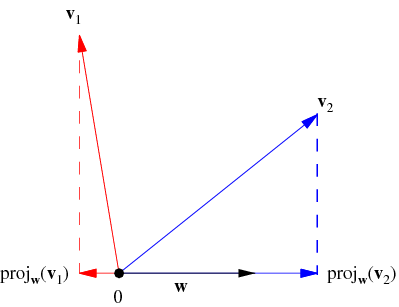
As a small "trivia", you can see this function as a "projection".

Imagine you are on the R2 plane and you define a function that takes a point (x,y) and transforms it into (x,0). That function fulfills the conditions of the one in the exercise and what it does is project a point into the "x line". Like this picture:

ProjectionVectors_1000.gif


Sometimes, when you're having a hard time with an exercise, try imagining it with things you're familiar with. In this case, R2 and lines!
 
It should seem obvious once you make the equation :

(x+4)^(1/2) - x^(1/2) = -2

Since both x's are a square root, you know it can only give you positive integers because x cannot be less than 0. And a positive number minus a smaller positive number or zero is always going to produce a positive number. But this function is producing a negative number, which is impossible.

I see and understand, thank for you the follow up explanation as well, I really appreciate it. I'm newer to actually somewhat understanding math!
 
That feeling when your calculus 2 teacher curves you up nearly 4% to an A.
suQ0EFW.gif


Kind of fair though considering he stripped away nearly 7 assignments(would of easily gotten an A), due to time constraints and the fact he is a slow grader.
 
I need some help with Newton's Method, I have the following equation:

vm9Tzjr.gif


With t=0.05, L=5 and C=10^-4

I want to find R when q/qo = 0.1, and I'm asked to do so, by reformulating the problem with a non linear function whose solution (the R we want) is a zero of that function.
I have to use Newton's Method and I need to define an interval where the solution is unique and the initial aproximation x0 is appropriately chosen.

I assume I need to turn the equation into f(R)=
render.png

But I'm pretty lost on what to do now. How do I choose an interval and a good initial approximation?

I need to get this (along with many other things) done by friday, but I'm totally lost... Thank you in advance!

 
I need some help with Newton's Method, I have the following equation:

vm9Tzjr.gif


With t=0.05, L=5 and C=10^-4

I want to find R when q/qo = 0.1, and I'm asked to do so, by reformulating the problem with a non linear function whose solution (the R we want) is a zero of that function.
I have to use Newton's Method and I need to define an interval where the solution is unique and the initial aproximation x0 is appropriately chosen.

I assume I need to turn the equation into f(R)=
render.png

But I'm pretty lost on what to do now. How do I choose an interval and a good initial approximation?

I need to get this (along with many other things) done by friday, but I'm totally lost... Thank you in advance!


Your second image isn't working, but I'm guessing you picked something like:
f(R) = 0.1 - q(0.05)/q0
right?

Look at the range of possible values for R. It can't be too large or the root becomes imaginary. If you plug in your constants and the interval for R, you'll see that cos() only takes arguments from about 0.7*pi to 0 (the zeros being at the end points of the interval for R). On that interval cos() is a monotone function, and so is exp(-R*t/2L) (obviously), so if you set the interval to [0,R_max] or [-R_max,0] there's a unique solution (you need to check that q(0.05,R) contains 0.1 on [-R_max,R_max] as well, but it does. Since it's monotone you just check the end points).

To pick a better interval, you can note that q(0.05,R) should be positive, so discard the parts of [0,R_max] where it isn't.
 
Guys I'm revisiting some early topics from my math lectures and I'm really struggling with simplifying algebraic terms with indices and fractions

here's one I'm stuck on

What are the steps taken to simplify this
MSP7431d93e958bg14c4210000108chbh496d44c75_zps24ac6969.gif

into this


MSP7471d93e958bg14c421000047dg867d1067a764_zps3f8ddecf.gif


Not being able to do this is fucking me now I'm starting differentiation and integration :~#
 
Guys I'm revisiting some early topics from my math lectures and I'm really struggling with simplifying algebraic terms with indices and fractions

here's one I'm stuck on

What are the steps taken to simplify this
MSP7431d93e958bg14c4210000108chbh496d44c75_zps24ac6969.gif

into this


MSP7471d93e958bg14c421000047dg867d1067a764_zps3f8ddecf.gif


Not being able to do this is fucking me now I'm starting differentiation and integration :~#

Convert the bracket into fractional powers, then you have two fractions multiplying together so multiply the numerators and divide the by the product of the denominators. Then simplify by using the fact that a^x/a^y = a^x-y.
 
How long would it take if someone studied intensely using the resources we have now (Wolfram, forums, KhanAcademy, etc) to become strong enough to do well in a test that covers all math covering to precalc?

Assuming that their current knowledge is good enough up to around algebra?
 
How long would it take if someone studied intensely using the resources we have now (Wolfram, forums, KhanAcademy, etc) to become strong enough to do well in a test that covers all math covering to precalc?

Assuming that their current knowledge is good enough up to around algebra?

It depends entirely on how quick you are at learning.
 
Status
Not open for further replies.
Top Bottom