

• Hey Guest. Check out your NeoGAF Wrapped 2025 results here!

The Math Help Thread

Status
Not open for further replies.
In the first step you are dividing by (x - 2) but then in the 2nd step you are multiplying by (x - 2). That's not equivalent.
It should be 4 /( (3x+4) * (x - 2) )

Dividing is the inverse of multiplying.
So dividing is the same as multiplying by the reciprocal, which means you need to multiply by 1/(x - 2), not (x - 2).

If you want to play around with the logic of it, replace your expressions with set numbers and try both ways and see if you get the same thing.
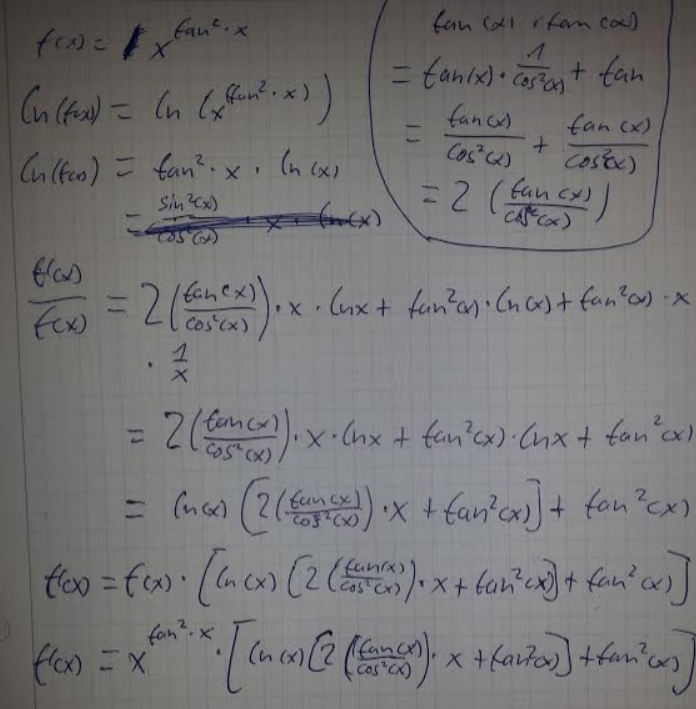
 
anybody know whats wrong with this derivative ? it doesnt match with the solution i got from class

0a028139a396c9092625b8977d6e7590.png
 
from f(x) = x^(x * tan^2 x), I get that:

f'(x) = x^(x * tan^2 x) (tan^2 x + lnx(2 * x * tanx * sec^2 x + tan^2 x))

Which wolfram alpha agrees with and matches your solution, assuming the missing x in the exponent is a mistake. Do you happen to have the solution presented in class.
 
Could use help from anyone with knowledge of signal process/sampling.

I'm going over sampling continuous signals and learning about the nyquist rate/frequency, and how you need to sample at/more than 2 times the highest frequency in your input.

1. I'm seeing somewhat conflicting info on if its <= 2f or just < f. This is really annoying and clarification would be great.

2. I'm in matlab playing around with the sampling rate and want to see what happens when I'm near/below the nyquist rate. For some reason I'm completely missing something as this doesn't make sense.

Say I have a signal that is sin(4*pi*t). It's frequency is 2hz, meaning the nyquist rate is 2hz and then nyquist frequency is 4hz, so the nyquist sampling period is 1/4 seconds or less correct? So then this is saying I could sample the function at 1*1/4, 2*1/4, ect and reconstruct the original signal? But doing so just gives me zeros, which obviously wont give me anything important. I feel like this is really simple to grasp but I'm making some dumb assumption/error. Any help/explanation would be great.
 
I need help with this question: Consider two vectors vector A = 1.00 cm i hat - 1.00 cm j and vector B = -1.00 cm i hat - 4.00 cm j.

What is the direction of vector A(hat) + vector B(hat)?

I found A+B which is, well with the help of the internet, 0cm i - 5cm j
To find the direction, I would have to arctan(-5/0) which the answer would be undefined, but for some reason I got it wrong on webassign. Should it be capitalized?

Edit: Now I tried capitalizing the term, and its still wrong.
 
I need help with this question: Consider two vectors vector A = 1.00 cm i hat - 1.00 cm j and vector B = -1.00 cm i hat - 4.00 cm j.

What is the direction of vector A(hat) + vector B(hat)?

I found A+B which is, well with the help of the internet, 0cm i - 5cm j
To find the direction, I would have to arctan(-5/0) which the answer would be undefined, but for some reason I got it wrong on webassign. Should it be capitalized?

Edit: Now I tried capitalizing the term, and its still wrong.

270 degrees/ -90 degrees direction at 5cm magnitude. I think.
 
Could use help from anyone with knowledge of signal process/sampling.

I'm going over sampling continuous signals and learning about the nyquist rate/frequency, and how you need to sample at/more than 2 times the highest frequency in your input.

1. I'm seeing somewhat conflicting info on if its <= 2f or just < f. This is really annoying and clarification would be great.

2. I'm in matlab playing around with the sampling rate and want to see what happens when I'm near/below the nyquist rate. For some reason I'm completely missing something as this doesn't make sense.

Say I have a signal that is sin(4*pi*t). It's frequency is 2hz, meaning the nyquist rate is 2hz and then nyquist frequency is 4hz, so the nyquist sampling period is 1/4 seconds or less correct? So then this is saying I could sample the function at 1*1/4, 2*1/4, ect and reconstruct the original signal? But doing so just gives me zeros, which obviously wont give me anything important. I feel like this is really simple to grasp but I'm making some dumb assumption/error. Any help/explanation would be great.

For perfect reconstruction, the signal has to be bandlimited to frequencies in the range [-B, B], where B < f_s / 2 (the Nyquist limit). In your example, B = 2 Hz but you are setting f_s = 4, giving a Nyquist frequency of 2 Hz. Thus B is not below the Nyquist limit and you are seeing aliasing.
 
For perfect reconstruction, the signal has to be bandlimited to frequencies in the range [-B, B], where B < f_s / 2 (the Nyquist limit). In your example, B = 2 Hz but you are setting f_s = 4, giving a Nyquist frequency of 2 Hz. Thus B is not below the Nyquist limit and you are seeing aliasing.
So I guess this is part of the problem. In texts I'm seeing that the nyquist frequency is the highest frequency in the input and that double that or greater will result in an ideal reconstruction while other places are strictly saying greater than 2 times and not equal.

So just to be clear, the inputs highest(and only) frequency is 4pi rad/s or 2hz which is the nyquist frequency. If I sample at double that rate and not greater than double, 4hz, I won't be able to reconstruct is what you're saying. I have a matlab program I'm using for this and even at 5hz or 1/5 seconds period sampling I'm not getting a good reconstructed signal. I have to go to 7-8hz for it to look similar to the input.
 
So I guess this is part of the problem. In texts I'm seeing that the nyquist frequency is the highest frequency in the input and that double that or greater will result in an ideal reconstruction while other places are strictly saying greater than 2 times and not equal.

So just to be clear, the inputs highest(and only) frequency is 4pi rad/s or 2hz which is the nyquist frequency. If I sample at double that rate and not greater than double, 4hz, I won't be able to reconstruct is what you're saying. I have a matlab program I'm using for this and even at 5hz or 1/5 seconds period sampling I'm not getting a good reconstructed signal. I have to go to 7-8hz for it to look similar to the input.
Your example proves that it has to be strictly greater than 2 times, since your 2 Hz signal aliases perfectly to a constant 0 signal.

As for your second point, if you sample at 5 Hz and look at the sampled waveform directly, it may not look much like the original signal. However, the piecewise linear connect-the-sample-points signal (corresponding to what you see when you plot in MATLAB) is not bandlimited below Nyquist. What the sampling theorem says is that the original signal is the only signal bandlimited below Nyquist matching your sampled values. Another way you can think of this: you could take a pen and draw any arbitrary signal that happens to go through your sampled points. Then the signal you drew cannot be bandlimited below Nyquist, unless you exactly retraced the original signal.

To reconstruct the original signal (assuming it is properly band limited) from samples, you can use sinc interpolation or other methods of bandlimited interpolation.
 
I need help: An air-traffic controller observes two aircraft on his radar screen. The first is at altitude 800 m, horizontal distance 19.4 km, and 24.0° south of west. The second aircraft is at altitude 1200 m, horizontal distance 17.8 km, and 37.0° west of south.

a) Write the displacement vector FROM the first plane TO the second plane, letting i represent east, j north, and k up.
b) How far apart are the two planes?

a) (19.4cos(24)i + 19.4sin(24) + .8k) - (17.8cos(37) + 17.8sin(37) + 1.2k) = 3.5i - 2.82j - .4k
b) sqrt((3.5)^2 + (-2.82)^2 + (-.4)^2) = 4.51 km

The answers I got are wrong. If this calculation is incorrect, what's the correct calculation to get the right answers?
 
I need help: An air-traffic controller observes two aircraft on his radar screen. The first is at altitude 800 m, horizontal distance 19.4 km, and 24.0° south of west. The second aircraft is at altitude 1200 m, horizontal distance 17.8 km, and 37.0° west of south.

a) Write the displacement vector FROM the first plane TO the second plane, letting i represent east, j north, and k up.
b) How far apart are the two planes?

a) (19.4cos(24)i + 19.4sin(24) + .8k) - (17.8cos(37) + 17.8sin(37) + 1.2k) = 3.5i - 2.82j - .4k
b) sqrt((3.5)^2 + (-2.82)^2 + (-.4)^2) = 4.51 km

The answers I got are wrong. If this calculation is incorrect, what's the correct calculation to get the right answers?

There are two things going wrong here. First, if you want the displacement from the first plane to the second, you want (position of second plane) - (position of first plane).

Also, your angles aren't quite right. 24 degrees south of west would be 180 (=west) + 24. 37 degrees west of south would be 270 (=south) - 37.

I think if you fix those, that should give you part a, and the way you are calculating b looks correct once you get the right values to plug in.
 
There are two things going wrong here. First, if you want the displacement from the first plane to the second, you want (position of second plane) - (position of first plane).

Also, your angles aren't quite right. 24 degrees south of west would be 180 (=west) + 24. 37 degrees west of south would be 270 (=south) - 37.

I think if you fix those, that should give you part a, and the way you are calculating b looks correct once you get the right values to plug in.

How come your adding 24 degrees with 180 and subtracting 270 degrees with 37?

Edit: Thank you so much. Got the right answers.
 
i gots a PDEs midterm coming up and I don't know shizzles

so fucked

dunno how to solve bessels equation, don't know how to solve basic heat equation, hold me math gaf
 
anyone here knows how to actually solve this?
3EhCTXD.png

Assuming j is the imaginary unit, multiply by the conjugate, i.e. multiply the first fraction by (1+2j)/(1+2j) and the second fraction by (2-3j)/(2-3j). This will give you real denominators, and the rest is just simplifying.
 
Need help with graphing inequalities. I don't generally struggle with algebra, but here I am.

first: Solve the inequality and graph the solution set.
25x^2 + 60x > &#8722;36
I got down to (5x+6)^2 where x = -6/5. If there is only one solution, the interval notation is (-infinity, -6/5) U (-6/5, infin), correct?

Second:Solve the inequality and graph the solution set.
x^2 &#8722; 2 &#8805; 0

I forgot the rule here :\ Do I X^2=2 then Square?

solve the compound inequality with absolute value. Express the solution set in interval notation.
0 < |2x &#8722; 1| < 3

I graphed it properly, but my interval notation is incorrect. I get -1<x<2 and 1/2<x<1/2 how do I write this down? (-1, 2)U(1/2, 1/2)?
 
Need help with graphing inequalities. I don't generally struggle with algebra, but here I am.

first: Solve the inequality and graph the solution set.
25x^2 + 60x > &#8722;36
I got down to (5x+6)^2 where x = -6/5. If there is only one solution, the interval notation is (-infinity, -6/5) U (-6/5, infin), correct?

Second:Solve the inequality and graph the solution set.
x^2 &#8722; 2 &#8805; 0

I forgot the rule here :\ Do I X^2=2 then Square?

solve the compound inequality with absolute value. Express the solution set in interval notation.
0 < |2x &#8722; 1| < 3

I graphed it properly, but my interval notation is incorrect. I get -1<x<2 and 1/2<x<1/2 how do I write this down? (-1, 2)U(1/2, 1/2)?

1) Correct

2) Yeah just square root.

3) Don't include the 1/2 because |2*(1/2) - 1| = 0 which is equal to 0, but 0 is not included since the symbol is < instead of <=.
 
Need help with a triple integration problem. I don't need help actually integrating this thing, I just need help with setting the actual integral up. Specifically, I dont know how to determine what the bounds are.

We basically have a 3D donut. The problem says we can model the donut as a torus centered at the origin (0,0,0) with outer radius R=4 and inner radius r=2. The points (x,y,z) inside the torus are described by the following condition:


Here, c is the radius from the origin to the center of the torus tube (so I *think* it's 3), and a is the radius of the donut tube (so I think it should be 1?), the cross section of the donut tube is a circle.

I need to calculate the volume of the donute. I realize that I need to integrate it with the outer radius first and then separately for the inner radius. I can just subtract the two volumes after that. But what are the actual bounds for the integration?

The problem then asks me to calculate the volume if I cut the donut parallel to the x-axis at y=-2. I assume I just need to integrate the function again, but only with respect to y? And then probably subtract that from the total volume right?
 
Need help with a triple integration problem. I don't need help actually integrating this thing, I just need help with setting the actual integral up. Specifically, I dont know how to determine what the bounds are.

We basically have a 3D donut. The problem says we can model the donut as a torus centered at the origin (0,0,0) with outer radius R=4 and inner radius r=2. The points (x,y,z) inside the torus are described by the following condition:


Here, c is the radius from the origin to the center of the torus tube (so I *think* it's 3), and a is the radius of the donut tube (so I think it should be 1?), the cross section of the donut tube is a circle.

I need to calculate the volume of the donute. I realize that I need to integrate it with the outer radius first and then separately for the inner radius. I can just subtract the two volumes after that. But what are the actual bounds for the integration?

The problem then asks me to calculate the volume if I cut the donut parallel to the x-axis at y=-2. I assume I just need to integrate the function again, but only with respect to y? And then probably subtract that from the total volume right?

I would personally change the coordinate to cylindrical. It's much easier because then r integral goes from 2 to 4, the theta integral goes from 0 to 2*pi and the z integral goes from 0 to 1, and the function being integrated is obtained from the one you posted.

Edit: Sorry, my mistake. Just pure cylindrical 3d integral with the limits based on the equation you gave. theta from 0 to 2*pi, z from -sqrt(a^2 - (r-c)^2) to sqrt(a^2 - (r-c)^2), and r from 2 to 4.
 
I would personally change the coordinate to cylindrical. It's much easier because then r integral goes from 2 to 4, the theta integral goes from 0 to 2*pi and the z integral goes from 0 to 1, and the function being integrated is obtained from the one you posted.

Edit: Sorry, my mistake. Just pure cylindrical 3d integral with the limits based on the equation you gave. theta from 0 to 2*pi, z from -sqrt(a^2 - (r-c)^2) to sqrt(a^2 - (r-c)^2), and r from 2 to 4.

So if I understood you correctly:

AJOOJeW.png


?

Edit: Didnt see your most recent edit. So basically we set r=sqrt(x^2 + y^2) and then we solved for z. Cylindrical coordinates makes wayy more sense to solve this problem. I think this is correct so I thank you. Is there a similar way (using this transformation) to solve the second part of the problem where it asks to find the volume after you cut it parallel to the x-axis at y=-2?

Edit (again): Would you also agree about the values of r and c?
 
Does anyone know the best online resources to find a good tutor? Don't really like the ones who are at my college so I was hoping to find one who could come over and spend more time 1 on 1. Wasn't sure which sites are well-regarded and so on.

Anyone know the general hourly rate I should expect to pay? Only in Cal 2 and Engineering Physics 1.
 
I need help with this problem: A position-time graph for a particle moving along the x axis is shown in the figure. The divisions along the horizontal axis represent 3.0 s and the divisions along the vertical axis represent 2.0 m.

GHn86eI.gif


(a) Find the average velocity in the time interval t = 9.0 s to t = 24 s.

I can't tell whether I should count the x axis by 2's, the graph doesn't give me much help.
 
I can't tell whether I should count the x axis by 2's, the graph doesn't give me much help.

I need help with this problem: A position-time graph for a particle moving along the x axis is shown in the figure. The divisions along the horizontal axis represent 3.0 s and the divisions along the vertical axis represent 2.0 m.

Its stated in the question, unless I misinterpreted what you are asking.

Each x-axis tick is 3.0s and y-axis tick is 2.0m.

x-axis
9s/(3s/tick) = 3 ticks
24s/(3s/tick) = 8 ticks

y-axis
@9s (3 ticks over) you intercept the curve at 8 ticks upwards. (8 ticks)(2m/tick) = 16m
@24s (8 ticks over) you intercept the curve at 2 ticks upwards. (2 ticks)(2m/tick) = 4m

Solution: (a) Vavg
= (Xf-Xi) / (tf-ti) = (16-4)/(24-9) =
 
So if I understood you correctly:

AJOOJeW.png


?

Edit: Didnt see your most recent edit. So basically we set r=sqrt(x^2 + y^2) and then we solved for z. Cylindrical coordinates makes wayy more sense to solve this problem. I think this is correct so I thank you. Is there a similar way (using this transformation) to solve the second part of the problem where it asks to find the volume after you cut it parallel to the x-axis at y=-2?

Edit (again): Would you also agree about the values of r and c?

Almost. A cylindrical Jacobian has an extra r in it.

For part 2, there has to be two parts to the integral. First part is r from 2 to 4, and theta from 0 to pi. Second part is r from 2 to -2/sin(theta) and theta from pi to 2*pi.
 
Its stated in the question, unless I misinterpreted what you are asking.

Each x-axis tick is 3.0s and y-axis tick is 2.0m.

x-axis
9s/(3s/tick) = 3 ticks
24s/(3s/tick) = 8 ticks

y-axis
@9s (3 ticks over) you intercept the curve at 8 ticks upwards. (8 ticks)(2m/tick) = 16m
@24s (8 ticks over) you intercept the curve at 2 ticks upwards. (2 ticks)(2m/tick) = 4m

Solution: (a) Vavg
= (Xf-Xi) / (tf-ti) = (16-4)/(24-9) =

Okay thanks, either I'm dumb or it's clever.

How do I find the instantaneous velocity at t = 12 s?
I've found a similar example like this one but doesn't make sense to me.
 
Okay thanks, either I'm dumb or it's clever.

How do I find the instantaneous velocity at t = 12 s?
I've found a similar example like this one but doesn't make sense to me.

By definition, the velocity represents how fast the position of an object changes.


Before, you were considering the average velocity between 9 sec and 24 sec (how fast the position changes on average between these two times).

You found the number by looking at the graph of the position function and calculating the slope of the secant line that passes through the points (9 sec, 16 m) and (24 sec, 4 m).


Now, you are considering the instantaneous velocity at 12 sec (how fast the position changes on this particular time). Geometrically, this is the slope of the tangent line that passes through the point (12 sec, 12 m).

Notice that the problem already drew you a green line, which is the tangent line. Use what you see from the graph to determine the slope of the tangent line.
 
By definition, the velocity represents how fast the position of an object changes.


Before, you were considering the average velocity between 9 sec and 24 sec (how fast the position changes on average between these two times).

You found the number by looking at the graph of the position function and calculating the slope of the secant line that passes through the points (9 sec, 16 m) and (24 sec, 4 m).


Now, you are considering the instantaneous velocity at 12 sec (how fast the position changes on this particular time). Geometrically, this is the slope of the tangent line that passes through the point (12 sec, 12 m).

Notice that the problem already drew you a green line, which is the tangent line. Use what you see from the graph to determine the slope of the tangent line.

Okay, thanks for your and TUSR's help. I got the answers right.
 
Hope people don't mind me asking here, but I'm really quite desperate on this problem and I really would appreciate some help to acquire the marginal densities (once I have that I can do it fine, but in this particular example I don't understand how to get them):
wUZIRrG.png


I don't quite understand how we can use properties to acquire the marginal density function. Typically, to get the marginal density function of a random variable X, we have to integrate/sum over all possible values of the random variable Y. In this case, that becomes nightmarish, and from the hint I know it's not necessary. This is what we get if we, foolhardidly, integrate it over y:

fouLSJS.png


If we multiply it out we can represent it as exp(any) of these:
6FY12HI.png


Also, a related question, for the marginal distribution, in an instance such as this, do we need to integrate over all possible values of theta as well, or is it just integrating over the random variables?

Anyway, thanks for any help as I've been working on it for quite awhile with no progress to speak of and I have no idea how to connect the hint to the problem.
 
Hope people don't mind me asking here, but I'm really quite desperate on this problem and I really would appreciate some help to acquire the marginal densities (once I have that I can do it fine, but in this particular example I don't understand how to get them):
[/img]http://i.imgur.com/wUZIRrG.png[/img]

I don't quite understand how we can use properties to acquire the marginal density function. Typically, to get the marginal density function of a random variable X, we have to integrate/sum over all possible values of the random variable Y. In this case, that becomes nightmarish, and from the hint I know it's not necessary. This is what we get if we, foolhardidly, integrate it over y:

[/img]http://i.imgur.com/fouLSJS.png[/img]

If we multiply it out we can represent it as exp(any) of these:
[/img]http://i.imgur.com/6FY12HI.png[/img]

Also, a related question, for the marginal distribution, in an instance such as this, do we need to integrate over all possible values of theta as well, or is it just integrating over the random variables?

Anyway, thanks for any help as I've been working on it for quite awhile with no progress to speak of and I have no idea how to connect the hint to the problem.

You need to evaluate the integration at y=0 and y=+inf. Theta is the parameter, so just leave it in.

BTW, is using wolframalpha so common for homeworks now? (Just curious, not judging).
 
You need to calculate the limit at y=0 and y=+inf. Theta is the parameter, so just leave it in.

BTW, is using wolframalpha so common for homeworks now? (Just curious, not judging).

Why is that so if you don't mind me asking? If you're integrating it you integrate it over those values because they're all possible values of y to find the the probability of X=x, but I don't really see the connection between the joint probability density function at (X=x, y=0) and as (X=x, Y going to infinity), and the marginal density of X, nor the connection it has to the properties (the density function and expected value 1/lamba) of the exponential distribution.

As for WolframAlpha, while I can't speak for others, it's pretty common for people in my applied maths and statistics modules (I'm a pure maths major so that's really just my single statistics and applied maths modules) to both confirm you've the correct result after difficult integrals or expansions using it, and to use it as a means of communication rather than literally typing out an aspect of the problem in words and to share the (more understandable) image. It's really not much use in general for homework problems as you don't get marks for the final answer, questions are rarely answerable using it (e.g. finding whether some graphs are Hamiltonian or if they're in the same equivalence class) and, furthermore, any student who's reliant on it is pretty much crippled and doesn't survive the exams. In this instance, it's just easier to use it to show what the integral you would get (and you're not meant to do that anyway) would look like rather than type it all out.
 
Why is that so if you don't mind me asking? If you're integrating it you integrate it over those values because they're all possible values of y to find the the probability of X=x, but I don't really see the connection between the joint probability density function at (X=x, y=0) and as (X=x, Y going to infinity), and the marginal density of X, nor the connection it has to the properties (the density function and expected value 1/lamba) of the exponential distribution.

You need to evaluate the integration at y=0 and y=+inf, not the pdf at y=0, y=+inf, you are evaluate the cumulative distribution function of y.
 
Status
Not open for further replies.
Top Bottom