• Hey Guest. Check out your NeoGAF Wrapped 2025 results here!

The Official Religion Thread

Status
Not open for further replies.
JGS said:
We can take the same approach with God. If God is timeless, no beginning or end, then we shouldn't really sweat about who created God. It's not like we can appeal to them for salvation from the one who created us.
Oh boy, salvation from what exactly?

I think people would still want to know who created God, I'm pretty sure I'm not the only one that would be curious about that.
 
DeusTrinitas said:
No, you're not getting it. I'm not question-begging at all. The point is that I believe the Bible is inerrant and infallible. Thus, there's no way I could ever give a satisfactory answer to someone who charges that the Bible is wrong because my answer will always be the same: "No, it isn't."
since it was directed at you, feel free to handle the Herod/Quirinius issue.
 
Dabookerman said:
fossil-hominid-skulls.jpg


There really is no missing link now. What you could call it is adding more links to the chain, or further re-enforcing it.

I mean I'm certainly not gonna try to debate about it, because there really is no point. You and Deus believe in what you believe that no matter what is presented, you will never change your mind.

No straight line. This is evolution by segments.

How could you not know I was going to say this? :lol

BTW, I'm not arguing evolution. You asked why, so I gave a common answer, not necessarily one I agree with (At least completely). Anyone who has read Deus and my comments know we don't see things the same way. Plus he's a lot nicer than me.

Personally, I have no problem thinking that minor differences over time between species happening. Those minor differences add up, so I would be arguing for arguings sake to voice personal doubts about particular aspects of where humans evolved from within the same family.

My only real contention is with the idea that evolution of one species begets an entirely new species, which I think lack proof and the next thing to abiogenesis. Neither of which needs to happen with a creator in the mix.
 
Shanadeus said:
Oh boy, salvation from what exactly?

I think people would still want to know who created God, I'm pretty sure I'm not the only one that would be curious about that.
Salvation from the God you don't like. EDIT- By saying you, I'm not saying YOU per se although it may apply.

I'm sure people who don't trust the Bible on the matter would want to know, there's just no point to it except for curiosity. Further, you will never find the answer just like you'll never know about the multiverses' existence.
 
Pandaman said:
I'd be interested to hear of an explanation of how a dead king coexisted with a human appointed by the romans who were quite good with records. i imagine it involves moving at 88 miles per hour.

It's out there. I'm not Sherlock Holmes in the investigation dept. which is why I dont' have time to do it again. My point in bringing it out was to mention thatI have no problems with it, not to convince you.

If I remember, the sources I loked to was the Google Books, Wikipedia, and a good old fashioned Yahoo Search. It took me about 2 hours to find four sources which was part of the challenge. If I didn't have a life and the guy I was challenged by wasn't also a jerk about it, I could have found more.
 
JGS said:
Salvation from the God you don't like.

I'm sure people who don't trust the Bible on the matter would want to know, there's just no point to it except for curiosity. Further, you will never find the answer just like you'll never know about the multiverses' existence.

Why would I require salvation?
My soul, if it exists, is my own. It is not his to punish or covet.

Curiosity is the point of everything, it's the one trait that we with confidence can say describe us.

And saying that we'll never further our understanding of this universe and creating means to certify the existence of other universes speaks of a lot of doubt in the capabilities and ingenuity of the human mind.
 
JGS said:
My only real contention is with the idea that evolution of one species begets an entirely new species, which I think lack proof and the next thing to abiogenesis. Neither of which needs to happen with a creator in the mix.
since im lazy, ill just quote myself over at shoryuken:

Ensatina eschscholtzii are a group of pacific coast salamanders whose range stretches from southern British Columbia down around both sides of the California rift valley to a stop just beyond the southern edge of the valley. Ensatina is a mountain salamander which prefers a cool wet high altitude enviroment, they are not native to the valley floor itself, although one species is suspected to have crossed the valley at one point.

Starting in Canada and extending down to the top of the valley we find E e. oregonensis, the most common and diverse breed of ensatina and the parent species from which the others diverge. there really isn't much to say about oregonensis, it only gets interesting when you begin to examine the salamanders as they diverge across the east and west sides of the rift valley. on the west side, we find E e. Picta and on the east, E e. Platensis, both of which can breed in the wild with oregonensis. Further down the east side of the slope we eventually find Picta populations giving away to another species E. e. xanthopica and later E e. eschscholtzii.

On the east side, we find Platenis populations giving way to E. e croceater and eventually, E. e klauberi. The interesting thing about these various salamanders is that they can all breed with their relatives directly north of them. ie: eschscholtzii can breed with xanthopica, which can breed with picta which can breed with oregonensis. likewise: klauberi can breed with croceater, which can breed with platensis which can also breed with oregonesis. so we have a ring of species that can breed together up to a common starting point, but here's the thing: the southernmost east salamanders cannot breed with the southernmost west salamanders wherever their territories overlap. Xanthopica cannot breed with platensis and eschscholtzii can breed with neither croceater or klauberi.

they're quiet a powerful example of the effects of genetic drift when breeding populations are isolated and natural selection begins to take its course.

many cichlid populations exhibit unique alleles and in a few cases, whole new genes have sprung up. there is and was no ur-cichlid species that had an unfathomably deep gene pool which the modern day fishes divided up. Besides, seeing how cichlids adapted, radiated time and time again as new lakes opened up, shouldn't there be a noticeable difference between genetic variability of the first cichlids and the most recent? [after all, Malawi fish sprung from a parent population of haplochromine cichlids from Tangyanika roughly 700,000 years ago. they speciated and eventually a few of them snuck over to lake Victoria some ~14,000 years ago. shouldn't the Tangyanika cichlids then share traits in common with Victoria cichlids if Victoria cichlids are solely the product of normal gene variability within haplochromine cichlids? they certainly dont.]
- Dr. peter & rosemary Grant's work on Darwin's finches, documenting changes in beak sizes and gene frequencies according to selective pressures on the island. the example i was given was a drought in 1977 wherein the ground finch g. Fortis evolved a larger, sturdier beak which allowed it to access caltrop seeds as an additional food source. [the finches had not been observed eating these seeds in the 4 preceding years the grants were studying them]. there are details on changes in the finches morphology and genotypes documented on the birdd website.
http://www.bioquest.org/birdd/molecular.php
-fun fact! my current biology professor actually worked with the Grants!
a species is defined as a breeding population that shares a genotype. why? because that's the only way it could work and make sense. species are, quiet obviously, not genetically uniform and many of their adaptions are the result of selective pressures and consequences of various environments, but, as long as their is a modest amount of gene flow between these variants, they'll keep from drifting away from each other. As such, the only way for a population to speciate is for their to be either be sympatrically within a population with few genetic intermediates [like with bdelloid rotifers] or allotropically [like with... pretty much every other speciation event].

as you should guess, allotropic speciation is the most common, but also requires a little bit of extra time for genetic drift to work its magic. a really good example of allotropic speciation in action would be the Desmognathus ochopaeus salamander [salamanders, yay!], in Dr. Stephen Tilley's 1990 paper he examined the extent of sexual isolationism within the species scoring the fraction of matings between heterotypic and homotypic pairings measured by an index range of 0 to 2. [with 0 = no discrimination between partners and 2 being no interbreeding what so ever]

the results indicated a degree of sexual isolation that varied relative to the distance between two paired populations that was later correlated with genetic distances. basically, the distance between individuals of d. ochopaeus was acting as a barrier to gene flow allowing genetic drift to slowly begin to fragment the species into distinct populations. on the scale of things, they would be an example situated between dogs and the ensatina ring species example. a species that has clearly begun to separate into multiple populations.

if i were to list the examples given in the recent posts documenting the extent of speciation in progress, it would probably look like this:

species undergoing selective pressures and evolving:
g.fortis + P.reticulata

multiple phenotypes connected via gene flow:
c.auratis/c.a.cafer + canis familiaris

species undergoing genetic drift:
d.ochrophaeus

ongoing speciation:
e.ensatina

groups that have speciated in the recent past:
chiclids + sticklebacks

and all these varied examples of different stages of speciation are coming from two people whose fields aren't even directly related to the concept! it's hard to believe the evidence for speciation is lacking when this is just the stuff we've managed to find in our spare time.

its alittle disjointed, but its easier then rewriting everything given that i have yet to sleep.

It's out there. I'm not Sherlock Holmes in the investigation dept. which is why I dont' have time to do it again. My point in bringing it out was to mention thatI have no problems with it, not to convince you.

If I remember, the sources I loked to was the Google Books, Wikipedia, and a good old fashioned Yahoo Search. It took me about 2 hours to find four sources which was part of the challenge. If I didn't have a life and the guy I was challenged by wasn't also a jerk about it, I could have found more.
I hope you're not surprised that i don't take this claim on faith. 'oh there's an argument out there, it clears everything up. don't know where it is but boy does it solve the problem!' seems convenient that whatever argument you may have seen will go unchallenged and accepted uncritically.
 
Pandaman said:
I'd be interested to hear of an explanation of how a dead king coexisted with a human appointed by the romans who were quite good with records. i imagine it involves moving at 88 miles per hour.

I can't help but be amused when people in this thread bring up supposed "discrepancies" that supposedly prove the Bible to be false, as though they are bringing something new to the table that no one has thought of previously. The question over Jesus being born during Herod's reign and the census by Quirinius has been around for a long, long time (since at least the 16th century and probably much earlier) and has been plausibly answered (whether to your satisfaction or not, I do not know).

Do most of you on GAF who are atheists simply go to infidels.org or other predictable hangouts and look for arguments to support your atheism, believing that what you'll find on these popular websites are unobjectionable arguments?

I guess it's easy to pretend that discrepancies in the Bible have been proven when you are either unaware of or purposely ignore CONTINUED SCHOLARLY DEBATE REGARDING THEM.
 
DeusTrinitas said:
I can't help but be amused when people in this thread bring up supposed "discrepancies" that supposedly prove the Bible to be false, as though they are bringing something new to the table that no one has thought of previously. The question over Jesus being born during Herod's reign and the census by Quirinius has been around for a long, long time (since at least the 16th century and probably much earlier) and has been plausibly answered (whether to your satisfaction or not, I do not know).

Do most of you on GAF who are atheists simply go to infidels.org or other predictable hangouts and look for arguments to support your atheism, believing that what you'll find on these popular websites are unobjectionable arguments?

I guess it's easy to pretend that discrepancies in the Bible have been proven when you are either unaware of or purposely ignore CONTINUED SCHOLARLY DEBATE REGARDING THEM.
dude, you're a literalist. if there was a just god you'd catch fire for even uttering the words 'scholarly debate' as if it ever supported your position. :lol

By the way, you didn't actually answer the problem. alluding to 'plausible answers' isn't in itself an answer. I positively love how easily unhinged you are though.
 
DeusTrinitas said:
I guess it's easy to pretend that discrepancies in the Bible have been proven when you are either unaware of or purposely ignore CONTINUED SCHOLARLY DEBATE REGARDING THEM.

Is it a coincidence that "scholarly" debate continues to exist when, as you have yourself stated, no matter what evidence is brought to the table, when someone claims the Bible is wrong, others will respond: "no it isn't."
 
Dabookerman said:
What do people look for when they ask for evidence about Humans being evolved from Primates?

I mean I don't know anyone personally who doesn't believe Evolution to be fact. The last time I had was back in Secondary School.. when i was about 13, and this kid's basic knowledge of evolution was what he knew from Pokemon.

I also think that when you reach a certain age, whatever you believe, it is probably unlikely that you will change your mind no matter how solid the evidence. People have already said that if there was utter proof that God didn't exist, and that proof was shown to them, they would still believe in God. That's just an example, but you get my meaning.
I think people need to embrace evolution as a fact.
People who don't believe in evolution either have no idea how it works and just say its false and there is no evidence supporting it or they are just crazy religious people who aren't going to believe i evolution no matter how much evidence is available because their book said a different story.
 
Mumei said:
Well, I was actually looking for something in the Old Testament that had God explaining why he commanded the Israelites to sacrifice animals when I was asking for the chapter / verse thing. I know that God commands the sacrifice of animals in the Old Testament, and so I was looking for the section so I could get some context on that.

I appreciate you answering the other half of my question, but I'm still interested in this part.

I also should add that my initial reaction to what you did post was skepticism - it seems to me that Christ's sacrifice resembles the sacrifices or intended sacrifices that other fathers had made of their children in the Bible (Abraham or Jephthah) more than it did the practice of animal sacrifice. It seems to fit in line with those better, at least thematically - God asks Abraham to sacrifice Isaac, God saves Isaac at the last instant. Jephthah says he'll sacrifice the first thing to come out of his house to greet him as a burnt offering if God leads him to victory; God leads him to victory and his daughter is the first to greet him, so he fulfills his promise to God. God sacrificing his son seems to fit that better.

I mean, I get the argument being made that those sacrifices weren't efficacious for the washing away of sin, but I hadn't gotten the impression from what little I've read (the beginning of Leviticus) on animal sacrifice in the Old Testament that it was supposed to serve the same purpose as Jesus' sacrifice.

Right, you'll find the relevant OT passages on animal sacrifice in Exodus and Leviticus. And Christian scholars do believe that the Abrahamic attempted sacrifice of Isaac was very much Christological typology. When you look at OT animal sacrifices, though, and the emphasis upon the spilling of blood, you see that the idea of sins being absolved is present (see the relevant passages concerning the "scapegoat," for example). And from the New Testament we learn that that those sacrifices foreshadowed the perfect sacrifice of Christ, which was the only sacrifice that could truly absolve the sins of man. In other words, the animal sacrifices in the Old Testament looked toward Christ's sacrifice, though the Israelites did not understand this fully at the time.
 
Pandaman said:
dude, you're a literalist. if there was a just god you'd catch fire for even uttering the words 'scholarly debate' as if it ever supported your position. :lol

By the way, you didn't actually answer the problem. alluding to 'plausible answers' isn't in itself an answer. I positively love how easily unhinged you are though.

I'm not unhinged at all. But at the risk of going ad hominem here, I'm a Ph.D. student in Systematic Theology, so I'd say that strictly from the standpoint of probability, I'd know a heck of a lot more about scholarly debate over the Bible than you. So, before you go spouting off about "scholarly debate" supporting positions as if you have remotely any idea what you're talking about, you might want to do your research.

As for the answer to the Quirinius problem, I'd be glad to direct you to some introductory scholarly articles in dictionaries and peer-reviewed journal articles that address the issue if you are so inclined.
 
thelooseteeth said:
Is it a coincidence that "scholarly" debate continues to exist when, as you have yourself stated, no matter what evidence is brought to the table, when someone claims the Bible is wrong, others will respond: "no it isn't."

How is that coincidental exactly? There's no sense in pretending that any person, whether religious or not, can ever approach the Bible without some presuppositions already in place.
 
DeusTrinitas said:
I'm not unhinged at all. But at the risk of going ad hominem here, I'm a Ph.D. student in Systematic Theology, so I'd say that strictly from the standpoint of probability, I'd know a heck of a lot more about scholarly debate over the Bible than you. So, before you spouting off about "scholarly debate" supporting positions as if you have remotely any idea what you're talking about, you might want to do your research.

As for the answer to the Quirinius problem, I'd be glad to direct you to some introductory scholarly articles in dictionaries and peer-reviewed journal articles that address the issue if you are so inclined.

Theology... ah brother to astrology and alchemy.
 
DeusTrinitas said:
I'm not unhinged at all. But at the risk of going ad hominem here, I'm a Ph.D. student in Systematic Theology, so I'd say that strictly from the standpoint of probability, I'd know a heck of a lot more about scholarly debate over the Bible than you. So, before you go spouting off about "scholarly debate" supporting positions as if you have remotely any idea what you're talking about, you might want to do your research.

In that case, I would love to see you scholarly debate and establish the foundations and development of the bible instead of continuing to spout off that it must be true because it's the word of God. I'd say up to this point I've done much more on that face than you, working on a Ph.D., have even attempted. Speaking of which, I've yet to see you respond to the elaboration I provided that you requested of one of my comments earlier in the thread.

As for the answer to the Quirinius problem, I'd be glad to direct you to some introductory scholarly articles in dictionaries and peer-reviewed journal articles that address the issue if you are so inclined.

Please, do so. It'd be a large improvement from your current stance.
 
Peronthious said:
In that case, I would love to see you scholarly debate and establish the foundations and development of the bible instead of continuing to spout off that it must be true because it's the word of God. I'd say up to this point I've done much more on that face than you, working on a Ph.D., have even attempted.

Please, do so. It'd be a large improvement from your current stance.

So, you're presupposing that because I believe the Bible is the Word of God and is inerrant that such a belief negatively affects my capacity for evaluating scholarly debate?

There are plenty of books on the foundations and development of the Bible, written by scholars whose focus is on such, that I could recommend to you if you like.
 
I don't think anyone can prove the existence of God, nor can anyone disprove his existence. That's why they call it faith, it requires you to believe in something that is beyond your capacity to understand.

I don't know if it will help anyone, but I am currently working through the Bible-in-a-year plan, and blogging about it - you can check it out here:

http://brandonsbibleadventure.blogspot.com
 
DeusTrinitas said:
How is that coincidental exactly? There's no sense in pretending that any person, whether religious or not, can ever approach the Bible without some presuppositions already in place.

My point is, as long as the Bible is considered infallible, there will always be scholarly debate between those who are on the infallible side, and those who bring up points of contention with that view.

It seemed to me that you are referring to the existence of a controversy as evidence, as opposed to actual evidence.
 
Zaptruder said:
Theology... ah brother to astrology and alchemy.

An uninformed and clearly erroneous comment. A GAF staple, no doubt.

You apparently know little of the history of academia and theology's place in it. No doubt a Middle Ages education consisting of the Trivium, Quadrivium, and theology would have served you well.
 
thelooseteeth said:
My point is, as long as the Bible is considered infallible, there will always be scholarly debate between those who are on the infallible side, and those who bring up points of contention with that view.

It seemed to me that you are referring to the existence of a controversy as evidence, as opposed to actual evidence.

Referring to the existence of debate is not evidence. Referring to the existence of debate shows that the issue is far from settled. But you are assuming that those who are on the infallible side hold exclusive claim to solutions for difficult problems regarding supposed biblical discrepancies. That simply isn't true. There have been and will continue to be scholars with no vested interest in infallibility at all who will agree with and argue possible solutions to the problems.
 
DeusTrinitas said:
So, you're presupposing that because I believe the Bible is the Word of God and is inerrant that such a belief negatively affects my capacity for evaluating scholarly debate?

I never said that. I said that thus far I have not seen you establish a scholarly debate on the bible. All I have seen you do is sit on the side and shut down everything by stating that the Bible is the infallible word of God. If I missed a post or two I apologize, but this is what I've seen.

There are plenty of books on the foundations and development of the Bible, written by scholars whose focus is on such, that I could recommend to you if you like.

You must not have seen my comment on your proposed answer to the Quirinius problem. I'll repeat it here.

Please do so.
 
DeusTrinitas said:
I'm not unhinged at all.
ofcourse not. clearly you've been nothing but the picture of patient resolve.
But at the risk of going ad hominem here, I'm a Ph.D. student in Systematic Theology, so I'd say that strictly from the standpoint of probability, I'd know a heck of a lot more about scholarly debate over the Bible than you.
:lol systematic theology? :lol thats a dozy. in anycase, you've done nothing to demonstrate any of that knowledge so i don't much care what you claim to be.
So, before you go spouting off about "scholarly debate" supporting positions as if you have remotely any idea what you're talking about, you might want to do your research.
yes, certainly not unhinged at all.
As for the answer to the Quirinius problem, I'd be glad to direct you to some introductory scholarly articles in dictionaries and peer-reviewed journal articles that address the issue if you are so inclined.
why do you continue to delay? I did not ask because i enjoy typing.
 
Shanadeus said:
Why would I require salvation?
My soul, if it exists, is my own. It is not his to punish or covet.

Curiosity is the point of everything, it's the one trait that we with confidence can say describe us.

And saying that we'll never further our understanding of this universe and creating means to certify the existence of other universes speaks of a lot of doubt in the capabilities and ingenuity of the human mind.
You're reading too much into it.I was saying that there is no reason to discover who created God because if if we didn't like it, the "God" that may have created him isn't going to do anything about it anyway. If God is a figment of one's imagination, then one can simply accept that he has no beginning and no end as part of that imagination.

If someone can say we have no real choice because we have a finite amount of choices, I'm not sure why it would be odd to think of something as timeless anyway.

I never said for a second we wouldn't further our understanding of the universe, so not quite sure where you got that one unless you're saying discovering multiverses is a requirement for further knowledge, which would be a big stretch for such an unlikely goal.

Further I agree that curiosity starts everything, but not every curious action results in anything which will be the outcome of tryng to discover another multiverse when we will never realistically leave the galaxy [alive]. Avatar explained space travel the best, but that's another discussion.

Also understand I never said I had profound trust in human ability to begin with. Sure we've got the smarts and nosiness down pat to accomplish a lot of stuff, but when it comes to things that matter most, we tend to suck- religious or not. So I will always maintain doubts about mankind's ability to take care of himself if as they press on for the relentless pursuit of multiverses.
 
Peronthious said:
I never said that. I said that thus far I have not seen you establish a scholarly debate on the bible. All I have seen you do is sit on the side and shut down everything by stating that the Bible is the infallible word of God. If I missed a post or two I apologize, but this is what I've seen.

Well, I apologize if it has seemed like I've been trying to shut things down. Not at all. I was just making my presuppositions known so that it would be known that, even if a majority of liberal scholars agree that something in the Bible is in error, I will disagree and assert that there is some missing historical information that we do not have that would reconcile such a problem.

Peronthious said:
You must not have seen my comment on your proposed answer to the Quirinius problem. I'll repeat it here.

Please do so.

Sure. Give me some time and I'll provide some sources. As for your question regarding the development and reliability of the Bible, a good place to start would be last week's debate between Bart Ehrman and Craig Evans: http://apologetics315.blogspot.com/2010/04/craig-evans-vs-bart-ehrman-debate-does.html
 
Pandaman said:
:lol systematic theology? :lol thats a dozy. in anycase, you've done nothing to demonstrate any of that knowledge so i don't much care what you claim to be.

1. You're clearly incorrigible.
2. If you've read through this entire thread and have concluded that I've "done nothing to demonstrate any of that knowledge," then is there really anything I can say that you'll find satisfactory?
3. Your incredulity towards Systematic Theology as an academic discipline belies your ignorance regarding it.
 
Pandaman said:
since im lazy, ill just quote myself over at shoryuken:


-fun fact! my current biology professor actually worked with the Grants!


its alittle disjointed, but its easier then rewriting everything given that i have yet to sleep.


I hope you're not surprised that i don't take this claim on faith. 'oh there's an argument out there, it clears everything up. don't know where it is but boy does it solve the problem!' seems convenient that whatever argument you may have seen will go unchallenged and accepted uncritically.

You didn't have to bother with even this.

Basically, salamandar became a new improved salamandar, cichlid became new cichlid, finch became new & improved finch- something I distinctly said I didn't have a problem with, certainly not one worth arguing over.

Now if one could only show me the salamandar turning into a new & improved fish, then we would be in business.
 
JGS said:
This happens in real life.

However, an atheist's head would explode if they saw the value of religion. It even hinders a lot of them from seeing that we agree on most things they do.

This is an interesting exercise though so when I have time, I'll bring up all kinds of things to compliment and atheist on.

Keep in mind that whether a religion has some kind of "value" is a completely separate question from whether or not religious claims are actually true (in any normal sense of the word).

This is actually where a lot of discussions break down. Nonbeliever tends to approach things from the "is there any evidence this stuff actually happened?" standpoint. Believers initially do as well, since they think evidence is a good thing as well in 99% of their lives. No one likes to be thought of as "irrational", after all. But eventually, the inevitable holes/contradictions/fantasy/magic stuff generally associated with major religions starts to pop up. At this point, the arguments on the religious side either get even worse (I mean, maybe those kids deserved to be mauled by bears, duh), or the mental bail out kicks in and says "Yeah, but I have faith. And aren't people happier with religion anyway? Why do you hate other people's happiness?", trying to subtly paint the nonbeliever as some sort of emotionless logic pushing robot.

It's quite clever, actually.
 
DeusTrinitas said:
...even if a majority of liberal scholars agree that something in the Bible is in error, I will disagree and assert that there is some missing historical information that we do not have that would reconcile such a problem.

So basically, evidence has no effect on your world view. If evidence does not coincide with your beliefs, it is dismissed. Do you not see this as a problem? How is this a useful approach to understanding the world around us? Doesn't this approach make you unsuitable for participation in a debate?
 
JGS said:
You didn't have to bother with even this.

Basically, salamandar became a new improved salamandar, cichlid became new cichlid, finch became new & improved finch- something I distinctly said I didn't have a problem with, certainly not one worth arguing over.

Now if one could only show me the salamandar turning into a new & improved fish, then we would be in business.

Uhm, are you purposefully asking for something that can never be provided, in hopes that it validates your skepticism?

The Salamander quote is a perfect example of 'speciation' - It is obvious they are all related, but on one opposite ends of the spectrum, the salamanders cannot breed with each other - which is usually the arbitrary line the seperates species.

Let me ask you, would you be okay with the claim that Humans and Chimpanzees are of a different species? Even though, when all is said and done, we look pretty much the same?
 
JGS said:
You didn't have to bother with even this.

Basically, salamandar became a new improved salamandar, cichlid became new cichlid, finch became new & improved finch- something I distinctly said I didn't have a problem with, certainly not one worth arguing over.

Now if one could only show me the salamandar turning into a new & improved fish, then we would be in business.
http://www.youtube.com/watch?v=QhKDjI49KfA#

also a friend did this write up on reddit about an experience he had in the Mormon MTC (missionary training center). Sadly I wish I could say it was surprising. But it's a good depiction of why many leave. Not all Mormons are like this but definitely some are. It was really good and I didn't know if this was the place to post it. But I figured hey, you guys can ignore it if you want

This is one of my true MTC experiences, and looking back, was when I learned what "keeping and feeling the spirit" was really all about. .

I was in the MTC during the start of the Gulf War in early 1991. Before the war, the MTC had an open-door policy for families and relatives hand-delivering gifts to missionaries in the MTC. But then the church decided to use the start of the war as a pretext to set a ban on accepting any hand-delivered care packages from families to MTC missionaries.

I was an Assistant to the President (AP) in an MTC Branch at the time the new rule took affect.

(As a side note, I learned later that someone started a business just down the street from the MTC, that would take family care packages and for a fee, "deliver" them to the MTC. For security reasons, said the MTC rule, the MTC would only accept packages from couriers but not from family members.)

There had been a long tradition for years that every Easter Sunday, a certain member family that lived directly behind the MTC, would make tons of cinnamon rolls and hand them over the fence to missionaries. My MTC Branch roomed in one of the buildings at the back of the MTC, closest to this member family's yard, which shared a fence with the MTC.

My Branch President pulled me in the Sunday before Easter Sunday and told me that under no circumstances should anyone accept cinnamon rolls from the family. He told me that the tradition violated the new rule against hand-delivered packages and he would hold me PERSONALLY accountable if anyone in the Branch broke the rule and got a cinnamon roll. He called on me to get up in Sacrament Meeting and talk on obedience and warn everyone not to take a cinnamon roll "lest we lose the spirit."

The Branch President also insisted that I remind each missionary individually about the rule and admonish them not to go near the MTC fence on Easter Sunday. At the time, I was a TBM and took the whole thing to heart, obeying the Branch President's every word in order to "keep the spirit."

Easter Sunday came and went and I thought we had made it through the day without incident. Looking out my window, the family stood at the fence with plates of cinnamon roles and nobody dared go near them.

Three days later, the First Counselor in the Branch Presidency pulled me out of my language class for a "Personal Priesthood Interview." He escorted me to the Presidency's office, where the other counselor and the President were waiting. They were all furious. Apparently one of the missionaries in our Branch was caught eating a cinnamon roll in his room the afternoon of Easter Sunday. He got caught because someone else had snitched on him in the mandatory weekly letter confessional to the Branch President.

The hard thing was, the presidency was furious with me, not the missionary who had eaten the cinnamon roll. They ripped me up one side and down the other - for not being a true leader, disappointing my family and losing their trust. I felt like a piece of sh*t, seriously. They quoted scriptures on obedience, priesthood authority and losing the spirit.

Worst of all, I felt like I had committed a terrible sin. I had repented for some things before my mission, but the guilt I felt for this incident was almost unbearable - worse than the guilt I had felt for other more serious "transgressions" prior to my mission. This guilt over the cinnamon rolls was the most horrible, incredible guilt I have ever felt in my life! I really feared that I had lost "the spirit" for good.

At the time, my only defense was that I didn't understand how accepting a cinnamon roll from a member family violated Christ's spirit of love. But the First Counselor cut me off, saying in a raised voice, "Elder, I don't think you can even feel the spirit anymore!"

They immediately released me as AP and gave the calling to my companion - a fate I felt was close to death. As part of my repentance, they had me write a one-page paper on why I had failed as a mission leader, which was given to my Mission President when I entered the mission field. In my written confessional-of-sorts I wrote that I had disobeyed one of the Lord's Commandments and therefore, had lost his spirit and "amen to my authority as a leader."

That was the low point of my mission, for once I left the MTC I felt like I had "the spirit" again. I went on to prove my obedience and priesthood worthiness in the mission field, baptizing in all of my areas and serving in several leadership positions.

It wasn't until after my mission, going through my papers that I stumbled across that confessional paper I had written in the MTC. I was so angry reading it again, realizing for the first time that they had manipulated my faith and desire to be righteous. All that guilty torment self-loathing over a cinnamon roll that I didn't even eat...

And then it hit me, the whole Mormon thing was a guilt trip! They could make me feel guilty for anything they wanted. Those pangs of guilt weren't coming from God, they were coming from my religious conditioning. I had let church leaders program my conscience!

If my faith in the Mormon gospel meant the leaders could make me feel guilty about cinnamon rolls, then it meant they could make me feel guilty for anything. They used my faith to pull at my guilt strings, and they were doing the same thing with things like tithing too! The whole evil control process of the church unraveled for me.

That day I decided I would never let anyone play the guilt trip game on me again. I would decide for myself, based on true ethics (not external obedience or "keeping the spirit"), what of my own behaviors were wrong or right. I would never again turn that guilt control over to someone else - especially an institution as manipulative as the church.

It would take several more years before I would eventually leave the church, but that decision helped me through all the other guilt headgames my family tried to play on me for "falling away." I hadn't fallen away, I had freed myself from their guilt control.

I see petty rules come from the prophet against earrings, tattoos and beards and wonder how many people out there are suffering the "cinnamon roll guilt-trip" as my wife now humorously calls it.

 
JGS said:
You didn't have to bother with even this.

Basically, salamandar became a new improved salamandar, cichlid became new cichlid, finch became new & improved finch- something I distinctly said I didn't have a problem with, certainly not one worth arguing over.

Now if one could only show me the salamandar turning into a new & improved fish, then we would be in business.
Im confused then, what you are describing would not be evolution. Evolution does not work on the principle of hopeful monsters.

but if you're interested in a fish-amphibian:
http://en.wikipedia.org/wiki/Tiktaalik

1. You're clearly incorrigible.
2. If you've read through this entire thread and have concluded that I've "done nothing to demonstrate any of that knowledge," then is there really anything I can say that you'll find satisfactory?
3. Your incredulity towards Systematic Theology as an academic discipline belies your ignorance regarding it.
1. thank you.
2. sure, you can start by tossing the biblical literalism part. you're patching the swiss cheese of literature, most sane[dont even bother pointing out a no-true scotsman] scholars accepted the bible as an evolving document centuries ago. You can also stop commenting on topics to wit you have no education should you wish to lord over your pending degree in this particular instance.
3. Belie
Verb
* S: (v) contradict, belie, negate (be in contradiction with)
* S: (v) misrepresent, belie (represent falsely) "This statement misrepresents my intentions"
4. i notice you've completely neglected the topic at hand in favour of discussing me, personally. is this a common tactic taught in systematic theology?
 
JGS said:
You didn't have to bother with even this.

Basically, salamandar became a new improved salamandar, cichlid became new cichlid, finch became new & improved finch- something I distinctly said I didn't have a problem with, certainly not one worth arguing over.

Now if one could only show me the salamandar turning into a new & improved fish, then we would be in business.

And with time and more changes, the new "improved" salamander might resemble a salamander just as much as we resemble this fellow:
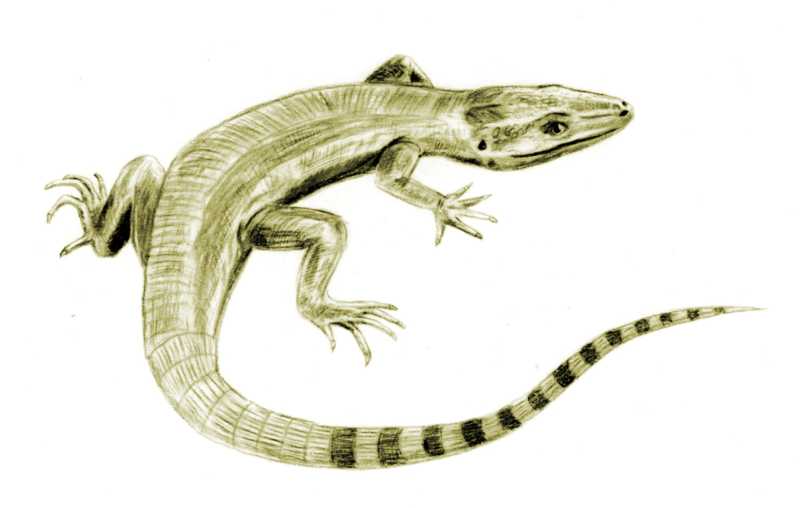
Archaeothyris_BW.jpg

The Archaeothyri, the oldest member of the synapsids

Synapsids ('fused arch'), also known as theropsids ('beast face'), are a class of animals that includes mammals and everything closer to mammals than to other living amniotes.[1] The non-mammalian members are described as mammal-like reptiles in classical systematics,[2][3] but are referred to as "stem-mammals" or "proto-mammals" under cladistic terminology.

Really, this information isn't that hard to find if you want to learn.

EDIT: The bolded is nonsense.
Why don't you show me a triangle that is a circle?
 
Pandaman said:
1. thank you.
2. sure, you can start by tossing the biblical literalism part. you're patching the swiss cheese of literature, most sane scholars accepted the bible as an evolving document centuries ago. You can also stop commenting on topics to wit you have no education should you wish to lord over your pending degree in this particular instance.
3. Belie
Verb
* S: (v) contradict, belie, negate (be in contradiction with)
* S: (v) misrepresent, belie (represent falsely) "This statement misrepresents my intentions"
4. i notice you've completely neglected the topic at hand in favour of discussing me, personally. is this a common tactic taught in systematic theology?

1. Um, you're welcome.
2. "Most sane scholars"? Such a sweeping statement without a shred of evidence.
3. Typo. Should have "betray."
Transitive Verb
a : to reveal unintentionally <betray one's true feelings> b : show, indicate c : to disclose in violation of confidence <betray a secret>
4. I haven't neglected the topic at hand. I agreed that I would provide some sources regarding the development of the Bible and the Quirinius problem.
 
Kinitari said:
Uhm, are you purposefully asking for something that can never be provided, in hopes that it validates your skepticism?

The Salamander quote is a perfect example of 'speciation' - It is obvious they are all related, but on one opposite ends of the spectrum, the salamanders cannot breed with each other - which is usually the arbitrary line the seperates species.

Let me ask you, would you be okay with the claim that Humans and Chimpanzees are of a different species? Even though, when all is said and done, we look pretty much the same?

Why would I want proof of something proven?

Atheist do it all the time when they ask for proof of God, I'm not quite seeing the difference. Besides interspecies evolution should be proveable since it has to fall in lines with all manner of scietific rules and regulations. Heck, it's even been peer reviewed to death, thus inerrant.

I disagree that chimps and humans look anything alike, but again it's not something worth arguing over. They have similar features, but that's not a big enough deal to wrap an evolutionary "fact" around that I can get behind. Further, there is a big enough difference between them that for a creator believer like myself, I would see it as pointless to have us evolve from them.

If there is a particular biological functions/parts that gets the job done and works for all members of a particular species/class/order/etc.., then why would God need to uniquely create it for each different species?
 
Shanadeus said:
And with time and more changes, the new "improved" salamander might resemble a salamander just as much as we resemble this fellow:
Archaeothyris_BW.jpg

The Archaeothyri, the oldest member of the synapsids


Really, this information isn't that hard to find if you want to learn.

EDIT: The bolded is nonsense.
Why don't you show me a triangle that is a circle?

I can't. That's the point:lol

That sure is a nice drawing btw
 
Pandaman said:
Im confused then, what you are describing would not be evolution. Evolution does not work on the principle of hopeful monsters.

but if you're interested in a fish-amphibian:
http://en.wikipedia.org/wiki/Tiktaalik

Wow, a flippant response sure is being taken seriously.

Let's be clear, I was joking over something that is impossible to do.

But it's good to know that evolution agrees with me.
 
DeusTrinitas said:
1. Um, you're welcome.
2. "Most sane scholars"? Such a sweeping statement without a shred of evidence.
3. Typo. Should have "betray."
Transitive Verb
a : to reveal unintentionally <betray one's true feelings> b : show, indicate c : to disclose in violation of confidence <betray a secret>
4. I haven't neglected the topic at hand. I agreed that I would provide some sources regarding the development of the Bible and the Quirinius problem.
1. thank you, its not a true synonym for hardheadedness, but rather the particular type held in the face of reprisal.
2. yep, i can make them too. its easy. soon we can devolve further and discuss if it is rabbit session or duck session.
3. Curious, why would i have pointed it out if i did not have the impression you were not complimenting me? you then feel the need to match my correction with a needless definition, presumably so that you would not feel to have 'lost' an exchange. Cute.
4. Excellent, Don't let me keep you.
 
JGS said:
Wow, a flippant response sure is being taken seriously.

Let's be clear, I was joking over something that is impossible to do.

But it's good to know that evolution agrees with me.
well, I presume you must not have a problem with speciation then.
 
JGS said:
Why would I want proof of something proven?

Atheist do it all the time when they ask for proof of God, I'm not quite seeing the difference. Besides interspecies evolution should be proveable since it has to fall in lines with all manner of scietific rules and regulations. Heck, it's even been peer reviewed to death, thus inerrant.

I disagree that chimps and humans look anything alike, but again it's not something worth arguing over. They have similar features, but that's not a big enough deal to wrap an evolutionary "fact" around that I can get behind. Further, there is a big enough difference between them that for a creator believer like myself, I would see it as pointless to have us evolve from them.

If there is a particular biological functions/parts that gets the job done and works for all members of a particular species/class/order/etc.., then why would God need to uniquely create it for each different species?

First let's ignore any possible ulterior motivations, and just stick to our current understanding of evolution.

I need to preface this by asking you a question, can you be more specific about what is required for your version of 'speciation'? I ask because it sounds like you don't understand the Theory of Evolution.

1. For a Salamander to change from a Amphibian to a Fish would be like having the top most branches in a tree all of a sudden curve downwards and merge with a branch somewhere in the middle. It is entirely possible that an Amphibian could develop fish-like qualities to better survive in whatever aquatic environment it resides in, but for it to become a 'fish' is asking for the impossible, or at least damn near impossible.

2. Secondly, the methodology in which we seperate species is entirely superficial, created only so we have an easier way to categorize animals - there are no invisible walls seperating one species from another, when an animal differs enough that scientists feel it is now a 'different species', it is then classified as a different species - and EVEN then, the classification is many times debated.

3. Could you explain the bold? I don't understand what you are trying to say.
 
Pandaman said:
1. thank you, its not a true synonym for hardheadedness, but rather the particular type held in the face of reprisal.
2. yep, i can make them too. its easy. soon we can devolve further and discuss if it is rabbit session or duck session.
3. Curious, why would i have pointed it out if i did not have the impression you were not complimenting me? you then feel the need to match my correction with a needless definition, presumably so that you would not feel to have 'lost' an exchange. Cute.
4. Excellent, Don't let me keep you.

1. Yes, I'm aware of the definitions of words before I use them.
2. When you're ready to discuss how believing in the inerrancy and infallibility of the Bible makes a scholar insane, I'm ready to hear it. Until then, I'll simply suffer your silly inferences.
3. I wasn't aware that so much inference could be attached to a simple correction. You seem to be an expert at presuming things that aren't the case. Cuter.
4. Patience, young padawan.

And with that, I'm done trading pointless exchanges with you. When you're ready to make a comprensive argument against the Bible based on incontrovertible evidence, I'm ready to hear it.
 
Pandaman said:
well, I presume you must not have a problem with speciation then.
Well, there would have to come a point in time where I disagree with it.

Believing in creation would mean that at some point there comes a time that God does not use evolution to further his creative works. He doesn't need to.

However, for the piddly stuff, why waste time arguing about that when science does a pretty good job of showing that, in minor ways at least, it happens.
 
DeusTrinitas said:
1. Yes, I'm aware of the definitions of words before I use them.
2. When you're ready to discuss how believing in the inerrancy and infallibility of the Bible makes a scholar insane, I'm ready to hear it. Until then, I'll simply suffer your silly inferences.
3. I wasn't aware that so much inference could be attached to a simple correction. You seem to be an expert at presuming things that aren't the case. Cuter.
4. Patience, young padawan.

And with that, I'm done trading pointless exchanges with you. When you're ready to make a comprensive argument against the Bible based on incontrovertible evidence, I'm ready to hear it.
:lol You're too easy.

Get to the counterpoint of the very first question i posed to you and then you may worry about the future.
 
DeusTrinitas said:
2. When you're ready to discuss how believing in the inerrancy and infallibility of the Bible makes a scholar insane, I'm ready to hear it. Until then, I'll simply suffer your silly inferences.
Really? You don't see it?

Let me put it this way.

It's like I went to my employer and said, "Hey you know I'm a really good worker, in fact I'm the best worker you'll ever have. But I'll admit that there are times when it'll look like I'm not doing anything. But that's just my enemies trying to make me look bad." If I could get them to actually believe this then it totally exonerates me from any responsibility. I could be the best worker in the world or I could be the worst. It doesn't matter, the boss has already decided I'm the best no matter what.

I don't see how any rational person would consider this anything other than a positive feedback loop. Something happens to reinstate your faith and your faith grows. Something happens that would make you question your faith and your faith grows.

Certainly you wouldn't accept it if your wife came to you and said, "Hun, now there are times when it's going to look like I'm cheating on you. But I'm not." And your response would be, "Well it really looks like she's screwing that guy over there. But she told me it would only look that way." Why then would you do that with the book that's most important to your life. You'll never progress except for the path you put yourself on your a tree with no branches, and those don't grow.

You can believe what you want but a positive feedback loop is not belief. It's delusion.
 
JGS said:
Well, there would have to come a point in time where I disagree with it.

Believing in creation would mean that at some point there comes a time that God does not use evolution to further his creative works. He doesn't need to.

However, for the piddly stuff, why waste time arguing about that when science does a pretty good job of showing that, in minor ways at least, it happens.
it sounds like you believe there must be a flaw in the scientific account solely because you believe god must have been involved somewhere in someway contrary to the scientific account. Why couldn't god have been hands off in the creation of life? I see no reason why a god could not have kicked the bang and watched. Why earth? why even life?

if you came across someone who believed god created the universe for black holes and had nothing to do with life, how would you resolve that difference?
 
JGS said:
You didn't have to bother with even this.

Basically, salamandar became a new improved salamandar, cichlid became new cichlid, finch became new & improved finch- something I distinctly said I didn't have a problem with, certainly not one worth arguing over.

Now if one could only show me the salamandar turning into a new & improved fish, then we would be in business.
Why, in your view, are biological processes bounded by the structure of human language (in specific, the process of naming)?

In other words, why can't finches turn into something with a different name? Is there some causal relationship between what we choose to call things and the processes driving natural selection that prevents finches from turning into non-finches? Can you explain those relationships to us?

Because as I see it we humans have historically created names for things based on limited knowledge: we call a finch a finch and differentiate it from sparrows and jays because of obvious, macroscopic, directly viewable differences between them. I see no reason to arbitrarily decide those names- chosen centuries ago using available limited, macroscopic knowledge- should be a guide to what is biologically possible. I also cannot understand why we should dismiss new knowledge- such as better understanding of body structure, the operation of ecology and catalogues of the creatures occupying them, fossil records, DNA and other genetic data, and so forth- on the basis of the restrictions of an old name.

What if we came to an understanding that when scientists say finches descended from dinosaurs (a view that has become mainstream in the scientific community over the past decade or so), they could also say that finches ARE dinosaurs? Would the reconsideration of old names using new data, in the "finches are dinosaurs" manner, solve your problem? If not, why not?
 
Kinitari said:
First let's ignore any possible ulterior motivations, and just stick to our current understanding of evolution.

I need to preface this by asking you a question, can you be more specific about what is required for your version of 'speciation'? I ask because it sounds like you don't understand the Theory of Evolution.

1. For a Salamander to change from a Amphibian to a Fish would be like having the top most branches in a tree all of a sudden curve downwards and merge with a branch somewhere in the middle. It is entirely possible that an Amphibian could develop fish-like qualities to better survive in whatever aquatic environment it resides in, but for it to become a 'fish' is asking for the impossible, or at least damn near impossible.

2. Secondly, the methodology in which we seperate species is entirely superficial, created only so we have an easier way to categorize animals - there are no invisible walls seperating one species from another, when an animal differs enough that scientists feel it is now a 'different species', it is then classified as a different species - and EVEN then, the classification is many times debated.

3. Could you explain the bold? I don't understand what you are trying to say.

I don't have a version of speciation. I usually wait to be told the various views regarding evolutionary developement. At that time I decide whether to beieve it or not. As with all of my discussions, if it's proven I accept it. If not, I don't although there are varying degrees of what "proof" is on this board.

Now to the bullets:

1. Agreed

2. I have no problems with that either except I would say the seperations are distinct but don't have to do much with man's classification of them.

3. I'm saying that any similarities between chimps and humans can be explain by creation as much as by evolutionary process.
 
ronito said:
Really? You don't see it?

Let me put it this way.

It's like I went to my employer and said, "Hey you know I'm a really good worker, in fact I'm the best worker you'll ever have. But I'll admit that there are times when it'll look like I'm not doing anything. But that's just my enemies trying to make me look bad." If I could get them to actually believe this then it totally exonerates me from any responsibility. I could be the best worker in the world or I could be the worst. It doesn't matter, the boss has already decided I'm the best no matter what.

I don't see how any rational person would consider this anything other than a positive feedback loop. Something happens to reinstate your faith and your faith grows. Something happens that would make you question your faith and your faith grows.

Certainly you wouldn't accept it if your wife came to you and said, "Hun, now there are times when it's going to look like I'm cheating on you. But I'm not." And your response would be, "Well it really looks like she's screwing that guy over there. But she told me it would only look that way." Why then would you do that with the book that's most important to your life. You'll never progress except for the path you put yourself on your a tree with no branches, and those don't grow.

You can believe what you want but a positive feedback loop is not belief. It's delusion.

I'm sorry, but how does your example apply to the Bible specifically? Whom do the employer and worker represent? I'm not being facetious, but I want to make sure that I'm understanding exactly what you are trying to portray through your example.
 
Pandaman said:
:lol You're too easy.

Get to the counterpoint of the very first question i posed to you and then you may worry about the future.

I'm not aware of the argumentative prowess of the laughing smiley. Given your proclivity for using them, though, you apparaently believe they amount to substantive argumentation. Perhaps I should look into that.

As to the counterpoint, again, patience.
 
Status
Not open for further replies.
Top Bottom