
Shanadeus said:Buddha was a fine atheist, he's the atheist role model.
Yep yep. Too bad people feel like injecting stuff into his philosophy...

Shanadeus said:Buddha was a fine atheist, he's the atheist role model.
thelooseteeth said:Not sure. I see this sort of thing from my family all the time. I wondered ever since I was young, if God has a plan from which nothing can deviate, why pray? I'm talking about for all the trivial nonsense I've had to endure throughout my life, such as for safety on a plane flight, or like above, good weather, etc.
Something goes right: Thank the Lord.
Something goes wrong: The Lord works in mysterious ways.
Fucking perfect.

So believe me, I know boring hum drum rhetoric when I hear it. I left religion because of it. Non-Bible reading atheists have boring hum drum rhetoric in spades.jdogmoney said:But...but you're religious...
Mumei said:Damnit, I hate when I do that.
ronito used to be Mormon. Many - maybe even most - of the atheists in this topic used to be Christian and have at least some level of familiarity with the Bible.
And if the flaws being mentioned are weak ones, why haven't they been addressed sufficiently? I'm not really interested in a theological debate over Scripture - I'm more interested in hearing a justification for why someone believes in scriptural inerrancy when the Scriptures are inconsistent with one another.
Certainly not. The core statements of faith for a very large number of Christians worldwide- the Creeds - are not contained in the Bible and make minimal mention of scripture. The Apostle's Creed and the Athanasian Creed do not mention scripture at all. The Nicene Creed merely assents that certain parts of Christ's life occurred "according to the Scriptures": it says nothing further about the veracity or necessity of scripture to the Christian faith. So to that point, the token of Christian faith has little to nothing to do with the inerrancy of the Bible for wide swaths of Christianity.DeusTrinitas said:Again, as I've said in this thread previously, all arguments concerning the Bible and Christianity all boil down to one basic epistemological question: "How do you know that the Bible is the Word of God?"
JGS said:So believe me, I know boring hum drum rhetoric when I hear it. I left religion because of it. Non-Bible reading atheists have boring hum drum rhetoric in spades.
 " would have ruined the comedic timing, for which I apologize.
Yet what is your proof for this? And who else even argues this? I'm interested in knowing.JGS said:& Wikipedia says just as much. However, from my POV, if there are two schools of thought and one is verified more than the other, then the logical course would be choose the one with the most points going for it.
This isn't, at least to me, an argument about free will. This is an argument for the incoherence of Christianity. Humans can have free will. But if god knew what was going to happen, then he cannot condemn because he is partially culpable for having chosen those initial conditions. If he didn't know, then he is mistaken prone. Either way, I am making an argument about god himself.Again, this is a fancy way of saying that man should not have had free will to begin with or that no rules of right or wrong whatsoever could enter into the equation. Basically humans remain perfect on the basis of the standard being so low as to be non-existent. Considering there was only a handful of rules to follow and only one leading to death (Rule the Earth, have kids, and don't eat from the one tree).
There were already tons of animals that could fill the role of lacking rules beyond basic instinct. Man was made in God's image meaning they could make decisions for themselves. The angels had free will but were spirits. Man was a nice bridge between the two.
I do not hold to the idea that free will is lost simply because there are predetermined choices, especially if there are numerous ones out there, although I see where some would say that since the rules are in place, it hinders us. To me, it doesn't take a mental giant to see all of the possible circumstances and develop free will from all the various offshoots and branches that come with each choice made. For example, if Adam held off eating from nthe tree until he had kids, that would have caused a different outcome. If the serpent hadn't seduced Eve at the tree- different outcome. The options go on and on just for the Garden of Eden scenario. In fact, God, being greater than us, is also pretty predictable.
Actually, it's a law that entropy only tends to increase. We know that matter can spontaneously arrange itself into a low entropy state. Now, that doesn't get us to a new universe, but if by conjecture you mean complex mathematical formulas, then sure, it's just "conjecture". But, okay, the point of science is to predict something and then test it. General relativity was "just" a formula until it was proven. There are many good reasons to support these theories, more than the idea that goddidit. You could try to argue that god set a low entropy condition and leave it at that, but again, that runs into massive problems. You still must explain vacuum energy that caused the rapid inflation of the universe. You must explain why the amount of usable energy in our universe is decreasing. You have to explain why it's expanding quicker and quicker. And all these from a design perspective.Things as complex as the entire universe do not appear out of thin air whether we are talking magically or scientifically. The only example we have of this is people saying that it happened- conjecture.
Dang it! I have to go to work.
No, but I can show you a mammal becoming a "fish".JGS said:You didn't have to bother with even this.
Basically, salamandar became a new improved salamandar, cichlid became new cichlid, finch became new & improved finch- something I distinctly said I didn't have a problem with, certainly not one worth arguing over.
Now if one could only show me the salamandar turning into a new & improved fish, then we would be in business.
History never claimed to be perfect and ineffable. The Bible did. If you're so sure that the Bible is perfect, then you've sure failed to actually engage in most of the arguments about these supposed errors, instead making broad claims about faith instead. The point isn't whether there can be an explanation. It's about the best explanation. Look, I used to be a Bible apologist. But eventually I just realized that a bad explanation that keeps my faith alive didn't make it a good faith. An error can be explained away, but it's still an error. The Bible has to be held to a higher standard. If a supposed mistake, especially if it's an outright contradiction, has to be explained away, then god isn't a good communicator. If it is an error, then the Bible is fallible. Either way is a problem.DeusTrinitas said:There are no errors in the Bible. If you believe that the aforementioned standard of accuracy is what it takes to constitute no errors, then the majority of ancient history just got tossed out the window.
jdogmoney said:Also, I was joking at this point. A "
jdogmoney said:It's too broad to be taken seriously?
If you're claiming the Bible doesn't err, ever, at all, then any error, no matter how small, is worthy of discussion.
JGS said:Now we're getting somewhere. There is no reason for a bird to come from a reptile, creatively speaking. It makes for a good movie.
Awww, why?Also, done with evolution although that sure is a fine drawing in your post.
Dani said:You see it, I see it, anyone that understands basic mathematics can see it. It's a factual error. A mistake.
I know what he said.Dani said:He said understand, not appreciate. You thing think religious folks understand more of the natural word than scientists?
I disagree with this. I think everyone should have an understanding of the natural world & it's insulting to think that religious folk do not, and I think that if people observed and appreciated the natural world more, there would not be as much destruction of it- from both common man and brilliant scientists. The world is not exactly a much better place now just because of a scientific discovery.
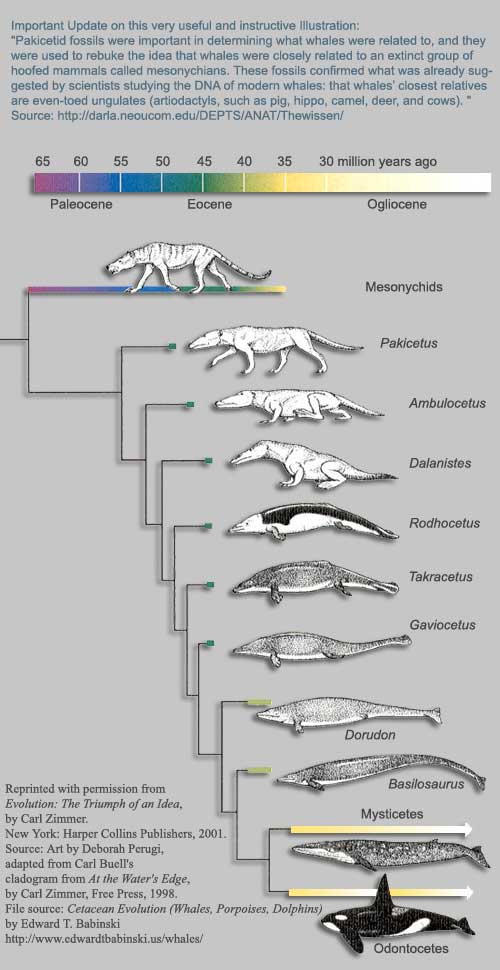
Kinitari said:Mogblue, thanks for that bit of information! I knew that whales were descendants of land mammals, but I wasn't sure of the specifics, very informative.
I have been trying to understand this since yesterday, and I still don't. What do you mean, creatively speaking? And what sort of reason are you looking for? If you are making a joke, I dun get it, I am slow =/.
edit:
Awww, why?
GS said:I know what he said.
Are you saying that ALL scientists have a better understanding of nature than others- religious or not? I would disagree with that sure.
What des it say about the scientist who understand nature better but still finds a way to mess it up?
Surely you're not thinking all scientist are with Greenpeace
I can see why people put so much blind faith in them now if ALL scientists have more understanding and knowledge of nature than us dimwitted blokes.
For your benefit, I'll fix my quote. Notice that I am staying humble by not putting "equal" in there":
What? The world is definitely a better place now because of scientific discovery. And lastly, you are entirely misunderstanding my original point, when it comes to better understanding how the world - and in fact the universe ticks, I will ask a scientist, not a religious scholar and not a regular Joe - simply because what Scientists do is essentially attempt to understand the world better, and the limited understanding we have now is almost entirely thanks to the work of scientists.The world is not exactly a much better place now just because of a scientific discovery.
It's fine I guess - you don't have to talk about anything you don't want to, it's just frustrating. It seems like no matter what anyone says, you just don't like the idea of speciation, and thus, you will not believe it happens. Aw well, if that's how it's always going to be, there is no real point discussing it anyway.JGS said:I've said it numerous times already in other posts, but it's arguing about something I have no interest in arguing about. Isn't that a good enough reason?
Evlar said:Certainly not. The core statements of faith for a very large number of Christians worldwide- the Creeds - are not contained in the Bible and make minimal mention of scripture. The Apostle's Creed and the Athanasian Creed do not mention scripture at all. The Nicene Creed merely assents that certain parts of Christ's life occurred "according to the Scriptures": it says nothing further about the veracity or necessity of scripture to the Christian faith. So to that point, the token of Christian faith has little to nothing to do with the inerrancy of the Bible for wide swaths of Christianity.
While most Christian faith traditions will go on to acknowledge the inspiration of Scripture (and delineate what those inspired scriptures are- the content differs from tradition to tradition), many do not carry that concept of inspiration to inerrancy as understood today. The inerrancy is only when properly interpreted, and some teaching authority must provide guidance on the interpretation (typically the Holy Spirit through the organs of the church, or directly to believers). Therefore the Bible's position as the "Word of God" is predicated on being able to discern which parts are to be taken literally and which parts are meant to be understood in other ways- metaphorically, poetically, and so forth. This is meant to dodge the kinds of obvious criticisms brought up here and in every other thread topic on the Bible (though I can't say how effective a defense it is).
Arching over all of this is the very obvious fact that Christians existed before the New Testament, hundreds of years before the canon was anything like settled. How did they persist? Through shared beliefs of course, beliefs that can and did survive and thrive without a settled collection of words thought to be breathed by the divine down to the tenses and particles.
Kinitari said:It's fine I guess - you don't have to talk about anything you don't want to, it's just frustrating. It seems like no matter what anyone says, you just don't like the idea of speciation, and thus, you will not believe it happens. Aw well, if that's how it's always going to be, there is no real point discussing it anyway.
How can scripture be the highest authority when it depends on someone else ie. the church to say this is scripture, It didn't fall from heaven leather bound gilt edged with a nice table of contents at the startDeusTrinitas said:What you've touched on here is a big debate within Christian circles: whether or not the Bible is God's revelation or only a record of God's revelation. If you believe that the Bible is indeed God's revelation itself, then all of Christianity's claims do boil down to the epistemological question I mentioned because God chose to reveal himself through the Scriptures. Yes, interpretation is necessary and yes, this interpretation comes through the power of the Holy Spirit, but that doesn't change the fact that Christians who believe that the Scriptures are God's revelation are going to appeal to them as their highest authority. That's why the question, "How do you know the Bible is the Word of God?" is the basic question all claims boil down to. Tradition is important yes, as was the teaching of the apostles while they were alive, but now that all apostles are gone, the Scriptures serve as the highest authority.
Kinitari said:I'm sorry, what? Firstly, the natural world != 'nature' in the sense of the word you seem to be using. Secondly, just because someone understands 'nature' better, does mean they are obligated to care for it. Thirdly, how are scientists 'messing up' nature? Fourthly:
Kinitari said:What? The world is definitely a better place now because of scientific discovery.
Kinitari said:And lastly, you are entirely misunderstanding my original point, when it comes to better understanding how the world - and in fact the universe ticks, I will ask a scientist, not a religious scholar and not a regular Joe - simply because what Scientists do is essentially attempt to understand the world better, and the limited understanding we have now is almost entirely thanks to the work of scientists.
JGS said:You've said that a bunch of times and I have no idea why. If this is an all or nothing thing, then I guess you're right, but I've been pretty accommodating on the topic which adds to the point that it's not worth arguing about if no one sees that.
Of course, all of them - because that is what I said isn't it? I specifically said that all Scientists not only know about the natural world better than non-scientists (which is not a hyperbole I have that much issue with to be honest) I ALSO said, that all of them do not care about the natural world, and thus are laying waste to it, even as we speak. I said those exact words.JGS said:So you think that ALL scientists understand the natural world better, but don't have to care about what they know. Understanding does not measn caring. That would certainly explain a lot. They are mutually exclusive. Got it.
Concern for the natural world was not relevant for my point - not in general. Whether or not someone cares for the natural world has no relevance as to whether or not they understand it - I was pretty sure that was clear enough for anyone to understand.If concern for the natural world isn't that relevant then why would I concern myself with scientific thought if the curiosity isn't there? In other words, why worry about what a scientists thinks if it isn't linked to something I care about or something that benefits the natural world? I would be listening to the scientist only to here how it benefits him.
This might be something interesting to talk about. Which is fascinating because we would not even be able to do this, discuss this on the internet, had it not been for the toils of Scientists. Still, elaborate if you want.That is a matter of persective. I disagree. IMO, The world is at best no better than it was except in terms of scientific advancement (Whoopee), & quite frankly I think it's worse off.
I don't know what you mean. Who is saying that Science and Religion 'contradict'? I am simply saying that I would go to a Scientists if I wanted to better understand the natural world, thus weighing their explanations more than I would a non-Scientist. Is this a confusing thing to understand? If it is, maybe it's because of the way I've worded it?If you're talking about the natural world, then I guess you are thinking I'm disagreeing with that? I'm not. I'm the one that says science and religion don't contradict so naturally I'm fine with science.
When did I even kind of imply I was talking about Scientists understanding the world in 'a general sense' - that can be taken to mean a thousand different things. I do not, for example, think that Scientists are better at understanding women - I would not go to a Scientists if I needed help getting laid. I have repeatedly and specifically said "natural world" and even outlined what I mean by saying that, I don't know why you are going off on this little tangent.However, if you are saying scientist know the world better in a general sense, I say scientists have absolutely no understanding of the world. Think about all the godless scientists out there now who have a hard time understanding religious people. That's the world. They are clueless about what makes people tick even if the know when a meteor is going to fly by the earth.
Uhm, Okay - that's a silly comparison (you can be religious and be less knowledgeable about religion than someone who is Atheist, it is hard to be a Scientist and be less knowledgeable about Science than someone who is not one) but I'll let you have it - essentially you are saying that you will ignore any non-religious people when it comes to religion.To break it down:
1. I wouldn't pick any scientist (or non-religious person) to trust on religious matters. So why would I start taking the advice of a bunch of admitted non-religious folk on religious matters? Short answer is I wouldn't.
Who the hell asked you to do this?2. I would not rely on a scientist to tell me how best to care for this natural world they know so much about but often show little regard for it.
Are we talking like String theory here? Or are we talking about something that is not wacky, but something you want to pretend is wacky, like http://en.wikipedia.org/wiki/Speciation3. Further, since there is no scientist that can see/prove/provide evidence of some of the whackier "scientific" theories out there, I'll remain a skeptic on those matters as well.
If only Scientists who made claims had to back them up with evidence! That's where religious people have them beat.4. I do not accept things solely on the basis of a guy wearing a lab coat. I'm not that blind of faith.
JGS said:So you think that ALL scientists understand the natural world better, but don't have to care about what they know. Understanding does not measn caring. That would certainly explain a lot. They are mutually exclusive. Got it.
JGS said:If concern for the natural world isn't that relevant then why would I concern myself with scientific thought if the curiosity isn't there? In other words, why worry about what a scientists thinks if it isn't linked to something I care about or something that benefits the natural world? I would be listening to the scientist only to here how it benefits him.
JGS said:That is a matter of persective. I disagree. IMO, The world is at best no better than it was except in terms of scientific advancement (Whoopee), & quite frankly I think it's worse off.
JGS said:If you're talking about the natural world, then I guess you are thinking I'm disagreeing with that? I'm not. I'm the one that says science and religion don't contradict so naturally I'm fine with science.
JGS said:However, if you are saying scientist know the world better in a general sense, I say scientists have absolutely no understanding of the world. Think about all the godless scientists out there now who have a hard time understanding religious people. That's the world. They are clueless about what makes people tick even if the know when a meteor is going to fly by the earth.
So I have not gone crazy, I was pretty clear with my point, wasn't I?Shanadeus said:It's almost as if you're not even trying to understand what he's saying, maybe he's just pushed your buttons or annoyed you by being insistant - I don't know.
operon said:How can scripture be the highest authority when it depends on someone else ie. the church to say this is scripture, It didn't fall from heaven leather bound gilt edged with a nice table of contents at the start
He's a basic question though that I keep on posing but getting no answer.DeusTrinitas said:What you've touched on here is a big debate within Christian circles: whether or not the Bible is God's revelation or only a record of God's revelation. If you believe that the Bible is indeed God's revelation itself, then all of Christianity's claims do boil down to the epistemological question I mentioned because God chose to reveal himself through the Scriptures. Yes, interpretation is necessary and yes, this interpretation comes through the power of the Holy Spirit, but that doesn't change the fact that Christians who believe that the Scriptures are God's revelation are going to appeal to them as their highest authority. That's why the question, "How do you know the Bible is the Word of God?" is the basic question all claims boil down to. Tradition is important yes, as was the teaching of the apostles while they were alive, but now that all apostles are gone, the Scriptures serve as the highest authority.
ronito said:He's a basic question though that I keep on posing but getting no answer.
We know that god didn't just reach out and write the bible himself (or is that what you're claiming?) but rather used prophets and apostles to do this for him.
Now because the bible itself teaches us that there was no one that was perfect outside of Jesus, then to say that the prophets/apostles did a perfect job would mean they'd have to be perfect as well. Which again, is a Muslim belief, not so much a christian one.

DeusTrinitas said:The Christian response to this is that the writers were divinely inspired by the Holy Spirit to write what they wrote and hence, were preserved from error in writing scriptural documents. However, that's not to say that through the years, transmission errors have not crept into the text, through scribal errors and the like. That's why those of us who believe in inerrancy will say that the Scriptures are inerrant in the original manuscripts.
so what I'm gleaming from this is that the writers then were perfect, since what they wrote was perfect?DeusTrinitas said:The Christian response to this is that the writers were divinely inspired by the Holy Spirit to write what they wrote and hence, were preserved from error in writing scriptural documents. However, that's not to say that through the years, transmission errors have not crept into the text, through scribal errors and the like. That's why those of us who believe in inerrancy will say that the Scriptures are inerrant in the original manuscripts.
Dude Abides said:So they're inerrant only in documents that have been lost and nobody will ever see? That's conveniently non-falsifiable.
ronito said:so what I'm gleaming from this is that the writers then were perfect, since what they wrote was perfect?
DeusTrinitas said:Might I recommend the following book that deals with how the canon of Scripture developed?
http://www.amazon.com/Canon-New-Testament-Development-Significance/dp/0198269544/ref=sr_1_4?ie=UTF8&s=books&qid=1270742283&sr=8-4
Without going into too much detail here, there were distinct criteria by which the church recognized which items were divinely inspired.
Thanks for this.Fourth Storm said:Just popping my head in to recommend that anyone interested in early Christianity/Judaism check out a podcast called "The Bible Geek." I find him incredibly informative, entertaining, and respectful. He basically answers questions from a skeptical POV on anything from theology to Christ Myth Theory. Here's his webpage, which also contains some interesting reviews and articles.
Drastic said:Question for atheists:
Do you believe in the existence of any spiritual powers, forces or entities such as:
karma
voodoo
witchcraft
spirits
ghosts
auras
etc.
?
Drastic said:Question for atheists:
Do you believe in the existence of any spiritual powers, forces or entities such as:
karma
voodoo
witchcraft
spirits
ghosts
auras
I really don't see what you'd have to aim this question at atheists specifically, I don't think they are that different from theists in that question.Drastic said:Question for atheists:
Do you believe in the existence of any spiritual powers, forces or entities such as:
karma
voodoo
witchcraft
spirits
ghosts
auras
etc.
?
DeusTrinitas said:Do some research on how many ancient documents whose original manuscripts we are possession of. There are very few. And you expect differently for the Bible?
There are more ancient copies of the New Testament text than any other ancient document in existence: http://www.carm.org/manuscript-evidence.
But, if the critics want to disregard the New Testament, then they must also disregard other ancient writings by Plato, Aristotle, and Homer.
DeusTrinitas said:Do some research on how many ancient documents whose original manuscripts we are possession of. There are very few. And you expect differently for the Bible?
There are more ancient copies of the New Testament text than any other ancient document in existence: http://www.carm.org/manuscript-evidence.
operon said:I already know all this, but this does not mean that scripture is the sole authority when the church decreed what was canon and what was not
DeusTrinitas said:They were not decreeing it as though it were something new, a la "We're going to decide right here and right now what we want our Scriptures to be." They were affirming what was already the standard agreed upon by a vast majority of the churches in the ancient world.
Dude Abides said:Did I say that I did expect something differently? Of course not (though one would imagine a God who thought his Word was of any importance might have ensured their preservation in their only inerrant form. I guess that's just another of His many blunders.) It's just an obvious dodge to say "They're only perfect in the versions that nobody will ever see."
Dude Abides said:This is irrelevant. Per your assertion, we can't be sure those ancient copies are any more inerrant than the KJV if they aren't actually the originals.
It's also completely stupid and a great example of the unrelenting bad faith of Christian apologetics:
Except, of course, nobody claims Politics or the Iliad are inerrant accounts of mercantilism in the golden age of Athens or the actual Trojan war.
"vast majority of churches" no that was the catholic church, they confirmed the canon as they had the authority,.DeusTrinitas said:They were not decreeing it as though it were something new, a la "We're going to decide right here and right now what we want our Scriptures to be." They were affirming what was already the standard agreed upon by a vast majority of the churches in the ancient world.
No.Drastic said:Question for atheists:
Do you believe in the existence of any spiritual powers, forces or entities such as:
karma
voodoo
witchcraft
spirits
ghosts
auras
etc.
?
Shanadeus said:It's almost as if you're not even trying to understand what he's saying, maybe he's just pushed your buttons or annoyed you by being insistant - I don't know.
But understanding doesn't mean caring at all, without meaning they're mutually exclusive.
Science is a effective and reliable way of understanding the natural world better, much better so than any other method. And I base that simply on that practically all understanding and knowledge of the surrounding world have come from scientific research and progress.
Boy that was a lot of imaginaruy words you placed in my mouth. It's tough to swallow it. In fact it's impossible to swallow so I got no reply to something I didn't say.Shanadeus said:Not being curious about matters regarding the natural world in general is your prerogative, but you might wanna make an effort to learn it even if it's just to help your kids with their homework.
Shanadeus said:Enjoy your average lifespan of 40-50 years with children and mothers dying like flies in labour among other things. The scientific method has lead to tons of knowledge that has directly led to saving and improving lives, along with knowledge that can hurt and destroy lives and nature.
Shanadeus said:But I'd say that all in all, we've used it more for helping lives than destroying.
You yourself are almost guaranteed to have benefited from the scientific progress in one way or another.
Shanadeus said:Unless when science and religion do contradict? Like how man was evolved rather than created?
Shanadeus said:Psychology is a relatively new science, and rather undeveloped in my opinion, but to say that they are clueless about what makes people tick is a rather incorrect statement.
Shanadeus said:And get off your high pedestal, humanity is not the world.
Jesus christ this is a futile discussion.
operon said:Just diving late into this thread and have most definetly missed a good deal, but there seems to be some who want to deal with the Bible as a scientific book as opposed to what it is actually is a religous text. You wouldn't look up a scientific to research about God no more than you would look up the Bible to research about the how the world works, etc. Science deal with the how, Religion deal with the why. Genesis is not meant to be taken as an exact account of how the world was made step by step, but is meant to explain God's role in creation and about man's separation with him, no more and no less.
operon said:"vast majority of churches" no that was the catholic church, they confirmed the canon as they had the authority,.
JGS said:.... stuff
DeusTrinitas said:You're placing a human standard of "perfection" on a divine being. "If God really wanted to..., then of course he would have..."
DeusTrinitas said:I didn't say that the number of manuscripts proves inerrancy. You are making inferences that I am not, so before you go off calling apologetics stupid, it might help if you paid attention to what people are arguing. My point is that if the originals are inerrant, then because of the sheer number of copies of the ancient text, the transmission errors must be minimal. Thus, we can be sure the text of the New Testament we have now is extremely close to the originals, which obviates the need of the originals.