• Hey Guest. Check out your NeoGAF Wrapped 2025 results here!

US college students fail to develop critical thinking, reasoning and writing skills

Status
Not open for further replies.
teruterubozu said:
Yeah but being critical of your employer rarely flies. It's useful in the dorms at 2 AM after a few drinks and trying to woo that chick in your class, but often counterproductive in the real world (unless you love Poli-Gaf or something).

lol wtf
 
Antimatter said:
Yeah, and the thing is absorbing information has limits, the brain needs time to digest it, the information grind becomes destructive. When you think about it is there any effort you guys have heard of to develop a person's brain along with giving them the info and skill for their field? I mean using a scientific approach to development, you know, instead of multiple hour powerpoints.
Yeah, this was my biggest problem... I enjoy learning and I feel like I have a pretty good aptitude for it, but by the fourth year of college I had a hard time approaching even the most enjoyable classes in my major as anything more than another pile of facts to memorize. And 90% of that knowledge disappeared as soon as the test was over.

Now that I've been out of school for two years, I'm finding myself getting interested in tons of stuff that I regret not seeking out while I was there. But I'm positive I wouldn't have given the tiniest crap about it at the time. Maybe I'm just lazy or maybe it's a problem with the system, but nearly every step of the education system made even the most interesting subjects feel like a chore. And I had some great teachers and professors! I can definitely sympathize with the information overload theory.
 
dr3upmushroom said:
That would be the way to go, but I'm already doing a double major in econ/ sociology. (I know that sociology is largely seen as a worthless degree, but I want to go to grad school (which I also know is starting to be seen as less and less worthwhile) for what I'm really interested in, behavioral economics, which combines econ with sociological and psychological studies. Also, I find it interesting).
That also depends on what you want it for and what you want to do afterward. I'm planning on going to grad school after my 4-year but not specifically because I want my Masters, although that's certainly good.
I want to do research work as a grad student with a good robotics department so that when I come out I can show prospective employers "look, I worked on these projects here, I have experience in this field, you want to hire me"
 
This shocks me in the least. I just graduated, and a ridiculous amount of people I met thought they already knew everything there was to know the moment they stepped foot in class. To me, what you put in you get out. If you go to college wanting to learn, you'll learn, be it a community college or whatever.
 
dr3upmushroom said:
Yup, I have definitely seen boys at the age where they should be grown-ass men using the credential of their expensive art degrees enacting what basically amounts to a pseudo-intellectual console ware argument.

Thing is though, pretentious artsy types have always been around. Maybe I'm just believing what I want to believe, but I think if you went back a couple decades you'd see a huge change in attitude and ability in people taking business, econ, and political science classes. Other majors too, I mean that the areas most effected by a drop in critical thinking and reasoning (and writing) are the ones somewhere between the hard sciences and the completely abstract disciplines like Art, Film, Philosophy, etc.

The difference are that 40 years ago, less people were in college, and college major wasn't so closely tied to a job. Just having a degree really helped your chances.

Another question that needs to be answered before wide ranging policy initiatives, is what do Americans want out of college?

In elementary school, a kids get asked what he or she learned that day. As they get older, it became more about grades. Perhaps Americans should never stop asking "What did you learn today?" to each other.
 
dr3upmushroom said:
I know that sociology is largely seen as a worthless degree, but I want to go to grad school

I mentioned my friend is finishing his PHD in sociology and is a Junior Professor in Sociology, yeah he was floored when he was taking his master in sociology his peers were just as unmotivated as students in the baccalaureate level. The doctorate is a little better but he said there are a lot of high social class snobs who think they are better then everybody. Well that is his experience he went to CUNY schools which varies from good academic studies to mediocre. He has no regrets though he travels to Russia and other old Soviet Republic Eastern Bloc nations, writing a paper on their society.
 
I don't know, so far my experience [in Science/Math classes - haven't taken enough humanities to be a proper judge]
- Much more difficult than high school
- Requires you to read the actual text, and understand the underlying meaning and logic behind the math/proofs
- Physics classes have been much more difficult and a lot more enriching (I feel like I am actually learning, even when doing basic mechanics that I learned in high school)
 
JCX said:
The difference are that 40 years ago, less people were in college, and college major wasn't so closely tied to a job. Just having a degree really helped your chances.

Another question that needs to be answered before wide ranging policy initiatives, is what do Americans want out of college?

In elementary school, a kids get asked what he or she learned that day. As they get older, it became more about grades. Perhaps Americans should never stop asking "What did you learn today?" to each other.

That's because most parents don't remember what they learned in high school and can't have a productive discussion about what their kids learn in school.

"What did you learn today?"
"The Renaissance."
"Oh."
 
I don't think it had to do with a lack of time spent studying I think it's because too few teachers in elementary and middle school encourage and demand critical thinking from their students. Far too many "teach the test" and blindly follow the set curriculum. I know I only had a few who did it right in my school
 
I currently have a GPA greater than 3.8 at a community college, but it doesn't feel like an achievement at all. I'm hardly even trying. I genuinely have no interest whatsoever in any of my classes and I don't feel that I'm learning anything, but I'm always told that I have no choice but to attend college. I'm probably just going to switch to a liberal arts major so that I can graduate as soon as possible. I would experiment with more challenging classes, but I feel like even community college is too expensive for me to take a risk on a degree with extensive course requirements. :/
Maybe if I was bold enough to take risks or wasn't so depressed I would be excited about learning but I can't envision ever being enthusiastic about education.
 
I am not sure if you can actually teach someone critical thinking or reasoning skills. And without those, it's impossible to develop strong writing skills as all great writing relies not on simple points like grammar and formatting but on the ability develop and maintain an argument or an analysis of a topic.

Anyway, I feel that I learned quite a lot in university. In my first year I struggled with the introductory classes. From that point, however, it was all smooth sailing, and I absorbed a lot of information. If the professor introduced a topic, I would take the time to do research outside of class on that topic. I do have to say that 2 year language requirement was a complete waste of time. I took Korean and can't speak the language at all (and can barely read it). In the 4 years since I graduated, I have studied Indonesian, Old Norse, and Old English and have achieved a greater competency in all of these languages than I did in Korean. And now I'm taking up Latin as well. As the famous writer noted, I have never let my schooling interfere with my education.

Certainly there are a lot of flaws in the system, but I think that they have always been present. You are given the opportunity to learn, but of course making good marks is more about pleasing your instructor than anything else. If you've got a BA or MA degree in the arts or liberal sciences and have absolutely no job prospects, I guess that's when you look at getting certified to teach in public schools. Again, isn't that what people have always done? I mean, what did you expect you'd be able to do with an MA in English? Write essays for a living? Or an MA in history or psychology (a bogus science in the first place)? And I think it's common knowledge now that in most fields if you want to be a professor you'll need to get your PhD from a program that is ranked among the top 25% in the nation.
 
Similar discussion popped up on reddit a while back. My feelings about college haven't changed much since I graduated;

WickedAngel said:
It's quite simple; "higher" education is basically a prerequisite for gainful employment unless you take a specific trade job (Welding, plumbing, etc). In order to meet this new need, standards have been drastically lowered and our teaching methodologies have moved from teaching people how to think critically into the realm of fact memorization, which accomplishes approximately jack shit. If you are in the minority that actually did manage to learn something (Likely through personal efforts), you're hamstrung by the dozens of other imbeciles that your particular institution put out that have come in and embarrassed themselves under the banner of your college.

You graduate and you realize that you've wasted 4-6 years memorizing shit that has almost no bearing on your career. Upon entering the job market, you see just how drastically oversaturated it is with other candidates holding undergrad degrees. Adjusted for inflation, you make less than your father while working more hours, having less benefits, and having 40-100K in student loans to pay off. God bless America.
 
I went to BYU and certainly I see this a bit.

I did FAR more work in my music history class than my peers taking business or other more mainstream/popular majors. It was like the majors you expected to be easy would just destroy you with their difficulty and the ones that were mainstream were fairly simple in comparison.

And that was stone cold sober BYU. I can't imagine how a party school must be like.
 
JCX said:
The difference are that 40 years ago, less people were in college, and college major wasn't so closely tied to a job. Just having a degree really helped your chances.

Another question that needs to be answered before wide ranging policy initiatives, is what do Americans want out of college?

In elementary school, a kids get asked what he or she learned that day. As they get older, it became more about grades. Perhaps Americans should never stop asking "What did you learn today?" to each other.
I think the growth of colleges has resulted in the increase of perception that students weren't really learning. With the increase in growth, many students who would have never gone to college 30-40 years ago are there now, the ones who aren't really there to get educated but just going through the motions. It's likely much easier to find these students now than it was many years ago. Yes higher ed is changing, but the numbers heavily skew everything as well.

Also as someone who regularly deals with the gamut of students, the good ones, the bad ones, I call bullshit on those in hard degrees being more genuinely dedicated to their education. Based on what? The amount of work required to coast by across the curriculum doesn't really vary so much in my opinion. And just because they may eventually earn that hard degree also doesn't mean they'll go anywhere with it.
 
The idea of going to college suffers from a huge inherent contradiction, IMO.
If you're there because you don't really know what you want to do with your life, but its just what you're "supposed to do" then you're honestly wasting time and money.
But at the same time a lot of people need an experience like going away to college to "discover" themselves and realize what they want to do with their lives.

We need an experience for people, for the vast population, that can take them away from home and away from their old life and let them flounder into finding out more about themselves, but that doesn't cost 20,000 a year.
 
The_Technomancer said:
The idea of going to college suffers from a huge inherent contradiction, IMO.
If you're there because you don't really know what you want to do with your life, but its just what you're "supposed to do" then you're honestly wasting time and money.
But at the same time a lot of people need an experience like going away to college to "discover" themselves and realize what they want to do with their lives.

We need an experience for people, for the vast population, that can take them away from home and away from their old life and let them flounder into finding out more about themselves, but that doesn't cost 20,000 a year.
Armed services, peace corps, Americorps?
 
Like a lot of people mentioned, College needs to stop being a requirement for the vast majority of jobs these days. If you want College to become a place truly populated with people interested in learning, that needs to happen. Society shouldn't be pushing kids into college straight out of high school without any idea of what they actually want to do only for them to come out of it still unsure, with a lot of debt and in a lot of cases no jobs waiting for them. College isn't for everyone, lots of people go into it to get a job. But can you blame them? The economy is shit, and if you aren't coming from a well off background, your family is looking to you to eventually start making real money.

Lots of things need to be changed, but it isn't gonna happen soon with nobody willing to take risks in this bad economy, with schools looking to make a profit more than anything else, and with idiots in office that will cut funding for education (Texas) before they even consider raising taxes.
 
The_Technomancer said:
The idea of going to college suffers from a huge inherent contradiction, IMO.
If you're there because you don't really know what you want to do with your life, but its just what you're "supposed to do" then you're honestly wasting time and money.

I probably did. :(

But at the same time a lot of people need an experience like going away to college to "discover" themselves and realize what they want to do with their lives.

We need an experience for people, for the vast population, that can take them away from home and away from their old life and let them flounder into finding out more about themselves, but that doesn't cost 20,000 a year.

I didn't even do this right; I stayed at home for my four years of college.

I don't want to say I've been wasting my time, but leaving college with a Bachelor's in psychology, my prospects seem shitty. My major is the largest at my school and 90% women, meaning it's value is lessened (not a shot against women, but this tends to be the case with anything). I like my major, but am wondering how if it was a huge mistake to major in a social science. I'm not going to jump into grad school like I did for my undergrad. I graduate this Spring and am betting on internships to help me land a decent job. I don't see any other way...
 
rohlfinator said:
Yeah, this was my biggest problem... I enjoy learning and I feel like I have a pretty good aptitude for it, but by the fourth year of college I had a hard time approaching even the most enjoyable classes in my major as anything more than another pile of facts to memorize. And 90% of that knowledge disappeared as soon as the test was over.

Now that I've been out of school for two years, I'm finding myself getting interested in tons of stuff that I regret not seeking out while I was there. But I'm positive I wouldn't have given the tiniest crap about it at the time. Maybe I'm just lazy or maybe it's a problem with the system, but nearly every step of the education system made even the most interesting subjects feel like a chore. And I had some great teachers and professors! I can definitely sympathize with the information overload theory.
Here's a quote from The Brain That Changes Itself. The discovery initially mentioned in the quote is about a patient who used brain exercises from a certain school because he was frustrated with the limits of his intelligence, he felt like he wasn't functioning at his potential.

The irony of this new discovery is that for hundreds of years educators did seem to sense that children’s brains had to be built up through exercises of increasing difficulty that strengthened brain functions. Up through the nineteenth and early twentieth centuries, a classical education often included rote memorization of long poems in foreign languages, which strengthened the auditory memory (hence thinking in language) and an almost fanatical attention to handwriting, which probably helped strengthen motor capacities and thus not only helped handwriting but added speed and fluency to reading and speaking. Often a great deal of attention was paid to exact elocution and to perfecting the pronunciation of words. Then in the 1960s, educators dropped such traditional exerciess from the curriculum, because they were too rigid, boring, and ‘not relevant’.

“But the loss of these drills has been costly; they may have been the only opportunity that many students had to systematicallty exercise the brain function that gives us fluency and grace with symbols. For the rest of us, their disappearance may have contributed to the general decline of eloquence, which requires memory and a level of auditory brain power unfamiliar to us now. In the Lincoln-Douglas debates of 1858, the debaters would comfortably speak for an hour or more without notes, in extended memorized paragraphs; today many of the most learned among us, raised in our most elite schools since the 1960s, prefer the omni-present PowerPoint presentation - the ultimate compensation for a weak premotor cortex.
I don't have the quote on hand but they do mention the brain needs rest after learning to reinforce what it initially processed. Don't recall the conditions or time but it is mentioned in there.

Edit: The will to learn is also paramount but building on brain function and intelligence doesn't have to be a spirit crushing grind, different tactics are employed in the book than what is mentioned here but the old school way was an improvement over some of the worthless techniques used now.
 
Not surprising. My last english college level english class the only thing we did the entire course was watch self-help movies. The final was sit through a recovering alcoholics movie and write one sentence on the meaning of the movie.
 
Mr. B said:
Not surprising. My last english college level english class the only thing we did the entire course was watch self-help movies. The final was sit through a recovering alcoholics movie and write one sentence on the meaning of the movie.

What the fuck? Seriously?
 
ronito said:
I went to BYU and certainly I see this a bit.

I did FAR more work in my music history class than my peers taking business or other more mainstream/popular majors. It was like the majors you expected to be easy would just destroy you with their difficulty and the ones that were mainstream were fairly simple in comparison.

And that was stone cold sober BYU. I can't imagine how a party school must be like.

Is business considered a hard major by most people?
 
It's funny to see people railing against standardized testing when the results of this study were attained through .... (wait for it) ... standardized tests.


I haven't stepped in a classroom in years, but college was more about gaming the system (and getting a degree) than learning. Pick a class and find out you have a hard teacher? Transfer class. Get a couple D's on your first few tests? Withdraw and try again next semester. Have a higher level math class you need for your degree? Take it in summer for easier teachers. Maybe these things have changes in the past decade, but it was a frequent topic among me and my peers.
 
Ducarmel said:
I mentioned my friend is finishing his PHD in sociology and is a Junior Professor in Sociology, yeah he was floored when he was taking his master in sociology his peers were just as unmotivated as students in the baccalaureate level. The doctorate is a little better but he said there are a lot of high social class snobs who think they are better then everybody. Well that is his experience he went to CUNY schools which varies from good academic studies to mediocre. He has no regrets though he travels to Russia and other old Soviet Republic Eastern Bloc nations, writing a paper on their society.
Yeah, I plan on getting a Masters at a University of California campus and am totally ready for my experience to be very similar to your friends.

The most disappointing thing about it to me is that in sociology classes, one of the fundamental things you learn over and over and over again is that socialization and who your parents are, and that the only difference between us and an inner-city thug type is that our parents valued education enough to get us to go to college, read to us as children, cared about what we were doing school, etc.

And yet even a few professors I've met are still pretentious, holier-than-thou douchebags disgusted by people who don't know exactly why our country is falling apart the way they do. How about trying to teach people the way you were taught?

Totally agree with the general attitude in the thread that the actions and attitudes of teachers and students aren't necessarily at the heart of the issue (though they don't help), it's the general attitude towards college of people in it, in high school, who have graduated, who learned a trade, everyone.

Not to turn this into a political discussion, but the anti-intellectual bullshit spewed by a lot of right-wing personalities definitely isn't helping this problem. I'm pretty sure I was linked to it by a thread on GAF, recently Bill O'Reilley said on his show that the reason he believes in God is because there is no other way to explain why the ocean's tides. So a lot of popular media also does not value critical thinking and reasoning at all.

I'd say even the internet is contributing to this. I always hear about how people's attention spans are shortening, in a lot of cases I think people don't want to spend the time on really learning anything, they just want to consume as many opinions as they can so they can have some shit to spew at any topic and some knowledgeable just by the amount of issues and events they can relay someone else's opinion of.

I'm reminded to of a hilarious/ depressing picture in the "pics that make you laugh" thread. Some girl claimed on a facebook status that if the sun were 10 feet closer to or further than the sun all life would die. One of her friends corrects her, explaining that since the earth's orbit is elliptical, the earth is at vastly varying distances from the sun at different times. The girl says that if she wants another's "opinion" of her updates she'll ask for it, and a bunch of other people side with the idiot. Just an anecdote, but I definitely think it speaks to a common modern mindset.

 
ToxicAdam said:
It's funny to see people railing against standardized testing when the results of this study were attained through .... (wait for it) ... standardized tests.


I haven't stepped in a classroom in years, but college was more about gaming the system (and getting a degree) than learning. Pick a class and find out you have a hard teacher? Transfer class. Get a couple D's on your first few tests? Withdraw and try again next semester. Have a higher level math class you need for your degree? Take it in summer for easier teachers. Maybe these things have changes in the past decade, but it was a frequent topic among me and my peers.
That's exactly what school is like now for a huge majority of students.
 
Halvie said:
Is business considered a hard major by most people?
not necessarily, but it's hard to get into a good business program. it was quite cut-throat at Michigan. then again, it's one of the best programs in the nation.
 
How do you guys pay for school, especially when you don't know what you want to do.

I'm stuck in this rut where most degrees (especially the degrees that seem interesting to me) seem worthless, aside from business/engineering. I've wasted money "trying" different majors and I'm to the point where I don't want to take any classes because I'm wasting money when they don't turn out..

It's stressful, because I want to get school finished, but I can't decide on any specific major to go for.. It's ridiculous because whenever I get an idea for a major, I find out that earning statements from the schools are inflated (ie: I looked into Occupational Therapy Assistant.. School websites give estimates of $20-28 an hour.. Found a forum with people in the industry, stating that OTAs make much less and that the market for assistants is dying). Had similar experiences with several different options (like geography.. most entry level jobs make much less than I make now).

I'm not in it just for the money, but I do decent at my current job and want at least similar earnings after getting a degree. The main reason for school is for opportunities to move up in the future, as they're limited in my current field. It's depressing.
 
Halvie said:
Is business considered a hard major by most people?
Not really.

What is possibly most alarming is how little critical thinking and reasoning is actually required in the workplace, particularly in entry level business careers.

The vast majority of these jobs are filled with grunt work, with the real analytical, sophisticated (and interesting) work hoarded by the higher ups.

You have to show up on time. Stay till the work is done. Get it done on time. Handle multiple projects and communicate effectively with your superiors about your progress. Be a decent team player. Don't make stupid mistakes. If you don't know how to do something, ASK.

If you can do the above, and can perform algebra, you can easily do many, many 50k+ jobs out of college. Not really any intelligence required.
 
School sux.

I wish it wasn't required. I just want to make video games for a living (:lol) and now I'm forced to get an engineering degree just so I can have a chance at getting a job. 2 more years until my B.Eng is finished. Can't wait.
I mean, I like school and the work, but it's boring as fuck. It's disheartening hearing that I will never use it ever again after I've learned it; especially since I have to pay 8K a year in tuition. I'm only here at school because it's expected of everyone my age.
 
I gotta A's on all my papers in my Mass Comm class simply because I was the only person who wrote dissenting opinions. The professor was fed up with everyone because they would always agree with the author of the piece we were critiquing.

And on the other hand, I've had professors who fail you if you write papers that disagree with their point of view. College is a wonderful place. :|
 
Well at least I'm not paying a dime for my college education...

It'll be interesting to see how much more I learn (on my own) once I'm out of the current institution I'm attending.
 
Atramental said:
Well at least I'm not paying a dime for my college education...

It'll be interesting to see how much more I learn (on my own) once I'm out of the current institution I'm attending.

Interesting to me that despite spending a lot of time on my major and higher tier courses, the course material and profs I remember the most were from my 1st year courses.

I went to a great undergrad university which focuses on a rounded education and encouraged people of all majors to take 'required' electives outside of the department for their first 2 years of undergrad.

I took psychology and history for mine.
 
Dies Iræ said:
I go to UofT.

I have a 3.7.

I spend 8+ hours a day studying.

:(
Now my question to you is, have you learned anything? I have a 3.6 and I rarely study the material, mostly do the homework and take notes, and study before the test. I wish I had the pleasure of studying 8+ hours a day, not to mention be able to focus for that period of time. I need to somehow turn my life around...
 
tokkun said:
Well if that was the case, then might one not expect that the change in those skills (which is actually what they were looking at in this study) would be even higher? Especially once they're in an environment away from the horrors of standardized testing?


If you have not learned to focus on critical thinking and reasoning skills early on, why would you expect one to develop them in college? All of the research on the subject suggests that you have to develop these skills early on - not later on.
 
At Georgia State University, we have a freshman course devoted to this. It is actually called critical thinking. It is considered a philosophy class, but it really only teaches students how to analyze arguments and understand basic logic. The philosophy grad students here teach it (I know/hang out with a large portion of them).

Way too many students either fail or receive C's. But maybe that is just a criticism of the course setup (which was created by the philosophy chair and another important professor).
 
teruterubozu said:
That's because most parents don't remember what they learned in high school and can't have a productive discussion about what their kids learn in school.

"What did you learn today?"
"The Renaissance."
"Oh."

It's a little bit of this mixed with:

JCX said:
College now is more about getting a job than learning. I don't know why you guys are surprised.

Of course, for anyone that's followed the "AMERICA IS GETTING DUMBER" news/headlines over the past few years, this shouldn't be news for anyone.

JCX said:
Armed services, peace corps, Americorps?

Or hell, just volunteer locally. Sure it isn't "million of miles away" but it's a new experience and generally you'll learn something/get work experience and hey: Maybe you like doing (such and such) parts of a job and wouldn't mind doing more of it/getting a degree for it.

But honestly, the dumbing down of education/lack of care in America in addition to "YOU MUST HAVE A COLLEGE DEGREE IF YOU WANT TO LIVE COMFORTABLY" being drilled into kids heads is the spiraling problem for the education system.

Says a person that dropped out of college due to disability services not meeting him half-way and not knowing what he wanted to major in, thus knowing he was wasting time and peoples money on floundering around
 
Phoenix said:
If you have not learned to focus on critical thinking and reasoning skills early on, why would you expect one to develop them in college? All of the research on the subject suggests that you have to develop these skills early on - not later on.

If you are arguing that people cannot improve those skills by the time they are in college, then doesn't that mean the results of this study are meaningless?
 
collage hazant let me down yet so i dun disugreed wif watuvur this thar thread a dur hurr a durr hurr der

Seriously, it's not surprise. I've learned a billion times more self-studying than I ever would or could in a university setting. I think that quite literally 80-90% of my education costs have been a total waste outside of networking possibilities, and I constantly resent being forced into brainless fucking busywork when I could actually be furthering myself and my portfolio. The U.S. school system is completely broken, hopelessly and utterly.

UltimaPooh said:
I don't subscribe to that... It's never too late for anyone as long as they have the will to learn and understand.
If they haven't been taught critical thinking skills by that time, I doubt they have any instilled desire to learn or understand. They may decide to engage in learning on their own, but I'd bet very few people would be inclined to.
 
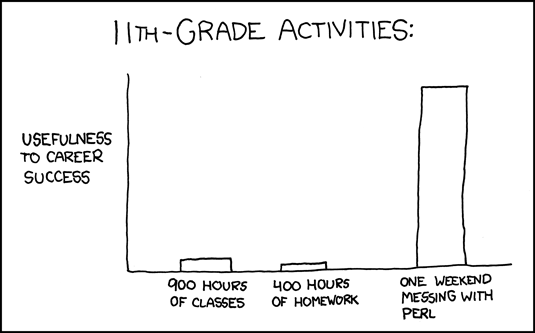
11th_grade.png
 
The elephant in the room is that college isn't for everyone. Yet society basically demands that if you want to make more than $10 an hour in life, you need a degree.

So you get students who only care about drinking and fucking. In the past generation, they never would have went to college. Getting a degree for these people then requires working the system. Failing that, pick an easy major that will let you live the college lifestyle (ie, cruise the bars 4-5 nights a week). With these easy classes, grade inflation is such an issue that if you don't get an A, you should feel embarrassed. I felt this way about every Sociology and Political Science class I ever took. I took a senior level journalism class, didn't show up half of the time, and got a 100%. It isn't that I'm that damn awesome, is that the class was just that pathetic.

Colleges themselves feed into this, advertising the college lifestyle or getting a job than actually learning anything. Actually learning anything seems to have taken a backseat. I can't blame them as most students these days feel it is their right to go to school and don't really give a rat's ass whether they learn anything or not. It's the new high school.

Which is why I've always taken the stance that the difficulty needs to be stepped up in high school. Make the high school degree worth something. Raise the bar high enough in college where the only way you can make it is to become a student who is serious about learning something. Since things are trending making college easier and easier, it looks like I won't get my wish.
 
Spire said:
And on the other hand, I've had professors who fail you if you write papers that disagree with their point of view. College is a wonderful place. :|

I had one professor who straight out told us to just write back exactly what he had said in his lectures for papers. He's a favorite among students, naturally, because doing that is ridiculously easy and requires nothing more than the ability to take notes and write semi-readable sentences.

I hated him. He was atrocious. The only things I got out of that class were: a) King Lear is awesome because OMG VIOLENCE (seriously, he only ever used the word "awesome" to describe the play) and b) his daughter is bisexual.

I've been thinking about this thread a lot in the last few days and all I can really say is: I'm awfully happy to be applying to grad schools. I hope it's different at the upper levels. I want to work, and work hard. I want to learn.
 
The average writing ability of students here at RIT is beyond terrible. A writing class is required for most majors and the papers I've had to peer edit...

You would not believe.

I was never a great english student in high school, far from it. In fact it was one of my worst subjects. But I cruise through most essay/paper assignments here because, and this I'm certain of, the standard of quality is just that low.
 
Status
Not open for further replies.
Top Bottom
