• Hey Guest. Check out your NeoGAF Wrapped 2025 results here!

Visual Arts majors, help me understand Jackson Pollock

Status
Not open for further replies.
Dresden said:

e·ther   
[ee-ther] Show IPA
–noun
1.
Also called diethyl ether, diethyl oxide, ethyl ether, ethyl oxide, sulfuric ether. Chemistry, Pharmacology . a colorless, highly volatile, flammable liquid, C 4 H 10 O, having an aromatic odor and sweet, burning taste, derived from ethyl alcohol by the action of sulfuric acid: used as a solvent and, formerly, as an inhalant anesthetic.
2.
Chemistry . (formerly) one of a class of compounds in which two organic groups are attached directly to an oxygen atom, having the general formula ROR.
3.
the upper regions of space; the clear sky; the heavens.

I'm assuming number 3?
 
You really have to see one in person to get the full effect.
But I somewhat agree, works of art.. and especially art such as this.. never hits two people in the same exact way.
Especially with a lot of more modern art within the past 100 or so years, artists have taken to invoking strong emotions in their work.. or trying to.
So this painting may look like paint splatters to you, may invoke something totally different in someone else.

I've been in countless art museums and galleries and I still find myself asking the same things though. Never could see what is so great about art installations. Like one guy who gave loose instructions to people on what to put up in a room, he paid them and did nothing.. and it was considered his art. Anyone know who I'm thinking of?
 
Snowman, I wouldn't go as far as you (I dislike Pollock and don't understand why this isn't ripping off native tribal art of the Americas and Asia http://www.lennonweinberg.com/current/current_1.html , but I like some and definitely like the original post's). Do you think the same about abstract animation?

Animation, generally, is concentrated on "forms" and "colors," and abstract animation actually preceded narrative kinds rather than proceding from and deconstructing it.

http://www.youtube.com/watch?v=KpCI67GMe7o
http://www.youtube.com/watch?v=hSA8-OuadME
http://www.youtube.com/watch?v=ZnLJqJBVCT4

I find all of those abstract ones really, really interesting and easily relatable to "regular" and "experimental" animation. Your thoughts?
 
Zaro said:
People interpreting the "art" is more hilarious than the fact that it costs $155 million.
+1

I tried looking for the video, but I failed. I think it was ABC that had kids do finger paints and mess around; they continued to post these paintings in a fine art exhibit and had art critics comment on them. They loved it, and discussed how much depth there was to the paintings (it was just splatters of colors).
 
You can certainly misunderstand intention if other parts of the work are clear, but only amateurs fully hide behind intention to excuse their shortcomings.

I doubt Pollock was using that as an excuse. His work was a shot in the dark just like many other artists.
 
I'm fine with abstraction and impressionism, but honestly I have greater artistic appreciation for a lot of the philosophies of graphic design from the mid to late 20th century like the Bauhaus school then most stuff like Pollock. Just my quirk *shrug*
 
This fall I'll be entering my fifth year of art school, and trust me, there are plenty of us who "get" Pollock's work and still think it's total bullshit anyway. I'm not saying the guy wasn't talented and wouldn't even bother to try and down-play the influence he had on the artistic community and abstract expressionism as a whole. But, when I see his paintings go for millions, I'm constantly reminded why the stereotype of the snobby/insane artist exists amongst the non-arts crowd (I.E. the majority of the population).

But hey, go to art school and you'll see all kinds of things that will make you question what the definition of "art" is.

By the way, if you can find it, check out the documentary called "My Kid Could Paint That", it's a very interesting over-arching commentary on abstract expressionism.
 
Yasae said:
You can certainly misunderstand intention if other parts of the work are clear, but only amateurs fully hide behind intention to excuse their shortcomings.

I doubt Pollock was using that as an excuse. His work was a shot in the dark just like many other artists.

The thing is, though, that sans intent/"the story behind the work," Pollock's whole body of work falls apart. That is, I think, the reason why laypeople tend to react so violently against AbEx and the like: the work itself really does nothing, despite all of the imbuement that goes on. I will freely admit that I'm less qualified to discuss painting specifically versus other arts, but I believe that I have a pretty good grasp of art in the general sense - things like its purpose and function - and the fraudulence of AbEx is something that stands out quite clearly.

Ghaleon: I will watch those tomorrow night after work. I'll say that the little bit of abstract animation that I have seen has been much the same experience for me - I enjoy it enough, on a purely visceral level, but on the objective/communicative level of art, it's thin. Though, there's at least form and direction to it and, as you said, some experimentation happening that the greater crop of animators may be able to use/take inspiration from, so it at least has that going for it.
 
Also, the whole "millions of dollars" thing can't be examined. At all. Its worth that much because that's how much people will pay for it. Whether that's because they actually desire the art that much, or because the name is prestigious, or whatever, the value of non-utility products is solely dependent on the psychology of the culture around it. You can't tie it down to any more concrete idea of "value", or underlying rationality, except for perhaps observations about human nature.
 
Snowman Prophet of Doom said:
e·ther   
[ee-ther] Show IPA
–noun
1.
Also called diethyl ether, diethyl oxide, ethyl ether, ethyl oxide, sulfuric ether. Chemistry, Pharmacology . a colorless, highly volatile, flammable liquid, C 4 H 10 O, having an aromatic odor and sweet, burning taste, derived from ethyl alcohol by the action of sulfuric acid: used as a solvent and, formerly, as an inhalant anesthetic.
2.
Chemistry . (formerly) one of a class of compounds in which two organic groups are attached directly to an oxygen atom, having the general formula ROR.
3.
the upper regions of space; the clear sky; the heavens.

I'm assuming number 3?
Really, dude?!

Ether

In case you still don't get it, it means something got fucked up, finished, killed, murdered, burned. Dissed beyond recognition.
 
I tried really hard to take his work seriously, but when you compare this type of work to something more refined and detailed, with a lot more skill and ability. Slopping paint on an empty canvas isn't difficult or noteworthy, you can call it art, but it doesn't get much respect from me. It's not as if the concept is difficult to grasp, I just think people are reaching a little too far.
 
This reminds of a situation back in high school. I was working on a set for a school play that needed some paintings hung in a study type room. We decided on having one of them be some abstract art. I, in passing, said that modern abstract art was all bullshit. The drama/art teacher was walking by at that time. She was none too pleased about my commentary.

Whatever, I stand by what I said.
 
For the Love of God

Hirst-Love-Of-God.jpg


Cost 14 million pounds to make, sold for fifty million.
 
The whole art market does seem like a game of musical chairs nowdays, especially with asian money coming in. A lot of people spinning money from out of nowhwere, build a musuem and put your collection in it to make them worth even more, all the while hoping not to be last one to get stuck with the actual art.

I can't same i like Hirst's work, but you gotta admit he knows how to play the game better than most.
 
HamPster PamPster said:
The very first GAF thread I read was about an artist in Brazil (I think) who tied up a stray dog and put a bunch of dog food out of it's reach and the art was watching a dog starve to death

Art is weird

That wasn't art, it was animal cruelty. Also the "art" the OP posted is stupid, if that is art then finger paintings by kids are priceless.
 
Art is subjective .. you can say that to paintings, music, theatre, movies, culinary, design, fashion, human bodies ....

It was sold so high because of how critics made "omfg" about it and this increased the price.

Picasso had a very good friend called Braque and they painted together for some time. They made lots of paintings in this time ....but they almost never signed.
And then one day they saw that and they went to sign the pieces ..... but not even then remembered who painted what exactly.
Picasso's paintings (means : signed by him) are still considerably more pricey than Braque's

And also there are stuffs in the renascence wich artists had almost painting factorys and the price of each piece was made based on how much the artist would be involved on each piece ... from doing everything to just signing.
Today this rarely affects the price of the painting too much =P

Besides the fact that each period was made by the critics of the "main country" .... wich liked people from their own country ... so people from renascence will always sell better than people from asia that were doing insanely awesome stuff at the same time, for example

xelios said:
Really one of the worst artists. Looks like mustard and ketchup squirted over diarrhea. Of course art is subjective, and some people are into scat.

Metallica_-_Load.jpg

Metallica_Reload.jpg

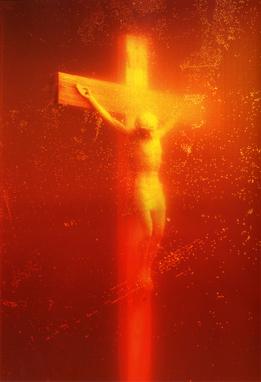
Piss_Christ_by_Serrano_Andres_%281987%29.jpg

works by Andres Serrano
 
Forkball said:
For the Love of God

Hirst-Love-Of-God.jpg


Cost 14 million pounds to make, sold for fifty million.

At least that one is kind of cool. Many of the ones being shown are just pseudorandom colour arrangements. In my opinion the fractal patterns that are trivially generated by a computer are orders of magnitude more beautiful. But appreciation of this sort of art is arguably more to do with the culture surrounding it and the opinions of those around you than it is to do with any quality of the artwork itself.
 
DanteFox said:
Basically the way the art world works is whoever does it first = revolutionary. It's the fact that it's Jackson Pollock that makes it so valuable. The same painting done by me wouldn't be worth jack squat.
This.

Art = ideas. People who pay money for art are buying a piece of history, and bragging rights.
 
H.P. Lovecraft - Pickman's Model said:
Any magazine-cover hack can splash paint around wildly and call it a nightmare or a Witches’ Sabbath or a portrait of the devil, but only a great painter can make such a thing really scare or ring true. That’s because only a real artist knows the actual anatomy of the terrible or the physiology of fear—the exact sort of lines and proportions that connect up with latent instincts or hereditary memories of fright, and the proper colour contrasts and lighting effects to stir the dormant sense of strangeness.

This quote has always made sense to me. Some art just isn't capable of the same thing, and a lot of long-winded explanations/interpretations are necessary to make it seem "worthwhile". If a painting can't show me raw emotion without some cheap theatrics or over-zealous "approach" then it is hard to buy into.
 
I can understand anyone thinking anything can have an intrinsic beauty. Heck show me a painting of a 1cm black sphere on a huge white empty canvas and I know someone out there enjoys it for what is is. I understand people thinking that "Piss" jesus is amazing, I understand that people think that Pollock painting is an astounding work of art.

What I don't understand is the amount of money spent on these ( outside of investment purposes that is ) just for the sake of hanging them in a room of yours and maybe watching it from time to time.
 
There was a girl in Junior Apprentice, who absolutely bummed Jackson Pollock. Suffice to say, she came across as an absolute pretentious twat. Not to say all people who like that sort of thing are pretentious twats, but for pretentious twats worldwide, that sort of stuff provides ample ammunition.

To me, Art is ultimately about evoking some sort of emotional reaction. When I see stuff like that, it evokes absolutely nothing. I look at it and think, well some sucker brought this for a lot of money...
 
The best thing about this kind of art is when people trick art critics into lauding the work of two-year-olds and dogs. Similarly:

http://scienceblogs.com/cortex/2007/11/the_subjectivity_of_wine.php

In 2001, Frederic Brochet, of the University of Bordeaux, conducted two separate and very mischievous experiments. In the first test, Brochet invited 57 wine experts and asked them to give their impressions of what looked like two glasses of red and white wine. The wines were actually the same white wine, one of which had been tinted red with food coloring. But that didn't stop the experts from describing the "red" wine in language typically used to describe red wines. One expert praised its "jamminess," while another enjoyed its "crushed red fruit." Not a single one noticed it was actually a white wine.

The second test Brochet conducted was even more damning. He took a middling Bordeaux and served it in two different bottles. One bottle was a fancy grand-cru. The other bottle was an ordinary vin du table. Despite the fact that they were actually being served the exact same wine, the experts gave the differently labeled bottles nearly opposite ratings. The grand cru was "agreeable, woody, complex, balanced and rounded," while the vin du table was "weak, short, light, flat and faulty". Forty experts said the wine with the fancy label was worth drinking, while only 12 said the cheap wine was.

In some very subjective critical professions you can be very far up your own ass, have no real talent or qualifications and never be called out for it.

If you try to hack it as an engineer you have to quickly prove you can engineer stuff. If you try to hack it as an art, food or wine critic you can just make shit up and praise expensive things for an entire career.

If you posted that Pollack and lied and said it was painted by an imitator a lot of people in this thread would probably have said "oh yes, that's quite obvious judging from..."
 
It's interesting that people assume they should have some innate right to understand art, be it Pollock or whoever else. It would be like me saying that economics, which I have never studied to any degree, is complete nonsense. If an artwork says nothing to you, regardless of who painted it, then fair enough. But it's also important to understand that it was made within a certain historical, cultural and / or political context and should be looked at as such. And as mentioned, it's one thing to see the work on your monitor and quite another to see it in person.
 
Just confront the work, focus a bit and move on. It does what it does to you. You don't owe any oblications to Pollock or his work.

GrotesqueBeauty said:
Maybe the OP is more of a Rockwell type?

20har94.jpg


;)

Thank you for posting this amazing piece.
 
the thing i don't get about pollock is not the style of art, which i do like and appreciate on an aesthetic and historical level for what it is, but how anyone can assess his body of work as a whole. like, what makes one of his paintings more successful or valuable than another? do they have individual merits beyond "i like this colour scheme"? is the fact that they simply exist enough?

i feel like it'd be a bigger deal coming from someone with a track record of variety in innovation.
 
Snowman you telling people what art is and what is not always makes me cringe.

You generalize and say all AbEx is bullshit and quote someone who is just as narrowminded. I beg you to splash paint on a canvas and come up with interesting patterns, textures and colors. It's not as simple as it sounds.

You completely ignore that not every piece of abstract art is minimalistic or banal. Something like the stargate sequence in 2001 can't be done by a layman. It takes great technical knowledge, skill and creativity. In fact it was an groundbreaking achievement.

And holding every artist to the standard of Picasso is a fallacy because he was arguably the single greatest painter of our time. Almost nobody could be considered a worthy artists by this standard. Tho it would be fair to argue that Pollocks paintings don't deserve to be priced similar.
 
He dd it first. That's what artistic success is about sometimes. Challenging the paradigms that cam before you.
 
Snowman Prophet of Doom said:
It SHOULD be about communication, about the artist having some idea or thought inside of him that is best expressed via the heightened medium of art.

Then you quote someone else who says:

Intent in art means nothing. One can claim they intended something, but so what, if it fails that claimed intent? Since there is no true way to know what an artist intended, it has no bearing on the art.

You're expert is basically contradicting your own assertion.
 
Oh man, I "love" modern art, long ago I would get angry at what certain people called art but I thought "who am I to judge what's art or not?" so now I just laugh at the "art". One of my favorite ones was the guy ( I'm kinda paraphrasing the article so bear with me if details are wrong ) who buried himself in a seethrough glass coffin below ground level and mastrubating looking "under" people who passed above him, he yelled obscenities at them while recording it.

Amazing.
 
GrotesqueBeauty said:
Maybe the OP is more of a Rockwell type?

20har94.jpg


;)


I love Rockwell.

As a visual artist, I don't understand Pollock, and never liked his work. It seemed like at the time he gained the notoriety purely because of shock value. But that's just Imo
 
Margalis said:
Then you quote someone else who says:


You're expert is basically contradicting your own assertion.

Uh, no. Neither point contradicts the other. The first point is that good art will usually come out of some expressive/communicative impulse of the artist; the second point is that art will also take on meanings and contexts separate from the artist and their attention and needs to be judged on its own merits, apart from what the artist may have intended. I did not know Caravaggio, for example, but when I judge his work, even as I ignore my own imbuement of intentions and things of that nature, I can still tell from the first that his work came out of a need to express something, to communicative something to an audience, though of course he could not account for every possible interpretation of his work, nor can any artist.

WorriedCitizen: Cringe all you like, I don't really care. You'll either think I have something to say of value or not. There is a huge, manifest difference between the Stargate sequence in 2001 and the work of AbEx painters. For one, 2001's sequences comes on the heels of over 2 hours of emotional, intellectual, and psychological build-up and so has an actual context within which to have artistic clout. For another, look at any single image of it and there is more form and direction within it than any AbEx painting that I've seen. It's a lot more akin to the Rockwell painting in this thread (which is an excellent painting, BTW). Go on that Jackson Pollock website in this thread and just play around for five or ten minutes, or watch the film My Kid Could Paint That; AbEx, at least as it's been practiced in art thus far, IS manifestly replicable by any layman or Joe Schmo because there is no skill or craft behind it. I mean, look at the paintings of that 4-year-old girl from My Kid Could Paint That, who one can see is just throwing paint against the canvas without rhyme or reason (though I can say that watching videos of Pollock work, as well); is there REALLY a difference between the unfocused, unartistic screwing around of that toddler (who became a "serious artist" off of her randomness) and the supposedly very precise and artistic work of a Pollock or a Rothko? Thus far, I've never heard a good, craft-based, artistic rationale behind the AbExers of the world.
 
I think why people consider Pollock a great artist was because he was painting images that came from within instead of painting things based off of reality and abstracting them (i.e. Picasso).
 
I don't think that intent is important to art inasmuch as that what defines art is an attitude (towards the creative decisions in the creation of a piece - artistry is fundamentally about self-expression; design is fundamentally about working towards a goal), although it may very well be important in assessing a work's quality, in that we may be able to compare how well a piece fulfils the artist's intent.

We might also judge a work by it's technical quality, which is of course separate from the intent of the artist. There's probably more than one factor here.

I do disagree with saying that "Since there is no true way to know what an artist intended, it has no bearing on the art." Yes, there is a way to know what an artist intended: ask them. Granted, with deceased artists we no longer have this luxury, but that doesn't make the quoted statement any less false.

I also think that knowledge of colour theory and good composition may disagree with this:

Snowman Prophet of Doom said:
Go on that Jackson Pollock website in this thread and just play around for five or ten minutes, or watch the film My Kid Could Paint That; AbEx, at least as it's been practiced in art thus far, IS manifestly replicable by any layman or Joe Schmo because there is no skill or craft behind it.

But, I do agree that some abstract expressionist paintings don't even display particular mastery of those, for there is so little to them.

I think my inability to agree fully with your views, Snowman, is that (unless I'm misunderstanding you) you're focusing too much on "communication" as in "communicating a message", on projecting some kind of philosophical or ideological view. However, I'd argue that communicating an emotion is sufficiently communicative. Perhaps there may be something in saying that poetry is the best medium in which one can do so, but I'd question that by pointing out how people link emotion to colour - red, I believe, is quite often seen as an antagonistic colour, one of anger, whereas blue is considered to be calm and soothing.
 
Status
Not open for further replies.
Top Bottom