DannyDanger
Member
Just let it die, if we keep mentioning it they will feel compelled to complete a game that might not be good in the first place.
Ohhh Yeeeaaah... What happened to Let It Die? New thread!

Just let it die, if we keep mentioning it they will feel compelled to complete a game that might not be good in the first place.
Ohhh Yeeeaaah... What happened to Let It Die? New thread!

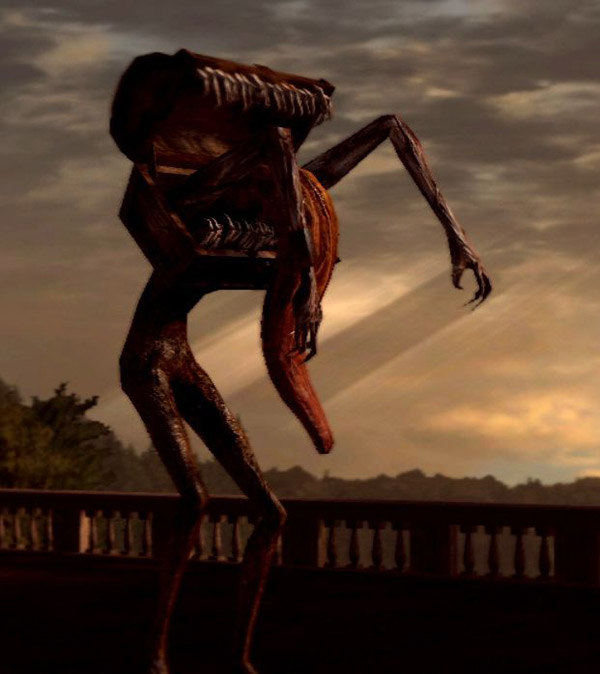
I haven't seen a Dark Souls mimic but that thing looks pretty savage the way it's chasing like that. I don't think I've ever seen a mimic give chase.
Seriously?
Development
Engine
Firefall uses a custom server and graphics engine with its renderer based on Offset Engine by Offset Software that was sold to Intel in February 2008. Offset Engine was originally built for Offset Software's first person shooter Project Offset that was cancelled in 2010 by Intel due to the failure of Larrabee. Red 5 Studios relationship with Project Offset gave them full access to source code, which they heavily modified to suit their needs. Modifications to the Offset Engine include a custom texture streaming engine, a character and terrain system designed to handle hundreds of players in a large open world, a vegetation and prop system, custom lighting and FX, and integration of Havok Physics onto the server-side. The server code is built in-house.
the deep down project has been offset.
I've never seen one that got up and walked around before DaS.
This is pretty funny in retrospect.It only existed for list wars, fool
Sugiura: “Deep Down is a game we’re going to be hedging out bets on for, give or take, 15 years, so we can’t put it out at its current visual level and say those graphics will be top-notch. It’s an extreme case, but this game takes five or six times the amount of productivity as Monster Hunter Frontier G.”
“Deep Down will take a little more time to finish,” Ono said. “There seems to be rumors that development has come to a stop, but those aren’t true.”
Ono continued, “It might be a while ahead, but we hope to show you something truly different from what was shown previously. In fact, since we announced it, the framework behind it has grown much larger to the point that what we had before may well have been a dud.”
The Capcom producer expressed his concerns with not launching with the game’s necessary parts, which ultimately led to its delay.
"Since maintaining an online game service is a long-term challenge, if you don’t properly create necessary parts of it in time for the launch, players won’t stick around long even if it’s interesting,” Ono said. “We eventually came to have concerns that Deep Down wouldn’t initially establish itself well with consumers, so we decided to put aside more time so we could perfect it.”
“We’re focusing on things like how to recreate real life gases and liquids, such as flames and running water,” Miyashita said.
What happened to the panta rhei engine?It was purportedly back burnered in favor of getting DDO out, but in reality it presumably just takes a long time to port things to Unity 5.
Not necessarily. If they are really adamant about including Voxel GI, fluid simulations, tessellating most of the environment objects, I doubt something like UE4 would make that any easier to get it all working on PS4. If there's a lesson to be learned it's probably knowing when to give up on certain features and that you're being too ambitious.
I'm fairly confident that for almost any team, licensing Unreal for the toolchain, base scripting, integrations, etc. and then just building all your custom rendering technology on top of it would be more efficient than trying to build a modern development environment from scratch. Basically every Japanese publisher that's tried to build out an internal engine has been hamstrung by content pipeline inefficiencies, features that need constant rebuilding, and other issues that drag out game development far past its allotted schedule -- in large part, it seems, because these efforts focus on fancy rendering tech but neglect the part that's actually important, which is the day-to-day toolset the artists and engineers work with.
No way. They're using $&@! Unity?! What a joke.It is being developed on - wait for it - Unity Game Engine :lol:
Is there any evidence for that though?
So much truth in this post. I used to work in the game industry, now I work with business visualization (we use game engines) and QOL along with a good, clear and git-able project structure is in the end of the day much more important than a few extra effects.I'm fairly confident that for almost any team, licensing Unreal for the toolchain, base scripting, integrations, etc. and then just building all your custom rendering technology on top of it would be more efficient than trying to build a modern development environment from scratch. Basically every Japanese publisher that's tried to build out an internal engine has been hamstrung by content pipeline inefficiencies, features that need constant rebuilding, and other issues that drag out game development far past its allotted schedule -- in large part, it seems, because these efforts focus on fancy rendering tech but neglect the part that's actually important, which is the day-to-day toolset the artists and engineers work with.
It's easy to say this from the comfort of an armchair but I wonder what's the publisher use case for having own one-engine-4all-dev like Frostbite. The people who work in the industry are likely far smarter than me so they probably have some data points / justifications for insisting on this.I'm fairly confident that for almost any team, licensing Unreal for the toolchain, base scripting, integrations, etc. and then just building all your custom rendering technology on top of it would be more efficient than trying to build a modern development environment from scratch. Basically every Japanese publisher that's tried to build out an internal engine has been hamstrung by content pipeline inefficiencies, features that need constant rebuilding, and other issues that drag out game development far past its allotted schedule -- in large part, it seems, because these efforts focus on fancy rendering tech but neglect the part that's actually important, which is the day-to-day toolset the artists and engineers work with.
Besides the track record of every other Japanese publisher (and several major Western pubs) on this sort of initiative, their complete inability to ship a game using this engine, their licensing of third-party engines for multiple titles despite this engine nominally being developed in-house, and all of the above being in line with the predictions people were making a few years ago about how this in-house engine drive would play out?
 IMO the lack of other games using an in-development engine doesn't exactly speak on its tools and content pipeline as much as the incomplete rendering tech that other games aren't even attempting in this particular case. I don't think it's fair to assume it's completely all on the toolset of the engine when it can very well be something else.
If you make enough games, owning the engine lets you mod it however you need to and of course developing it can take into account all existing toolchains and what not. Plus, obviously, no royalties to use your own engine if you can keep development costs reasonable vs theoretical royalties.It's easy to say this from the comfort of an armchair but I wonder what's the publisher use case for having own one-engine-4all-dev like Frostbite.
It's easy to say this from the comfort of an armchair but I wonder what's the publisher use case for having own one-engine-4all-dev like Frostbite.
What's Capcom's track record with MT Framework?
IMO the lack of other games using an in-development engine doesn't exactly speak on its tools and content pipeline as much as the incomplete rendering tech that other games aren't even attempting in this particular case.
Better, what's the case for a publisher having 6 engines?
(Snowdrop, AnvilNext, Distrupt, Dumia, GR Wildlands (YETI 2?), and UbiArt)
6 minute gameplay from 1 year ago
https://www.youtube.com/watch?t=81&v=eU8HEnvwixk&t=1m14s
Producer on wanting to increase graphical fidelity even further 7 months ago:
Ono on the game expansion 7 months ago.
6 months ago the producer still talked about what I'm assuming is the fluid simulation, which doesn't look to be implemented in any of the gameplay we've seen.
Ono said it was running on PS4 during the stage reveal and on his twitter. It was obviously just a tech demo at the time showcasing target graphics though.
https://www.youtube.com/watch?v=drGkHlrPuOM&feature=youtu.be&t=4m18s
http://p.twipple.jp/0vG60
Not necessarily. If they are really adamant about including Voxel GI, fluid simulations, tessellating most of the environment objects, I doubt something like UE4 would make that any easier to get it all working on PS4. If there's a lesson to be learned it's probably knowing when to give up on certain features and that you're being too ambitious.