• Hey Guest. Check out your NeoGAF Wrapped 2025 results here!

When humans becomes extinct, what will take our place?

Status
Not open for further replies.
Orcastar said:
Ants are an interesting choice, but I'm thinking that a hive mind intelligence has limits that a highly intelligent single mind doesn't. Does an ant colony as a single entity have the potential for complex problem solving for example? I don't know.
Nobody knows. We don't even understand how they solve simple problems (like how to pick the right spot for founding a colony — one ant can't do all that math).

And what if they cooperate across species? 22,000 different expressions of evolutionary win working towards the same goal: To colonize Mars by any means necessary.

It doesn't even stop there. They could very well enslave other insects (as they already do occasionally) as a general method to cultivate and form land to suit their needs.

The only limit they have as individual organisms is size. But that doesn't factor into it if you take whole supercolonies as sentient actors. Turns out science is on the verge of hypothesizing on that level to reason in a way that can give answers to some of the more crazy questions one comes up with. Like, how ant smell can dictate dynamic politics to the participants' benefit (this actually happens).
 
Deified Data said:
Hah, yeah, I've seen it. It's great except for the ludicrous creature names.
There is another in the series they didn't do, about the future evolutions of man. It got freaky fast. Like a race of humans devolving into livestock for another offshoot of humans.
 
Kraftwerk said:
We WILL go to the stars, and conquer them.

Glad to see I'm not the only human-optimist here. As fucked up as our species can be, we've also come quite a long way in a really short period of time. Imagine where we'll be in another millennium, provided we don't wipe ourselves out, which I don't think will happen. The possibility is obviously there though.
 
Deified Data said:
You may have a point. In the wild, they abandon their eggs to raise themselves and live solitary lives. On the other hand, they have been observed living in the same area and playing with one another. Perhaps sociability could be a learned behavior, if given enough time?
Could be. Actually there's examples of that in the world already: almost all cat species are solitary as adults, but lions are social. No reason why a social species of octopus couldn't emerge eventually and become highly succesful.
 
Slayven said:
There is another in the series they didn't do, about the future evolutions of man. It got freaky fast. Like a race of humans devolving into livestock for another offshoot of humans.
The fuck. Did that ever air? Any screens of the freaky chattle-men?
 
My bets are on the self replicating nanobots.
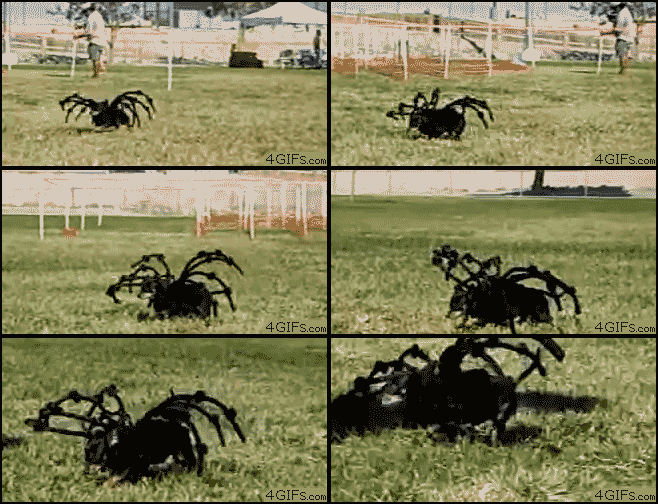
3VO8u.jpg
 
"And here, my prize, the Black
Widow. Isn't she lovely?.. and so deadly. Her kiss is
fifteen times as poisonous as that of the rattlesnake.
You see her venom is highly neurotoxic, which is to say
that it attacks the central nervous system causing
intense pain, profuse sweating, difficulty in
breathing, loss of consciousness, violent convulsions
and, finally.. death. You know what I think I love the
most about her is her inborn need to dominate,
possess. In fact, immediately after the consummation
of her marriage to the smaller and weaker male of the
species she kills and eats him - oh, she is
delicious.. and I hope he was! Such power and dignity
- unhampered by sentiment. If I may put forward a
slice of personal philosophy, I feel that man has ruled
this world as a stumbling dimented child-king long
enough! And as his empire crumbles, my precious Black
Widow shall rise as his most fitting successor!"

bw.jpg
 
Nothing. Considering that every species on earth has had just as long to evolve as us, and considering how few species took the "advanced intelligence" path, I doubt that another intelligent species will arise in the near future after we go extinct. Especially since there's a good chance that we will take out most of the likely candidates (cetaceans, the great apes, elephants, etc) before we wipe ourselves out.

Therion said:
Don't worry, I'm sure we'll manage to kill everything else before we go extinct ourselves.

Na. There are several species that could survive a nuclear apocalypse or anything else we come up with. Bacteria, Rotifers, etc. Tartigrades are especially hardy. They can withstand 1000 times the radiation dose required to kill a human being, and can live in the vacuum of space for days. It's pretty hard to wipe out microbes. Their populations number in the hundreds of trillions, and their generation times can be hours long. With so many random mutations and genetic combinations, they can adapt pretty quickly.
 
SUPREME1 said:
Oh fuck. I was staring at how beautiful it is, and my phone (which is sitting only a few inches from my hand) vibrated and scared the shit out of me.

LOL.


Oh man.

Well that's what happens when you ogle her. YOU PISSED HER OFF!!!!
 
Individual intelligence plays little part on how things evolve. As for what would succeed us when Humans are gone, the answer depends on how Humans died out.
 
Afaik, everything that has become extinct is dumb and didn't realize they needed to have a lot of sex. I think there are bears they try to mate?

I think there will always be humans, until the sun eats earth or the atmosphere leaves.
 
Insects or small mammals like rats. Another mass extinction is inevitible on Earth and we are probably overdue. My money is on a giant asteroid killing us all before we can even figure out space travel that would let us colonize another near Earth.
 
Anyone have the link to the discovery channel special that asked this question and said squids would take over...then went on to show them swinging from trees?
 
I heard this read by Ricky Gervais on his Guide to Natural History podcast. It was the first time I heard any writing by Dawkins. I'm so used to hearing him only debate and I had no clue he could weave such vivid prose.


Richard Dawins - The Ancestor's Tale

“A world without rodents would be a very different world. It is less likely to come to pass than a world dominated by rodents and free of people. If nuclear war destroys humanity and most of the rest of life, a good bet for survival in the short term, and for evolutionary ancestry in the long term, is rats.

I have a post-Armageddon vision. We and all other large animals are gone. Rodents emerge as the ultimate post-human scavengers. They gnaw their way through New York, London and Tokyo, digesting spilled larders, ghost supermarkets and human corpses and turning them into new generations of rats and mice, whose racing populations explode out of the cities and into the countryside.

When all the relics of human profligacy are eaten, populations crash again, and the rodents turn on each other, and on the cockroaches scavenging with them. In a period of intense competition, short generations perhaps with radioactivity enhanced mutation-rates boost rapid evolution. With human ships and planes gone, islands become islands again, with local populations isolated save for occasional lucky raftings: ideal conditions for evolutionary divergence. Within 5 million years, a whole range of new species replace the ones we know. Herds of giant grazing rats are stalked by sabre-toothed predatory rats. Given enough time, will a species of intelligent, cultivated rats emerge? Will rodent historians and scientists eventually organise careful archaeological digs (gnaws?) through the strata of our long-compacted cities, and reconstruct the peculiar and temporarily tragic circumstances that gave ratkind its big break?”
 
Status
Not open for further replies.
Top Bottom