
We don't even know exactly whats at the bottom of the 4 mile deep oceans on Earth :/
Rocks and melty rocks.

We don't even know exactly whats at the bottom of the 4 mile deep oceans on Earth :/
Rocks and melty rocks.
I haven't seen it mentioned but hasn't Titan(Saturn's moon) been in discussion recently as possibly having life?
It's probably an even more miniscule chance that man will ever find a way for any kind of efficient interstellar travel than there is that we'll find life on Europa. Unless some kind of wormhole shit is actually possible, that ain't gonna happen. Just gathering enough energy (in any way) to power up a space ship that could move vast distances at fast enough speed would take a long, loooong time, let alone it even being possible to store that much energy in any kind of realistic way, and it would still be problematic from a length of time POV.Europa is likely the best chance of finding living extra terrestrial organisms over the coming decades based on what we know and the technology we have at our disposal. And yes, that chance is likely to be tiny.
But it isn't the only chance, certainly not over the long term, and certainly not once we attain interstellar travel capability.
What would the outcome really be if we found life on Europa? Because we know the universe inhabits life (we live here).
Just to shut the religious fanatics up?
It would confirm life on two different solar bodies within our own star system. The implications would be profound
I haven't seen it mentioned but hasn't Titan(Saturn's moon) been in discussion recently as possibly having life?
In what way really? I mean, I know that it is a big thing that we find life on a different planet, and especially on a planet within our own solar system (which implies that life is more common that believed).
But in our daily lives short and long term? I can't see anything.
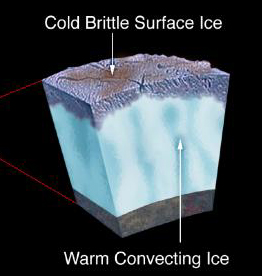
Well the main problem we have with drilling deep holes on Earth is the heat. That's not a problem when you're drilling through -100C ice.Many scientists estimate the ice of Europa is likely more than 10 miles thick. Seems like a difficult challenge indeed. Would be cool though to somehow get to the ocean beneath it.
Well the main problem we have with drilling deep holes on Earth is the heat. That's not a problem when you're drilling through -100C ice.
I agree that the heat is a problem which is nullified here. However, just shipping the raw materials required for a task like this to another body would be incredible, let alone constructing it all when it got there. This is a problem we don't really have here on earth.
It's probably an even more miniscule chance that man will ever find a way for any kind of efficient interstellar travel than there is that we'll find life on Europa. Unless some kind of wormhole shit is actually possible, that ain't gonna happen. Just gathering enough energy (in any way) to power up a space ship that could move vast distances at fast enough speed would take a long, loooong time, let alone it even being possible to store that much energy in any kind of realistic way, and it would still be problematic from a length of time POV.
As was mentioned earlier if we find life on Titan it will be very different from our own (having evolved in liquid methane, but Encaladus, Saturn's sixth largest moon, likely has liquid water and could also harbor life.
So far we have only one sample of life, our own, finding life that originated from a separate biogenesis would be a remarkable find that would challenge many of our assumptions about life. When doing science it is very difficult to have a sample size of one; with a second type of life we will have a better understanding of how life arises, what life is. The reverberations through our daily lives will not come immediately, but when they do they will be profound. Of course, we could find that both the life on some other world and our own life have a common ancestor which would also be a remarkable find. If that is the case then life must be able to travel between stellar bodies, and it would be even more likely that life very similar to our own is abundant in the universe, perhaps we even have distant cousins orbiting a distant star.

Damn it OP, you're right. E-mail NASA right away!
Alright guys, mission's off. Just got word from Badenergytroll. We're done here.


Cant we just send some radioactive thing that heats up so it goes through the ice? It's just ice right, some sort of mini nuclear reactor should do it.
2) A large body of water is basically the best radiation protection there is.
Probably not irradiated as the ice layer on the surface probably does a good job of blocking radiation etc.
And the gravitational forces of Jupiter heat the core of Europa, so there is the combination of heat energy and liquid water which I believe are considered necessary ingredients for biogenesis. I don't think "light" is a strict requirement.
Mars may have had life, but since losing its atmosphere the chance of it remaining has plummeted. Which isn't to say we won't find signs of former life, but it is hard enough to find fossils here on earth relative to how abundant life has been in our history much less with the limited and restricted equipment we have on Mars now and in the near future.
Based on our best understanding of how life gets the opportunity to arise, it seems Europa is the best candidate to find actual life outside of this rock. How to get under that ice is a massive engineering problem though.
Black abyss? Yes. Lifeless? Maybe.

I thought it was mediocreYou guys need to see Europa Report a very awesome movie of what can happen if we send people towards a planet like that.
Probably not irradiated as the ice layer on the surface probably does a good job of blocking radiation etc.
And the gravitational forces of Jupiter heat the core of Europa, so there is the combination of heat energy and liquid water which I believe are considered necessary ingredients for biogenesis. I don't think "light" is a strict requirement.
Mars may have had life, but since losing its atmosphere the chance of it remaining has plummeted. Which isn't to say we won't find signs of former life, but it is hard enough to find fossils here on earth relative to how abundant life has been in our history much less with the limited and restricted equipment we have on Mars now and in the near future.
Based on our best understanding of how life gets the opportunity to arise, it seems Europa is the best candidate to find actual life outside of this rock. How to get under that ice is a massive engineering problem though.
Black abyss? Yes. Lifeless? Maybe.
so probably maybe...you think?
no one knows the OOL requirements for even a single damn cell, its not probably it is definitely a guess.
Is it a complete abysys. If there is volcanic activity then isnt there is a possibility of continually open craters and rifts that continually emit light and heat?
What if we permanently fuck up the life there by drilling a hole into it? Like the ice around it is a shell that helped foster that life, akin to what our ozone layer does for life on Earth?
that movie sucked so badYou guys need to see Europa Report a very awesome movie of what can happen if we send people towards a planet like that.
Didn't the scientist believe there were oceans underneath because of vapor coming out? Or am I confusing it with another moon?
Maybe there are skeletons throwing their own heads around out there.
I keep hearing of missions to pierce the ice and explore the subsurface ocean of Europa, and rumors and conjecture that there is complex life in it's ocean. Even if there is a liquid ocean under the crust (which there probably is not), it is likely an irradiated sterile acidic lifeless black abyss. http://www.iflscience.com/space/nasa-plans-mission-europa
Depends. Have any biases toward Enceladus?Hmm... maybe i am just europaphobic? Gaf, am i a europaphobe?
http://science.nasa.gov/science-news/science-at-nasa/2011/16nov_europa/
What if we permanently fuck up the life there by drilling a hole into it? Like the ice around it is a shell that helped foster that life, akin to what our ozone layer does for life on Earth?

