
wait, what?
Its true, they admire him for his leadership and determination.... not for the evil and tyrany of course, and Hindus are pissed that their symbol has been tarnished so much.

wait, what?
Austrian, actually.I think in some parts of Europe, it's viewed differently. On the one hand, much of our continent was utterly wrecked due to WW2, but on the other hand, our societies and travel are so much more intertwined now. I've been to Germany more times than I can remember, actually, and so of course when someone says "Germany", I don't immediately think of Hitler - but if I'd never been there, I may well have, because he was obviously a very significant figure. No one's ever going to forget he's German, but I think he's much further down the list of "first thoughts" here in Europe.
Austrian, actually.
Like what exactly? I am genuinely interested in what you think Germany is doing to Europe.
I don't like Germans, I won't visit the country a or buy their products.
WWIi was horrific, I will never forgive
Weimar Germany was actually a pretty booming and progressive place, up until the point that the political system decided to give Hitler and his party a second chance. The thought was that they could be constrained and tempered by the more moderate elements in the system, but they underestimated his capacity for shrewdly playing by the rules until such a point in time that he could make new ones. This was all after he had previously led an armed revolution and went to prison. Anyone with sense knew he was a radical and no good, but they let him have a seat at the table because they thought they could use him. Enter the Hitlerian gangs sowing chaos and lighting fires to later blame on Communists, exit the relative calm that was ensuring recovery from Versailles and a rapidly liberalizing society. Hitler quite literally ran Germany off of the rails.
EDIT: Also, you are german. Don't want to offend you personally. It's just your governments that are making life very difficult for the rest of us.Don't take it as an insult.
Nah, that's not entirely true. Hitler only came to power after the small thing called Great Depression. That was in 1929, so at the time Hitler became Chancellor of the Empire (Reichskanzler) Germany wasn't really a "booming" place. There was a negative majority in the parliament for some time (negative in the sense that a majority of MPs rejected democracy), so Hitler certainly didn't come from nothing. He never had his own majority, yes, but he was elected in a correct way.Weimar Germany was actually a pretty booming and progressive place, up until the point that the political system decided to give Hitler and his party a second chance. The thought was that they could be constrained and tempered by the more moderate elements in the system, but they underestimated his capacity for shrewdly playing by the rules until such a point in time that he could make new ones. This was all after he had previously led an armed revolution and went to prison. Anyone with sense knew he was a radical and no good, but they let him have a seat at the table because they thought they could use him. Enter the Hitlerian gangs sowing chaos and lighting fires to later blame on Communists, exit the relative calm that was ensuring recovery from Versailles and a rapidly liberalizing society. Hitler quite literally ran Germany off of the rails.
The Depression was a setback and Versailles certainly helped, but what I'm trying to combat here is the notion that they made Hitler. Hitler snatched them up alongside the historical revisionism to use as ammunition against his political opponents and to strengthen his own brand, but it was never a given that Germany was doomed to be his. Even whilst suffering the setback of the Depression, Germany was one of the more progressive nations on the planet, and well on its way to finding its feet after the war and paying back its indemnities. Hitler derailed that as much as he could, because it couldn't have escaped him that he was strongest when the nation was weakest. The notion that he merely took advantage of the times absolves him and his cronies of no small amount of confirmed and alleged (as with the Reichstag) sabotage.Nah, that's not entirely true. Hitler only came to power after the small thing called Great Depression. That was in 1929, so at the time Hitler became Chancellor of the Empire (Reichskanzler) Germany wasn't really a "booming" place. There was a negative majority in the parliament for some time (negative in the sense that a majority of MPs rejected democracy), so Hitler certainly didn't come from nothing. He never had his own majority, yes, but he was elected in a correct way.
Even during the "Golden Twenties", which were pretty much like you described them, the Versailles Treaty always loomed in the background. It helped spreading the "Stab-in-the-back myth" (Dolchstoßlegende) that leftist people surrendered even though the army wasn't defeated in battle. Of course that wasn't true, but with the severe repercussions of the Versailles Treaty, it became popular. So yes, the Versailles Treaty certainly did have a large impact on Germany between the wars.
The burning of the parliament (Reichstag) could never be directly linked to the Nazis. Yes, it suited them, but such things do happen (I have a rather recent example, but that could be seen in a wrong way).
I don't like Germans, I won't visit the country a or buy their products.
WWIi was horrific, I will never forgive
I've been kinda interested in knowing what Europeans think of each other. There's maybe a few topics on message boards with europeans talking about it. Here's an article from The Economist
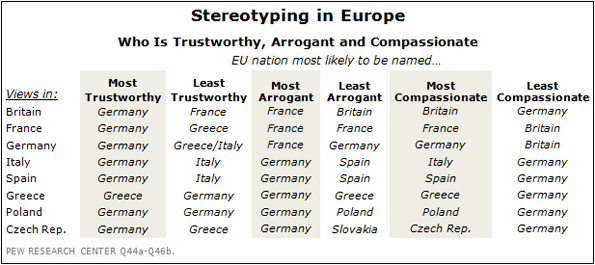
http://www.economist.com/blogs/graphicdetail/2013/05/what-europeans-think-each-other
I've been kinda interested in knowing what Europeans think of each other. There's maybe a few topics on message boards with europeans talking about it. Here's an article from The Economist
http://www.economist.com/blogs/graphicdetail/2013/05/what-europeans-think-each-other
The poll proves that the Greeks are possibly the least trustworthy of all.I've been kinda interested in knowing what Europeans think of each other. There's maybe a few topics on message boards with europeans talking about it. Here's an article from The Economist
http://www.economist.com/blogs/graphicdetail/2013/05/what-europeans-think-each-other
lol. I love how every country voted itself for most compassionate.I've been kinda interested in knowing what Europeans think of each other. There's maybe a few topics on message boards with europeans talking about it. Here's an article from The Economist
http://www.economist.com/blogs/graphicdetail/2013/05/what-europeans-think-each-other

I've been studying WWII since I knew so little and recently started dabbling in WW1. I was surprised to find Germany is big problem yet again!
The blank check helped cause WWI and the Treaty of Versailles is imo the reason for WWII because it allowed someone like Hitler get in power in the first place.
If you don't know what the Treaty of Versailles is, basically it made Germany pay reparations for WWI.
I recently heard in history class that Germany just finished off paying the reparations from World War I back in 2012! It's crazy.

Hitler is no Pyrrhus of Epirus
When I hear Germany I honestly think of beer halls before Hitler.
While getting taken out by an old woman with a sick arm is kinda embarrassing, I'm not convinced it equals gambling away one's homeland and being vilified by historyWell, that's kind of a Pyrrhic victory for him.


This kind of attitude actually genuinely rustles my jimmies. People who are content to package Hitler into a neat little "evil" box are doing the world a disservice. I don't think Hitler was that different from any other fucked up person, his position and reach just meant the results of his fucked up-ness was greater.
Not that everyone needs to be a watchdog, but it would be better if people knew a bit more about Hitler so they can read the warning signs when the next suitor shows up.
Lol, are you serious?I don't like Germans, I won't visit the country a or buy their products.
WWIi was horrific, I will never forgive

No country got damaged worse by Germans in WWII than Poland did and nowadays there isn't a lot of bad will here towards them. In fact they're considered our closest partner and the biggest friend in Europe.So how does the rest of Europe feel about Germany nowadays? Is there still some tension, hate, awkwardness towards the Germans? I would think Polish people would despise the country, but since I'm not from Europe, I don't know.
I don't like Germans, I won't visit the country a or buy their products.
WWIi was horrific, I will never forgive
If you don't know what the Treaty of Versailles is, basically it made Germany pay reparations for WWI.
That's under selling it a bit. It also stripped Germany of its colonies, transferred Elsass-Lothringen to France, established the free city of Danzig, ceded Posen to Poland, and placed the Saar basin under League of nations administration. Then they placed severe military restrictions on the country, whereby Germany was not permitted to have an army of over 100,000 men, conscription was abolished, Germany was not permitted to have an air-force, tanks or poison gas, nor construct or operate submarines. Finally, they were not permitted to station any military assets within a strip of land roughly 50km from the French border.
Were the people who wrote this treaty idiots?
How could anyone remotely rational look at this list of concessions and not think "Yeah...this might bite us in the ass in the future."
I think we also need to consider that international diplomacy was a lot different almost 100 years old. There weren't a lot of poli sci majors coming out of uni and this was unprecedented territory.It was the collaboration of several powers who had conflicting ideas. The French wanted it to be much more severe than it was, while the British and Americans wanted it less severe. You could probably make the case that either of those alternatives would have been better than the compromise.
That's under selling it a bit. It also stripped Germany of its colonies, transferred Elsass-Lothringen to France, established the free city of Danzig, ceded Posen to Poland, and placed the Saar basin under League of nations administration. Then they placed severe military restrictions on the country, whereby Germany was not permitted to have an army of over 100,000 men, conscription was abolished, Germany was not permitted to have an air-force, tanks or poison gas, nor construct or operate submarines. Finally, they were not permitted to station any military assets within a strip of land roughly 50km from the French border.
They weren't idiots. It was lenient compared to the terms Germany imposed on Russia to close the eastern front (the Treaty of Brest-Litovsk), which snatched up huge tracts of land out of Russian hands. Or the consequences for Germany after the Second World War, which laid low practical military and imperial ambitions far in excess than Versailles had. The Versailles Treaty in Hitler's mind was the stuff of bombast and propaganda mixed with a sliver of truth, much like any of his pet causes.Were the people who wrote this treaty idiots?
How could anyone remotely rational look at this list of concessions and not think "Yeah...this might bite us in the ass in the future."
A combination of secretly violating the restrictions, and when these violations could no longer be concealed, boldly committing to them and silently taunting Europe to do something about it. Hitler gambled successfully in that fashion over and over again, until Danzig and Poland.how did Germany build its army and airforce then to invade all the other countries without the allies not knowing or doing anything about it?
True. Unless it is in Football..then there is no such thing as 'bad taste'

how did Germany build its army and airforce then to invade all the other countries without the allies not knowing or doing anything about it?
Were the people who wrote this treaty idiots?
How could anyone remotely rational look at this list of concessions and not think "Yeah...this might bite us in the ass in the future."
Foch considered the Treaty of Versailles to be "a capitulation, a treason" because he believed that only permanent occupation of the Rhineland would grant France sufficient security against a revival of German aggression.[24] As the treaty was being signed Foch said: "This is not peace. It is an armistice for 20 years"
