To kick off this romp through the history of the Purple Dragon, lets start with the very beginning! Spyro is a 3D Platforming hero for the original PlayStation and with it being hemmed by the developers at Insomniac Games, a trilogy of games was formed.
Going to cover all the Spyro games but the original Spyro is very interesting title that is a 'mellow' Collect-A-Ton. And that is a great thing, which I will go into soon enough. Lets get started with the history of the development first before we move on to the gameplay!
Development:
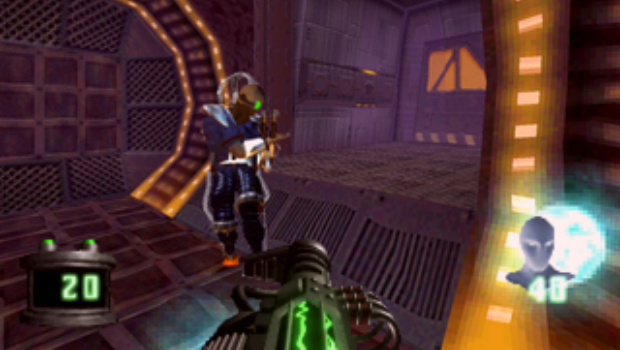
The origins of Insomniac date back to February 28, 1994, with Ted Price founding the studio at a very young age (I believe, 17-18 years old!). Their very first project was a first person shooter called 'Disruptor' and the game was at the time, a fantastic action shooter, but it failed to sell amazingly well. In the words of many reviewers, it was "the best game that nobody ever heard of".
So, when development on that wrapped up, Ted Price and the team looked toward their buddies right next to them, Naughty Dog. Both worked in the same building (Universal Interactive) and saw Naughty Dog develop a little game called 'Crash Bandicoot'. So, interested in shifting gears and making a cartoony action platforming adventure, they set sights on making a more open 3D Platformer compared to the linear hallways of Crash.

Mark Cerny produced the game with Insomniac, providing a similar role he did with Crash Bandicoot.
This created the early ideas of 'Spyro' and development of the game began. Here is a part of the development history of the game featured on its Wikipedia Entree:
"The idea of a dragon was introduced by Insomniac artist Craig Stitt, while Alex Hastings developed a 3D panoramic engine containing some of the first level of detail renderers used on the PlayStation. During the development of the game, Spyro was originally going to be green, but the developers thought it was a bad idea because he would blend in with grass, so they eventually changed him to purple. There were many released demos of Spyro, which did not have many differences from each other besides music and some areas being blocked off."
Spyro released in Fall 1998, the same year Crash Bandicoot 2: Cortex Strikes Back launched. And, the game was very successful! It holds a 85% average with its reviews and people praised the game. I even have a PS Magazine that reviewed the game, giving the game a 4 out of 5. People loved it and work on Spyro 2 soon began. In many ways, Spyro 2 was the time the torch was passed from Crash to Spyro regarding Sony's major platforming icon.
Gameplay:
The gameplay here is very simple; 3D Action Platformer where you run around, exploring large maps to find Frozen Dragons, Dragon Eggs and Tons of Gems scattered all over the place.

If this sounds fimiliar, then it should; the structure of Spyro is a more open take on Mario 64 or Banjo, with Spyro literally only having to run around and get X amount of things in each world before moving on to the next world.
But what makes Spyro so much fun to play, is how great he controls. This released with the PlayStation did NOT have analog control, so the game uses a D-Pad control set up (with no camera stick control) but Spyro still moves so natrual and smooth. Playing this with a D-Pad is just as great as playing it with a analog stick.
The game was designed with this set up in mind, but it was one of the earliest PS1 games that supported the Dual Shock Controller, so if you got that, you can play the game using analog control. Does not affect the camera though.
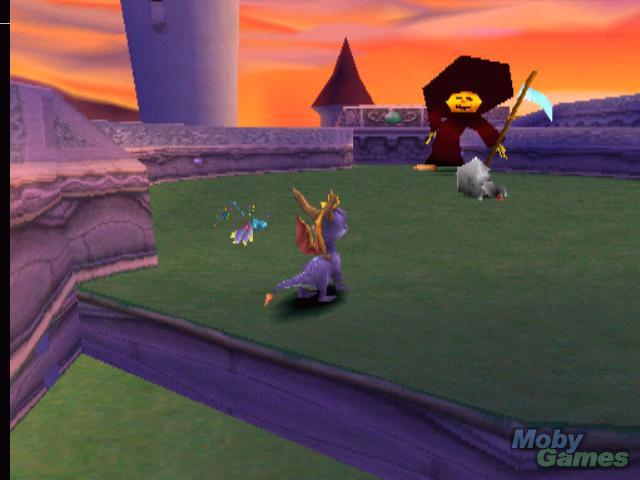
Jumping is interesting, as despite having wings, Spyro can only fly in very special Raceway Stages. Normal levels only has him gliding around with his wings and they work well enough. It is tricky to land correctly though, as Spyro does not have a good 'hover' mode when getting close to a ledge. So, you might just hit a ledge but Spyro misses it by a micro second, making you have to time your jump all over again. Spyro 2 fixes this with the Flutter move.

Spyro also has horns, so he can ram into people by holding down [] and man is it fun. He moves faster and if you run down special ramps, he speeds up quite a bit. Though during this, sometimes you can accidentally make sharp turns when trying to make a large jump.
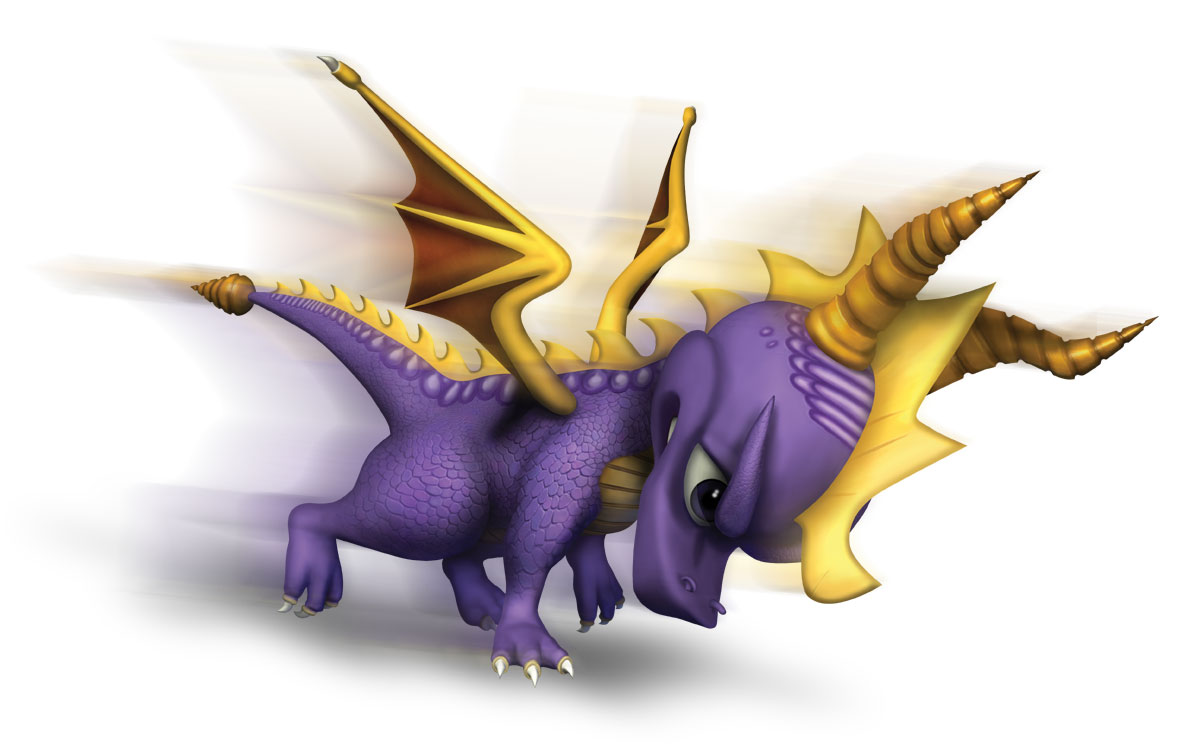
Spyro's main method of attacking is his charge move or his breath (used with the O button). His breath has large retch but combat gets interesting. If foes have silver armor, you cannot use your fire breath, so you use [] to ram into them and take them out that way. Makes combat encounters interesting.
The last element of Spyro's gameplay is the Speedway Stages and the Dragon Egg Collecting. The former gives you the power to fly in the sky and it controls great! Lots of freedom to move all about all the while having clear objectives to complete (kill X amount of things, fly through X amount of rings, ect. These can be hard, as you are on a timer and you get higher time the more you get the items/kill the things needed. That makes these stages replayable and very rewarding.
The latter has you racing a little imp thing in any of the hub/main levels holding a Dragon Egg. You chase them down by Charging and when you get all the Eggs.....nothing happens. This mechanic is brought back with Spyro 3 but will touch on that when we get there.
Level Design:
The level design here is interesting, as its both something I like and something that bugs me.
What I like about it is how open the game is, with every location having so much to see and collect. This makes exploring each of the large worlds so rewarding. But.....you do the same mission for each level; Collect all the Gems, Free all the Dragons, Collect the Dragon Egg(s) if the level has them or not.
Nothing changes and that is a shame honestly. It makes the large levels, a bit empty and outside of the Dragons, Spyro does not interact with anyone else. So it can get a bit lonely. Again, like the gliding move, this changes dramatically with Spyro 2. So, will touch on that when we get there.
Presentation:
For a 1998 PlayStation game, this looks beautiful to this day. The character models are colorful and animated, with the game having a very 'simple' look but that adding to its charm.

The designs of each level creates this 'otherworldly' location for the games world and it is haunting to explore each location at points. The music adds to this, with this Wikipedia section covering that well:
"The game's music was composed and produced by Stewart Copeland, the former drummer of The Police. The music is primarily progressive rock-themed. Many of the pieces from the game, or music motifs from them, have made their way into other Copeland pieces, such as the theme to The Amanda Show, Look Up, and Louis Hansa. The music for the level Jacques appears on Copeland's compilation album The Stewart Copeland Anthology, referred to as Rain."
Having a musician on board helps the game a lot, as the tracks here sound fantastic.
Title Screen: https://www.youtube.com/watch?v=YvFRWKklC6c&index=1&list=PLA6ECEC231DE28F97
Sunny Flight: https://www.youtube.com/watch?v=I76GV2bTcHI&list=PLA6ECEC231DE28F97&index=4
Dark Hollow: https://www.youtube.com/watch?v=JhqNfvJLEss&list=PLA6ECEC231DE28F97&index=5
Toasty: https://www.youtube.com/watch?v=THWsz93mfLM&list=PLA6ECEC231DE28F97&index=7
Dry Canyon: https://www.youtube.com/watch?v=SnRvn-euwTY&list=PLA6ECEC231DE28F97&index=9
Ice Cavern: https://www.youtube.com/watch?v=ZoIgMfMfkgY&index=11&list=PLA6ECEC231DE28F97
Alpine Ridge: https://www.youtube.com/watch?v=JAqo0g74zUs&list=PLA6ECEC231DE28F97&index=15
Dark Passage: https://www.youtube.com/watch?v=RhtRZdbAGAg&index=34&list=PLA6ECEC231DE28F97
Icy Flight: https://www.youtube.com/watch?v=vyULYZ2Xc2c&index=37&list=PLA6ECEC231DE28F97
Overall:
This is a great first shot at making a 3D Platformer for Insomniac, as the game really does a strong job making fun core gameplay, looks great and sounds amazing.
Spyro became a gaming icon not long after this games launch and its sequel is even better. Can't wait to cover that, as I really love that game!