• Hey Guest. Check out your NeoGAF Wrapped 2025 results here!

1080p Content on a 4k T.V.?

Status
Not open for further replies.
I bought a Sony 4K during "black Friday" sales and an upscaling 4K blu-ray player. The main reason I bought it, though, is because it will do full, 1080p 3D in a passive format, which I prefer.

The colors pop more, and it totally looks as good as a 1080p TV. It's an LED (as they all are now) and it looks as good as my Panny Plasma.

So you bought a bluray to do the upscaling instead of the TV to do the upscaling, does it do a better job?
 
Why does 1080p looks like crap?

Because the initial "comparison" image in the OP is far from accurate.

4k definitely looks better, but my primary concern is how will my 1080p blu-rays look on a 4k tv If they're upscaled to 4k, will they look better than a native 1080p display displaying the same movies??

It's going to look the same as a good 1080p TV.

Actually you're right. I remember the jump from SD to HD and it was awe-inspiring.

The jump from HD to FHD was impressive, but less so than the previous bump in resolution.

Now from FHD to QHD I'm really starting to see diminishing returns.

If you sit six feet away from a 50" plasma and watch SD content, then switch to HD content, the difference is night and day.

Switch from HD to FHD on the same screen at the same viewing distance, and it's not nearly as noticeable.

Given the above, I think if, given the same circumstances, the bump from FHD to QHD is nearly imperceptible.

Honestly, I prefer having FHD 3D rather than QHD. At least with 3D I can bob and weave my head and say "hey, the perspective is shifting!"

The difference in 4K is in fine detail (noticeable in close ups), but not much else right now.

In the near future, when 4K sets with expanded color support come out, then there will be a more noticeable difference. But for now, 4K is a "nice to have" rather than a "must have." It's really an early adopter thing.

Yeah, it honestly makes more sense at 3840 than 4096, scaling wise, not sure why Sony decided to go 4096 on their projectors, but they're not really targeted at the average consumer as it stand right now anyway, with the price point they're at.

4096 = Cinema 4K


From a marketing stand point, not technical. 4k sounds like you go from 1k (1080p) to 4k (4000whateverp), which would give you 4x the resolution. The original post I replied to asked why they'd call it 4k, and this would be one of the reasons for it.
 
So you bought a bluray to do the upscaling instead of the TV to do the upscaling, does it do a better job?

Hard to say -- Any upscaling will not look nearly as nice as native content. But the bluray movies through the player look pretty darned nice as opposed to just the PS4 and other devices that are plugged directly into the TV.

Again, I bought this mostly for future-proofing (and the price was really good at the time) and full "HD" passive 3D.
 
Hard to say -- Any upscaling will not look nearly as nice as native content. But the bluray movies through the player look pretty darned nice as opposed to just the PS4 and other devices that are plugged directly into the TV.

Again, I bought this mostly for future-proofing (and the price was really good at the time) and full "HD" passive 3D.

Wouldn't the TV have upscaled the movies, or did you need a player to do it ?? Just wondering if I should get a dedicated bluray player with 4k upscaler as opposed to playing movies through the PS4 and having the TV upscale.
 
So you bought a bluray to do the upscaling instead of the TV to do the upscaling, does it do a better job?
Will come down to the specific BD player and TV.


For example, I know the prior high-end 4K Vizio (I think before the M series?) had god awful scaling. I don't know if it was actually a bug, or the engineers involved just made a crap choice in the filter.

They've since updated it via firmware, and while I haven't seen an official review where they really put it throw its paces, from what I've heard it's much better now.
 
I sit 8ft away from a 40inch set. I wouldn't notice the difference between 4K and 1080p.

In terms of the image. Contrast, black level and colour accuracy are much more important to picture quality.
 
I sit 8ft away from a 40inch set. I wouldn't notice the difference between 4K and 1080p.

In terms of the image. Contrast, black level and colour accuracy are much more important to picture quality.

Yeah, a 40 inch set seems a little small to see the that added benefit of 4k, unless you sit right in front of it as a computer monitor.

I'll be going 55 or 60 inch and 6-7ft away.
 
I sit 8ft away from a 40inch set. I wouldn't notice the difference between 4K and 1080p.

In terms of the image. Contrast, black level and colour accuracy are much more important to picture quality.
Once UHD actually matures however, you will notice color gamut / depth, HDR, etc.
 
4kcomparisoncropcds2d.png

Thanks for non-horseshit comparisons!
 
Once UHD actually matures however, you will notice color gamut / depth, HDR, etc.
I think there is also the argument to be made that considering how high-end 1080p TVs are a dying breed in that 1080p flagships are becoming comparable to 'mid-range' 4K TVs even last year and more so this year, if someone values what he claims to value, the choice to go 4K is becoming the only choice.
 
Wouldn't the TV have upscaled the movies, or did you need a player to do it ?? Just wondering if I should get a dedicated bluray player with 4k upscaler as opposed to playing movies through the PS4 and having the TV upscale.

Not sure how that works, honestly. I know the TV has display options of 1080p, 720p, 1080i, etc. I don't know how the upscaling works. I bought this one, a Sony 55".

You could look into it and see. I *hope* I didn't get rooked in buying the upscaling player ... but you never know! (It wasn't that expensive.)

It says this in the description:
Watch 4K movies and TV shows at 4x the resolution of Full HD, and upscale your current HD content to gorgeous, Ultra HD-level picture quality
 
I find that my blu-rays look much better upscaled on my 4K TV. It's made me realize how insane blu-ray picture quality is. I have two PS4's, and a very old blu-ray player. Have tried with both, and the TV upscales the picture accordingly.
 
I think there is also the argument to be made that considering how high-end 1080p TVs are a dying breed in that 1080p flagships are becoming comparable to 'mid-range' 4K TVs even last year and more so this year, if someone values what he claims to value, the choice to go 4K is becoming the only choice.
Agreed, though it's kind of disappointing.

Well, it may be. I guess the question is once the UHD stuff shakes out would adding those features to 1080p displays bring it up to the same cost of an equivalent 4K set (ie. only difference between the two is resolution)?

If not, then it sucks they're forcing unnecessary resolution down our throats. I suspect though the price difference would be so small that it doesn't matter.
 
I find that my blu-rays look much better upscaled on my 4K TV. It's made me realize how insane blu-ray picture quality is. I have two PS4's, and a very old blu-ray player. Have tried with both, and the TV upscales the picture accordingly.

Good info, thanks.
 
I could be wrong, but wouldn't 1080p content look exactly the same on a 4K TV of the same size? The 1080p --> 4K jump is easy because it has 1:4 scaling available (like that pic on the first page). If the TV size is the same, the effective 1080p pixel density should be exactly the same as a native 1080p panel. The 720p --> 1080p jump was different because of the non-integer scaling involved.
 
Agreed, though it's kind of disappointing.

Well, it may be. I guess the question is once the UHD stuff shakes out would adding those features to 1080p displays bring it up to the same cost of an equivalent 4K set (ie. only difference between the two is resolution)?

If not, then it sucks they're forcing unnecessary resolution down our throats. I suspect though the price difference would be so small that it doesn't matter.
I don't think it really matters all that much tbh. The UHD stuff would take a while to make it out of higher end sets and a 4K set isn't actually more expensive to produce than a 1080p one. Much of the cost you see now is upfront tech premium. By the time it actually matters prices will have equated to what you'd pay for a high end 1080p set a few years ago before the market cratered, it has already begun in fact.
The industry sort of needed this since price wars on 1080p sets were getting unsustainable for several years which is part of what prompted both the 3D craze and Smart TV craze as attempts to bring prices back up.
 
I could be wrong, but wouldn't 1080p content look exactly the same on a 4K TV of the same size? The 1080p --> 4K jump is easy because it has 1:4 scaling available (like that pic on the first page). If the TV size is the same, the effective 1080p pixel density should be exactly the same as a native 1080p panel. The 720p --> 1080p jump was different because of the non-integer scaling involved.

It should.

People "seeing" a difference, are probably seeing the effects of a sharpen filter added by the upscaler.

It's not adding any information.
 
Here's a comparison between 4K, FHD, HD and SD images, cropped to 720x480 for each image.

4kcomparisoncropcds2d.png


I searched for sharp 4K wallpapers on Google, then reduced the image size to 1920x1080, 1280x720, and 720x480, then stretched them back to 3840x2160. All image processing was done in Photoshop CS6.

Eh... there's a lot of Interpolation being done when re-stretching back to 3840x2160. No doubt, 720p and 480p will look a lot better when only being re-stretched back to 1920x1090. Plus many 1080p sets have very sophisticated upscalers to handle 720p and 480p content.

As a result of the stretching process, this test isn't really an accurate way to compare the different resolutions. You're stretching a 480p image to 3840x2160, so of course it's going to look way worse than it actually looks when properly rendered. Same goes for really all of the other sub-4k resolutions.

Edit:
This one looks more correct to me. The resizing back up looks a lot less interpolated.
 
Eh... there's a lot of Interpolation being done when re-stretching back to 3840x2160. No doubt, 720p and 480p will look a lot better when only being re-stretched back to 1920x1090.
Actually, for high degrees of upscaling, higher resolve resolutions are arguably better since you have finer control of the reconstruction (and therefore less potential for what might be referred to as "reconstruction aliasing"). A cartoonishly high-resolution screen with a very powerful upscaler would effectively allow you to make the upscale look however you like; you could make it look like a shitty native LCD image with really squared-off pixels if you're into that sort of thing, you could use a more gaussian-like reconstruction filter to make the low-resolution image look sort of like it's being displayed on a CRT, etc.
 
I could be wrong, but wouldn't 1080p content look exactly the same on a 4K TV of the same size? The 1080p --> 4K jump is easy because it has 1:4 scaling available (like that pic on the first page). If the TV size is the same, the effective 1080p pixel density should be exactly the same as a native 1080p panel. The 720p --> 1080p jump was different because of the non-integer scaling involved.

Not all TV's have that mode, and even if they do many people will use the default mode which works conceptually the same as any other scaler ... it extrapolates information and is intended to 'add more detail'.

The issue of course is scaler performance (both speed and quality) can vary rather substantially.
 
I don't think it really matters all that much tbh. The UHD stuff would take a while to make it out of higher end sets and a 4K set isn't actually more expensive to produce than a 1080p one. Much of the cost you see now is upfront tech premium. By the time it actually matters prices will have equated to what you'd pay for a high end 1080p set a few years ago before the market cratered, it has already begun in fact.
The industry sort of needed this since price wars on 1080p sets were getting unsustainable for several years which is part of what prompted both the 3D craze and Smart TV craze as attempts to bring prices back up.

Yeah, I kind of figure that's the case. The way economy of scale works, there will be no real difference once fab lines are in full swing. Could actually cost more to do 1080p at that point.


Probably the only concern may be small displays. It's possible those would cost more to fab 4K panels for, and as such they simply won't be produced? In that scenario smaller sets would remain 1080p, and likely lose out on the improved non-resolution image quality advancements.

I suppose it could be argued that few people do critical viewing on sets smaller than ~40", so as long as those have 4K models I guess it doesn't matter much? I wonder how this will play out for regions / locations where space is a luxury though? For example, Japan prefers smaller sets particularly in their cities?
 
It should.

People "seeing" a difference, are probably seeing the effects of a sharpen filter added by the upscaler.

It's not adding any information.
That's the thing though, it is adding information.


If your TV is configurable (has a 4:1 mode) or something like Sony's DRC you can turn off ... that's fine. That's not always the case though. In that situation you have to hope it automatically uses different filter coefficients depending on the input resolution ... or that it simply does a good job scaling in general.

You really need to mess around with the particularly model and/or find some reputable reviews that explicitly discuss upscaling performance (and hopefully they test it with multiple resolutions - you may not only have 1080p sources).
 
Probably the only concern may be small displays. It's possible those would cost more to fab 4K panels for, and as such they simply won't be produced? In that scenario smaller sets would remain 1080p, and likely lose out on the improved non-resolution image quality advancements.

I suppose it could be argued that few people do critical viewing on sets smaller than ~40", so as long as those have 4K models I guess it doesn't matter much? I wonder how this will play out for regions / locations where space is a luxury though? For example, Japan prefers smaller sets particularly in their cities?
Interestingly enough you can already not purchase high-end 1080p sets at sizes smaller than 50" from many manufacturers. Most people don't buy TVs smaller than 50" these days especially not in the US. Not for their main 'fancy' TVs anyway. Countries with space being at a premium are interesting to consider in this. I suppose but 4K sets aren't really prohibitively dense to make making them expensive. A 55" 4K display is slightly less dense than a 24" 1080p screen. Any extra cost is probably greatly offset by the smaller size of the panel. Another interesting point was that countries like Japan saw very slow HD adoption to begin with largely in my opinion because the main driving factor of HD adoption in the west was large flat displays which were not as lucrative for people who couldn't fit huge screens.
 
Anyone here have their PC connected to their 4K TV? Specifically ones with HDMI 2.0. That seems like the main source of 4K content as of now as long as you have a capable graphics card(or two)

Currently owning a 4K tv without using it with a pc is kinda pointless, why paying that much for it if you can't use it anyway?
Some people argue that it doesn't cost that much more but c'mon
 
Currently owning a 4K tv without using it with a pc is kinda pointless, why paying that much for it if you can't use it anyway?
Some people argue that it doesn't cost that much more but c'mon

1) A PC is giving you games, yes, but for 4K media content you don't need a PC.

2) Like it or not, the best TV's currently on the market for image quality (other than OLED) are 4K. The CE's are no longer attempting to push IQ for 1080p sets due to market factors. So if you need a TV right now and care about IQ ... what else would you recommend?
 
I have a Seiki 39' 4K for a monitor and 1080p content looks exactly as you would expect it to look on a native 1080p screen.

Comparing 4K and 1080p content up close would result in 4K easily being the winner in clarity and color accuracy. When comparing from normal viewing distances, the differences between the two become less noticeable (but I can still spot the difference personally).

Edit: I play my videos in 4K mode on my PC so I don't have to worry about scaling issues.
 
I was really excited to get a 4K tv but this HDR thing really makes me want to wait. Seeing some images of what it can do to image quality, it really works on some of the things that have been bothering me for years. Like small amount of details in dark areas.
 
I was really excited to get a 4K tv but this HDR thing really makes me want to wait. Seeing some images of what it can do to image quality, it really works on some of the things that have been bothering me for years. Like small amount of details in dark areas.
It will also help with filesizes and stream quality in the near future since it negates the need for dithering in video, which is very difficult to compress.
 
It will also help with filesizes and stream quality in the near future since it negates the need for dithering in video, which is very difficult to compress.
I'm sad that I have to delay a purchase for a good year for it to kick off though. I really wanted to pick up a TV in December of this year. But I don't think I want to go another 6 years with a new TV with this just around the corner.

Didn't know about filesizes that's great. Have to do some more research on it because it sounds exciting. Hope it kicks off. Heard content creators were equally excited for it.
 
Keep in mind that alot of the examples posted here are from downscaled 20+ megapixel cameras. 4K(a measly 8 megapixels) movies wont look nearly as good, and the difference between 4k and 1080p movies will be even less.

Heres a 4K image from a red camera.

https://marvelsfilm.files.wordpress.com/2012/05/before.jpg
http://postimg.org/image/3n0m8j3dz/full/
Not quite as sexy as idris elba.

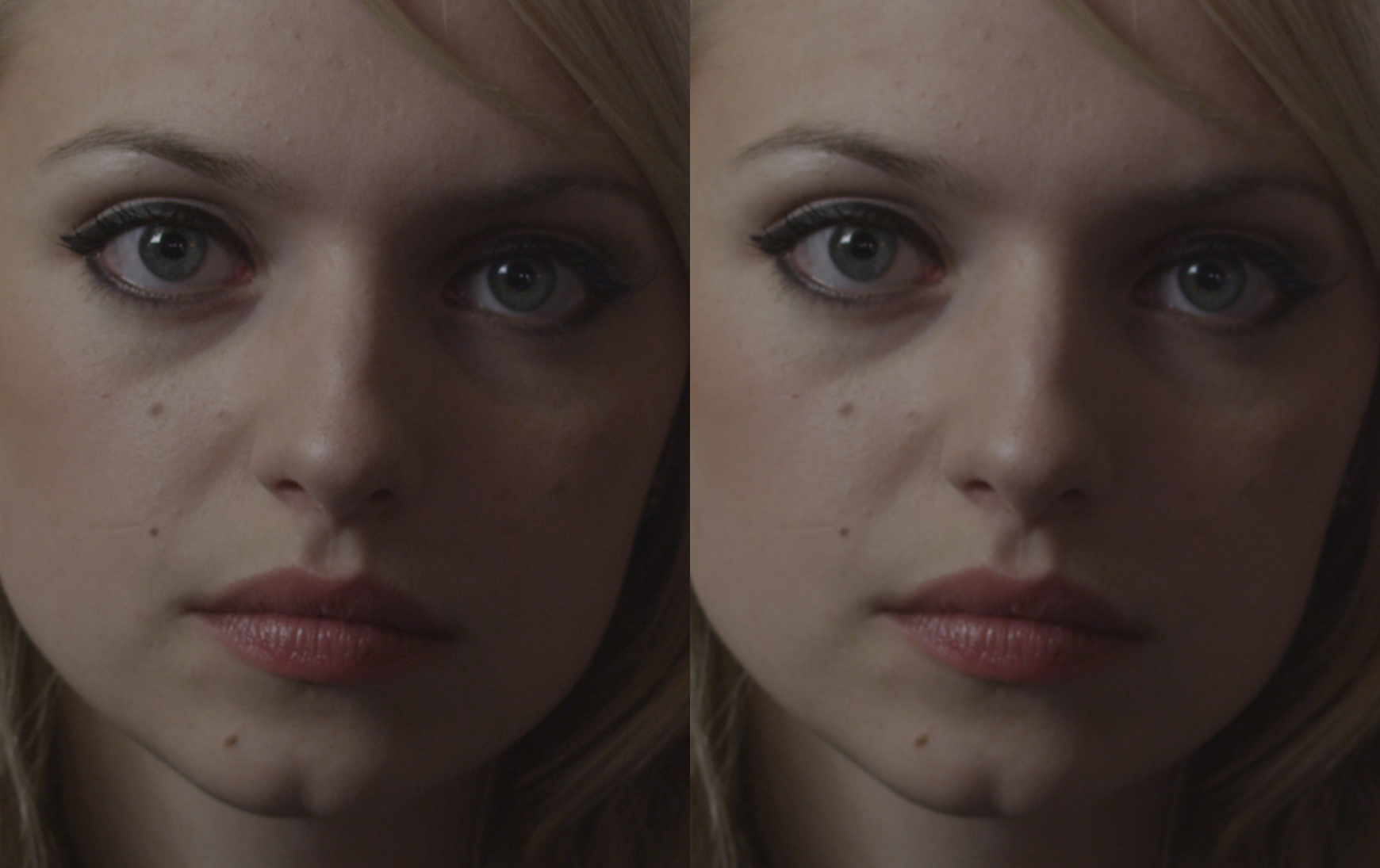
You're right, of course. Movies in general look kinda blurry, something that a super high-res photo won't suffer from. I only did the Elba thing because the original is hilariously inaccurate. I made these:

Big Hero 6, straight from the blu-ray. 1080p vs 720p, which is which? :P


And for your picture, 4K vs 1080p:


Edit:
This one looks more correct to me. The resizing back up looks a lot less interpolated.

I kinda screwed up there by letting Photoshop its own devices when upscaling the images. I re-did it with bilinear scaling. Maybe it's better if I had gone nearest neighbor to simulate what 1x4 pixel scaling does, but anything below 1080 would've looked seriously pixellated. Oh well, like Loofy said, it's a flawed comparison regardless.
 
Big Hero 6, the image to the right is 1080p and the picture was harder to tell but I'd go right image for 4k as well.

I mean maybe its my eyes or something but I dont get why people dont think the jump isnt huge. Anyone in London go the selfridge's electronic section and check out some of the content their, the difference is sensational
 
Status
Not open for further replies.
Top Bottom